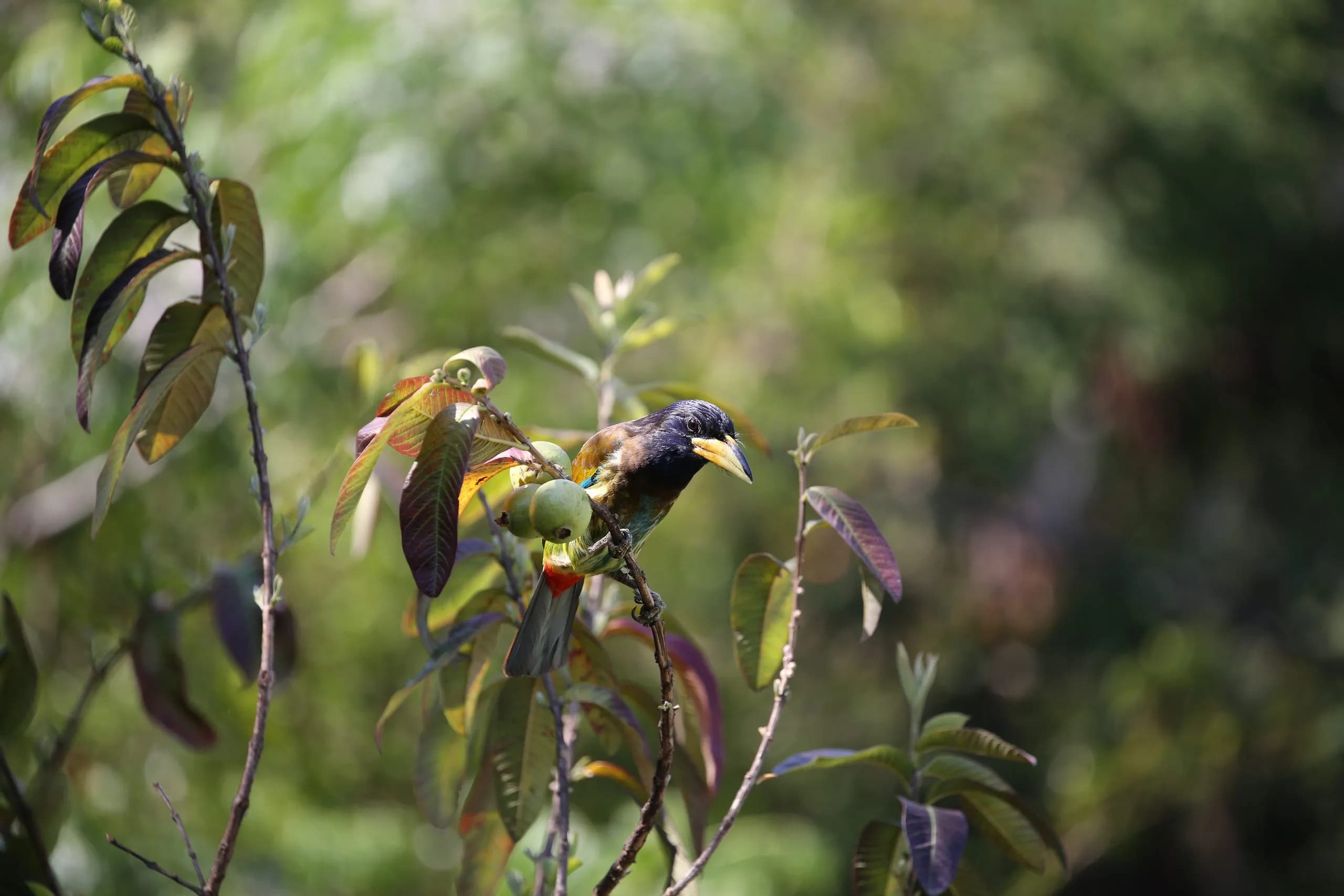
A SERIOUS BIRDING WEEK
Eight nights for the country's principal endemics — cranes at Phobjikha, the heron on the Punatsangchhu, the hornbills in the broadleaf belt.
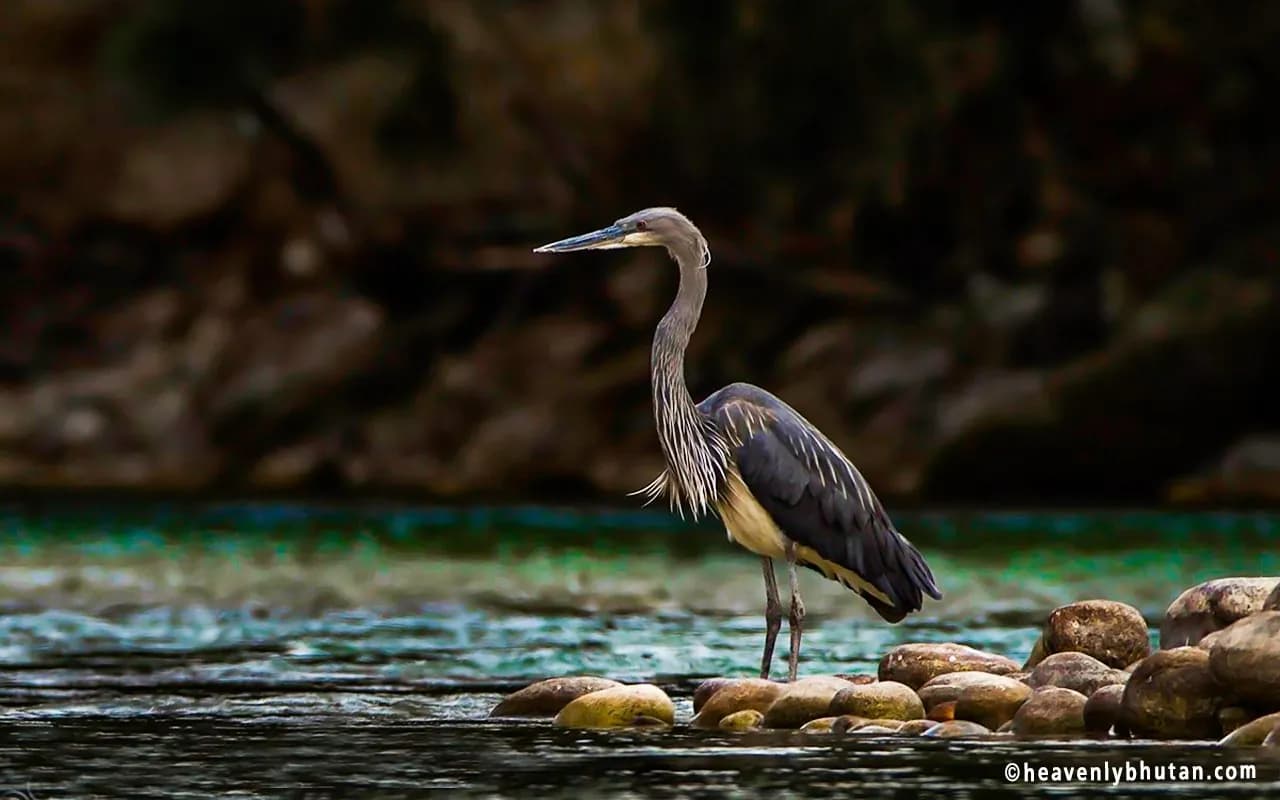
A small-group birding journey for serious lifelisters — the black-necked cranes wintering at Phobjikha, the critically-endangered white-bellied heron on the Punatsangchhu, the rufous-necked hornbill in the central forest belt, the beautiful nuthatch (a Bhutan endemic specialty), and the broader eastern Himalayan suite. Matched bird-specialist guide; the timing built around the December–February peak.
8 nights · Luxury tier · from USD 14,000 per traveller
- Nights
- 8
- From
- USD 14,000per traveller
- Tier
- Luxury
- Best season
- Clear sky bhutan
- Suits
- Small group
- Departing
- Worldwide
The species, and why Bhutan
Bhutan sits in one of the richest sections of the Eastern Himalayan bird belt — substantially under-birded compared to neighbouring Nepal or India's Northeast. The principal targets on this itinerary: the **black-necked crane** (Phobjikha valley; wintering 300–400 birds from late October to mid-February); the **white-bellied heron** (one of the world's rarest birds, fewer than 250 mature individuals globally, with a Bhutanese population along the Punatsangchhu); the **rufous-necked hornbill** and **wreathed hornbill** (the broadleaf forest belt at mid-elevation); the **beautiful nuthatch** (Bhutan-endemic specialty); the **satyr tragopan**, **Himalayan monal**, and **Kalij pheasant** for the pheasant cycle; plus the full Eastern Himalayan suite of sunbirds, woodpeckers, warblers, and the alpine higher-elevation specialties.
The itinerary built around the species
Two nights in Paro for the arrival and a first morning at Paro Chhu (the river-bird suite); three nights in Phobjikha for the cranes (the principal target; we time visits to the early-morning and late-afternoon feeding patterns at the RSPN site and the wider valley); two nights in Punakha and Wangdue Phodrang for the white-bellied heron along the Punatsangchhu (substantial patience required; the species is at low density and even specialist trips often see signs more than birds); one last night in Paro before the dawn flight. We pad the itinerary with stops at Royal Manas park-edge sites if time allows for the southern lowland suite — but the principal trip is the cranes + heron + western broadleaf belt species.
The matched guide and the kit
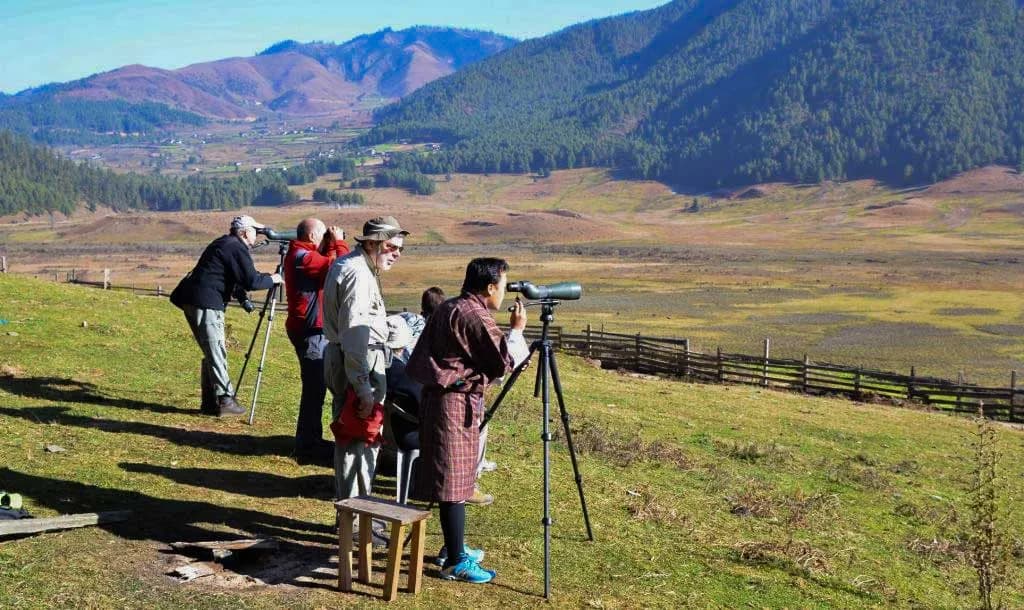
We match from the four or five guides in our network who are serious birders themselves — typically Bhutanese ornithology-trained, with substantial regional knowledge and the patience for the species that take time. The guide knows the call patterns, the seasonal habitat shifts, the access points (some birding sites are inside the RSPN-managed protected zones and require permits we arrange). Kit-wise: bring your own scope and your principal binoculars; we provide field guides specific to Bhutan and a tripod if you don't travel with one. Group size 4–8; smaller is better for the heron sites where quiet matters.
The route
A sample shape of the week
DAY 01
Arrival in Paro — first morning at the Pa Chhu
Met at PBH, twenty minutes to the lodge; if the arrival is early enough, the river site at dusk for the white-throated dipper and the ibisbills.
DAY 02
Paro day — Pa Chhu and Drugyel
Dawn at the Pa Chhu for the river-bird suite; an excursion up the valley to Drugyel for the higher-altitude species; an afternoon at the lodge to catch breath.
DAY 03
Across to Phobjikha — the cranes that afternoon
The drive over Dochu La and the Lawa La into Phobjikha; the cranes in the late-afternoon feeding pattern at the RSPN site; the lodge for the night.
DAY 04
Phobjikha day — the principal crane session
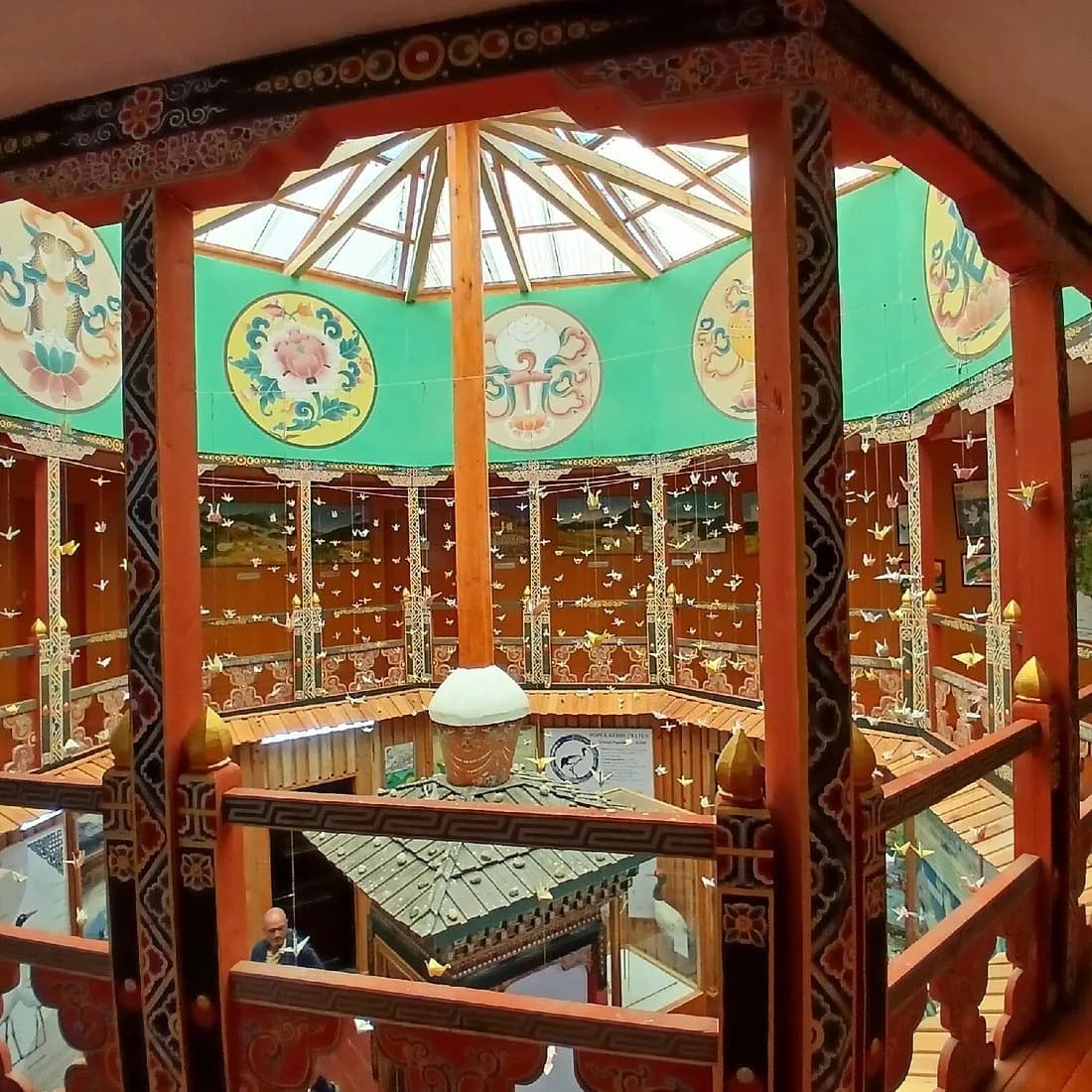
Dawn at the principal feeding-field site; the cranes' morning patterns; the RSPN visitor centre; the late afternoon at the alternative sites in the upper valley.
DAY 05
Phobjikha day — the wider valley and the alpine edge
A morning on the Gangtey Nature Trail (substantial small-bird traffic); the late afternoon on the eastern ridge above the valley for the alpine higher-elevation species.
DAY 06
Down to Punakha — the heron sites
The drive down to Punakha; the Punatsangchhu sites for the white-bellied heron in the late-afternoon light; the lodge for the night.
DAY 07
Punakha day — heron + broadleaf belt
Dawn at the heron sites (the second principal attempt); the broadleaf forest belt south of Punakha for the hornbill suite + the beautiful nuthatch + the satyr tragopan if the day allows.
DAY 08
Back to Paro
The drive back over Dochu La; an afternoon at the lodge or one final session at the Pa Chhu if the appetite holds.
DAY 09
Departure from Paro
Breakfast at the lodge, the guide walks you back to the terminal, the team writes a fortnight later with the full species list.
The day-by-day above is illustrative. The proposal you receive is built around your dates, your pace and your interests, not this template.
Frequently asked
- How many target species can we reasonably expect?
- Realistic species count across the eight-day itinerary: 150–220 species, with the principal targets (cranes, heron, hornbills, beautiful nuthatch, the principal pheasants) being the lifelist drivers. The cranes are essentially guaranteed in the right season window; the heron is at low density and ~70% of trips that target it specifically get clear sightings; the beautiful nuthatch is harder and we recommend two attempts in different broadleaf sites. The matched guide gives realistic species-by-species probabilities in your proposal.
- When's the right window?
- Late October through mid-February is the cranes' window — the principal driver of this trip's timing. December–January is the clearest weather + cranes-at-peak combination. The heron is year-round but slightly easier to see in the post-monsoon clarity (October–November). The Bhutanese spring (March–April) is a different birding window with more migrants but the cranes have departed.
- Can we extend to Royal Manas or the eastern circuit for more lowland species?
- Yes — the Royal Manas / Manas Tiger Reserve cross-border landscape adds the southern lowland suite (Bengal florican, several lowland hornbills, the lowland ibis suite, mahseer-feeding river birds). It adds three to five nights and substantially extends the species list — typically to 280–350 across the full itinerary. We discuss in the consultation.
- What's the group size and how is it structured?
- Small-group: 4–8 birders typically. Smaller is better at the heron sites where quiet matters; larger groups don't economise the lodge logistics. For couples who want a private (group of 2) version with the same access and matched specialist guide, we quote separately as a signature-tier offering — it's a different price band but the access is the same.
Journeys you might also weigh
- 01Bhutan Buddhist pilgrimageA small-group pilgrimage journey for Asian-Buddhist travellers — from Singapore, Malaysia, Taiwan, Korea, Japan, Hong Kong, Vietnam — who want the Tibetan-Vajrayana religious circuit rather than the secular cultural-tourism version. Matched monastic-trained guides; access to working monasteries; the Bumthang religious circuit at its full depth.10 nights
from $18,000 - 02Bhutan for a group of friendsA private Bhutan journey for a small group of friends, four to eight of you — Paro, Thimphu, Punakha, and back, with a light walk or two together and the Tiger's Nest at the end. One matched Bhutanese guide and one steady driver for the week, shared across the group, which is precisely why a journey like this comes in lower per traveller than the same week taken as a couple.7 nights
from $6,000 - 03Bhutan for the solo travellerA private Bhutan journey for the traveller arriving alone — Paro, Thimphu, Punakha, and back, with a light walk in the hills and the Tiger's Nest at the end. One matched Bhutanese guide and a steady driver for the whole week, in a country that asks little of you and watches over you all the same.7 nights
from $6,500
Begin when you're ready.
A few questions, or a conversation in your own words. A bespoke draft either way.

