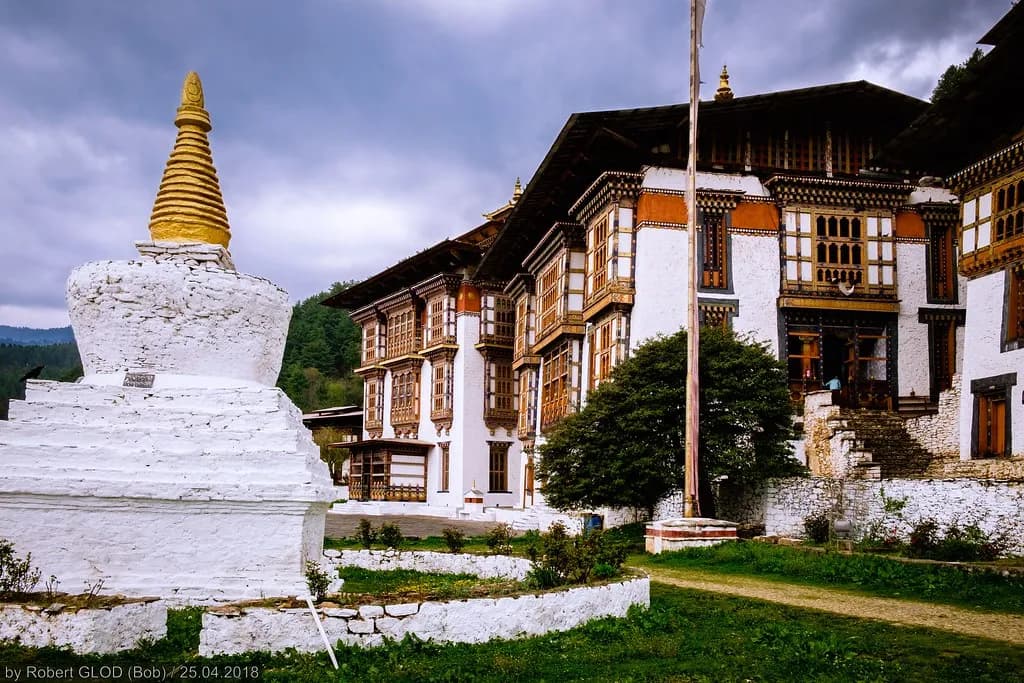
A WEEK IN THE COLD, A LONG WAY FROM THE HEAT
Seven nights in Bhutan, on the routing from Abu Dhabi.
A private Bhutan journey for couples flying from Abu Dhabi — the long-haul broken with a night in Bangkok or Kathmandu, then the western circuit through Paro, Thimphu, and Punakha in the post-monsoon autumn light. A particular kind of week for travellers who live in the Gulf heat and want the high cold, the altitude, and the quiet.
7 nights · Luxury tier · from USD 16,000 per couple
- Nights
- 7
- From
- USD 16,000per couple
- Tier
- Luxury
- Best season
- Autumn
- Suits
- Couple
- Departing
- Abu Dhabi
Why Bhutan from Abu Dhabi, and why the autumn
For travellers based in Abu Dhabi — Emirati, Gulf-resident, expatriate — Bhutan offers a contrast that few places hold. After the long summer heat and the air-conditioned indoors, the high cold of the eastern Himalaya in October reads as a different register of travel altogether. The autumn window, mid-October through late November, is the country at its clearest: post-monsoon visibility, the harvest in, the surrounding ranges sharp against the sky. The Thimphu Tshechu falls in late September or early October; the Bumthang festivals run through October and November; the black-necked cranes arrive at Phobjikha from late October. It is the season most Gulf-based couples settle on once they understand the calendar.
The routing — via Bangkok or Kathmandu
Abu Dhabi to Paro is one or two stops, and the clean way through is a hub city to the east. We recommend either Bangkok or Kathmandu. Etihad flies Abu Dhabi to Bangkok; Drukair (KB) and Bhutan Airlines (B3) operate the Bangkok–Paro leg, and the morning flight to Paro is calm after a settled night at the hub. Kathmandu is the other clean option — Drukair operates the Kathmandu–Paro leg, and the approach over the Himalaya on a clear morning is among the finest short flights anywhere. We do not route Abu Dhabi travellers through Delhi, Kolkata, or Mumbai: India requires a transit visa for non-Indian-passport-holders on many of these itineraries, and the friction is not worth carrying when Bangkok and Kathmandu connect cleanly. The hub hotel is your booking, on your terms; we recommend it, brief it, and coordinate the timing so the onward Paro flight is unhurried.
What the week tends to look like
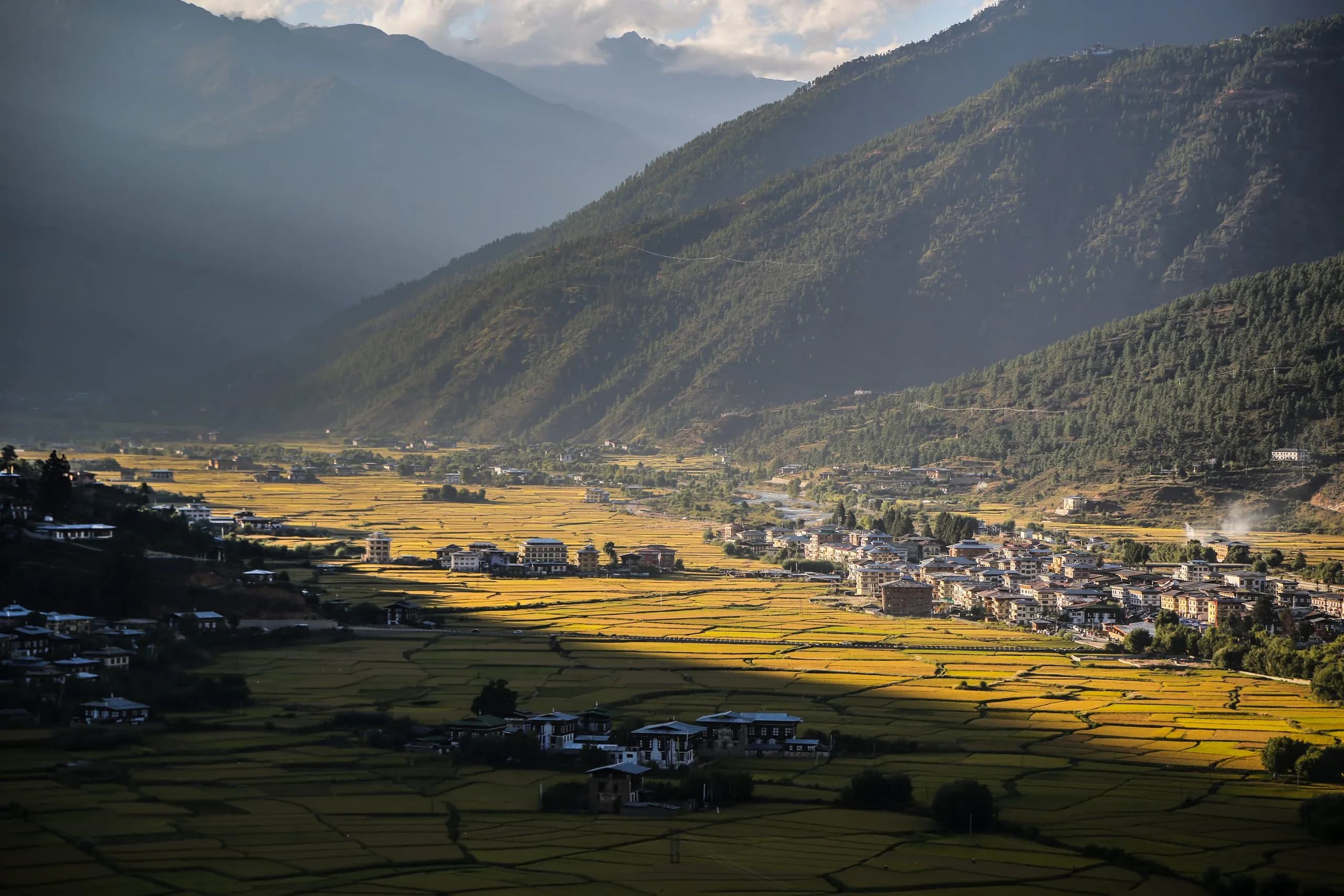
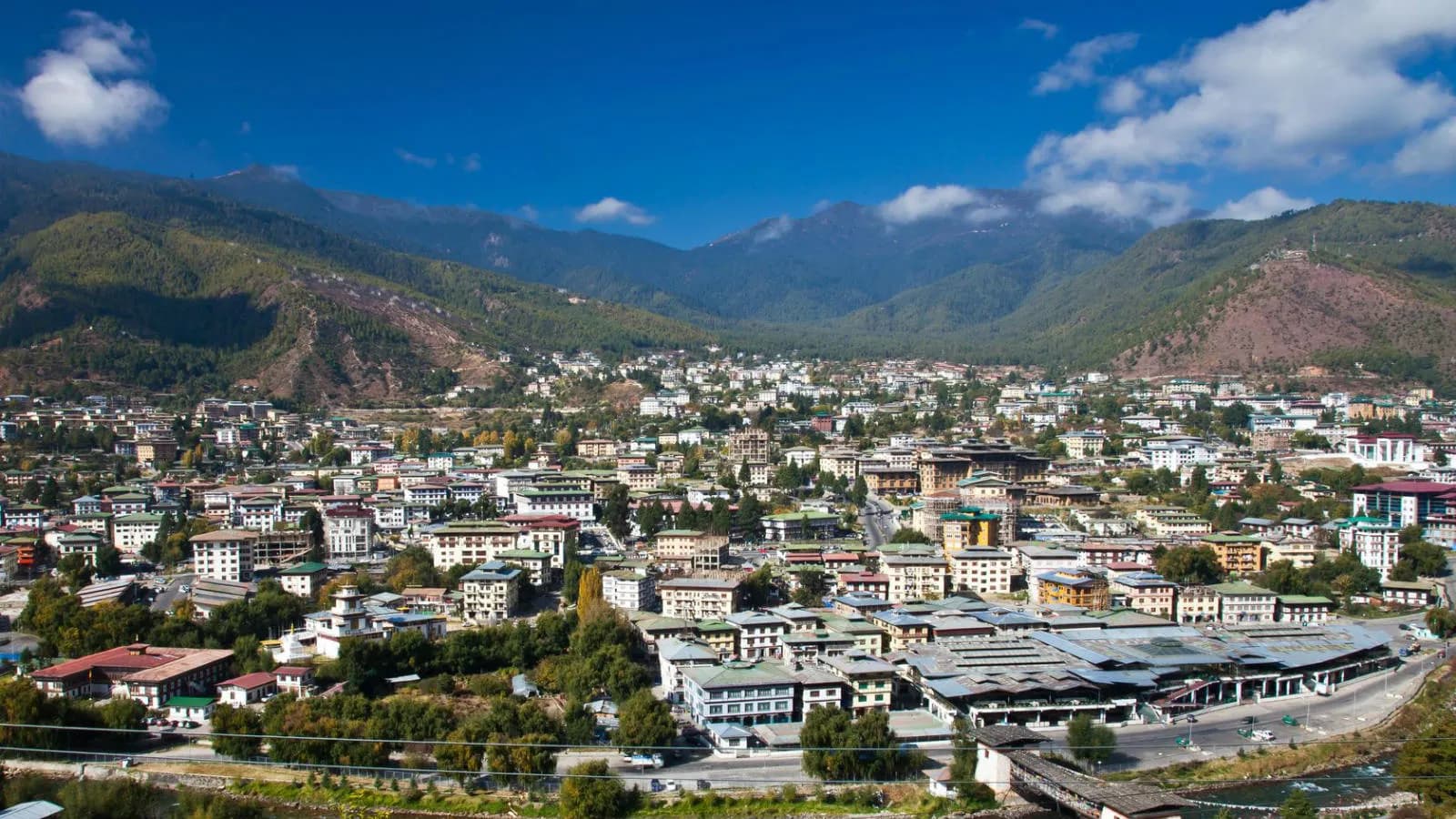
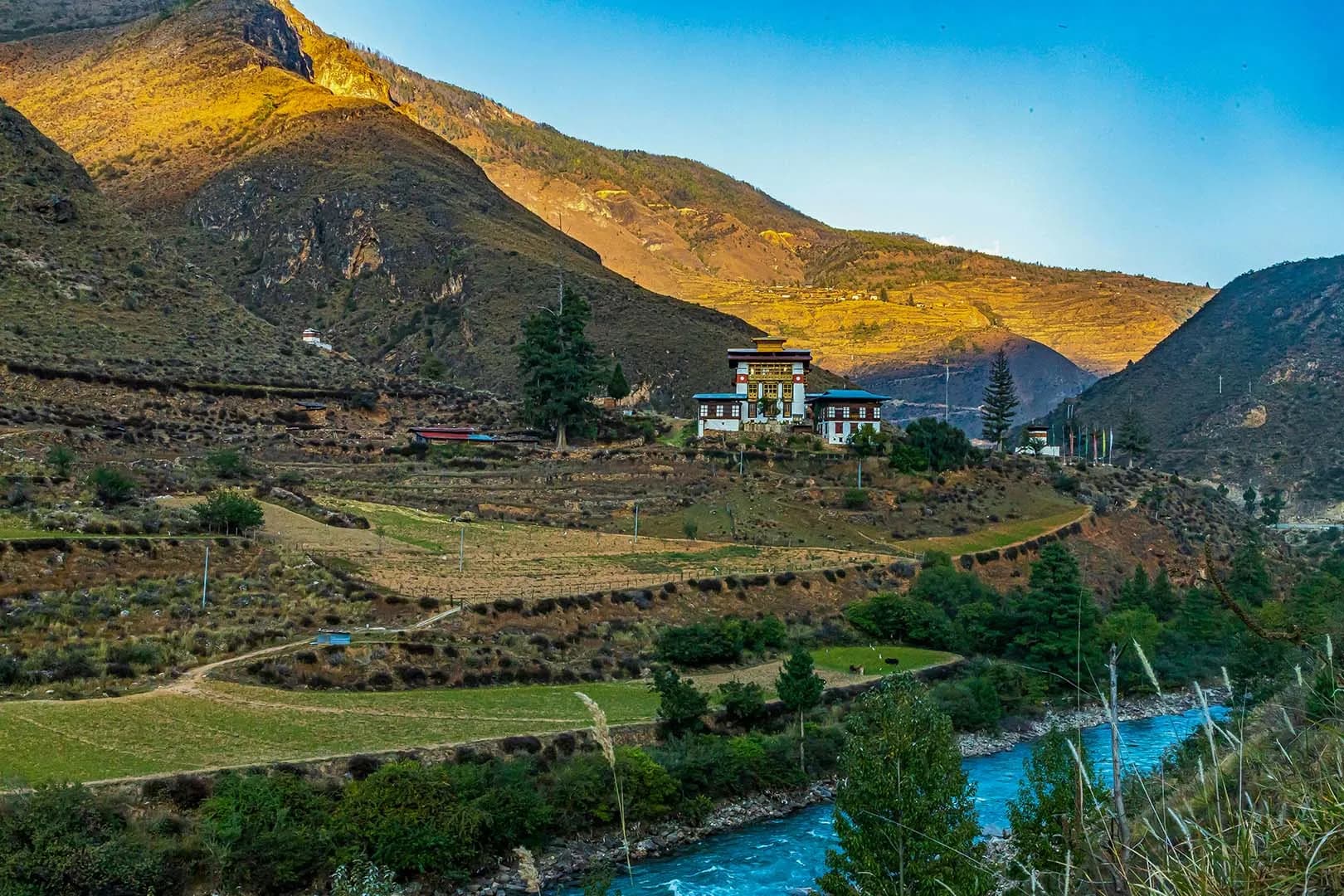
Two nights in Paro to settle in and walk Rinpung Dzong in the post-monsoon clarity; two in Thimphu, fifty-four kilometres and about an hour and a quarter on, for the capital taken slowly and the National Memorial Chorten in the evening; two over Dochu La at 3,100 metres into the warmer Punakha valley, with a long day at the dzong and Chimi Lhakhang; one last night in Paro before the climb to Taktsang at 3,120 metres and the morning flight out. The pace is unhurried, and we do not pad the week with sites you will have forgotten by the time you fly home. The matched guide is chosen for the way the conversation runs and the cultural register; meals are arranged with care, halal-friendly where you would like, with prayer times noted and respected without fuss.
The route
A sample shape of the week
DAY 01
Arrival in Paro — settled in by mid-afternoon
Met in the arrivals hall after the morning flight from Bangkok or Kathmandu; twenty minutes to the lodge; a quiet first walk along the Pa Chhu if the light holds.
DAY 02
Paro day — Rinpung Dzong and Kyichu
The principal Paro dzong in the morning light; Ta Dzong, the National Museum, in the late morning; an afternoon at Kyichu Lhakhang, one of the oldest temples in the country.
DAY 03
Across to Thimphu — 54 km, about an hour and a quarter
The Pa Chhu valley to the capital; the National Memorial Chorten in the early evening among the circumambulating elders; an unhurried supper.
DAY 04
Thimphu day
Tashichho Dzong in the late afternoon; the Buddha Dordenma on the southern ridge for the dusk light; a Bhutanese-cuisine dinner with halal-friendly preparations arranged in advance.
DAY 05
Over Dochu La — into Punakha
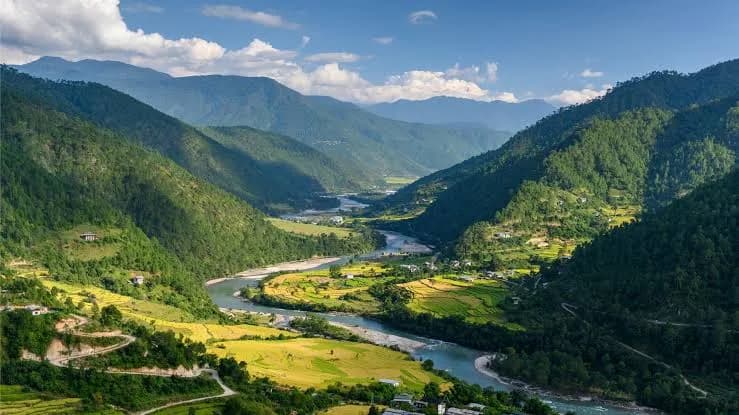
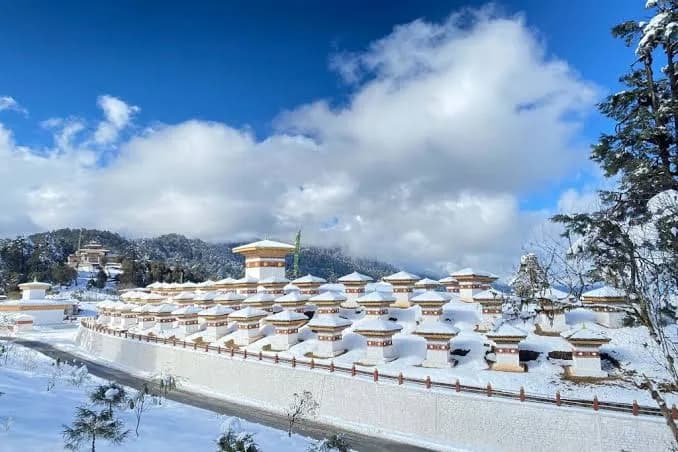
The 75 km and roughly three hours over the 3,100-metre pass, clearest before nine; the 108 chortens; Punakha Dzong in late-afternoon light at the confluence of the Mo and Pho Chhu.
DAY 06
Punakha day
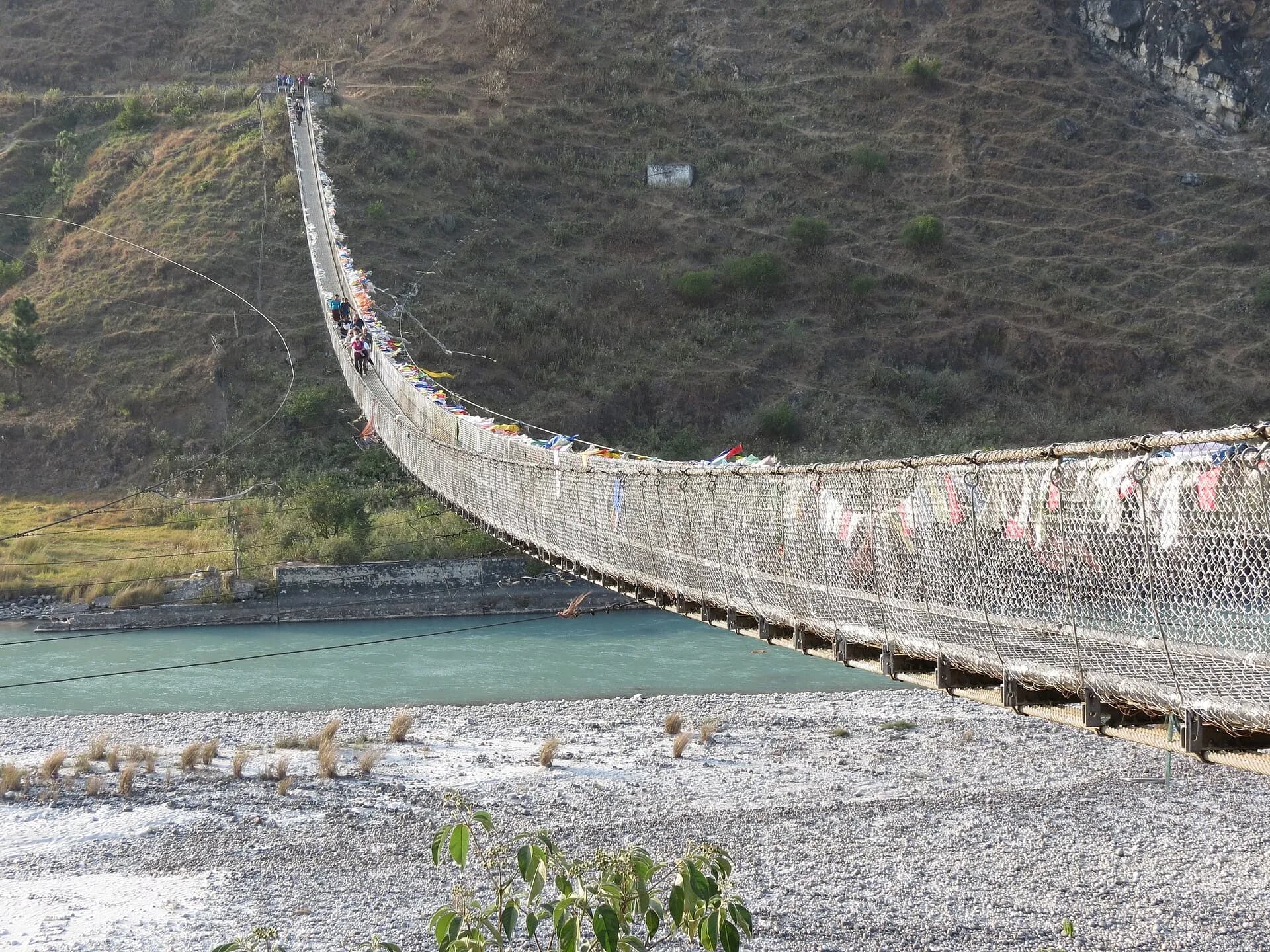
Chimi Lhakhang in the morning across the terraced paddies of Lobesa; the Mo Chhu walk to the Khamsum Yulley Namgyal Chorten; a long riverside lunch; the suspension bridge in the late light.
DAY 07
Back to Paro — ahead of Taktsang
The drive back over the pass; Kyichu Lhakhang in the afternoon; an early night with the climb to the Tiger's Nest briefed by your guide.
DAY 08
The Tiger's Nest — and the flight back
The dawn climb at the pace you can hold to Taktsang at 3,120 metres; lunch at the cafeteria; the descent; a hot stone bath at the lodge before the onward flight.
The day-by-day above is illustrative. The proposal you receive is built around your dates, your pace and your interests, not this template.
Frequently asked
- What's the routing from Abu Dhabi?
- Abu Dhabi to Paro is one or two stops, and the simplest clean routing is via Bangkok or Kathmandu. Etihad flies Abu Dhabi to Bangkok, then Drukair (KB) or Bhutan Airlines (B3) on the Bangkok–Paro leg; alternatively Drukair operates the Kathmandu–Paro leg, with the Himalayan approach on a clear morning. We discuss the specifics in the consultation and work to the most comfortable timing.
- Why not route through Delhi, Kolkata, or Mumbai?
- India requires a transit visa for non-Indian-passport-holders on many itineraries even when remaining airside, and the airline and immigration interpretation of transit versus arrival varies. For Abu Dhabi travellers holding non-Indian passports, that friction is best avoided — Bangkok and Kathmandu connect cleanly to Paro on Drukair and Bhutan Airlines without it. Indian-passport-holders have no such constraint and can route through any Indian hub.
- Are halal meals and prayer times looked after?
- Yes. Muslim guests are warmly looked after across our lodge network: halal-friendly meals are arranged with advance briefing, and prayer times are noted and respected as a matter of course. We confirm the specifics with each lodge in your proposal so nothing has to be asked for twice.
- Is the flight into Paro difficult?
- Paro is Bhutan's only airport, and the approach is difficult, not dangerous — a visual descent between the valley walls flown by a small number of certified pilots. It is one of the more memorable arrivals in aviation, handled by Drukair and Bhutan Airlines crews who fly it daily. Drukair operates under strict visual flight rules, so occasional weather delays on the Paro side are part of the picture; we build sensible buffers into onward plans.
- What is the Sustainable Development Fee, and is it included?
- Yes. The SDF is USD 100 per night for each international adult visitor, set by the Royal Government of Bhutan. It funds free health care and education for Bhutanese citizens and conservation across the country, and it is included in your transparent all-inclusive price breakdown.
- Best window for Abu Dhabi travellers specifically?
- Mid-October through late November is the principal window — post-monsoon clarity, the autumn festivals, the cranes arriving at Phobjikha. April and May are the spring window, with cherry blossom and rhododendron. We tend to advise against deep monsoon (July and August), and for travellers used to Gulf warmth we would flag the coldest weeks of January, when the high valleys can be sharp; the lodges handle the cold gracefully all the same.
- Can the week be longer to take in Phobjikha for the cranes?
- Yes — adding two nights at Phobjikha, the high glacial valley west of Punakha, gives you the black-necked cranes from late October, the valley silence, and one of the most photographed landscapes in Bhutan. The nine-night version is the considered autumn trip from Abu Dhabi for travellers who want the central valleys as well as the western circuit.
Journeys you might also weigh
- 01Bhutan trip from BangkokBangkok to Paro is the single easiest premium connection to Bhutan in the world — direct on Drukair, four hours, morning departure. A Bhutan journey for couples flying from Bangkok — the long-haul fatigue absent, the week starts at full energy, and the cultural-Buddhist depth that Thai premium travellers (often with substantial Buddhist-tradition background) tend to find rewarding.7 nights
from $13,000 - 02Bhutan trip from DubaiA Bhutan journey for couples flying from Dubai — the long-haul broken with a Bangkok overnight, then the week through Paro, Thimphu, and Punakha in the post-monsoon autumn light. A particular kind of trip for travellers who live in the heat and want the cold, the altitude, and the silence.7 nights
from $16,000 - 03Bhutan trip from AmsterdamA private Bhutan journey for couples flying from Amsterdam — Paro, Thimphu, Punakha, and back — with the long haul through a single Asian hub treated not as the price of the trip but as the first of its days. The distance is real. So is the slowing-down that begins the moment Schiphol is behind you.8 nights
from $16,000
Begin when you're ready.
A few questions, or a conversation in your own words. A bespoke draft either way.

