FOR THREE GENERATIONS, TRAVELLING TOGETHER
Bhutan multigenerational family journey — A seven-night Bhutan journey built for grandparents, parents, and children at once.
A luxury-tier western-circuit week — Paro, Thimphu, Punakha, and back — paced to the slowest comfortable walker in the party and arranged so that each day holds something for each age. Easy dzong courtyards, a farmhouse meal, and a hot stone bath for the grandparents; archery, a farmhouse visit, and the colour of a Tshechu for the children; the deeper culture for the parents in between. The Tiger's Nest climb is offered to the able while the others enjoy a gentle valley morning — never an obligation. One matched guide holds the whole arc together and choreographs it so quietly that nobody feels managed.
7 nights · Luxury tier · from USD 28,000 per family
- Nights
- 7
- From
- USD 28,000per family
- Tier
- Luxury
- Best season
- Autumn
- Suits
- Family
- Departing
- Worldwide
Why one journey, and not three
The instinct, when grandparents, parents, and children all want to see Bhutan, is to split the day — the energetic ones go one way, the slower ones another, and the family reconverges at dinner having had separate trips. We build the opposite. The whole party moves through the same valleys at the same unhurried rhythm, and the variety comes from what each person is invited to lean into within the shared day rather than from sending anyone off alone. The grandfather who cannot climb the long flight at [[punakha-dzong|Punakha Dzong]] still sits in the courtyard where the photograph is taken; the eight-year-old who has no patience for a chapel is the one drawing the archers; the parents get the half-hour of real conversation with the guide that the trip was quietly about. Seven nights is the shape that lets all of that happen without anyone feeling rushed or left behind.
Paced to the slowest comfortable walker
We plan the whole week around the slowest natural pace in the party — usually a grandparent, sometimes the youngest child — and pad every day accordingly. Walking is held to gentle stretches with seated tea breaks; drives are broken with stops rather than taken in one push; lunches are long and bedtimes are early. The western circuit keeps the driving short and the altitude kind: Paro and Thimphu sit a little above 2,300 m, Punakha drops to a warm 1,280 m, and the only real height is the [[dochu-la|Dochu La]] crossing at 3,100 m, which is a tea stop rather than an overnight. Three nights in Paro to settle without a transition day, two in Thimphu, one over the pass in Punakha, and a last night back in Paro for the morning flight — the pace flexes within the day, never the destinations.
The matched guide, quietly choreographing
One Bhutanese guide carries the family for the full week — we match from a small, carefully curated network, choosing for patience, for the warmth that puts an elderly traveller at ease and a shy child at ease in the same hour, and for the gift of reading a three-generation group and giving each person the day they came for without anyone noticing the choreography. Family guides in the network tend to be parents themselves; several have walked their own elderly parents through these valleys, so the rest cadence an older body needs is second nature to them. The guide is named in your proposal before you confirm, with the matching rationale set out plainly, and we change the match if it does not feel right. Much of what makes a multigenerational week work is invisible — the bench identified before the grandmother needs it, the archers arranged for the morning the children are restless — and that invisible work is the guide's craft.
The route
A sample shape of the week
DAY 01
Day 1 — arrival in Paro, settle without a transition day
Met in the arrivals hall by the matched guide and driven the gentle twenty minutes to the lodge in the upper valley. The rest of the day is unstructured — unpacking, a slow lunch, an early supper — so the grandparents sleep at altitude (2,250 m) on a low-stakes first night and the children burn off the flight in the garden. No temple, no climb, nothing asked of anyone on day one.
DAY 02
Day 2 — Paro at an easy pace, the family's first courtyard
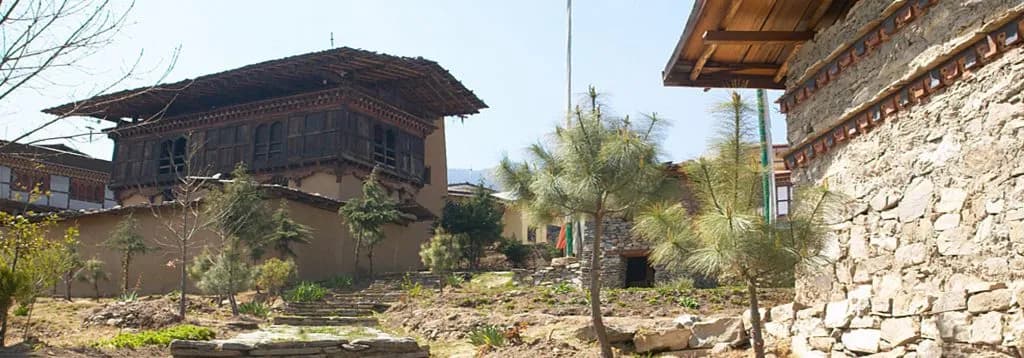
[[kyichu-lhakhang|Kyichu Lhakhang]] in the mid-morning — among Bhutan's oldest temples, reached by a short level walk with ample seating in the courtyard, the kind of place that rewards the grandparents and quietens the children at once. A long lunch in the Paro valley afterwards. The afternoon stays soft: a stroll along the Pa Chhu for those with the energy, the lodge spa and library for those without.
DAY 03
Day 3 — Paro, archery and a farmhouse afternoon
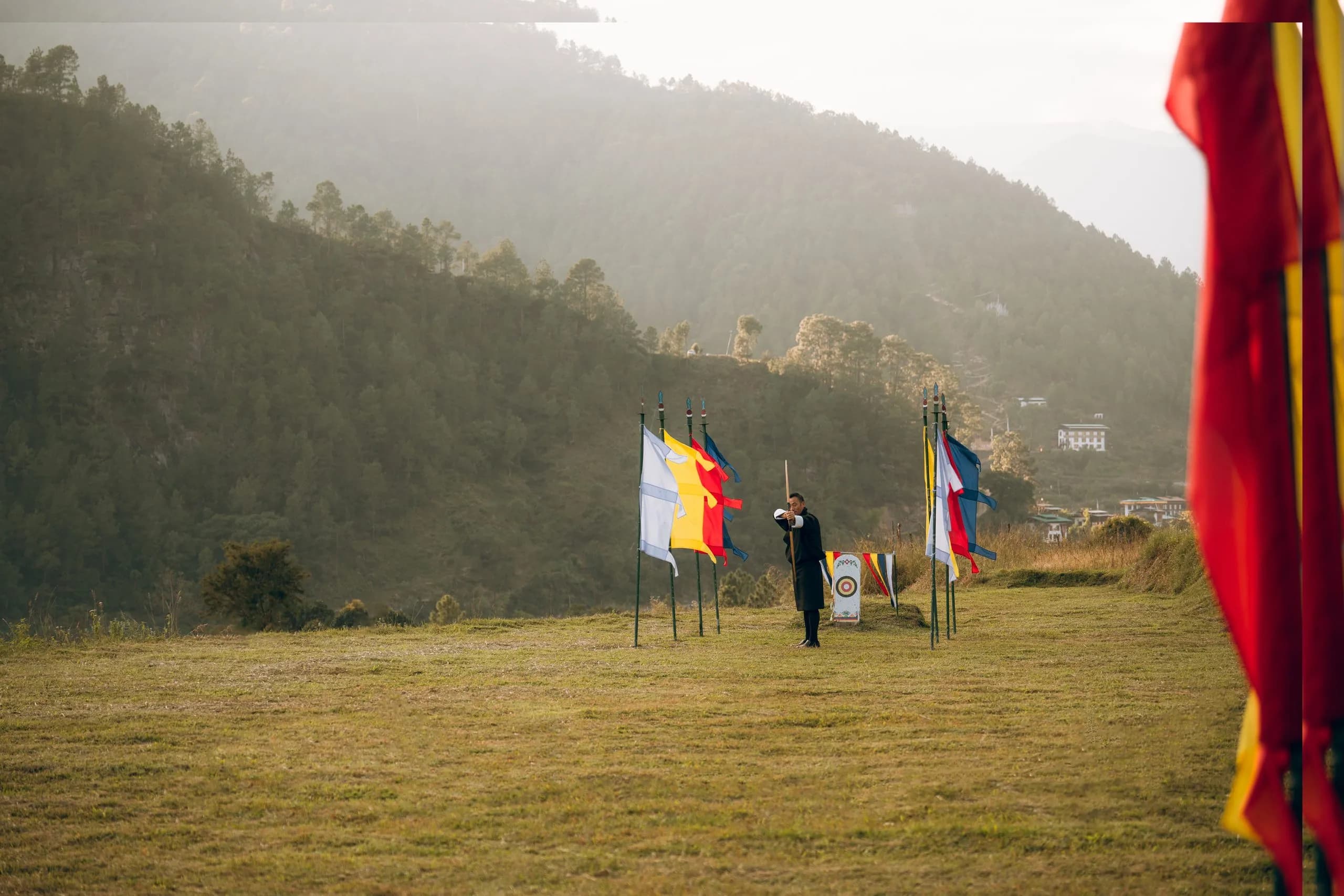
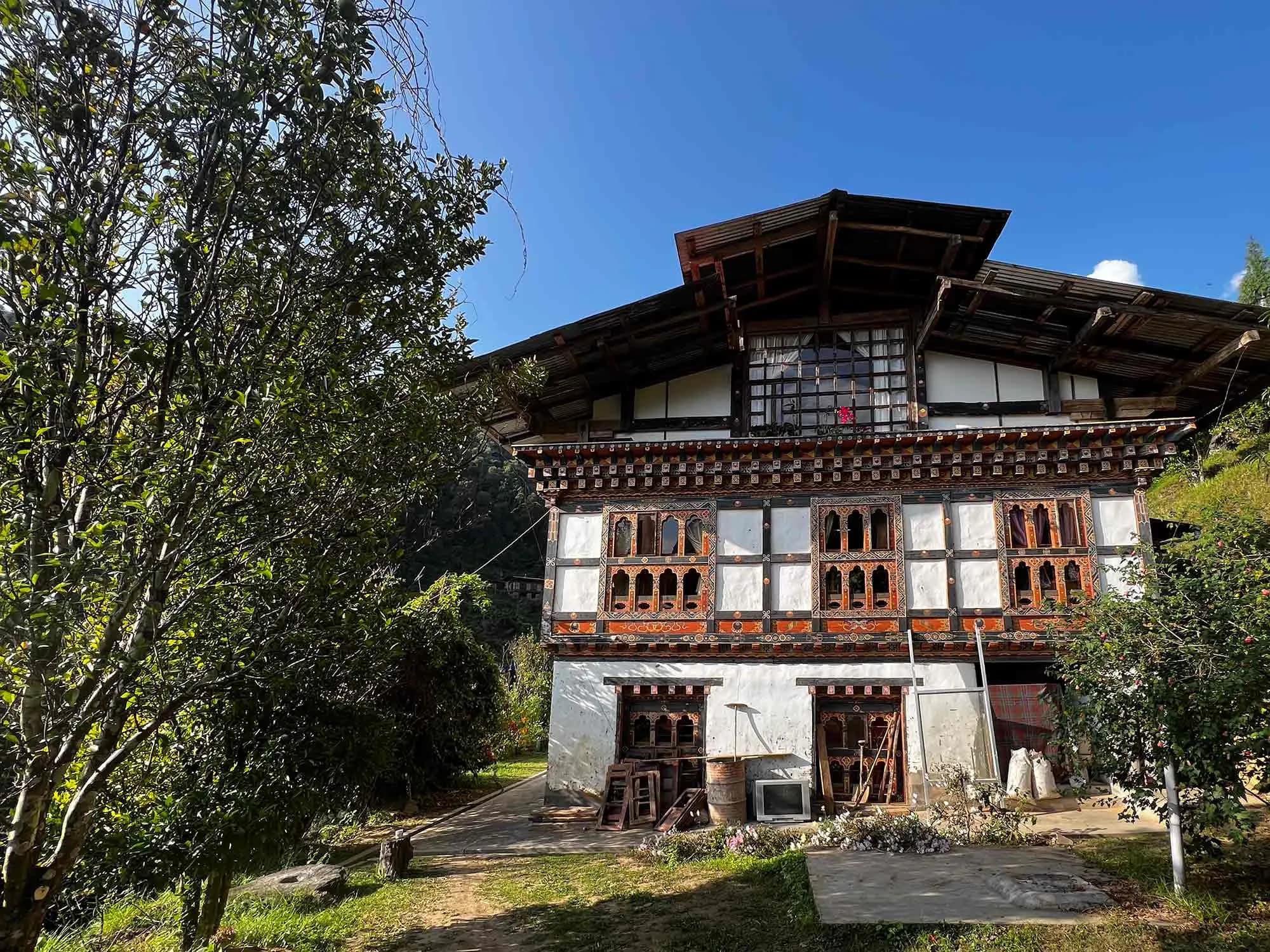
The morning is the children's — a session at a village archery ground, where the guide arranges a turn at the targets and the long, teasing songs that follow a good shot, the day's clear highlight for anyone under twelve. Lunch is a farmhouse meal with a family the guide knows: buckwheat pancakes, red rice, ema datshi served mild alongside the proper version. The grandparents can take a hot stone bath in the afternoon — river stones heated in a fire and dropped into a wooden tub of artemisia-scented water, the country's oldest comfort for tired limbs.
DAY 04
Day 4 — Paro to Thimphu, the capital slowly
The gentle drive to Thimphu (54 km, ~1h 15m along the river) with a stop where the children want one. The afternoon is built one moment at a time: the takin preserve for the children, who like the country's improbable national animal; the National Memorial Chorten at the late prayer hour for the grandparents, ample seating around it and a reverent Bhutanese crowd to share the time with. A quiet supper and an early night.
DAY 05
Day 5 — Thimphu, a craft school and a level afternoon
The morning at the school of traditional arts, where the children can sit in on a class of young students learning painting, woodcarving, and embroidery — a window for the parents into how the culture is kept alive, and a making-things hour for the children. [[tashichho-dzong|Tashichho Dzong]] in the late afternoon at the prayer hour, a short walk from the vehicle and its courtyards level underfoot. The middle of the day stays open for the lodge, for rest, for whatever the slowest walker's energy allows.
DAY 06
Day 6 — over Dochu La to Punakha, the warm valley
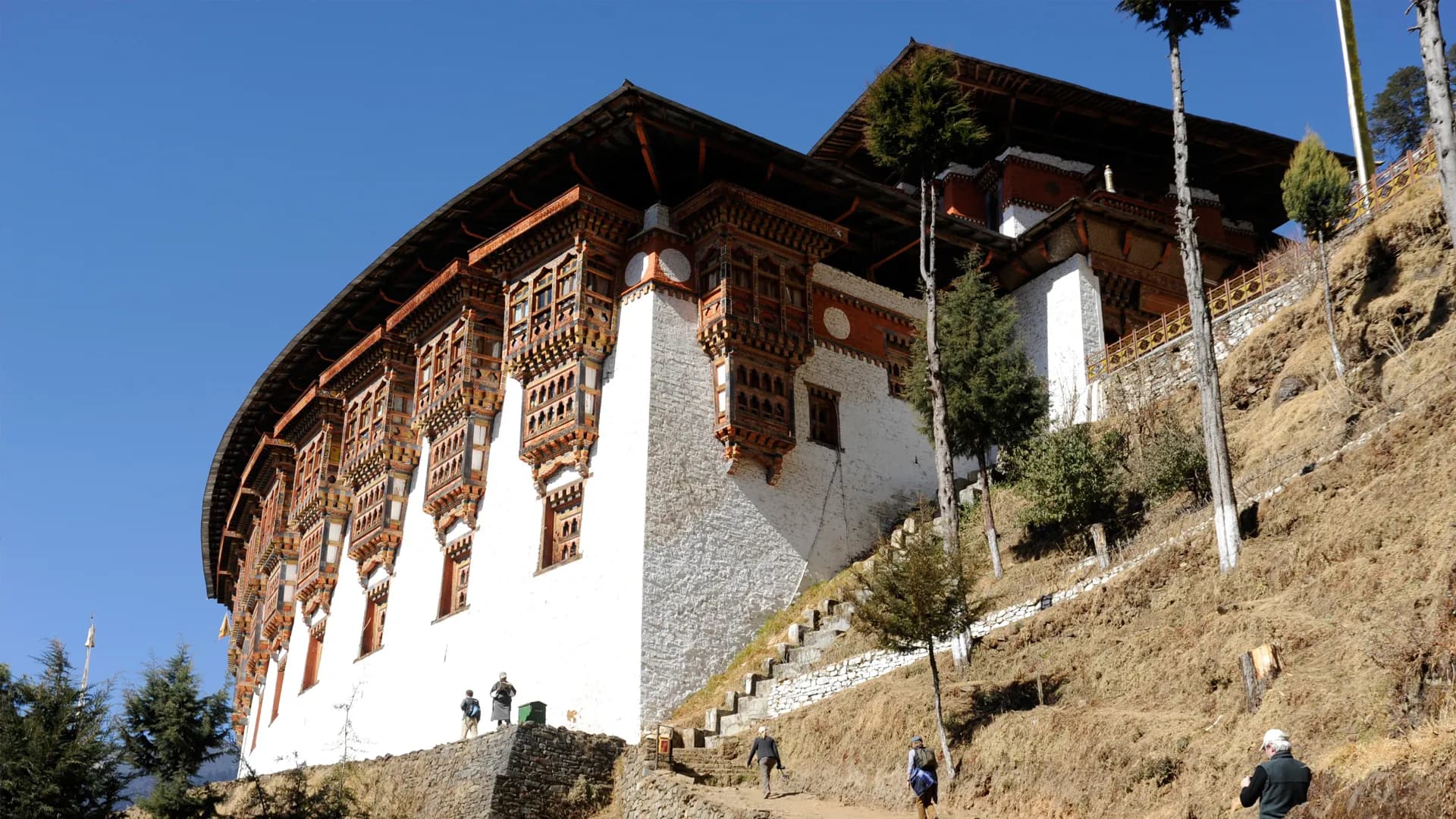
The drive to Punakha over [[dochu-la|Dochu La]] (75 km, ~3h, the pass at 3,100 m), broken at the 108 chortens for the eastern Himalayan skyline on a clear morning and the tea cafe; the guide reads the grandparents' altitude response while the children count the chortens. The descent runs down into the country's warmest, greenest valley. [[punakha-dzong|Punakha Dzong]] in the late-afternoon light — reached by a short walk over the cantilever bridge, the courtyards full of seating, the inner chapels up a flight of stairs the guide briefs on so each person chooses their own level. A long, late lunch and an early supper at the lodge.
DAY 07
Day 7 — back to Paro, the choice morning at the Tiger's Nest
The drive back over the pass to Paro, with the afternoon left deliberately open as the journey's one real fork. Anyone able and willing climbs the [[paro-taktsang|Tiger's Nest]] with the guide at their own pace — three hours of switchbacks to the temple at 3,120 m, a slow business done the right way; the grandparents and the youngest take a gentle valley morning instead, a walk to the viewing platform for the photograph from the angle most are taken from, and an unhurried lunch at the cafeteria that the climbers join on the way down. The family reconverges for a last dinner together, the team writes a fortnight on, and the onward Drukair flight leaves from Paro the following morning.
The day-by-day above is illustrative. The proposal you receive is built around your dates, your pace and your interests, not this template.
Frequently asked
- How does the pace work across three generations?
- We plan the entire week around the slowest comfortable walker — usually a grandparent, sometimes the youngest child — and pad every day with seated breaks, broken drives, long lunches, and early nights. The whole family stays together; the variety comes from what each person leans into within the shared day rather than from splitting up. Walking is held to gentle stretches, the benches and level routes are identified before they are needed, and the matched guide adjusts the rhythm through the day as he reads how the group is travelling. The western circuit helps — short drives, kind altitude, and Punakha at a warm 1,280 m where everyone rests easily.
- Should the grandparents attempt the Tiger's Nest, and what do they do if not?
- Generally no, and the journey is built so they never have to. The [[paro-taktsang|Tiger's Nest]] is roughly 700 m of climbing on switchbacks to a temple at 3,120 m — demanding for any traveller and not appropriate for most in their seventies or eighties. The viewing platform a short walk from the trailhead gives the photograph and the look at the temple from the angle most pictures are taken from. The grandparents and the youngest take a gentle valley morning and an unhurried lunch at the cafeteria, which the climbers join on the descent; the family reconverges by mid-afternoon. The day is the family's, not the climb's, and nobody is ever the reason another misses it.
- What is there for the children to do?
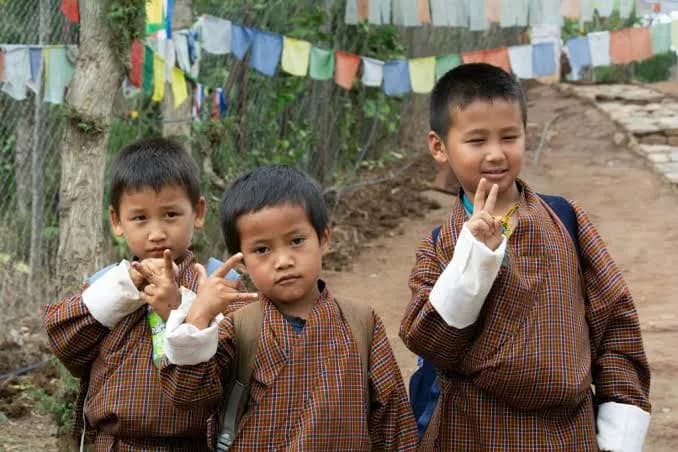
- A great deal that is theirs alone within the shared days. A turn at a village archery ground with the songs that follow a good shot; a farmhouse lunch with a family the guide knows, buckwheat pancakes and red rice and a chance to try grinding chilli; a class at the school of traditional arts where they can watch young students paint and carve; the takin preserve and its improbable national animal; and, in autumn, the colour and masked dances of a Tshechu if one falls in your dates. Bhutan also offers children something rarer — adults who are not paid to entertain them and who take the same questions seriously, which is what parents tend to remember most by the third evening.
- Is Bhutan a safe country for a family with elderly parents and young children?
- Yes, and reassuringly so. The United States Department of State places Bhutan at Level 1, its lowest travel advisory, the same tier as much of western Europe — violent crime against visitors is rare. Beyond the formal rating, the everyday texture matters more for a multigenerational party: Bhutanese culture extends a genuine, unforced warmth to elders and to children, who are welcomed rather than tolerated wherever the family goes. The matched guide carries a basic medical kit and an oxygen canister for the [[dochu-la|Dochu La]] crossing as a matter of course, and the lodges keep working relationships with the district hospitals. We gather any medical, mobility, or dietary considerations in the pre-arrival briefing and plan around them quietly.
- Can you connect or group our rooms across the three lodges?
- Yes. We block adjoining, interconnecting, or ground-floor rooms at all three lodges according to the family's shape — a two-bedroom suite where it helps the grandparents and grandchildren stay close, ground-floor villas for anyone who would rather not take stairs, and adjacent rooms for the parents nearby. The proposal names the specific accommodation and confirms the configuration before you confirm; the lodge concierge pre-arranges the particular suites or villas once the booking is held.
- When is the best time of year for this journey?
- Autumn — late September through November — is the clearest-skied window and the height of the Tshechu season, when the colour and masked dances are at their best and the eastern Himalayan range shows itself from [[dochu-la|Dochu La]] on a bright morning. Spring (April–May) is the second window, with rhododendron and longer evenings. We tend to steer multigenerational families away from the deep monsoon (July–August) unless you specifically want the quiet of Green Bhutan, when the trails are wetter underfoot and harder for the slowest walker.
Journeys you might also weigh
- 01Bhutan for Indian HNI familiesFor Indian families who want Bhutan done well — grandparents, parents, the next generation, all together — on the daily Drukair connection from Delhi, Kolkata, Mumbai, or Bagdogra. The Indian-national framework is structurally favourable (Nu 1,200/night SDF, no transit-visa, visa-free entry on arrival), the cultural-religious depth meets serious Indian-Buddhist and Hindu interest, and the matched knowledgeable guide is from the network with the deepest experience of multigenerational Indian families.8 nights
from $14,000 - 02Bhutan babymoonA private, unhurried Bhutan journey for a couple expecting a baby — Paro, Thimphu, Punakha, and back — paced for rest, with short valley walks rather than climbs, long lunches by the river, and the Tiger's Nest ascent left entirely optional. We plan every day around your comfort and your doctor's guidance.7 nights
from $14,000 - 03Bhutan Buddhist pilgrimageA small-group pilgrimage journey for Asian-Buddhist travellers — from Singapore, Malaysia, Taiwan, Korea, Japan, Hong Kong, Vietnam — who want the Tibetan-Vajrayana religious circuit rather than the secular cultural-tourism version. Matched monastic-trained guides; access to working monasteries; the Bumthang religious circuit at its full depth.10 nights
from $18,000
Begin when you're ready.
A few questions, or a conversation in your own words. A bespoke draft either way.

