FOR THE TRAVELLER WEIGHING BOTH
Bhutan or Nepal — Bhutan or Nepal: which Himalayan country suits the journey you have in mind.
A fair comparison for the couple choosing between two remarkable countries. Nepal is the great trekking heartland of the Himalaya; Bhutan is the quieter, guided, culture-first one. This page is here to help you work out which fits — and, if it is Bhutan, what a representative week across Paro, Thimphu, and Punakha looks like.
7 nights · Luxury tier · from USD 7,000 per traveller
- Nights
- 7
- From
- USD 7,000per traveller
- Tier
- Luxury
- Best season
- Autumn
- Suits
- Couple
- Departing
- Worldwide
Two countries worth admiring, asked to do different things
Travellers often hold Bhutan and Nepal in the same thought, and it is easy to see why — both are Himalayan, both are Buddhist in large part, both sit along the same great range. But they answer different questions. Nepal is one of the finest trekking countries on earth: Everest, the Annapurnas, the Langtang, a deep and welcoming mountaineering culture, and the freedom to travel independently and at a wide range of budgets. Bhutan asks to be travelled more slowly and more closely — every visitor with a licensed guide, fewer people on the ground, a living culture the country has been deliberate about preserving. Neither is better. They suit different travellers, and frequently the same traveller at different moments of life.
What Bhutan does that is hard to find elsewhere
Bhutan's high-value, low-impact policy is the heart of the difference. The Sustainable Development Fee of USD 100 per night for international adult visitors keeps numbers modest and funds free health care and education for Bhutanese citizens — you are, in a real sense, a contributor while you are here. The result is dzongs and monasteries you can stand in without a queue, tshechu festival courtyards where the masked dances are danced for the community first and the visitor second, and a culture that is lived rather than performed. The country is carbon-negative, the only one in the world to absorb more than it emits. No peak above 6,000 metres is open to climbers, by choice — the mountains are left to the deities they belong to. If what draws you is culture, calm, and the ease of being looked after, this is the country that delivers it.
What Nepal does that Bhutan does not
If your eyes go first to the high passes, Nepal is the country to choose, and we would say so plainly. The trekking infrastructure is world-class and decades deep: the tea-house network on the Annapurna Circuit and the Everest trails lets you walk for two or three weeks at a fraction of Bhutan's per-day cost, with the freedom to set your own pace and depart on short notice. Nepal is where serious mountaineering lives — Everest, the eight-thousanders, the great expedition history. The trails are busier in season, which some travellers love for the company on the path and the camaraderie of the tea house at dusk. For the trekker with a summit or a long high-altitude circuit in mind, and for the independent or budget-flexible traveller, Nepal is the natural home.
So which one are you
A short test. If you want world-class trekking, a long independent route, the freedom to improvise, and a lighter daily budget — Nepal, and you will not be sorry. If you want a living culture met at close range, far fewer people around you, the ease of a single guide and a planned arc, and you are content to walk for the views rather than the summit — Bhutan. Many of our guests have walked the Annapurna or stood at Everest Base Camp years ago and come to Bhutan now for something quieter and more curated. The two countries are not rivals in our telling; they are different chapters of the same range.
The route
A sample shape of the week
DAY 01
Arrival in Paro — the one gateway in
Paro is Bhutan's only airport, and the approach is a thing in itself — a visual descent flown by a small number of certified pilots, difficult but not dangerous. Met in the arrivals hall, a short transfer to the lodge, and an unhurried first walk to Rinpung Dzong if the light is still up.
DAY 02
Across to Thimphu — the capital, slowly
The 54-kilometre road to Thimphu, about an hour and a quarter, following the Wang Chhu. The Memorial Chorten in early light with its circling pilgrims, the great Buddha Dordenma above the valley, and the Centenary Farmers' Market if the day is right.
DAY 03
Over Dochu La to Punakha — the valley opens
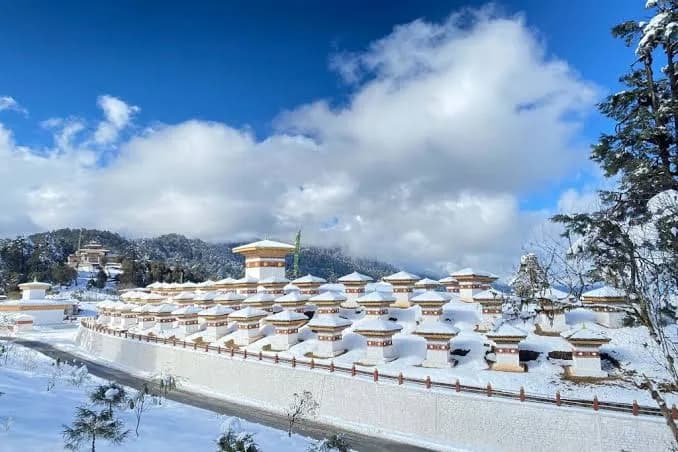
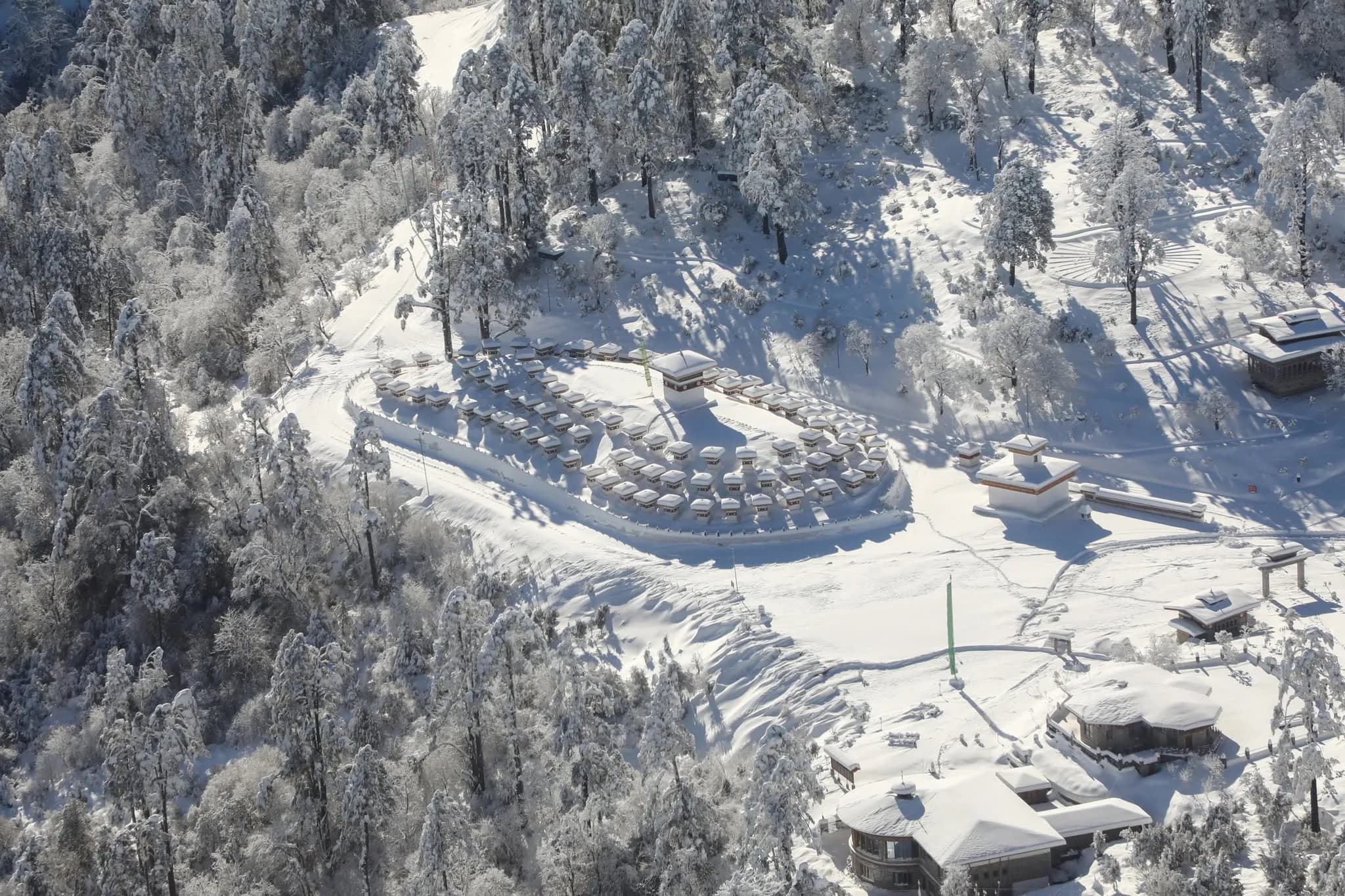
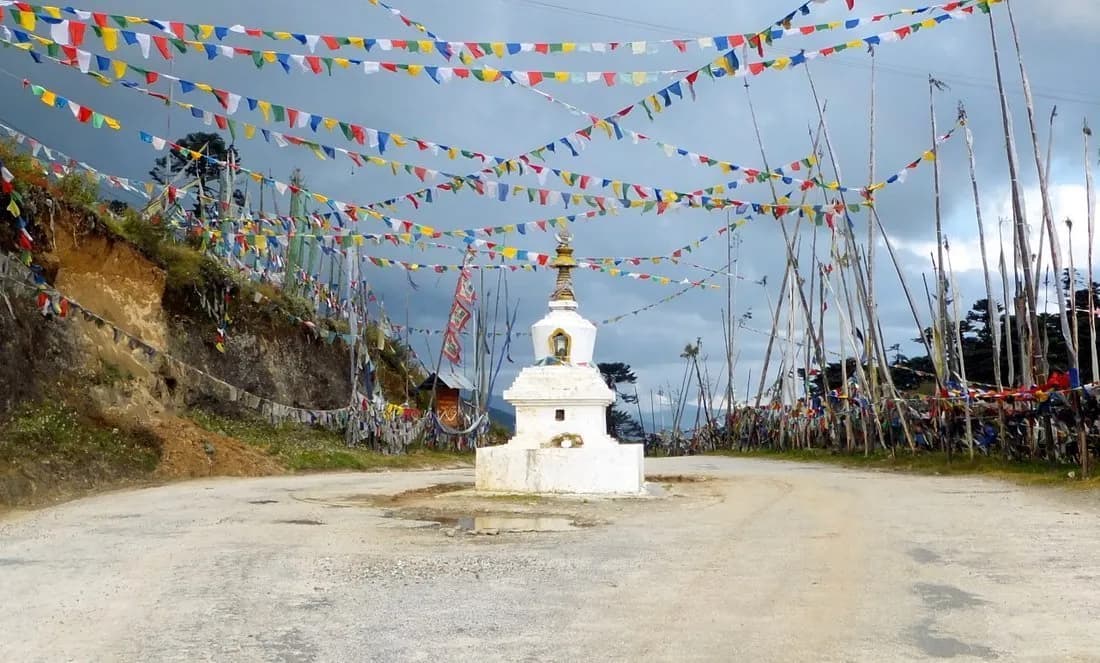
The 75-kilometre crossing to Punakha, about three hours, climbing to Dochu La at 3,100 metres where 108 chortens stand against the eastern Himalaya on a clear morning. Down into the warmer Punakha valley and to Punakha Dzong at the confluence of the Mo and Pho Chhu in late-afternoon light.
DAY 04
A day in Punakha — paddies, bridge, slow lunch
The terraced rice of Lobesa, the gentle walk to Chimi Lhakhang through the fields, the long suspension bridge over the Pho Chhu once the wind has dropped, and a riverside lunch with nowhere else to be.
DAY 05
Back to Paro — ahead of the climb
The return over Dochu La with the range behind you. Kyichu Lhakhang, one of the country's oldest temples, in the afternoon, and an early night with the next morning's walk briefed by your guide.
DAY 06
The Tiger's Nest — paced the right way
Taktsang clings to its cliff at 3,120 metres above the Paro valley. The switchbacks are walked at your own pace with the guide reading the altitude; lunch at the cafeteria across the gorge; a hot stone bath at the lodge for the descent.
DAY 07
Departure from Paro
Breakfast at the lodge, the guide walks you back to the terminal for the morning flight, and the team writes a fortnight on to hear how it settled.
The day-by-day above is illustrative. The proposal you receive is built around your dates, your pace and your interests, not this template.
Frequently asked
- Should I choose Bhutan or Nepal?
- It depends on what you are after, and both are excellent at what they do. Choose Nepal if trekking is the heart of the trip — the Everest region, the Annapurnas, a long independent route, world-class mountaineering, busier trails with good company on them, and a lighter daily budget. Choose Bhutan if you want a living culture met at close range, far fewer people around you, the ease of travelling with one guide on a planned arc, dzongs and tshechu festivals, and walks for the view rather than the summit. A useful rule of thumb: Nepal for the serious trekker and the independent traveller; Bhutan for the culture-first traveller who values calm, exclusivity, and being well looked after. Many guests have done Nepal's great walks already and come to Bhutan for something quieter.
- Is Bhutan more expensive than Nepal?
- Yes — honestly, and by design. Nepal can be travelled on a wide range of budgets, the tea-house trekking model in particular keeping daily costs low, which is one of its real strengths. Bhutan costs more per day, and the chief reason is the Sustainable Development Fee: USD 100 per night for each international adult visitor, set by the Royal Government of Bhutan. That fee is not a margin we keep; it funds free health care and free education for Bhutanese citizens and underwrites the country's carbon-negative, low-volume approach to tourism. What the higher cost buys you is uncrowded sites, a licensed guide for the whole journey, a preserved living culture, and the quiet that comes from a country choosing fewer visitors on purpose. It is a different model rather than simply a dearer one.
- Can I trek in Bhutan, or is it only cultural sites?
- You can certainly trek, though the character is different. Bhutan has fine routes — the Chomolhari trek to its base camp, the Druk Path between Paro and Thimphu, the long Snowman traverse for the very experienced — at a Bhutanese pace of roughly fifteen kilometres a day and considerably less crowded than Nepal's popular trails. What Bhutan does not offer is climbing: no peak above 6,000 metres is open to summit attempts, by deliberate policy. For a culture-first week like the one outlined here, the walking is gentle — the climb to Tiger's Nest, the paths around Punakha — with the option to build in a multi-day trek if that is where your interest lies. For a serious high-altitude objective or a long independent circuit, Nepal remains the country to choose.
- Why does everyone in Bhutan travel with a guide — can I go independently as I would in Nepal?
- International visitors to Bhutan travel with a licensed guide as a matter of course, and it is worth understanding this as a feature rather than a restriction. In Nepal you can walk the trails independently, which many travellers value. In Bhutan the guide is the thread through the whole journey — opening doors at temples, reading the room at a festival, carrying the language and the context, and adjusting the day to how you actually travel. For the traveller who wants ease and depth rather than logistics, the guided model is much of why a week in Bhutan feels the way it does. If complete independence on the trail is what you most want, that points you towards Nepal.
Journeys you might also weigh
- 01Bhutan or LadakhA gracious comparison for the couple drawn to both. Ladakh is one of the great high-desert landscapes on earth — a stark, luminous plateau of gompas and ochre ridgelines. Bhutan is its green counterpart: a self-contained Himalayan kingdom of forested valleys at a gentler altitude, where Vajrayana Buddhism is lived rather than visited and every guest travels privately with a guide. This page is here to help you choose — and, if it is Bhutan, to show what a representative week across Paro, Thimphu, and Punakha looks like.7 nights
from $7,000 - 02Bhutan or SikkimA gracious comparison for the couple drawn to both. Sikkim is one of the loveliest corners of the eastern Himalaya — a green, mountainous Indian state of monasteries, rhododendron forests, and clear Kanchenjunga mornings, easy to fold into a wider trip through Darjeeling. Bhutan is its near neighbour and quiet counterpart: an independent Himalayan Buddhist kingdom of working dzongs and living festivals, travelled as one seamless private journey with a guide and a single permit handled for you. This page is here to help you choose — and, if it is Bhutan, to show what a representative week across Paro, Thimphu, and Punakha looks like.7 nights
from $7,000 - 03Bhutan or TibetA gracious comparison for the couple drawn to both. Tibet holds some of the great monuments of the Buddhist world; Bhutan offers a living, freely practised tradition met at close range, with gentler altitude and the ease of a private guide. This page is here to help you choose — and, if it is Bhutan, to show what a representative week across Paro, Thimphu, and Punakha looks like.7 nights
from $7,000
Begin when you're ready.
A few questions, or a conversation in your own words. A bespoke draft either way.

