AN HONEST ANSWER TO A FAIR QUESTION
Yes — a guide travels with you in Bhutan, and it is the best of how the country works.
Every international visitor to Bhutan travels with a licensed Bhutanese guide, and on the road a driver as well — it is part of the Royal Government's framework, and the visa and permits are arranged through the licensed operator rather than by you. There is no provision for self-arranged backpacking. We could be defensive about that, but it would be the wrong instinct: the matched guide is the difference between seeing Bhutan and understanding it. Below: the honest answer, why the requirement reads as a privilege rather than a constraint, and a representative western-circuit week set firmly to your own pace.
7 nights · Premium tier · from USD 6,000 per traveller
- Nights
- 7
- From
- USD 6,000per traveller
- Tier
- Premium
- Best season
- Autumn
- Suits
- Solo
- Departing
- Worldwide
The honest answer first
Yes. Every international visitor to Bhutan travels with a licensed Bhutanese guide, and for road travel a driver as well — it is part of the Royal Government's framework, not a service we have invented to sell. The visa and the in-country permits are arranged through the licensed operator on your behalf, which is why there is no provision for arriving alone with a rucksack and working it out as you go. The one exception worth naming is Indian, Bangladeshi, and Maldivian nationals, who travel under different arrangements. For everyone else, a guide is part of the visit, and we would rather say so plainly at the top of the page than bury it three paragraphs down.
What the guide actually is
Think of the matched guide as a cultural translator and a quiet fixer in equal measure. The translator reads the room at a tshechu, tells you which of the cham dances you are watching and why the masked figure has paused, and renders the Dzongkha or the Sharchop you would otherwise only hear as sound. The fixer makes the logistics disappear — the permit for the inner courtyard, the right lhakhang at the right hour before the coach groups reach it, the call ahead so the farmhouse lunch is laid when you arrive rather than an hour after. None of this is on display. You simply find that the day works, and you are free to spend your attention on Bhutan rather than on arranging Bhutan. By the last evening, in our experience, the guide is rather more than a guide.
Not a chaperone — the days are yours
A guide is not a minder, and the framework is not a leash. You set the pace. If you want to sit in the courtyard at Punakha Dzong for an hour while the river runs below, you sit for an hour. If you want the climb to Taktsang taken slowly with three stops for breath and a long pause at the cafeteria, that is how it is taken. Solitude, when you want it, is arranged rather than refused — a morning walk along the Pa Chhu on your own, an afternoon left deliberately open, a quiet dinner with no commentary at all. The guide is there to make the country legible and the logistics invisible, then to step back the moment you would rather be left to it. The itinerary is a suggestion you author; it is never a schedule you are marched through.
Said plainly — who this does not suit
If your idea of travel is wandering a country alone with a guidebook and no plan, hopping a local bus on a whim and finding a bed when you find one, Bhutan is deliberately not that, and we would tell you so on a first call rather than after you had booked. The high Himalaya has places that serve the unplanned, low-cost, solo wander better, and there is no shame in wanting it. But the thing the framework protects is the thing most worth having here: a culture that is lived rather than staged, valleys that are quiet because visitor numbers are kept low, and a week in which the difficulty of a place you do not speak the language of simply dissolves. For the traveller who wants to understand Bhutan rather than merely pass through it, the guide is the reason the week lands. Much of what makes this country itself survives precisely because it is not arrived at carelessly.
The route
A sample shape of the week
DAY 01
Arrival in Paro — met, then unhurried
Your guide meets you in the arrivals hall, a short drive to the lodge, and an easy first walk along the Pa Chhu to Rinpung Dzong if the afternoon light holds — or a quiet hour to yourself if the flight has been long. Your call.
DAY 02
Paro — Kyichu Lhakhang and the valley at walking pace
One of the country's oldest temples in the morning, the farmhouses and paddies of the valley taken slowly, and the climb ahead briefed over dinner so nothing about it is a surprise.
DAY 03
Taktsang Palphug — the Tiger's Nest, at your own pace
The switchbacks to the 3,120-metre cliffside temple taken as slowly as you like, the pauses where you want them, lunch at the cafeteria on the way down, and a hot stone bath waiting at the lodge.
DAY 04
Across to Thimphu — the capital, slowly
The 54-kilometre road to Thimphu, the Memorial Chorten in early light, and the capital unhurried — a craft workshop, the markets, the National Library, with the afternoon left open if you would rather wander.
DAY 05
Over Dochu La to Punakha — the pass opens
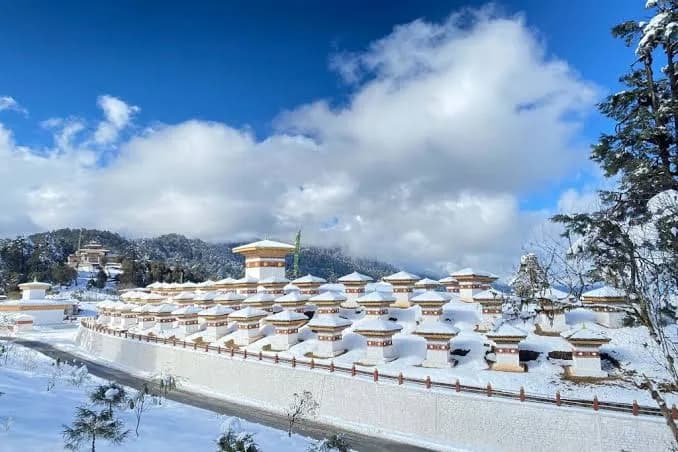
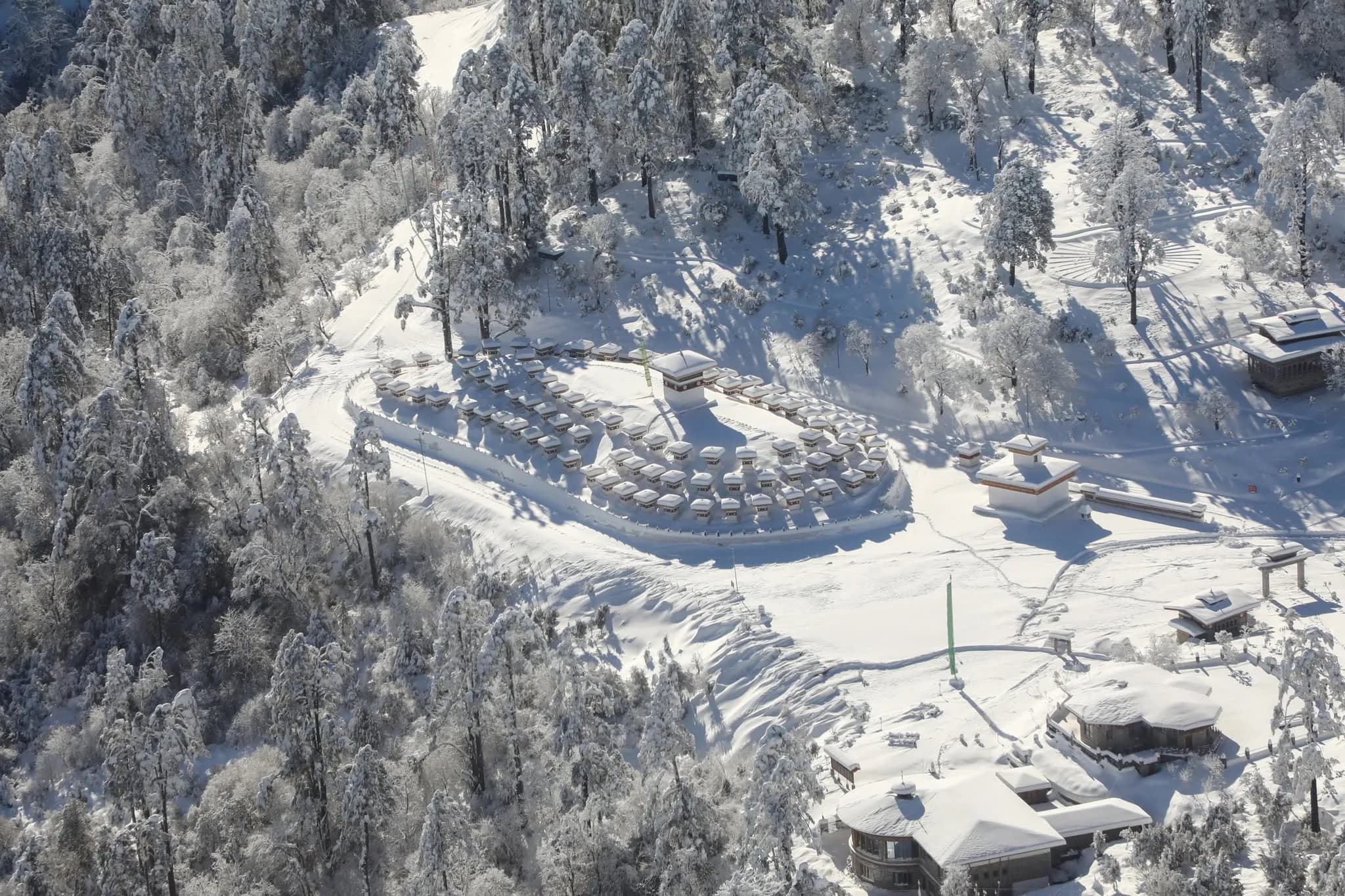
The 3,100-metre pass and its 108 chortens, the eastern range on a clear morning, and Punakha Dzong at the confluence of the Mo and Pho Chhu in late-afternoon light — as long in the courtyard as you wish.
DAY 06
Punakha — paddies, a suspension bridge, a slow lunch
The terraced rice of Lobesa, Chimi Lhakhang reached on foot through the fields, a long riverside lunch, and the suspension bridge when the wind has dropped — the day shaped around your pace, not a clock.
DAY 07
Back over the pass to Paro — departure
The return across Dochu La, a final evening in Paro, and in the morning the guide walks you back to the terminal — by now, more a friend seeing you off than a guide signing out.
The day-by-day above is illustrative. The proposal you receive is built around your dates, your pace and your interests, not this template.
Frequently asked
- Do I need a guide in Bhutan?
- Yes. Every international visitor travels with a licensed Bhutanese guide, and on the road a driver as well — it is part of the Royal Government's framework, and the visa and permits are arranged through the licensed operator rather than by you. The exception is Indian, Bangladeshi, and Maldivian nationals, who travel under different arrangements. Rather than read this as a restriction, most guests find the guide is the best of the visit: a cultural translator, a quiet fixer who makes the logistics vanish, and by the last evening a genuine companion — the difference between seeing Bhutan and understanding it.
- Can I travel Bhutan independently?
- Not in the backpacking sense, no, and that is deliberate rather than an oversight. There is no provision for arriving alone and arranging your own way around the country; the visa and the in-country permits are issued through the licensed operator, and a guide travels with you throughout. What that protects is precisely what brings most people here — a living culture that is not staged for visitors and valleys that stay quiet because numbers are kept low. If the unplanned solo wander is what you are after, the high Himalaya has places better suited to it, and we would say so on a first call.
- Will a guide restrict my freedom?
- No — the opposite, in practice. The guide is not a minder and the days are entirely yours: you set the pace, you choose how long to linger, and solitude is arranged whenever you want it — a morning to yourself, an open afternoon, a dinner with no commentary at all. What the guide removes is friction, not freedom. The permits, the timing, the language, the right lhakhang before the crowds arrive — all of that is handled quietly so your attention stays on the country rather than on the logistics of moving through it. The itinerary is one you author; it is never a schedule you are marched through.
Journeys you might also weigh
- 01How much does a trip to Bhutan cost?It is a fair thing to want settled before anything else, and we would rather set it out plainly than have you piece it together from a dozen half-answers. A Bhutan journey is priced as one figure that already carries the larger part of the trip — your private guide, your driver and vehicle, your lodging, most of your meals, monument and permit fees, and the Sustainable Development Fee of USD 100 per night for each international adult. International flights, any premium lodge upgrade, and personal spending sit outside it. Bhutan is not a budget destination and is not trying to be — that is a deliberate national choice, and below is what the choice buys, set against a representative western-circuit week.7 nights
from $6,000 - 02Is Bhutan worth the Sustainable Development Fee?The fee is the most reasonable thing to pause on before a Bhutan visit. It is USD 100 per night for each international adult — set by the Royal Government of Bhutan, confirmed through 31 August 2027 — and it is the reason the trails to Tiger's Nest are quiet, the dzongs are working buildings rather than exhibits, and the country remains one of the few on Earth that takes back more carbon than it puts out. Below: what the fee funds, what it underwrites for the people of Bhutan and for you, and a representative western-circuit week so the value is concrete rather than asserted.7 nights
from $6,000 - 03Bhutan for the solo travellerA private Bhutan journey for the traveller arriving alone — Paro, Thimphu, Punakha, and back, with a light walk in the hills and the Tiger's Nest at the end. One matched Bhutanese guide and a steady driver for the whole week, in a country that asks little of you and watches over you all the same.7 nights
from $6,500
Begin when you're ready.
A few questions, or a conversation in your own words. A bespoke draft either way.

