A Bhutanese royal palace
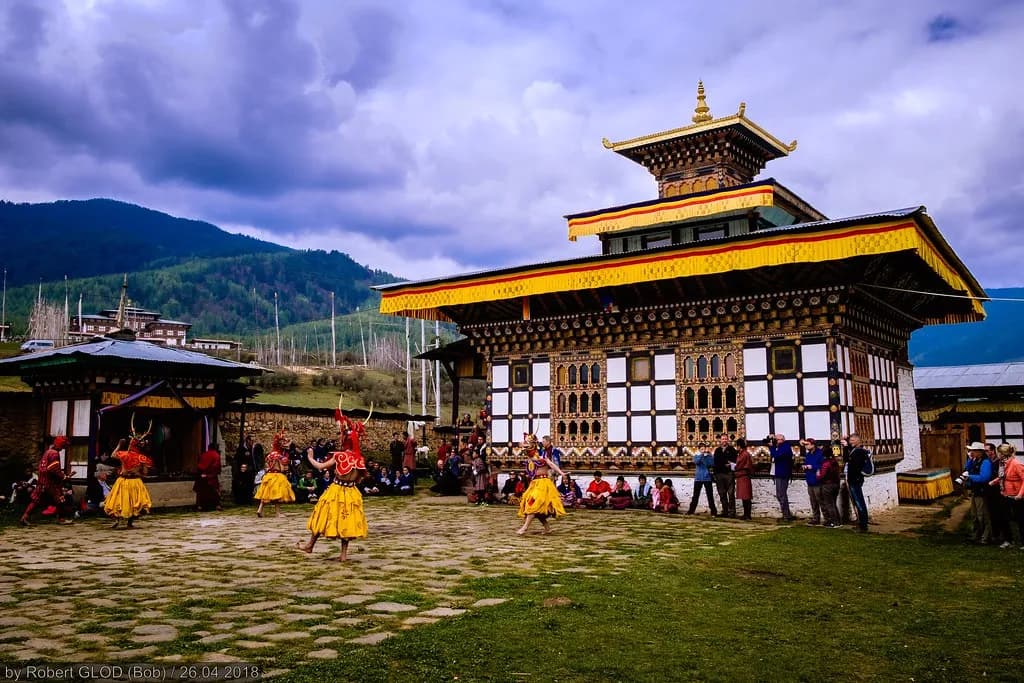
Domkhar Tashicholing — the 1937 summer palace of His Majesty the Second Druk Gyalpo, in the Chumey valley.
In the Chumey valley of Bumthang, the red-roofed Domkhar Tashicholing Palace was built in 1937 by His Majesty the Second Druk Gyalpo Jigme Wangchuck as one of his summer residences — a graceful royal house set among the fields and pines, with the architecture of a Bhutanese palace at its most refined. One of several residences His Majesty raised across the central valleys during his long reign, it carries the atmosphere of the early Wangchuck court, when the kings governed from the Bumthang heartland. The palace is a heritage building, viewed from its grounds, on the drive into the Bumthang valleys.
Also known as Domkhar Palace · Tashi Choeling Domkhar
- Location
- Domkhar, Chumey valley, Bumthang
- Founded
- 1937
- Founder
- His Majesty the Second Druk Gyalpo Jigme Wangchuck
- Elevation
- 2,700 m
- Kind
- palace
A king's summer house
Domkhar Tashicholing was built in 1937 by His Majesty the Second Druk Gyalpo Jigme Wangchuck, who reigned from 1926 to 1952 and governed principally from the Bumthang heartland of the dynasty. While His Majesty's main residence was the older Wangduecholing Palace nearby, he raised a number of further residences across the central valleys across his reign — Domkhar in the Chumey valley among them, built as a summer palace. It belongs to the period when the early Wangchuck kings ruled from Bumthang, before the capital moved to Thimphu under His Majesty the Third Druk Gyalpo in the 1950s, and it carries the atmosphere of that quieter, more pastoral seat of the early monarchy.
The architecture
Domkhar is a fine example of the Bhutanese royal residence — a tall, graceful house in the traditional manner, its white walls and red-banded upper storeys rising among the fields and pines of the Chumey valley, with the carved and painted woodwork that marks a building of rank. Set against the gentle Chumey landscape, it has the settled elegance of a country palace rather than the defensive mass of a dzong, and it speaks to the way the early Wangchuck kings lived: in the valleys, among the fields, close to the land and the monasteries of the Bumthang region. The palace and its grounds are a heritage asset, preserved as part of the dynasty's residential legacy.
On the way into Bumthang
Domkhar lies in the Chumey valley, the first of Bumthang's four valleys reached on the drive in from Trongsa over the Yotong La — so it falls naturally near the start of a Bumthang visit, close to the yathra-weaving village of Zugney and the Prakhar and Tharpaling monasteries. As an active heritage building it is generally appreciated from its grounds rather than entered, but it adds to the texture of the Chumey valley: alongside the weaving and the monasteries, the graceful royal house is a reminder that this quiet valley was once part of the working seat of the kings. The matched guide points it out and reads its history on the way through.
Visiting
- Getting there
- Domkhar is in the Chumey valley, the first Bumthang valley reached on the drive over the Yotong La from Trongsa — passed near the start of a Bumthang visit. The matched guide points it out on the way through, often alongside Zugney and the Chumey monasteries.
- What to see
- The graceful royal palace among the fields and pines, appreciated from its grounds (as an active heritage building it is generally not entered), and the gentle Chumey-valley setting. A short stop is the usual visit. The matched guide reads the palace's history and the early-Wangchuck-court context.
- Protocol
- As a royal heritage building, the palace is viewed with the appropriate respect from its grounds; visitors follow the guide's lead on access and photography. The royal-family register applies, as at all the dynasty's residences.
- Best time to visit
- Year-round, with the Bumthang autumn (clear skies, buckwheat harvest) and spring (blossom) the loveliest. The Chumey valley is high and can be cold; a warm layer is useful.
Journeys featuring this site
 JourneyThe signature-tier Bhutan journey — private knowledgeable guide, the most considered lodge curation, helicopter or charter between valleys, exclusive-use arrangements where the season allows.The signature-tier Bhutan journey. Private knowledgeable guide, the most considered lodges, helicopter or PC-24 charter, exclusive-use arrangements. By invitation, from USD 14,000.
 JourneyOctober light, Bhutan, a week.A seven-night Bhutan photography journey in October — Bhutan, golden-hour access at Punakha Dzong, a tripod-friendly guide, and transparent pricing.
Frequently asked
- Who built Domkhar Tashicholing Palace?
- His Majesty the Second Druk Gyalpo Jigme Wangchuck, who built it in 1937 as a summer palace in the Chumey valley of Bumthang. It was one of several residences he raised across the central valleys during his reign (1926–1952), when the early Wangchuck kings governed from the Bumthang heartland, before the capital moved to Thimphu in the 1950s.
- Can the palace be entered?
- As an active royal heritage building, Domkhar is generally appreciated from its grounds rather than entered. It adds to the texture of the Chumey valley — alongside the yathra weaving and the monasteries — as a reminder of the early Wangchuck court that once ruled from Bumthang. The matched guide reads its history on the way through.
- Where does it fit in a Bumthang visit?
- It lies in the Chumey valley, the first of Bumthang's four valleys reached on the drive in from Trongsa over the Yotong La — so it falls near the start of a Bumthang visit, close to the weaving village of Zugney and the Prakhar and Tharpaling monasteries, which it combines with naturally.

