The principal Bhutanese monuments
Dzongs, lhakhangs, and the great statues: the architectural and religious legacy of the Royal Kingdom.
The Bhutanese dzong is the country's distinctive architectural form: a fortified administrative and monastic complex, set on a high point above a confluence or a river bend. Alongside the dzongs sit the country's principal monasteries, lhakhangs (temples), and statues — the core of any Bhutan sightseeing itinerary. Each dzongkhag has its principal dzong; each carries centuries of continuous religious and civic life. Catalogued below by type, with founding year where it's known.
- Monuments
- 64
All monuments, alphabetical
Dzongs9
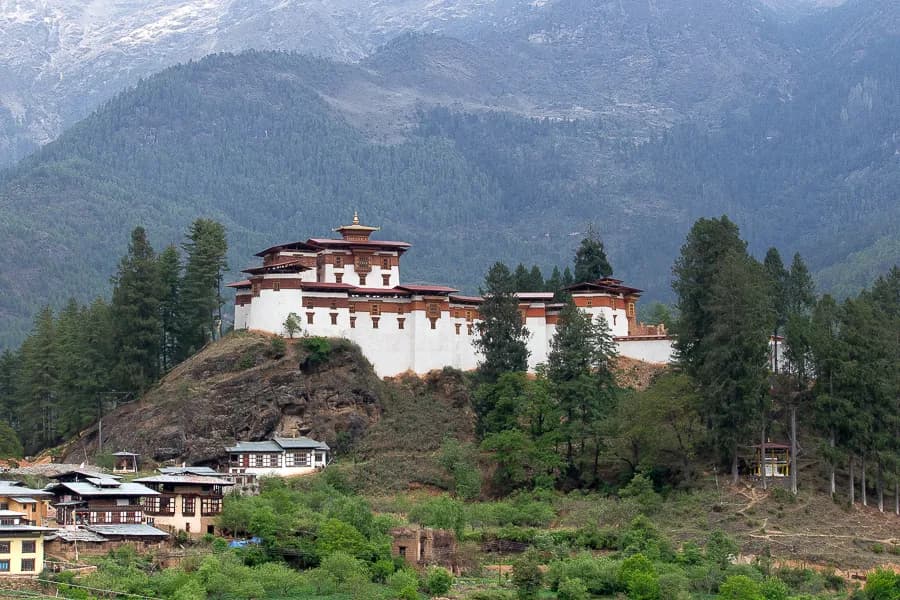
dzong · Paro · 2,500 m · founded 1649
Drukgyel Dzong
Drukgyel Dzong sits at the head of the upper Paro valley at 2,500 metres elevation, on a low ridge with an open view north to the snow peak of Chomolhari (7,326 m). Founded in 1649 by Tenzin Drukda to commemorate Bhutan's victory over a Tibetan invasion, the dzong was destroyed by fire in 1951 and stood as a romantic ruin for over six decades. Royal Government restoration commenced in 2016 and is ongoing.
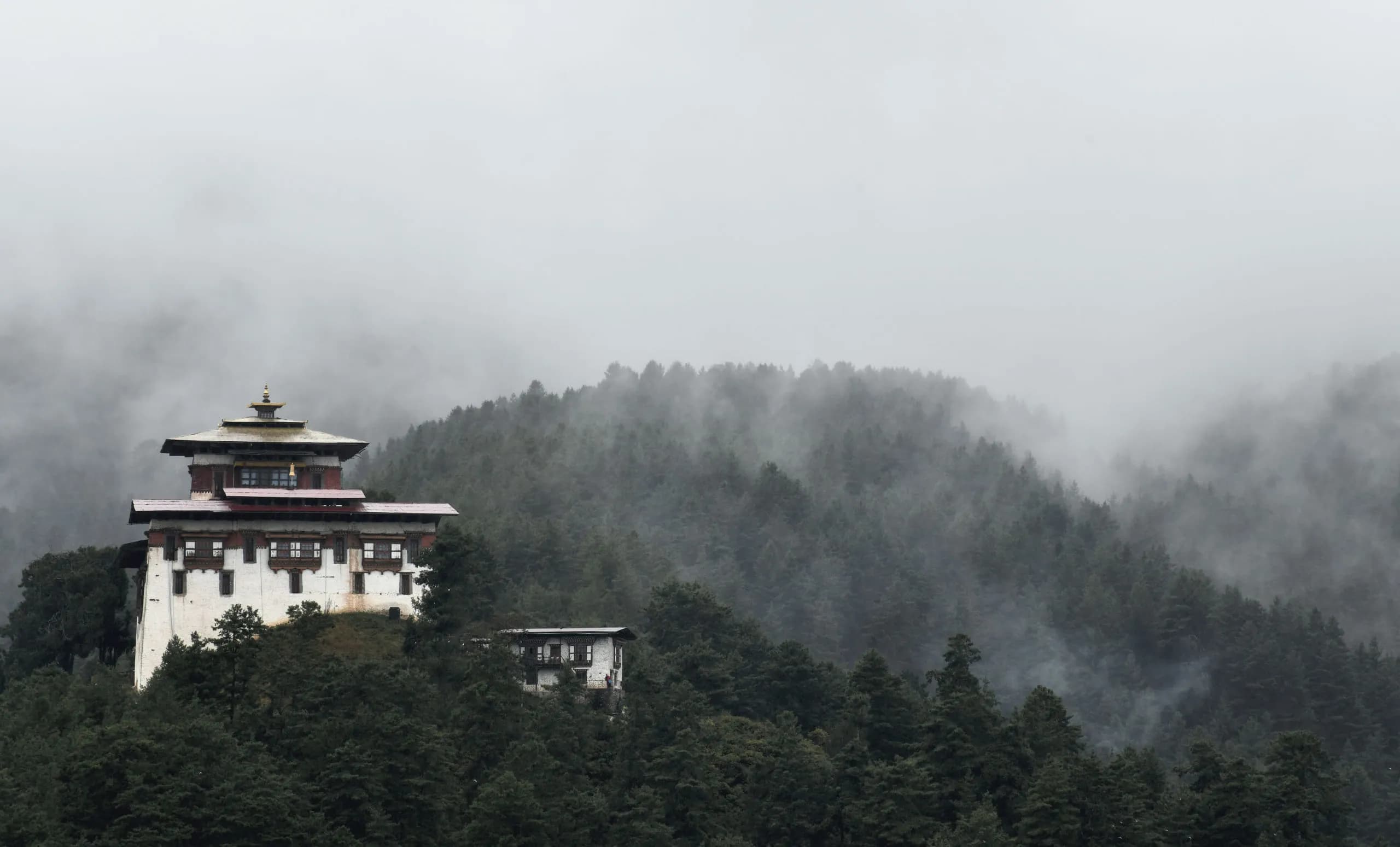
dzong · Bumthang · 2,700 m · founded 1549
Jakar Dzong
Jakar Dzong sits on a low ridge above the Chamkhar Chhu in the Choekhor valley of Bumthang at 2,700 metres elevation. Founded in 1549 by Ngagi Wangchuck, a great-grandson of Pema Lingpa, the dzong's name 'Jakar' (white bird) derives from a white-bird omen at the site selection. The dzong is the administrative and monastic centre of Bumthang dzongkhag and a notable architectural example of the Bhutanese fortress tradition.
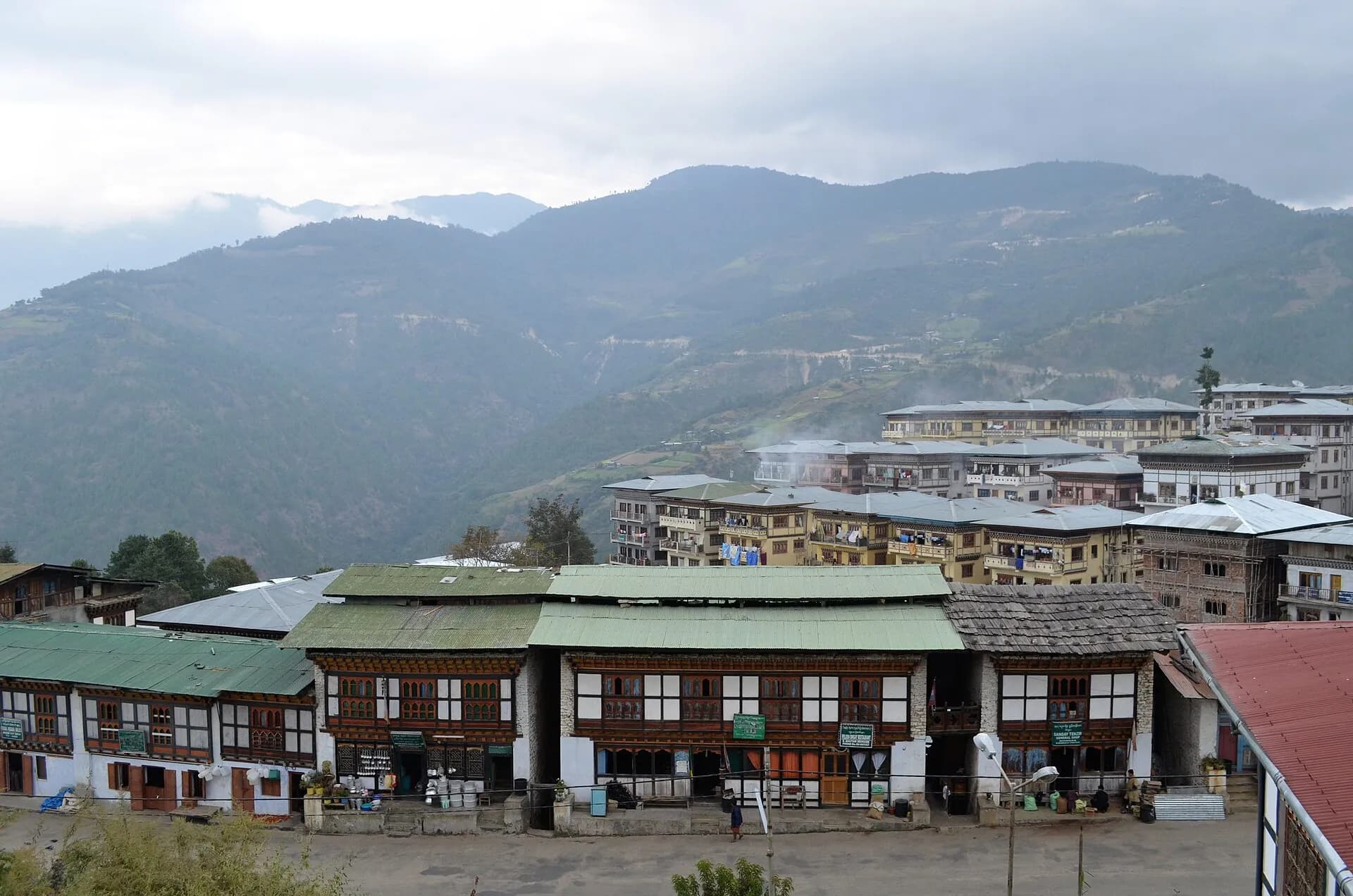
dzong · Mongar · 1,600 m · founded 1930
Mongar Dzong
Mongar Dzong was built in 1930 — one of the youngest principal dzongs in the country, replacing the older Zhongar Dzong that had been damaged by earthquake and fire in the early 20th century. The dzong was commissioned under the direction of His Majesty the Second Druk Gyalpo Jigme Wangchuck and follows the traditional Bhutanese dzong architectural framework at a moderate scale. The dzong houses both the Mongar dzongkhag administrative offices and the regional monk body; the architectural gives visitors a clear sense of how Bhutanese builders maintained dzong-construction continuity through the 20th century.
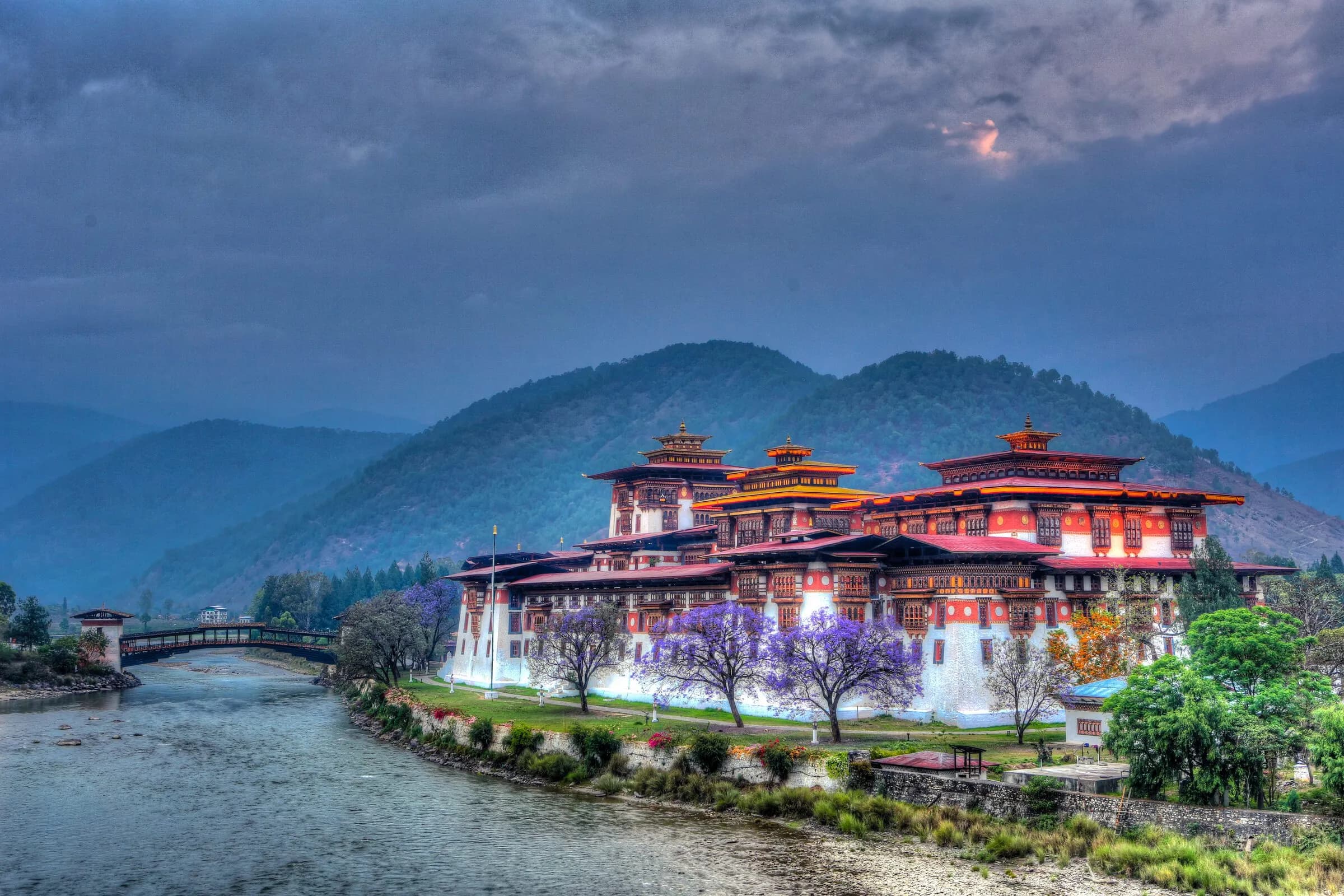
dzong · Punakha · 1,200 m · founded 1638
Punakha Dzong
Punakha Dzong — known formally as Pungtang Dechen Phodrang Dzong, the Palace of Great Happiness — sits at the confluence of the Pho Chhu (father river) and the Mo Chhu (mother river) in the Punakha valley at 1,200 metres elevation. Founded in 1638 by Zhabdrung Ngawang Namgyal, it served as the capital of Bhutan until 1955 and remains the winter residence of the Je Khenpo (the Chief Abbot) and the principal venue for state ceremonies.
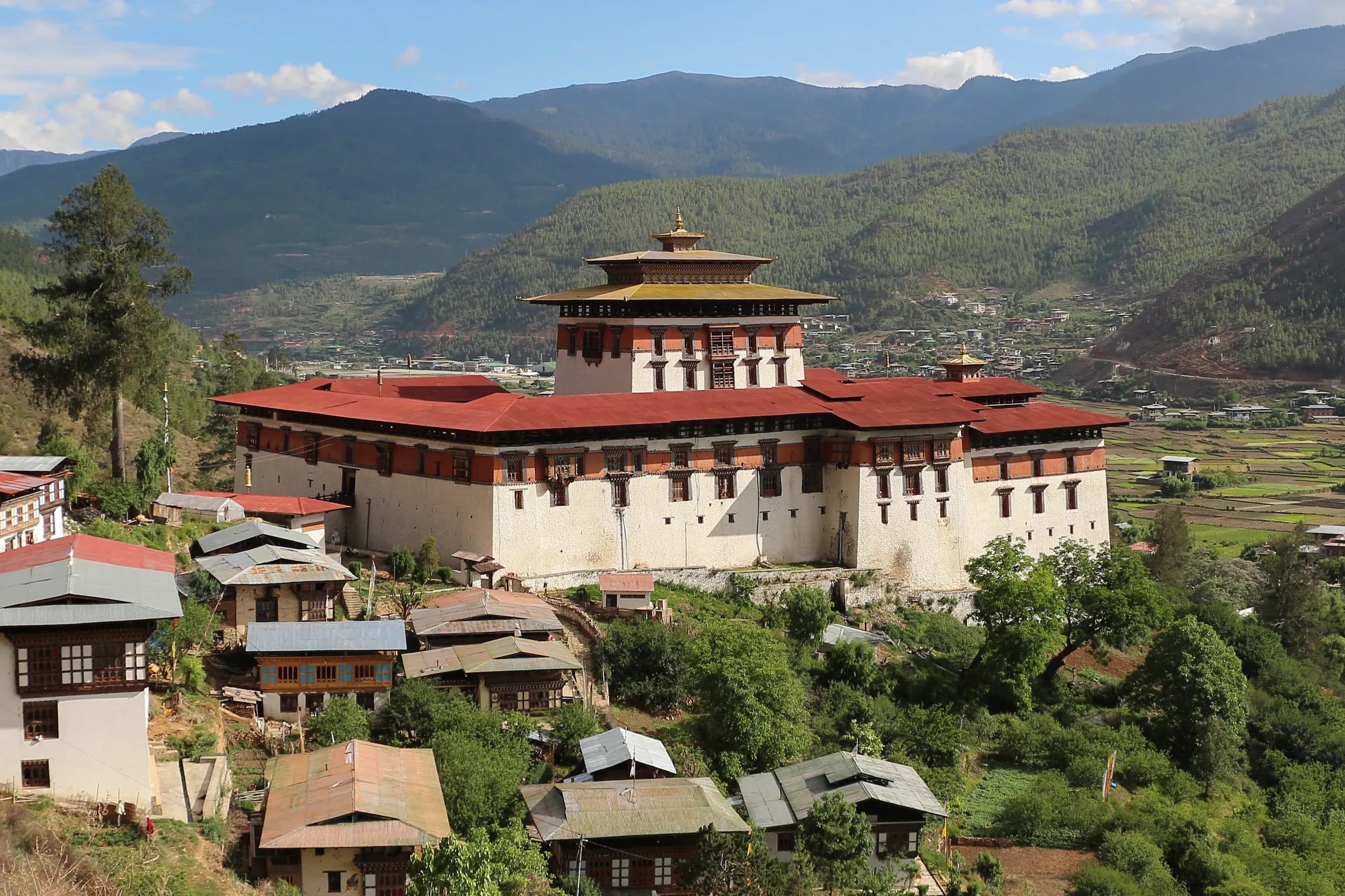
dzong · Paro · 2,280 m · founded 1644
Rinpung Dzong (Paro Dzong)
Rinpung Dzong — commonly called Paro Dzong by international visitors — sits on a low hill above the Pa Chhu in the Paro valley at 2,280 metres elevation. Founded in 1644 by Zhabdrung Ngawang Namgyal on the foundations of an earlier 15th-century fort, the dzong is the administrative and monastic centre of Paro dzongkhag and the venue of the Paro Tshechu, the country's most-internationally-attended festival.
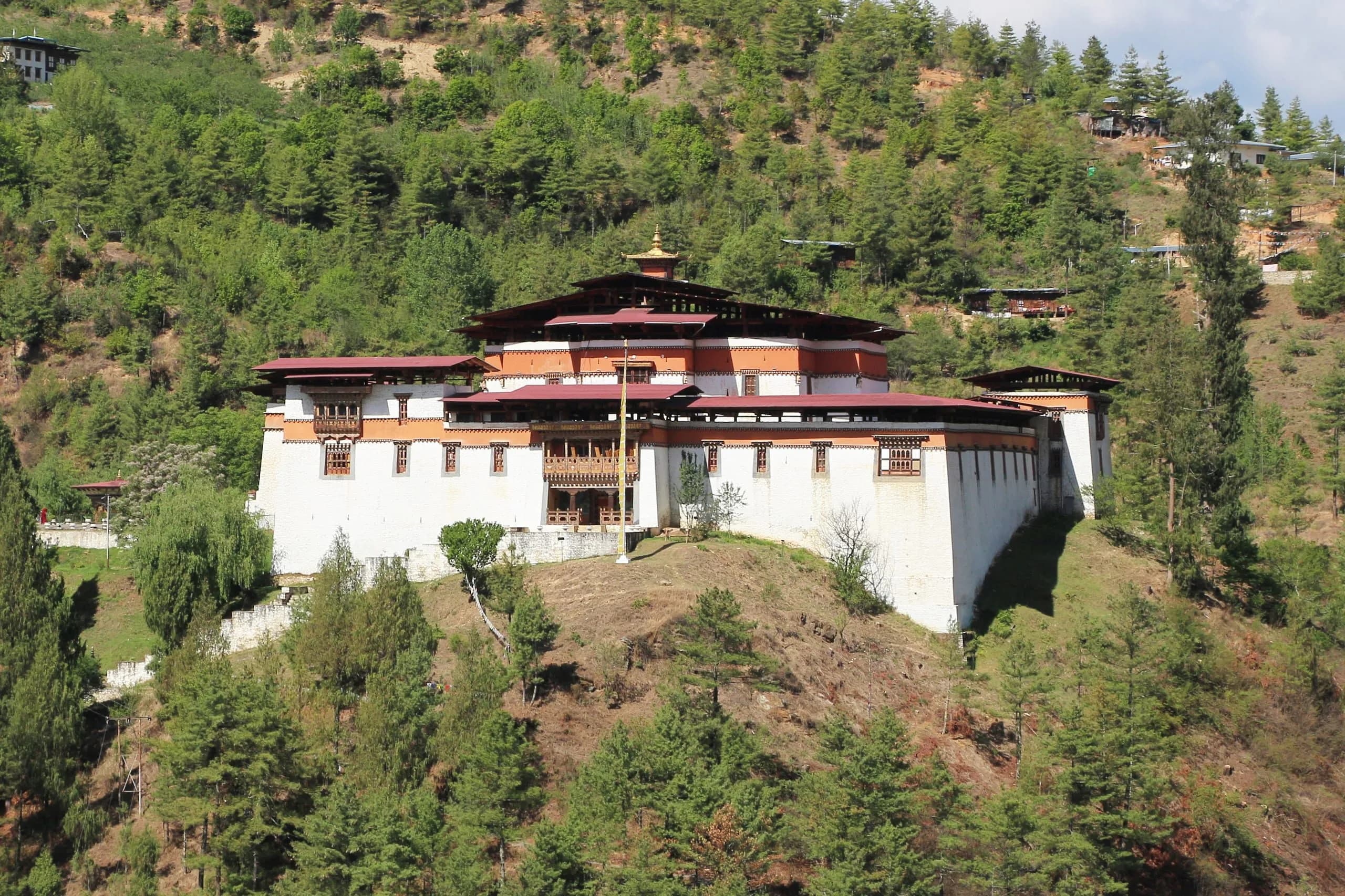
dzong · Thimphu · 2,350 m · founded 1629
Simtokha Dzong
Simtokha Dzong, on a ridge a few kilometres south of Thimphu, is the oldest surviving dzong in Bhutan — the first that Zhabdrung Ngawang Namgyal built, in 1629, as he began to unify the country. Its formal name, Sangak Zabdon Phodrang, means 'the palace of the profound meaning of secret mantras'; its strategic site once guarded the junction of the routes from Paro, Thimphu, and the south. Today it houses an institute of language and cultural studies, and a visitor comes for its place at the very beginning of the dzong tradition — and for the celebrated carved-slate reliefs set into its inner gallery.
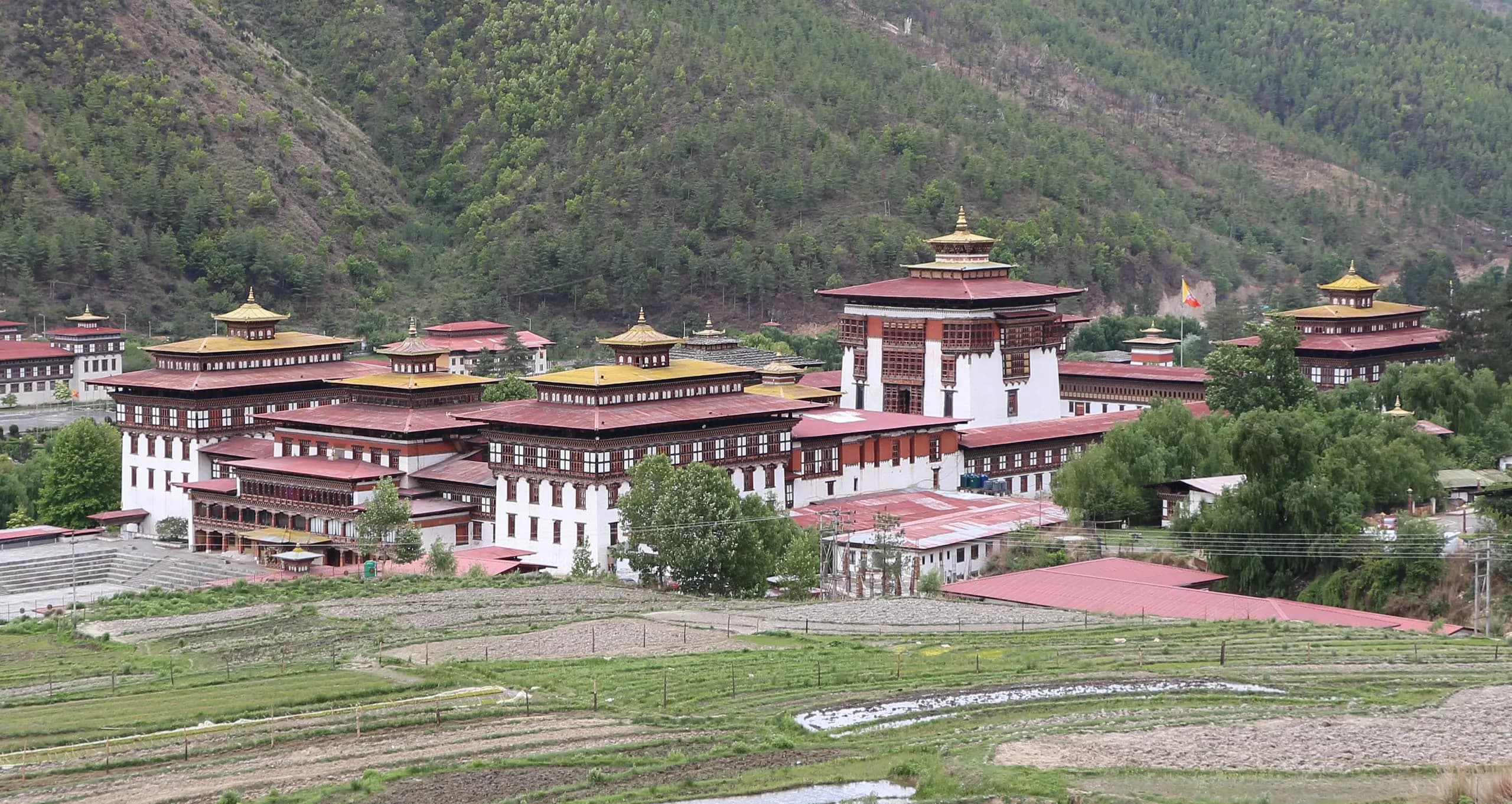
dzong · Thimphu · 2,330 m · founded 1216
Tashichho Dzong
Tashichho Dzong sits on the western bank of the Wang Chhu in Thimphu at 2,330 metres elevation. The original dzong was founded in 1216; the present structure was reconstructed under His Majesty the 3rd King in the 1960s as the seat of the central government and the summer residence of the Je Khenpo (the Chief Abbot). It is the principal civic and religious institution of modern Bhutan.
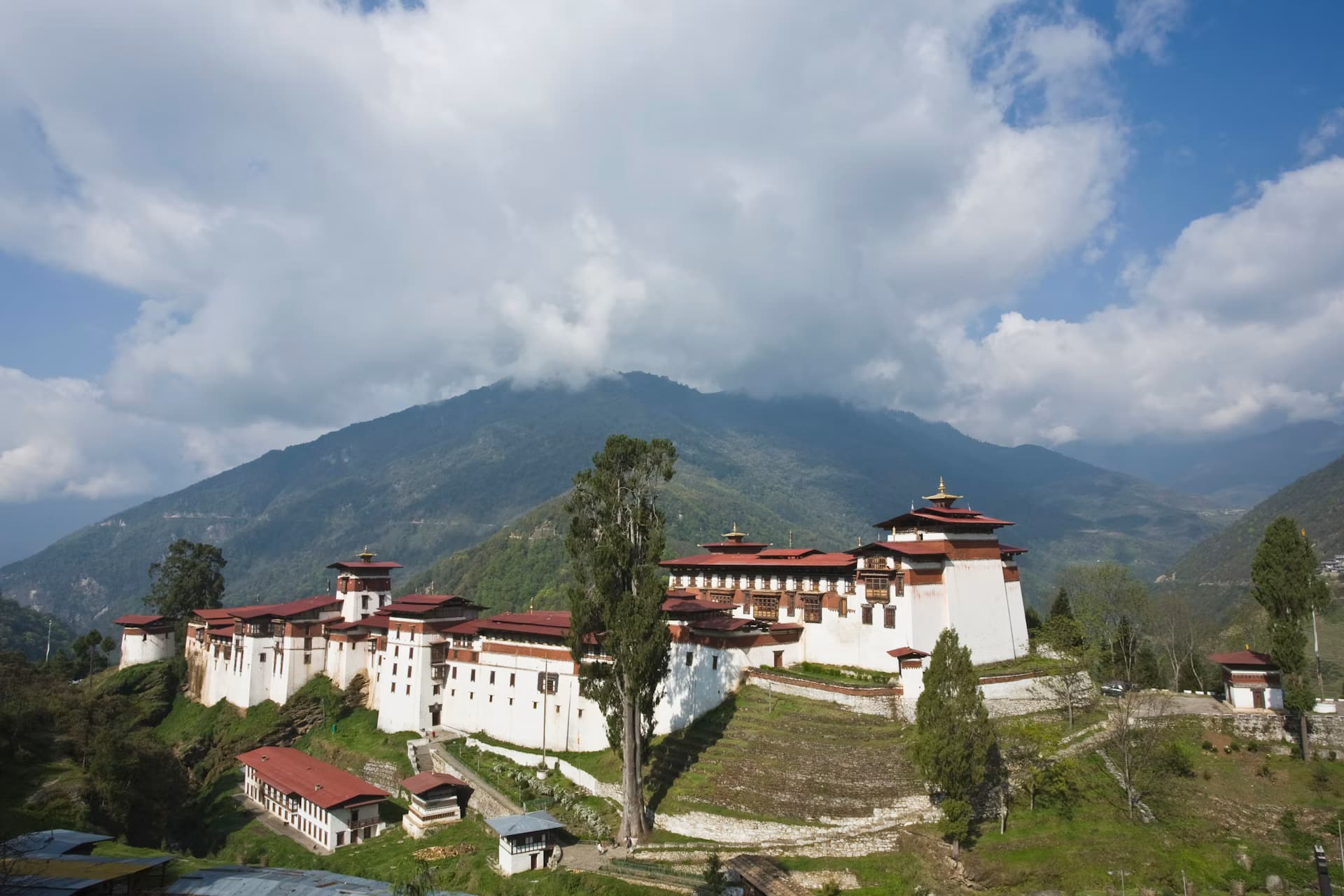
dzong · Trongsa · 2,200 m · founded 1648
Trongsa Dzong
Trongsa Dzong sits on a high ridge above the Mangde Chhu gorge in central Bhutan at 2,200 metres elevation. It is the largest dzong in the country by floor area, founded in 1648 by Chogyel Mingyur Tenpa as the seat of the Trongsa Penlop — the Governor of central Bhutan. The Wangchuck dynasty arose from this position; every Crown Prince of Bhutan serves as Trongsa Penlop before ascending the Golden Throne.
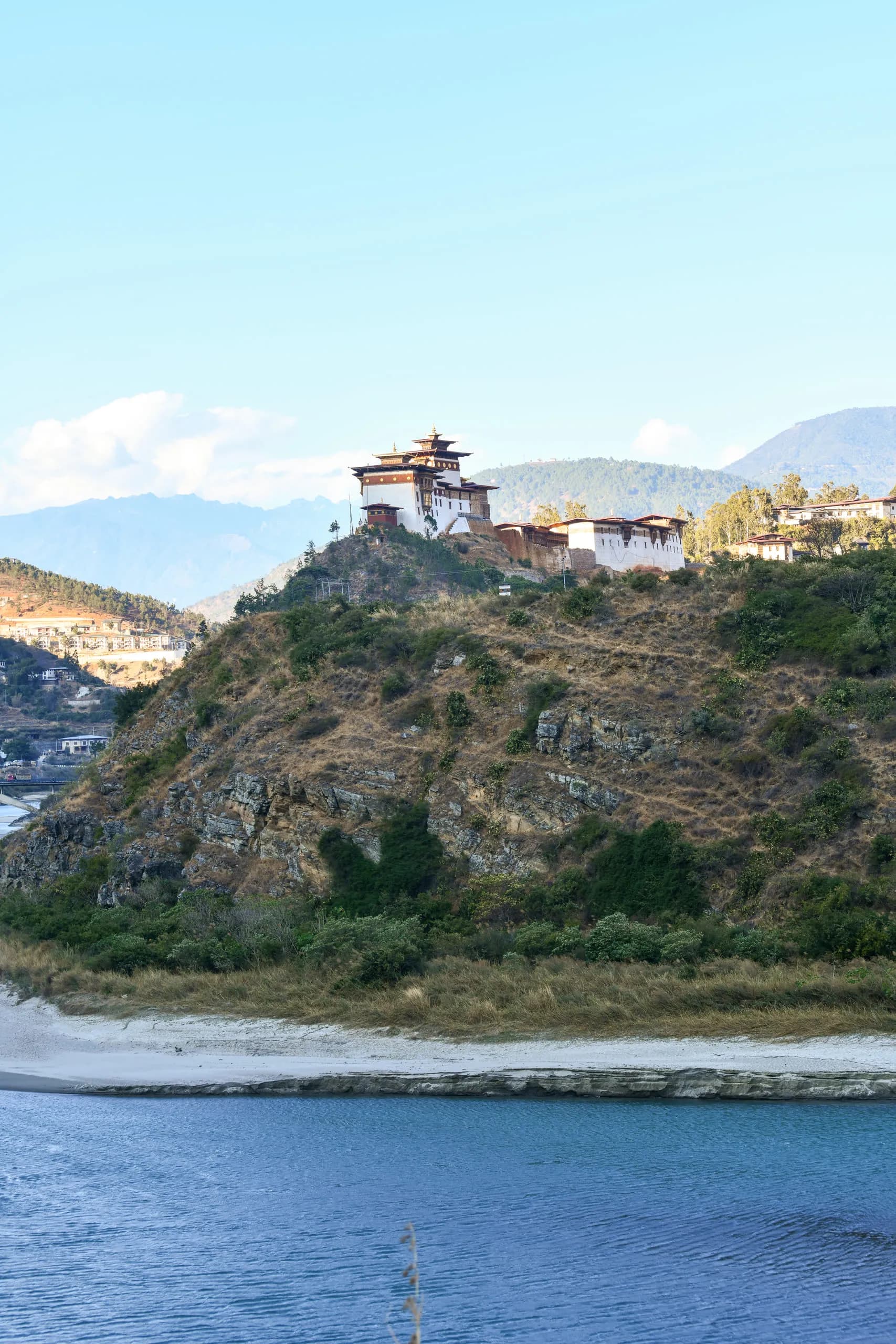
dzong · Wangdue Phodrang · 1,300 m · founded 1638
Wangdue Phodrang Dzong
Wangdue Phodrang Dzong sits on a ridge above the confluence of the Punatsang Chhu and the Dang Chhu in central-western Bhutan at 1,300 metres elevation. Founded in 1638 by Zhabdrung Ngawang Namgyal, the dzong burned to the ground in 2012 in an electrical fire. The Royal Government's decade-long restoration was completed and the dzong reopened on 11 November 2022 — the birthday of His Majesty the 4th King.
Lhakhangs17
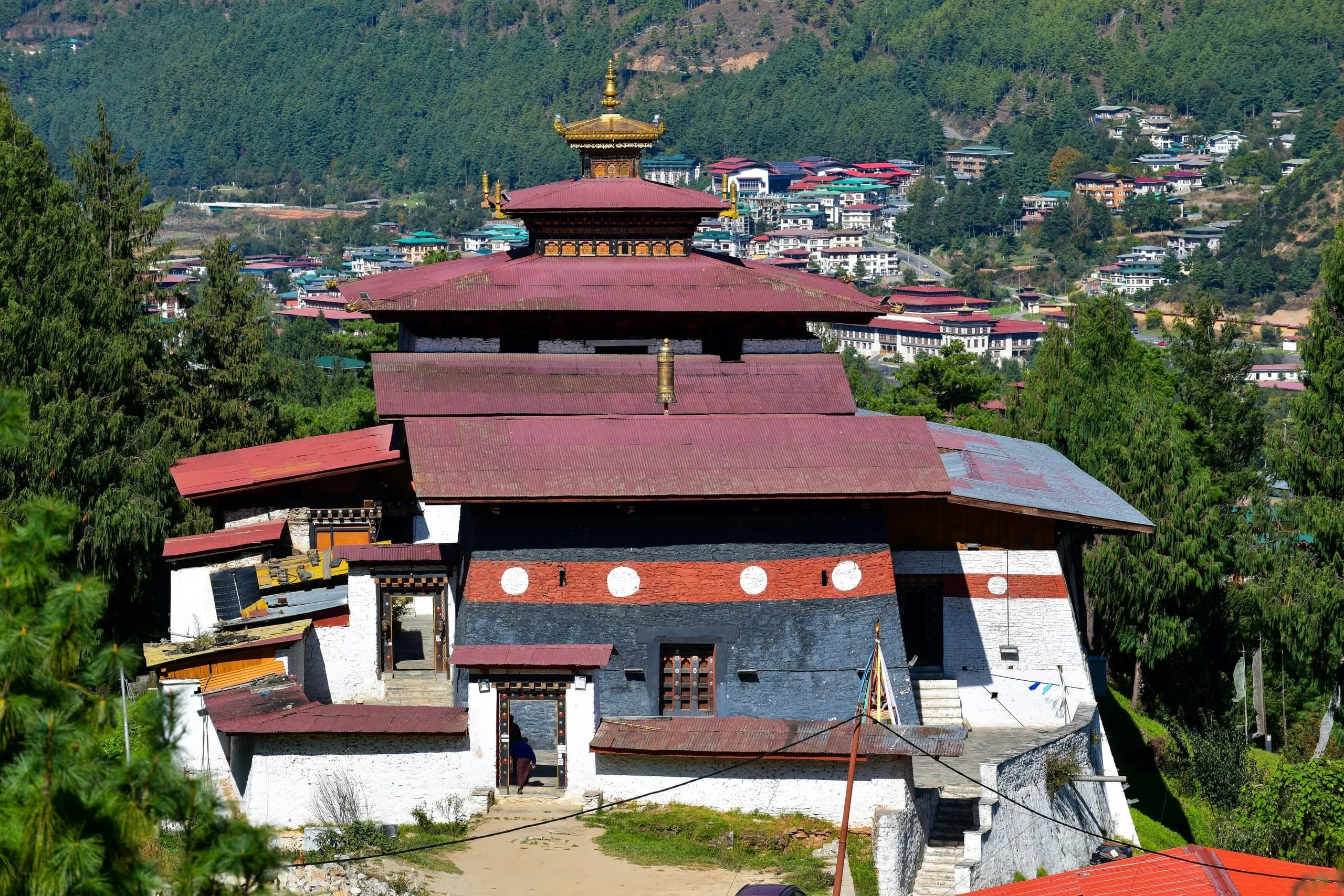
lhakhang · Thimphu · 2,400 m
Changangkha Lhakhang
Changangkha Lhakhang stands on a ridge above the Thimphu valley, fortress-like, the oldest temple in the capital — established in the 12th to 13th century by the family of Lama Phajo Drukgom Zhigpo, the master who first brought the Drukpa Kagyu tradition to Bhutan. Its central image is Chenrezig, the bodhisattva of compassion, in the eleven-headed, thousand-armed form. For the families of Thimphu it is the temple of beginnings: newborns are carried up to Changangkha to be blessed, to receive a name from the astrologer-lama, and to be given a protective thread — which makes it not a relic but a living part of the city's daily life.
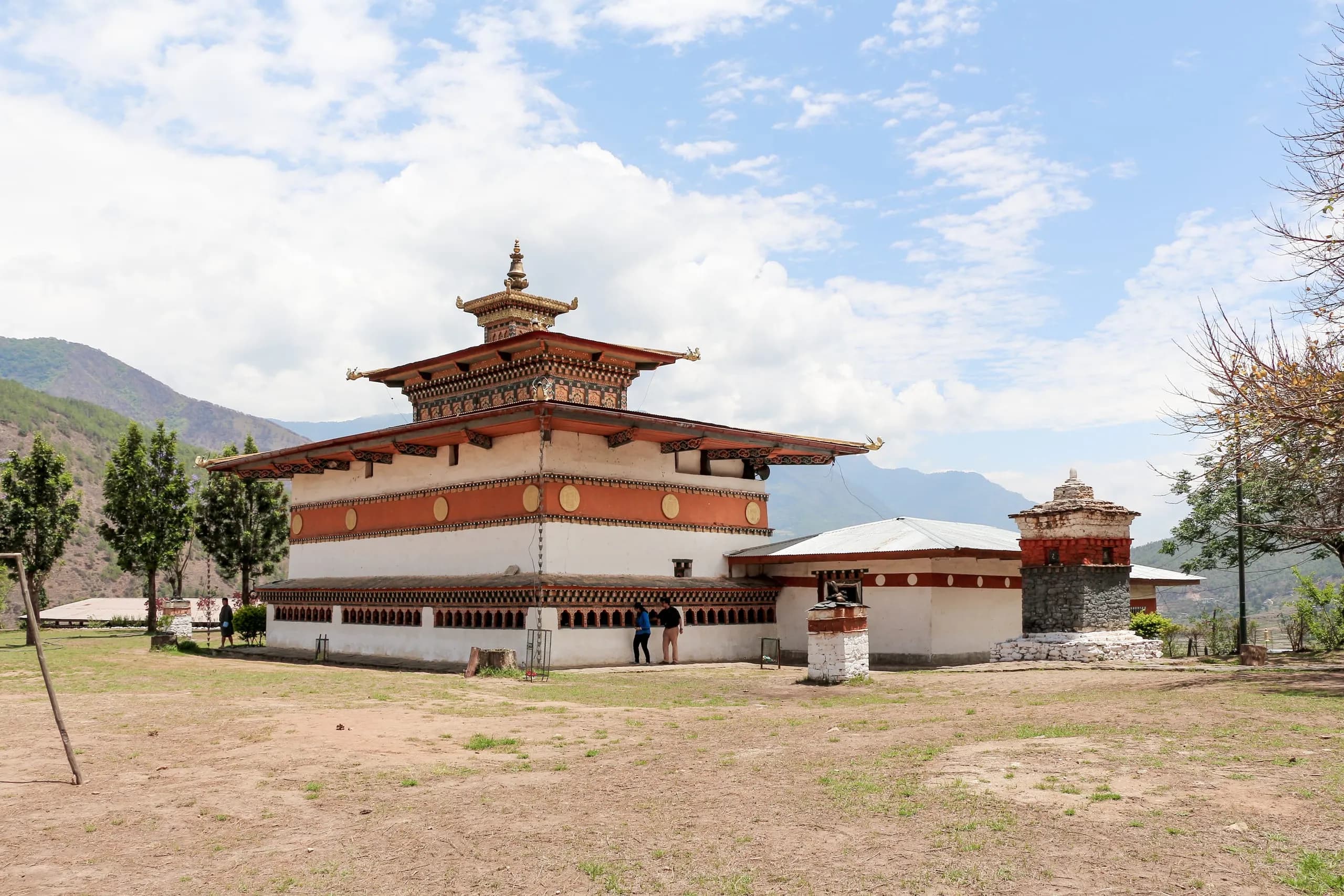
lhakhang · Punakha · 1,280 m · founded 1499
Chimi Lhakhang
Chimi Lhakhang sits on a low hillock above the Lobesa rice fields, a 20-minute walk from the road south of Punakha. Built in 1499 by Lam Ngawang Choegyel and dedicated to the great 'Divine Madman' Drukpa Kunley, the lhakhang is the country's principal fertility pilgrimage site and the source of the phallus iconography seen on Bhutanese village houses.
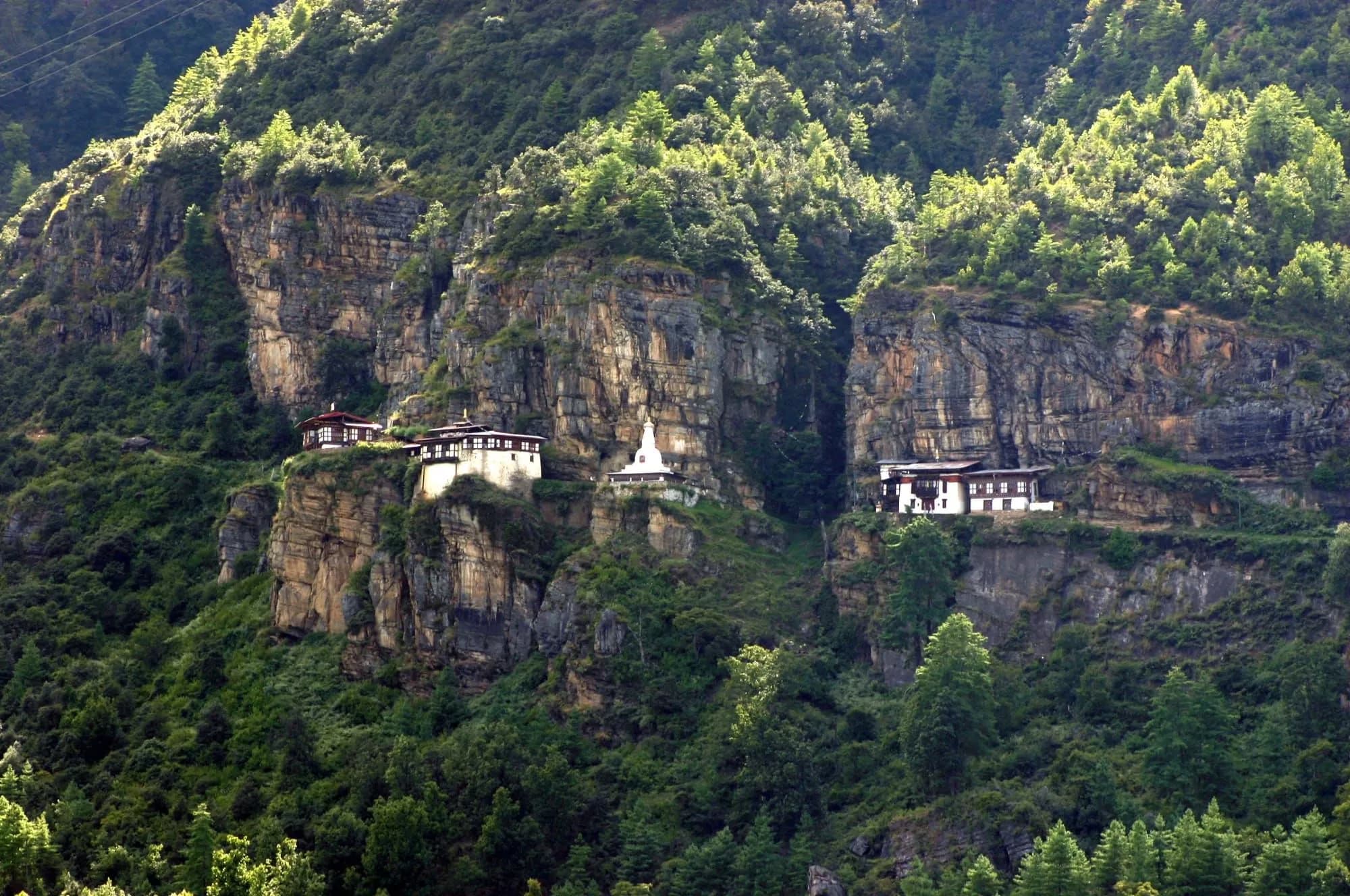
lhakhang · Paro · 2,550 m
Dzongdrakha Goemba
Dzongdrakha Goemba is a cluster of temples set into the cliff face above Bondey village in the lower Paro valley — sometimes called the 'mini Tiger's Nest' for the way the white shrines cling to the rock. Where Taktsang demands a steep half-day climb, Dzongdrakha is reached by an easy walk through fields and pine, which makes it a rewarding alternative for visitors who want the cliff-temple atmosphere without the altitude and the effort. The four shrines are dedicated to Drolma (Tara), Guru Rinpoche, Tsheringma, and the future Buddha Maitreya.
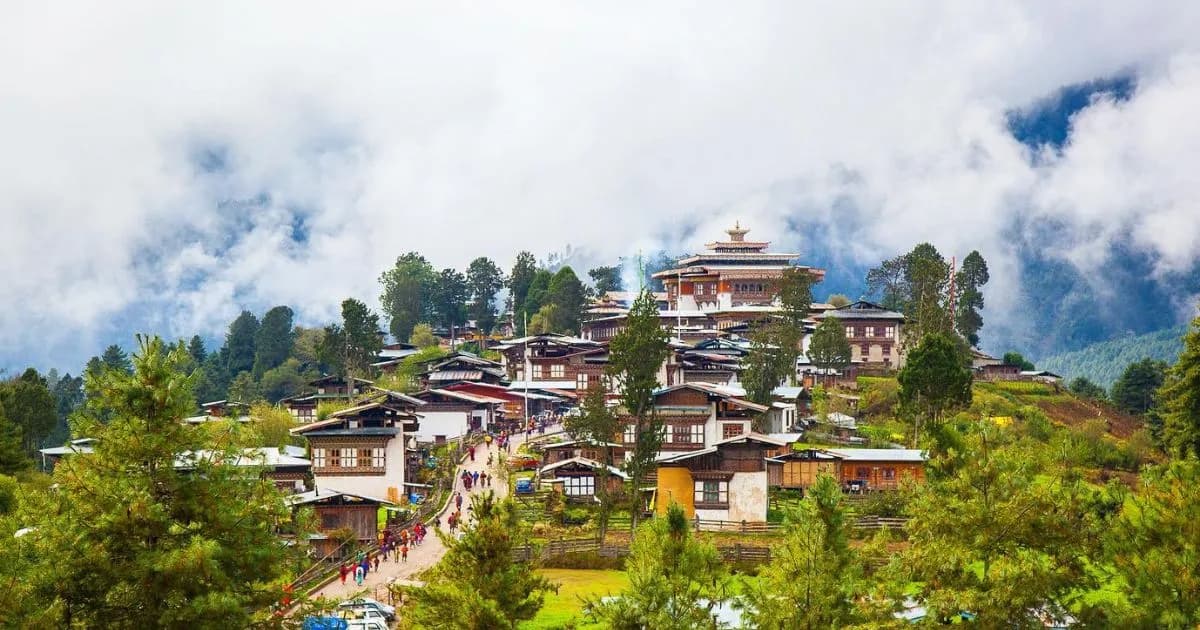
lhakhang · Wangdue Phodrang · 3,000 m · founded 1613
Gangtey Goemba
Gangtey Goemba sits on a hillock overlooking the Phobjikha valley at 3,000 metres elevation. Founded in 1613 by Pema Trinley — the grandson and reincarnation of the great Nyingma terton Pema Lingpa — the goemba is the principal Nyingma monastery of western Bhutan and overlooks the wintering grounds of the black-necked cranes.
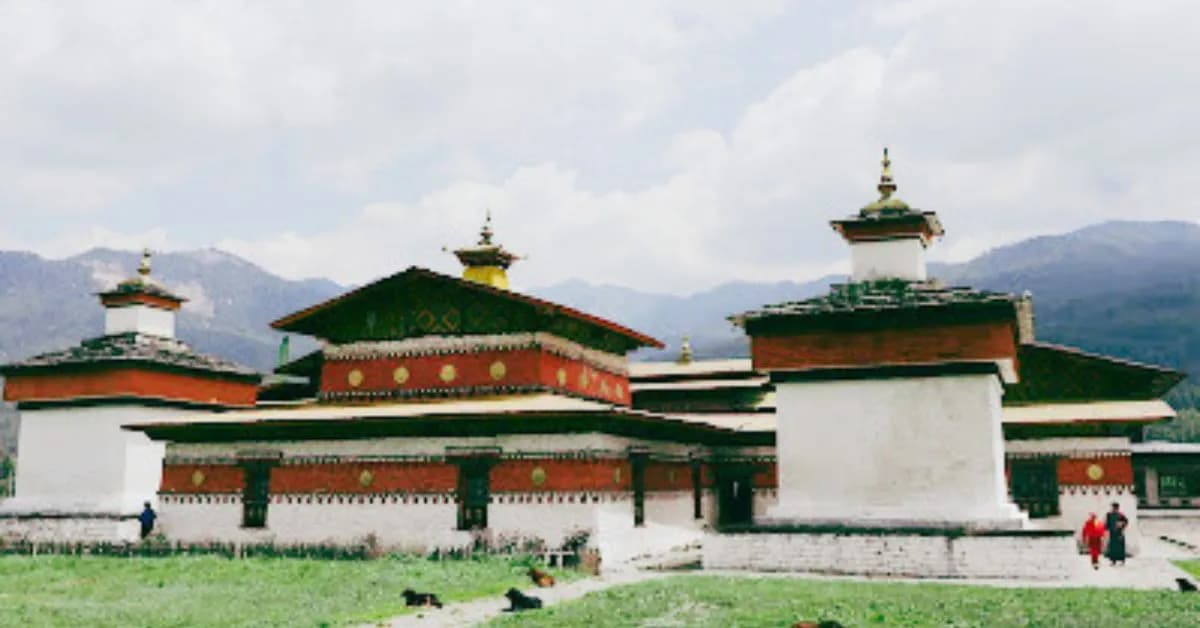
lhakhang · Bumthang · 2,600 m · founded 659
Jambay Lhakhang
Jambay Lhakhang sits in the Choekhor valley of Bumthang at 2,600 metres elevation. Like Kyichu Lhakhang in Paro, it is one of 108 temples built by the Tibetan king Songtsen Gampo in 659 CE — Jambay pinning the left knee of the giant ogress whose body lay across the Himalayan landscape. The temple has been continuously active for over thirteen centuries and is the venue of the famed Jambay Lhakhang Drup with its Mewang fire ritual.
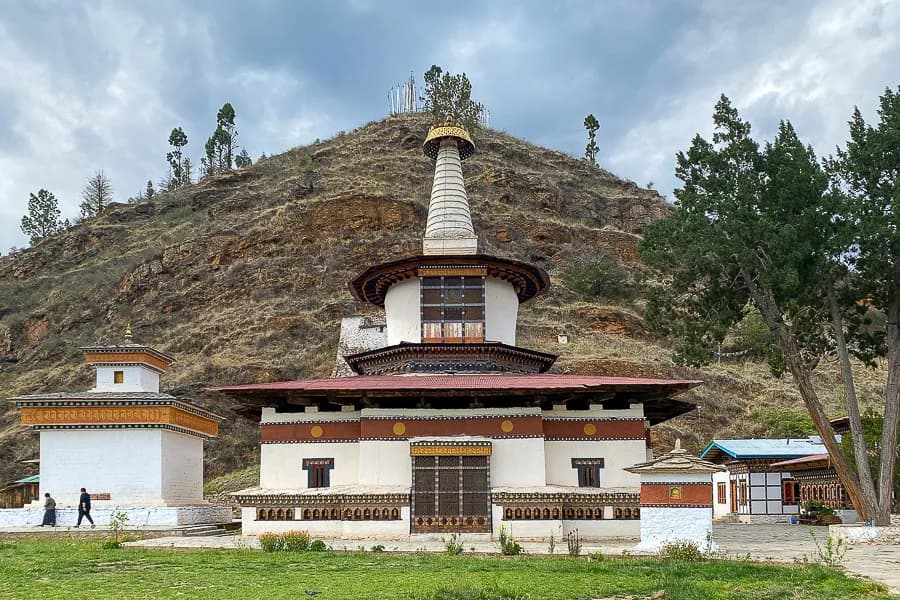
lhakhang · Paro · 2,280 m · founded 1421
Jangtsa Dumtseg Lhakhang
Jangtsa Dumtseg Lhakhang — usually shortened to Dumtseg — is one of the very few temples in Bhutan built in the form of a chorten (a stupa), rising in three diminishing storeys near Paro town. It was founded in the early 15th century, commonly dated 1421, by Thangtong Gyalpo, the great Tibetan adept, engineer, and builder of iron-chain suspension bridges. The three storeys represent ascending realms of Buddhist cosmology, and the interior holds one of the finest surviving collections of lineage and tantric wall paintings in the country — which makes Dumtseg a quiet treasure for visitors with a serious interest in Bhutanese sacred art.
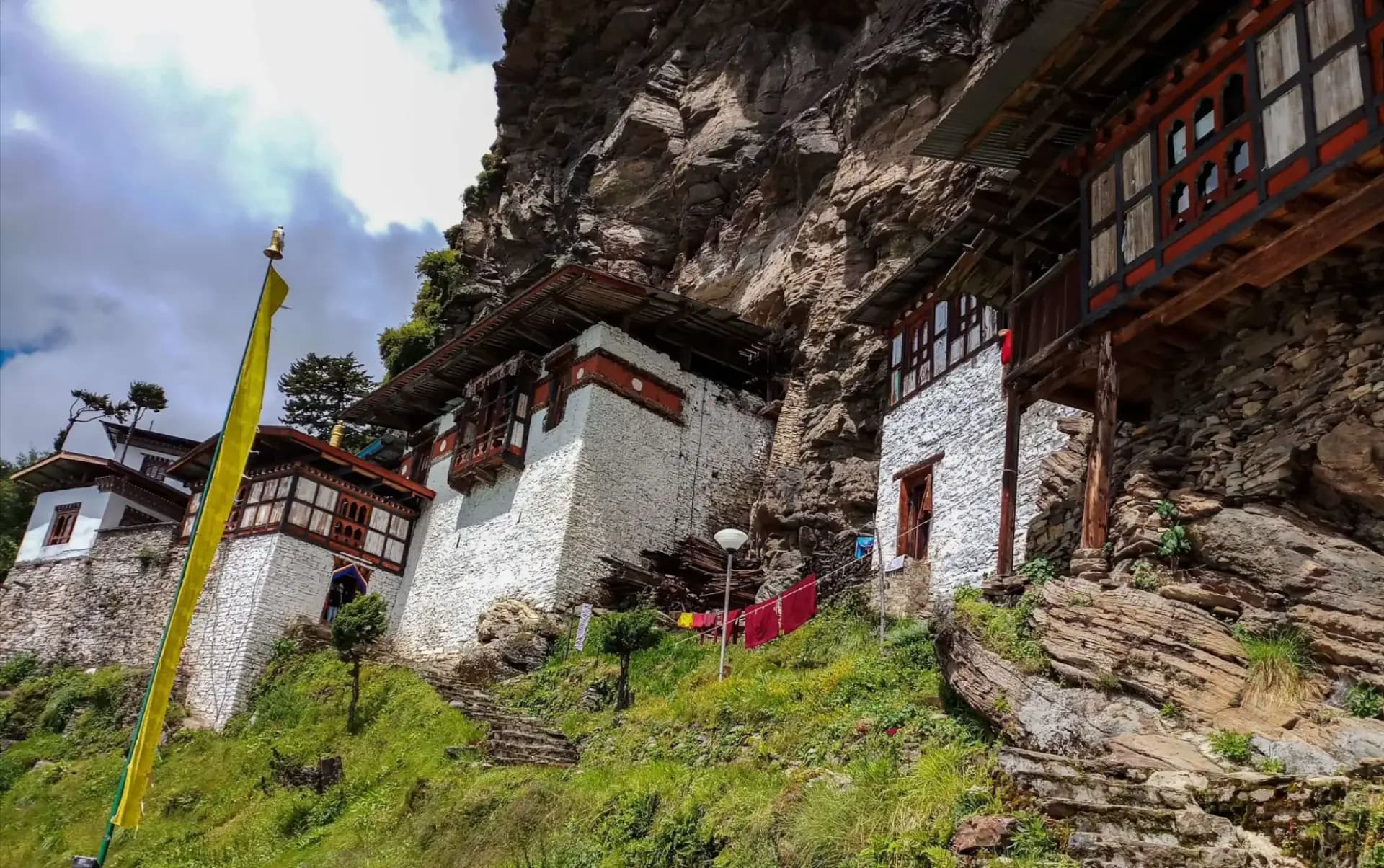
lhakhang · Paro · 3,500 m
Kila Nunnery
Kila Goemba — Kila Nunnery — clings to a series of rock ledges on the mountainside below the Chele La pass, between the Paro and Haa valleys. Among the oldest nunneries in the country, it is home to a community of anim (Buddhist nuns) who live and meditate in the cliff-set retreat huts and shrines. Reached by a forest walk down from the Chele La road, it is one of the most serene and least-visited religious sites within reach of Paro — a place of quiet devotion rather than spectacle.
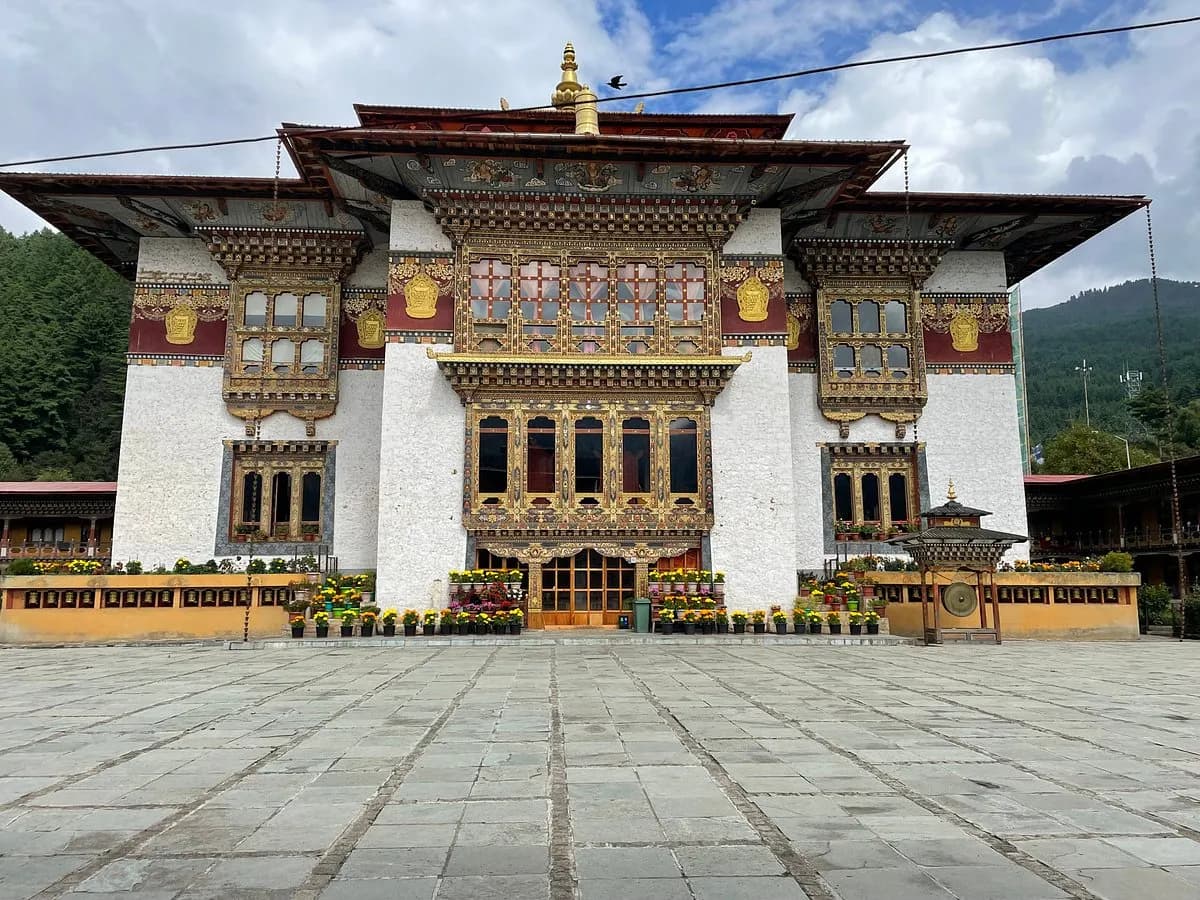
lhakhang · Bumthang · 2,680 m
Konchogsum Lhakhang
Near Jakar in the Choekhor valley of Bumthang stands Konchogsum Lhakhang, among the oldest temples in the region — its origins reaching back to the early spread of Buddhism, later restored and bound to the legend of the Bumthang treasure-revealer Pema Lingpa. Its most famous relic was a great bell, said to have rung so powerfully that its sound was heard all the way in Lhasa, the Tibetan capital. Damaged by fire and carefully rebuilt, the temple remains a place of deep antiquity and devotion, a quiet stop close to the main Bumthang sights for the visitor drawn to the valley's oldest layers.
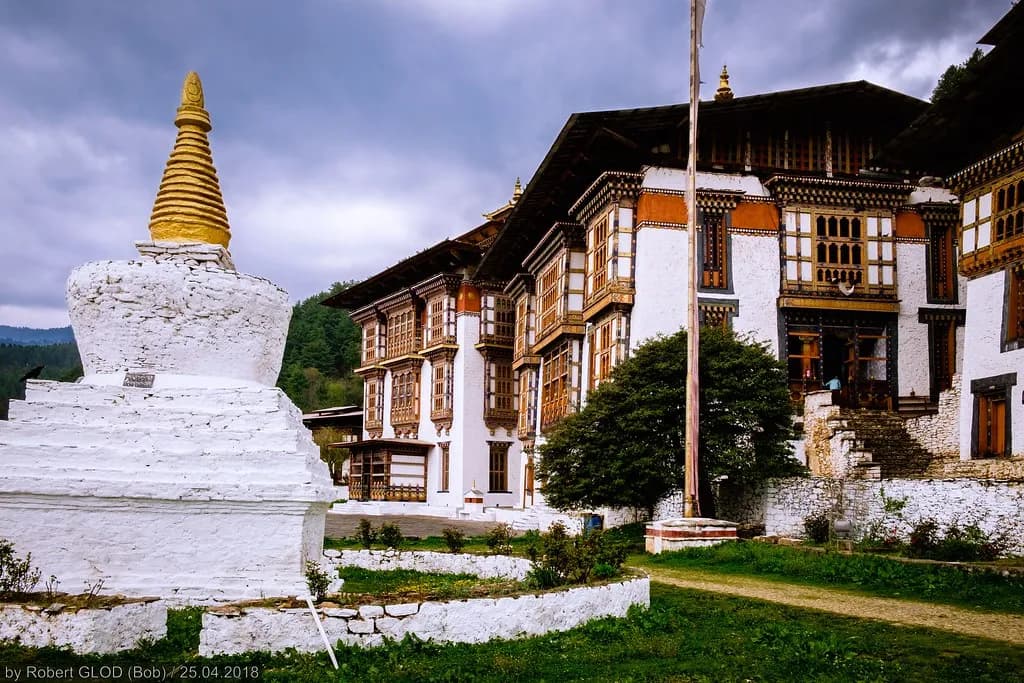
lhakhang · Bumthang · 2,600 m · founded 1652
Kurjey Lhakhang
Kurjey Lhakhang sits in the Choekhor valley of Bumthang at 2,600 metres elevation. The temple complex grew around a cave on the cliff face that Guru Rinpoche is held to have entered in the 8th century, leaving his body imprint (kur jey) on the rock — the impression is still visible inside the principal chapel and remains one of the most-revered devotional sites in the Bhutanese Buddhist tradition.
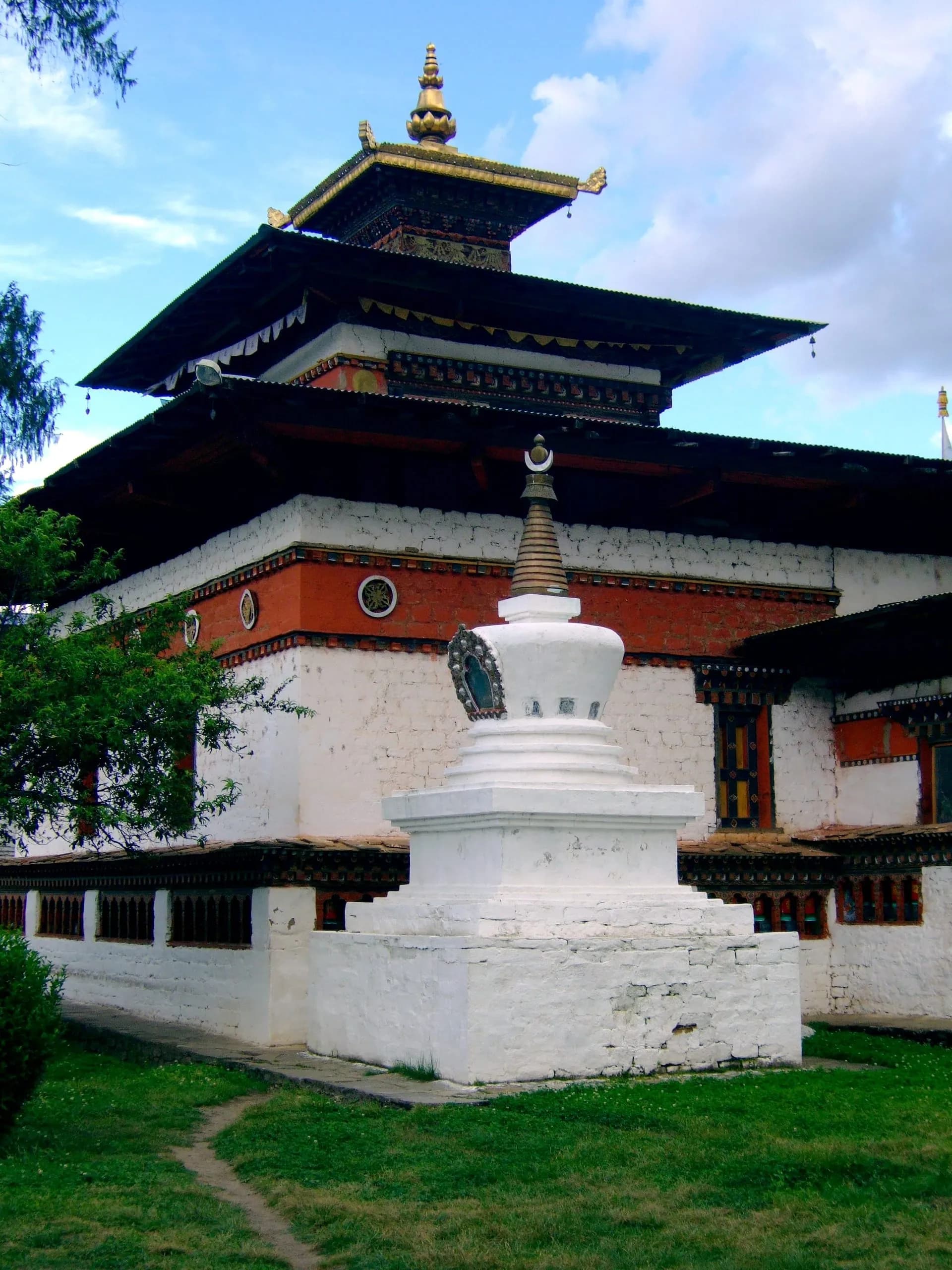
lhakhang · Paro · 2,300 m · founded 659
Kyichu Lhakhang
Kyichu Lhakhang sits in the Paro valley at 2,300 metres elevation — the oldest temple in Bhutan, founded in 659 CE by the Tibetan king Songtsen Gampo as one of 108 temples built across the Himalayan region to pin the limbs of a giant ogress whose body lay across the landscape. The temple has been continuously active for over thirteen centuries.
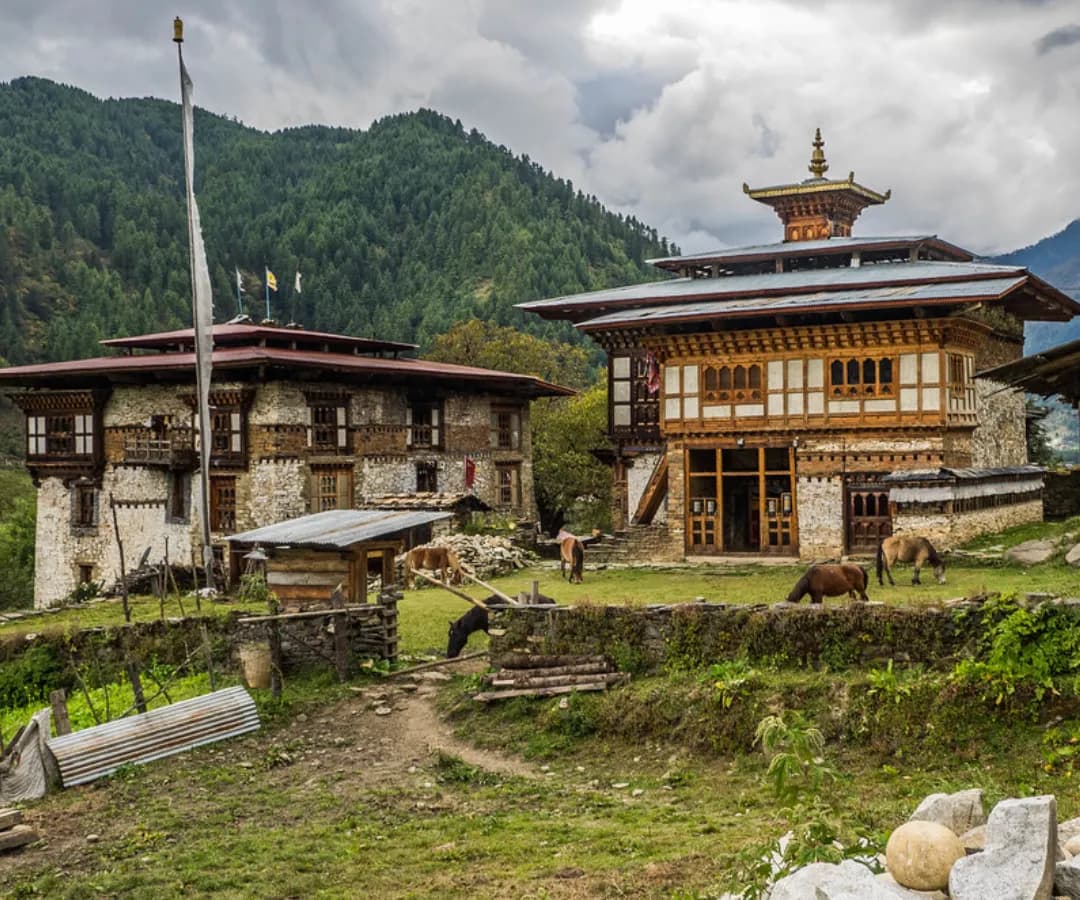
lhakhang · Bumthang · 2,800 m
Ngang Lhakhang
High in the upper Choekhor valley of Bumthang, beyond the farms and the river, stands Ngang Lhakhang — the 'Swan Temple', named for the swans that once frequented the place. Built in the 15th or 16th century on a site sanctified by Guru Rinpoche, it is one of the remote and atmospheric temples of the upper valley, the kind a visitor reaches by a walk through the fields and feels they have earned. Its festival, the Ngang Bi Rabney, fills the quiet temple with masked dance each winter, and it sits at the start of the gentle Bumthang Owl Trek into the hills beyond.
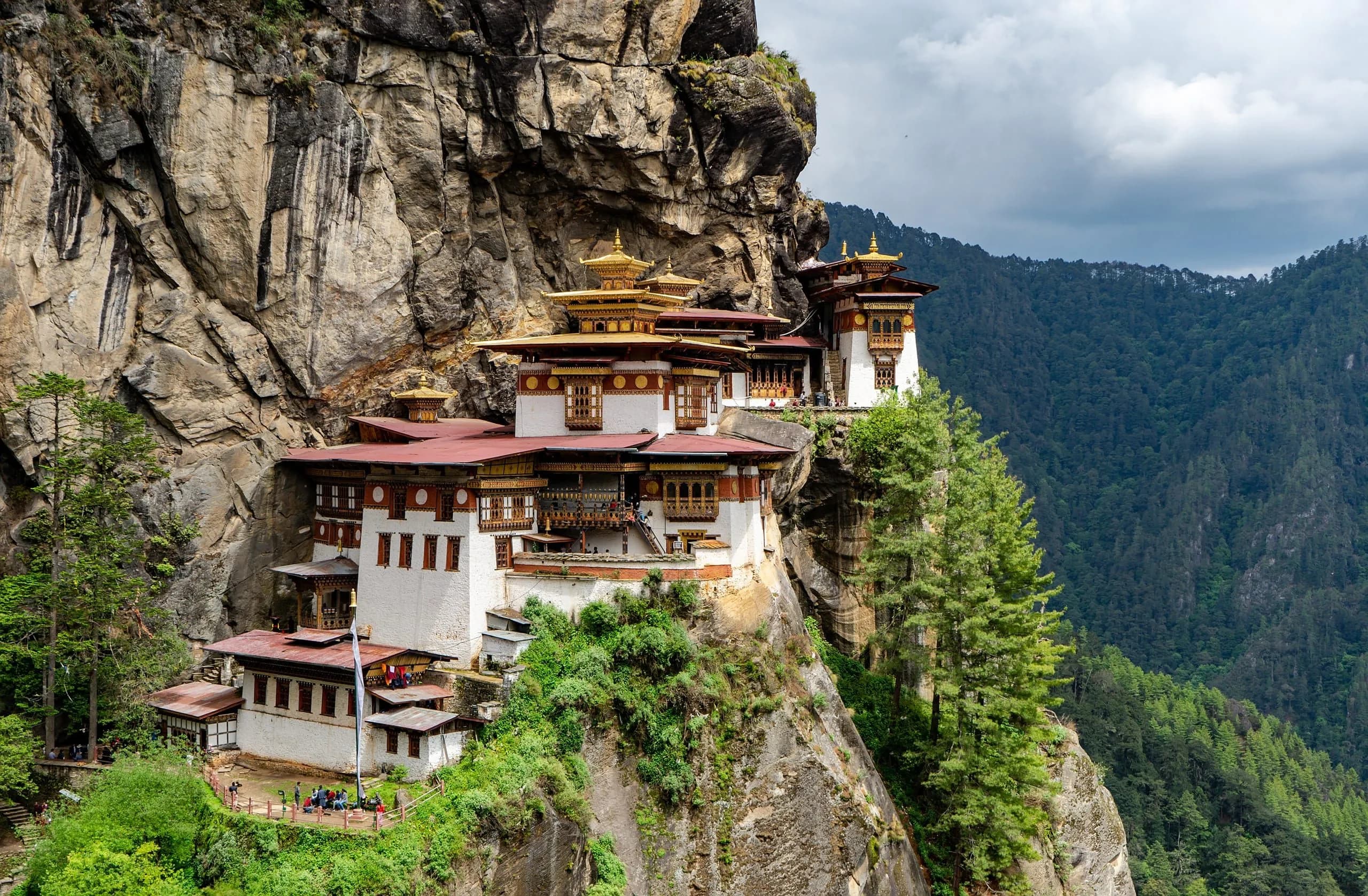
lhakhang · Paro · 3,120 m · founded 1692
Paro Taktsang
Paro Taktsang — known internationally as Tiger's Nest — is the most sacred site in Bhutan and the country's most-photographed monument. The monastery clings to a 900-metre cliff face above the Paro valley at 3,120 metres elevation. Guru Rinpoche is held to have meditated in the cave behind the monastery for three years, three months, three weeks, three days, and three hours in the 8th century.
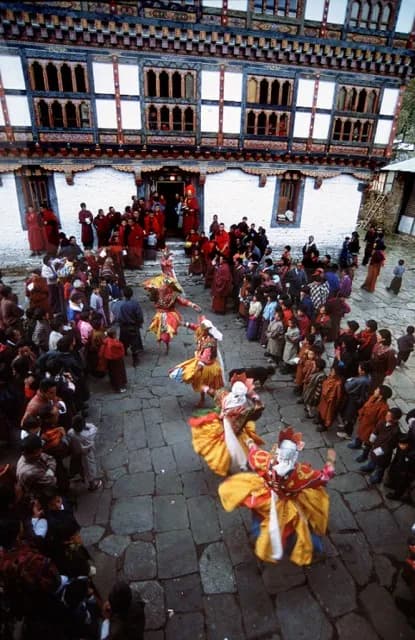
lhakhang · Bumthang · 2,700 m
Prakhar Goemba
On a rise above the Chumey river in Bumthang, the warm ochre walls of Prakhar Goemba — Prakhar Lhakhang — stand among the fields, a temple founded in the 16th century by a descendant of the great treasure-revealer Pema Lingpa. Its distinctive earth-red colour sets it apart from the usual whitewashed temples, and its annual festival, the Prakhar Duchhoed, is one of the loved village celebrations of the Chumey valley, drawing the surrounding farms to its courtyard each autumn. Close to the weaving village of Zugney, it is a quiet, atmospheric stop in the gateway valley of Bumthang.
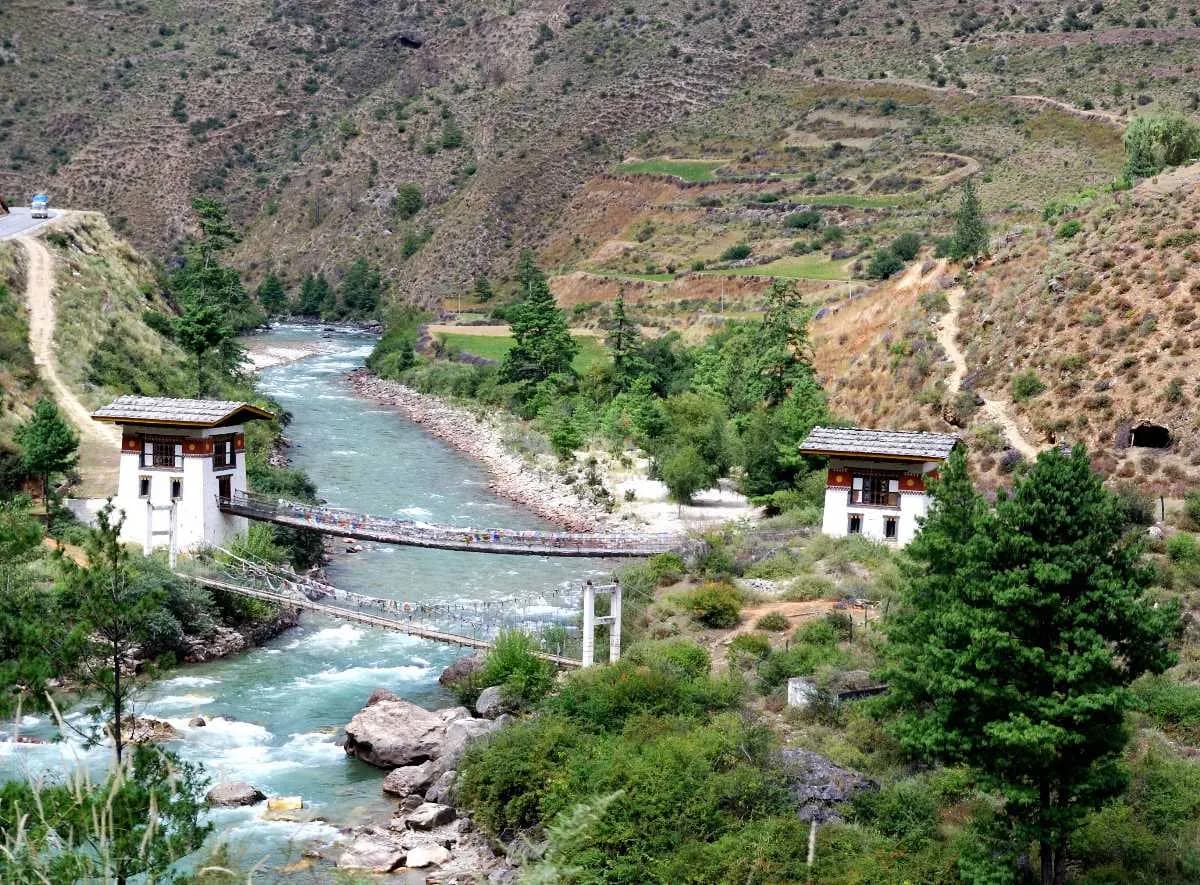
lhakhang · Paro · 2,150 m
Tachogang Lhakhang
On the road between Paro and Thimphu, where the river runs in a gorge, an iron-chain suspension bridge hung with prayer flags crosses the water to the Tachogang Lhakhang on the far bank — a temple founded by Thangtong Gyalpo, the 15th-century saint, physician, and engineer who strung iron bridges across the rivers of the Himalaya. He is said to have raised the temple after a vision of Avalokiteshvara on a hill shaped like a horse, which gave the place its name. To cross the swaying chain bridge to the temple is to walk, in living form, into one of the most remarkable engineering and spiritual legacies in Bhutan.
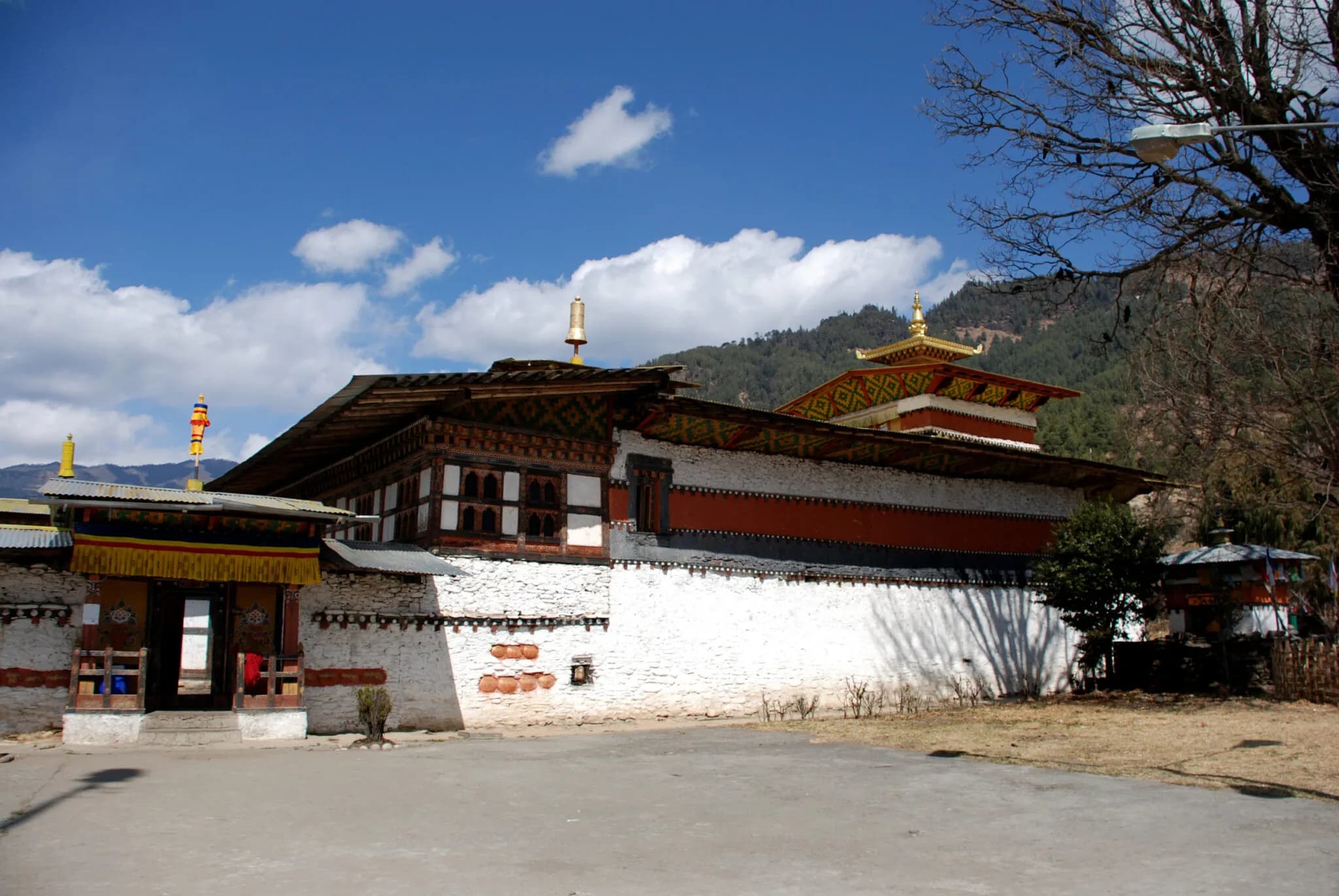
lhakhang · Bumthang · 2,600 m · founded 1501
Tamshing Lhakhang
Tamshing Lhakhang sits in the Choekhor valley of Bumthang at 2,600 metres elevation, across the Chamkhar Chhu from Jakar Dzong. The monastery was founded in 1501 by Pema Lingpa — one of the five sovereign tertons of the Nyingma tradition — as his principal seat. The Royal Family of Bhutan traces ancestry through Pema Lingpa's descendants, and the monastery holds a continuous lineage through more than five centuries.
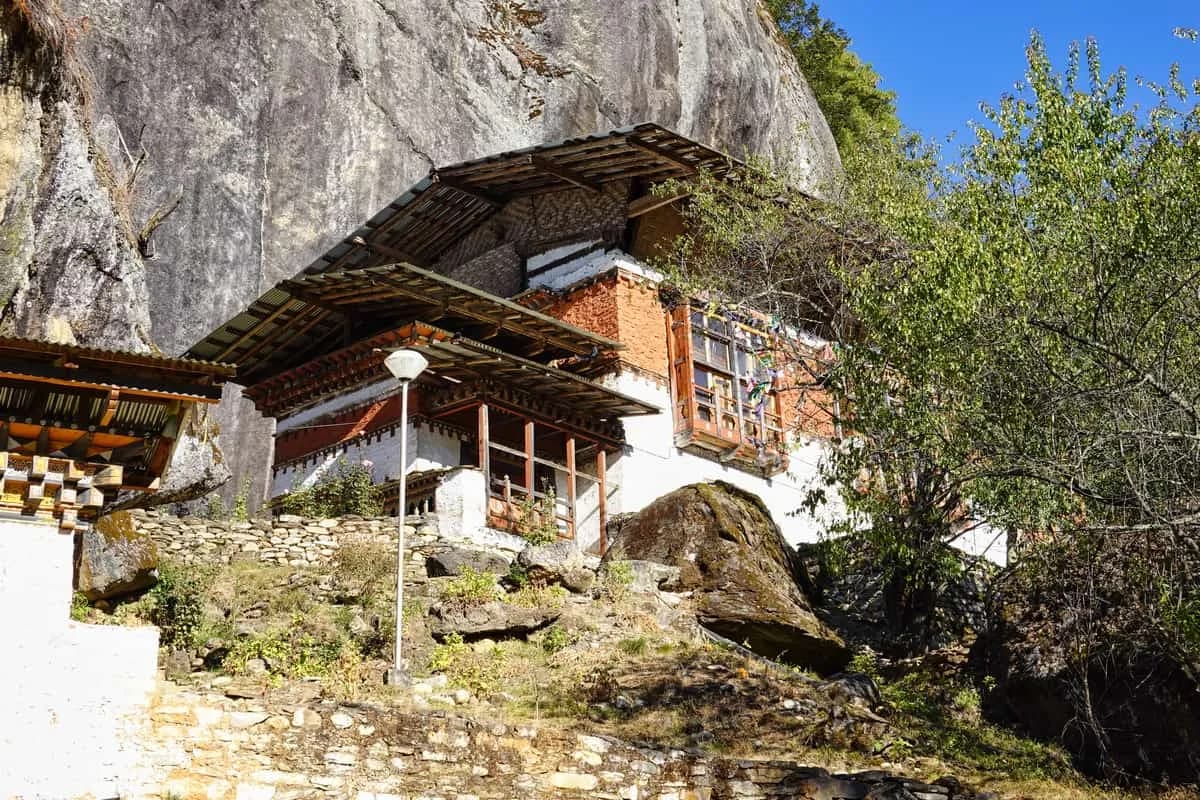
lhakhang · Bumthang · 2,840 m
Tang Rimochen Lhakhang
In the remote Tang valley of Bumthang, Tang Rimochen Lhakhang stands against a great rock face streaked with natural markings — 'Rimochen' means 'the one with marks', and the stripes are read as the print of the tiger-skin robe of Guru Rinpoche, who meditated here in the 8th century. The temple, associated with the treasure-revealer Pema Lingpa, marks one of the valley's most sacred sites, and below it, set in and beside the river, are boulders bearing what the faithful hold to be the body imprints of Guru Rinpoche and his consorts. It is a place of pilgrimage and quiet power rather than grandeur.
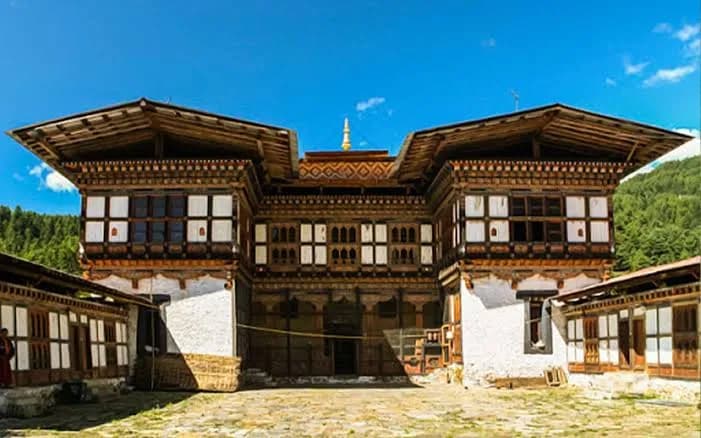
lhakhang · Bumthang · 2,700 m · founded 1470
Thangbi Lhakhang
North of Kurjey Lhakhang in the Choekhor valley of Bumthang, across the Chamkhar river and among the fields, Thangbi Lhakhang is a serene 15th-century temple founded by a master of the Karma Kagyu tradition and later linked to the great Bumthang treasure-revealer Pema Lingpa. It is best known for its winter festival, the Thangbi Mani, which culminates in a fire-blessing — the worshippers running through a gateway of flame to be cleansed of the year's misfortune. A quiet, old, and atmospheric temple away from the busier Bumthang sights, it rewards the visitor who reaches it.
Monasteries & goembas7
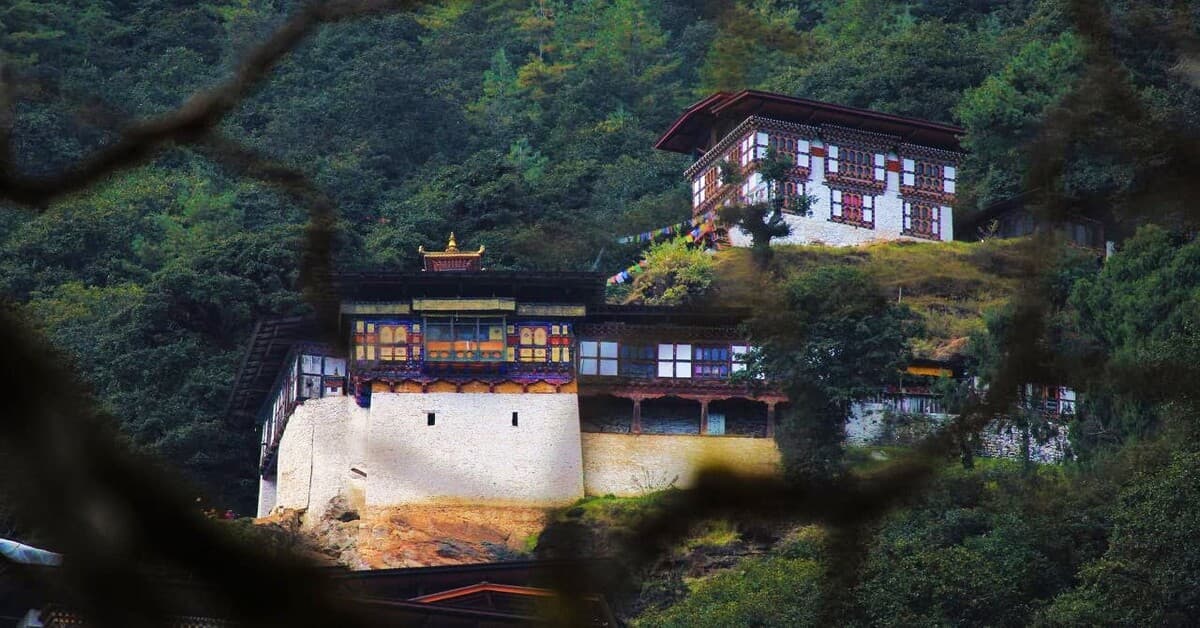
monastery · Thimphu · 2,850 m · founded 1620
Cheri Goemba
Cheri Goemba — Chagri Dorjeden — sits high on a forested hillside at the northern head of the Thimphu valley, reached by a walk up from the valley floor across a covered bridge over the rushing Thimphu Chhu. It was here, in 1620, that Zhabdrung Ngawang Namgyal established the first organised monastic community of Bhutan — the seed of the central monk body that endures to this day. A working retreat monastery still, where monks undertake the traditional three-year meditation, Cheri rewards the visitor who is willing to climb with one of the most serene and historically resonant settings within reach of the capital.
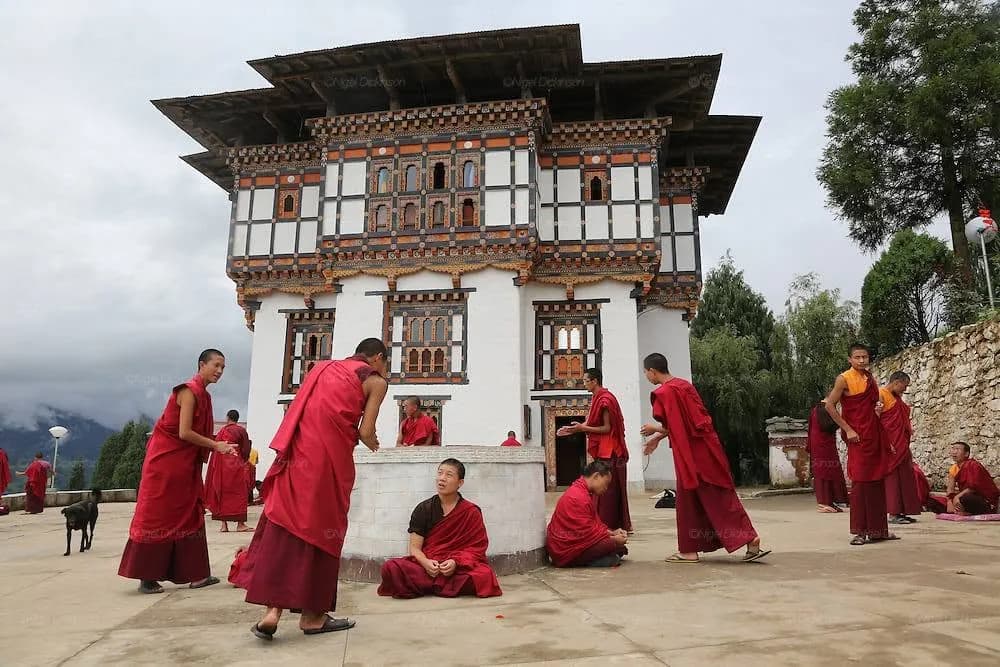
monastery · Punakha · 1,600 m · founded 1757
Nalanda Buddhist Institute
On a quiet ridge above the Punakha valley stands the Nalanda Buddhist Institute — Daley Goenpa — a monastic college founded in the 18th century by Bhutan's ninth Je Khenpo, Shakya Rinchen, and named for the great Nalanda university of ancient India, the fountainhead of Buddhist learning. It is a working shedra, where young monks pursue the long course of philosophical study, set in a peaceful, little-visited spot away from the valley's busier sights. For visitors drawn to the scholarly tradition of Bhutanese Buddhism — and to the quieter corners of the Punakha countryside — it is a rewarding and serene stop.
monastery · Thimphu · 2,420 m · founded 1529
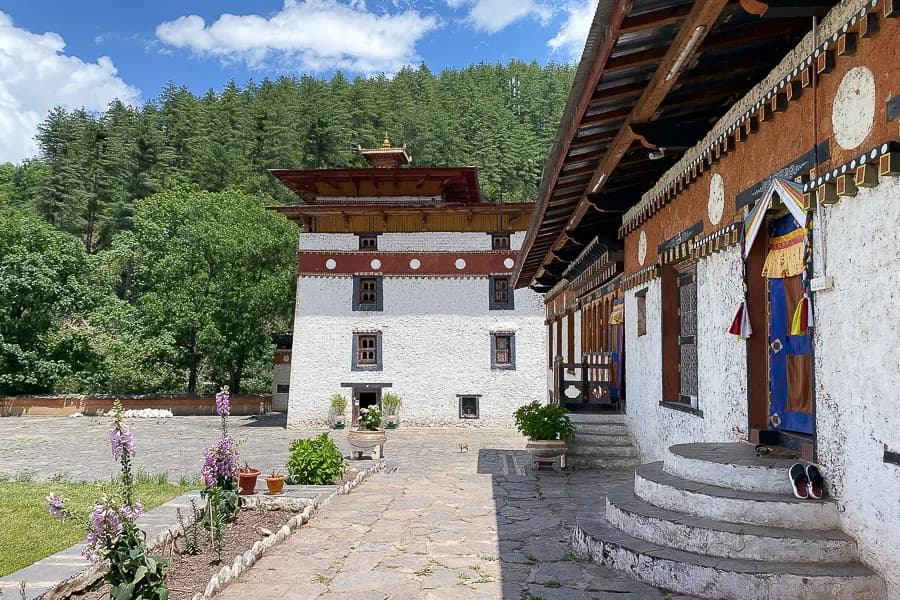
Pangri Zampa
North of Thimphu, beyond Dechencholing on the way up the valley, two tall cypress trees mark Pangri Zampa — a monastery founded in the early 16th century, and the place where, by prophecy, Zhabdrung Ngawang Namgyal is said to have first settled on arriving in Bhutan. Today it is the country's principal college of astrology, where young monks train for years in the intricate Bhutanese system of astrological calculation that still governs the timing of weddings, journeys, ceremonies, and the naming of children. A visitor finds a quiet riverside monastery and a living tradition of cosmic reckoning that shapes Bhutanese life to this day.
monastery · Thimphu · 3,600 m
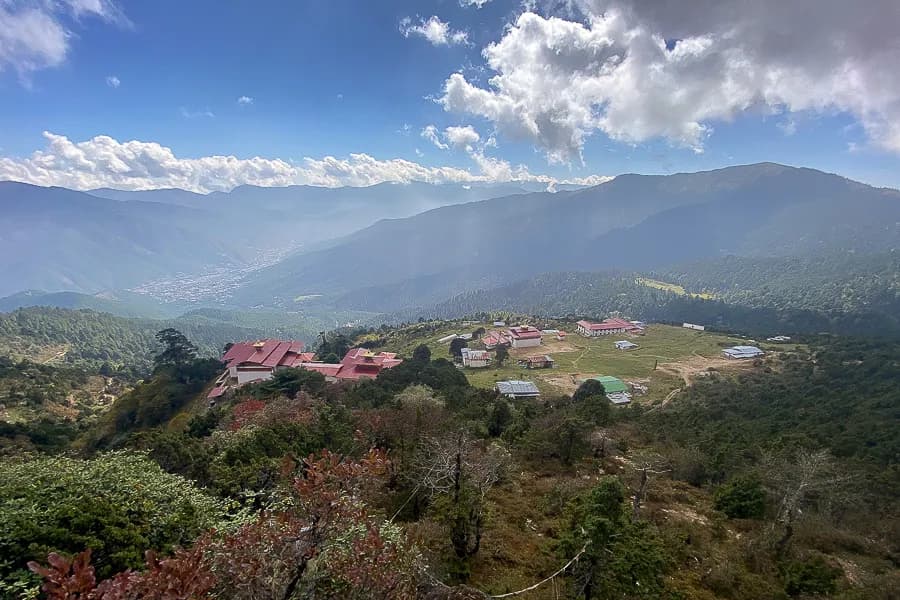
Phajoding Goemba
High on the mountainside above Thimphu, at around 3,600 metres, Phajoding is a scattered cluster of temples, shrines, and meditation retreats — once among the wealthiest monasteries in the country, named for Phajo Drukgom Zhigpo, the master who brought the Drukpa Kagyu tradition to Bhutan and meditated on this slope. Reached only by a steady climb of several hours through blue-pine and rhododendron forest, it rewards the walker with one of the great views over the Thimphu valley, the quiet of a working retreat far above the city, and the sense of a place where serious practice has been carried on for centuries. It is the capital's classic day hike, and a fine gentle taste of trekking.
monastery · Punakha · 2,800 m
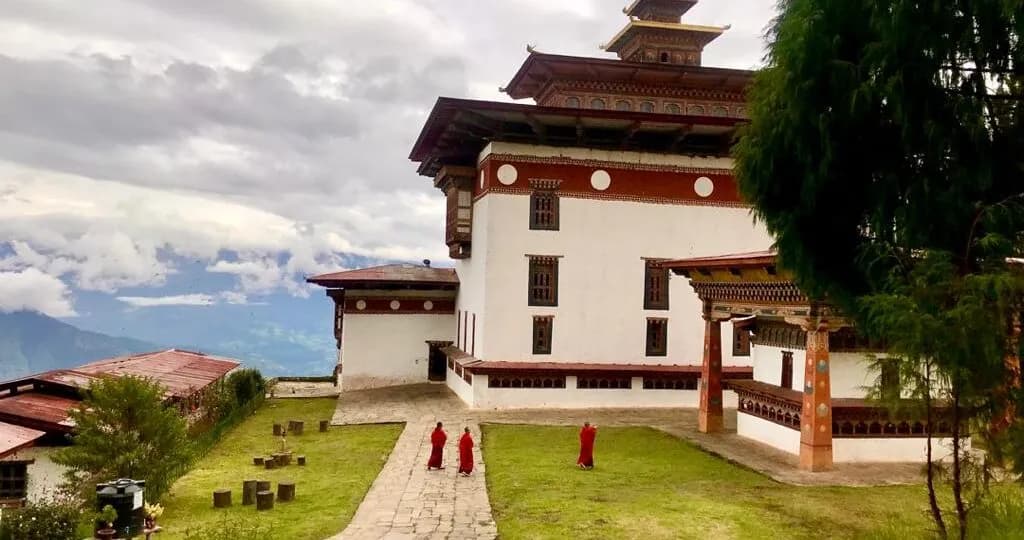
Talo
Talo sits high on a terraced shoulder above the Punakha valley, at around 2,800 metres — a village long admired across Bhutan for its order and cleanliness, its houses and fields arranged in neat steps up the hillside, with the Talo Sangngacholing monastery crowning the ridge above. The air is cool and clear after the warm valley floor, the views run for miles down the Punakha and Wangdue valleys, and the pace is entirely rural. Talo is the quiet, pastoral counterpoint to the grand dzong below: a place to walk, to see ordinary Bhutanese hill life, and to take in one of the great valley panoramas.
monastery · Thimphu · 2,920 m · founded 1222
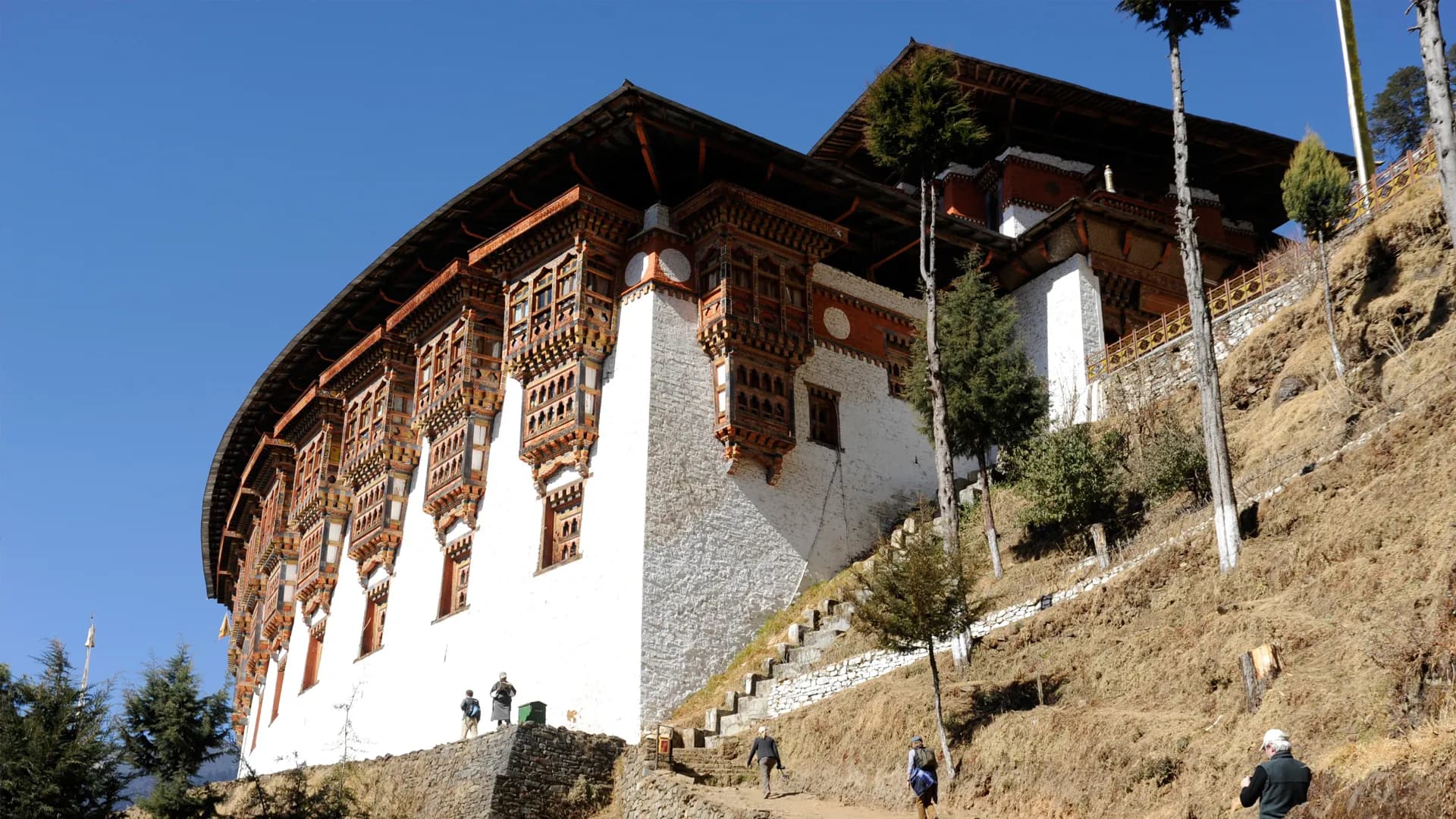
Tango Goemba
Tango Goemba stands on a forested spur at the northern head of the Thimphu valley, across the river from Cheri — the principal seat of higher Buddhist study in Bhutan, where monks undertake the long years of philosophical training. Its name means 'horse head', for the self-manifested image of Hayagriva, the horse-headed wrathful form of Chenrezig, around which the monastery grew. Founded in the 13th century by Lama Phajo Drukgom Zhigpo and rebuilt in its present form in the 15th, Tango is reached by a forest climb and carries a particular weight as a place of deep study and of royal retreat.
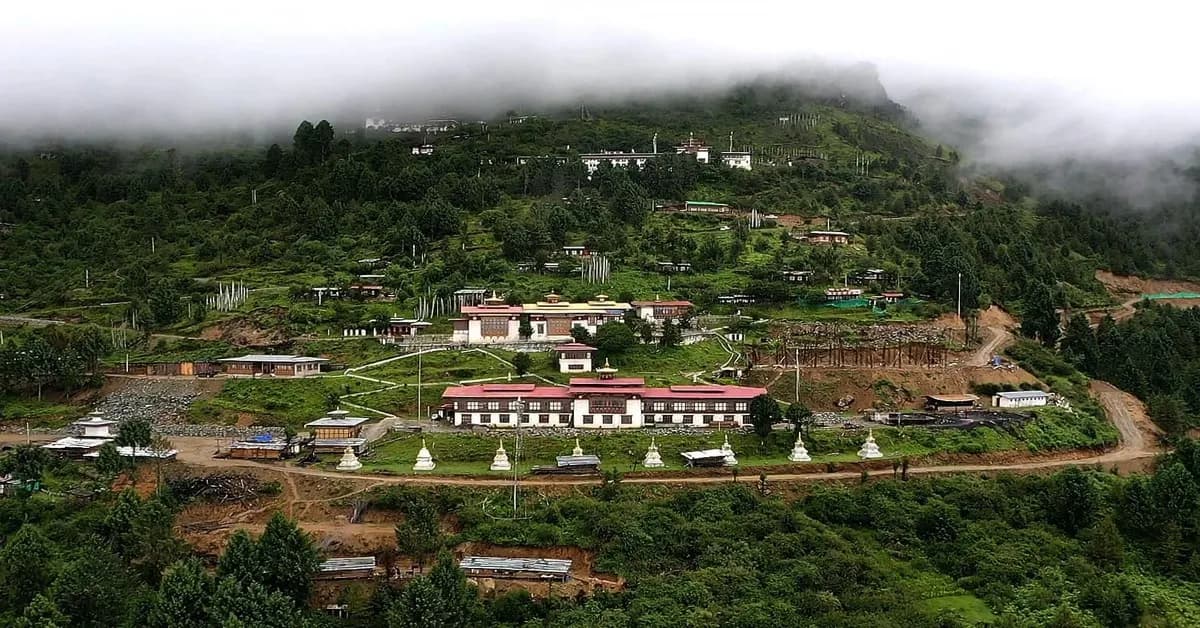
monastery · Bumthang · 3,600 m
Tharpaling Monastery
High on the mountainside above the Chumey valley of Bumthang, at around 3,600 metres, Tharpaling is one of the principal Nyingma monasteries of Bhutan — the seat established by Longchen Rabjam, the towering 14th-century master known as Longchenpa, who meditated, wrote, and taught here during his years in the country. A large and active monastic community still studies on the slope, the white buildings stepping up the mountain beneath the peak, with the whole Chumey valley falling away below. For visitors drawn to the contemplative tradition and the high places, Tharpaling is among Bumthang's most rewarding and least-crowded sites.
Stupas & chortens4
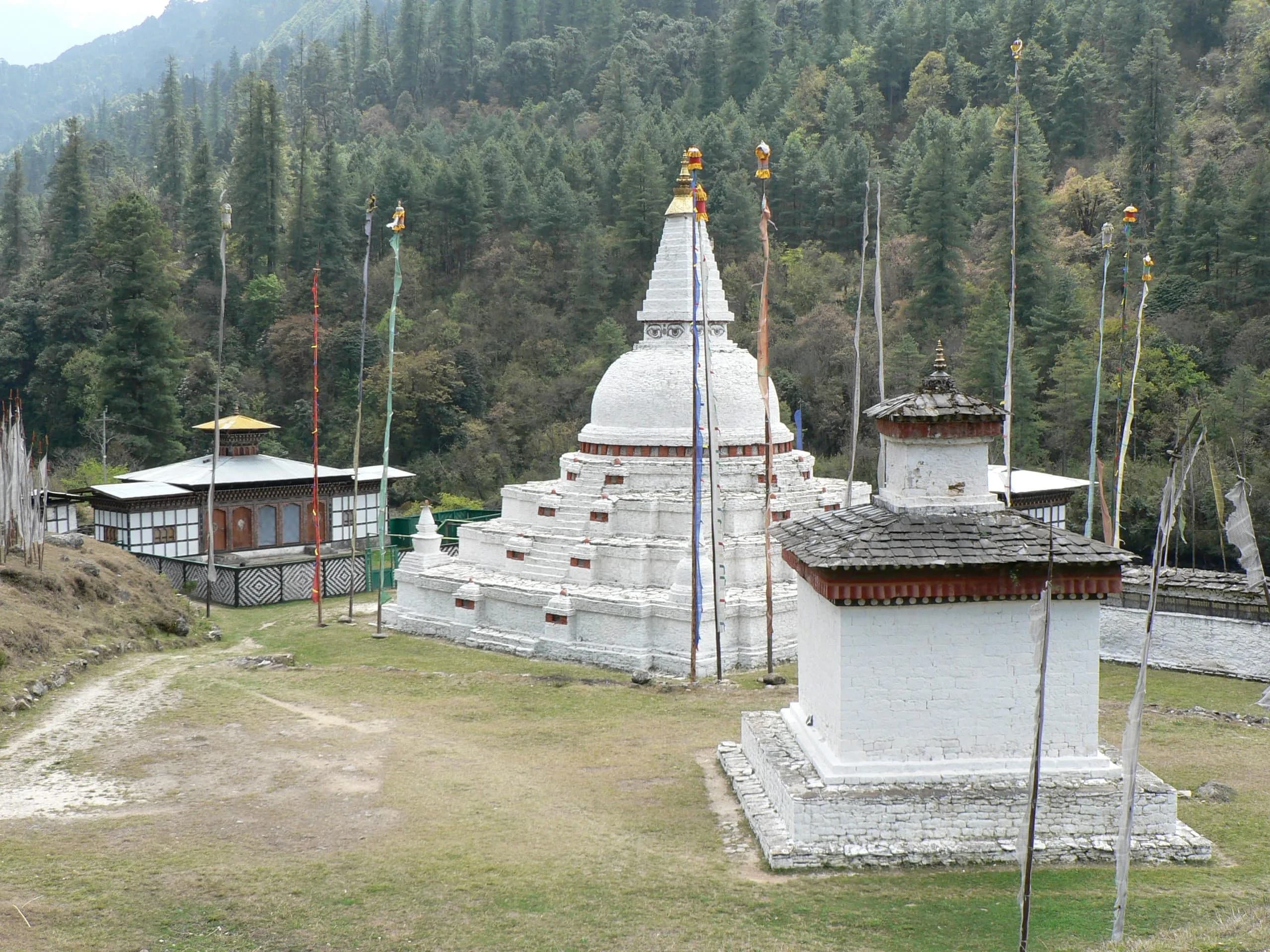
stupa · Trongsa · 2,400 m
Chendebji Chorten
On the long, lonely road between Pele La and Trongsa, where a river runs through a fold of the hills, the white dome of Chendebji Chorten rises beside the water — a large stupa built in the style of Boudhanath in Kathmandu, its tower painted on all four sides with the watchful eyes of the Buddha. Raised in the 18th or 19th century to subdue a demon that troubled the spot, it is the great landmark of the central highway, a place every traveller pauses, and one of the few stupas in Bhutan built in the distinctive Nepali form rather than the local Bhutanese one.
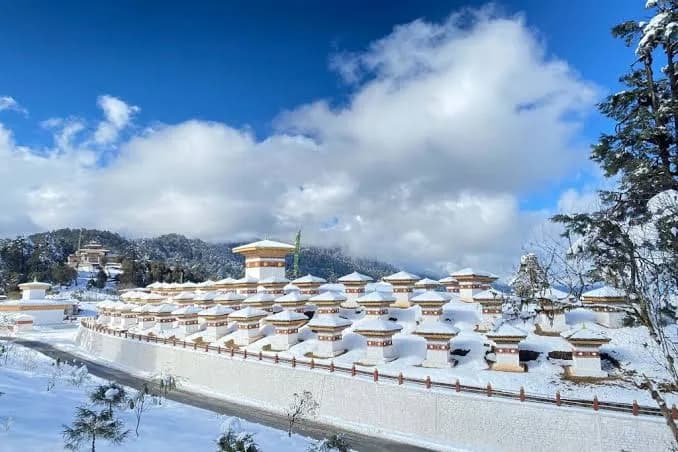
stupa · Thimphu · 3,100 m · founded 2003
Dochu La
Dochu La sits at 3,100 metres on the road between Thimphu and Punakha — the principal mountain pass of the western Bhutanese drive. The pass is marked by 108 small chortens (the Druk Wangyel Chortens) built in 2003 under the patronage of Her Majesty the Queen Mother Ashi Dorji Wangmo Wangchuck, and on clear winter mornings the panorama of the eastern Himalaya — Masagang, Tsendagang, Gangkhar Puensum, Chomolhari — is among the most-photographed Himalayan vistas accessible by road.
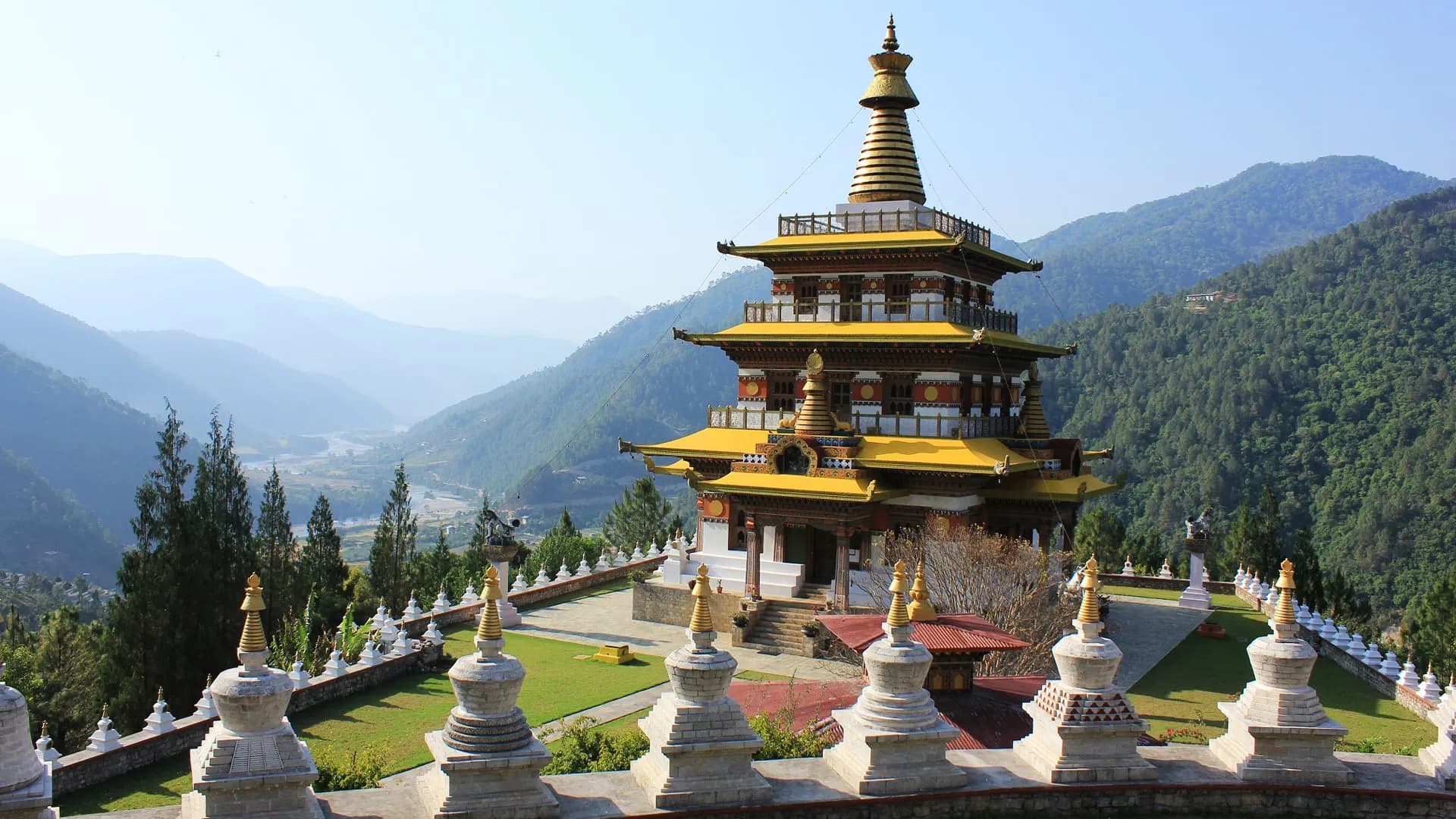
stupa · Punakha · 1,500 m · founded 1999
Khamsum Yulley Namgyal Chorten
Khamsum Yulley Namgyal Chorten sits on a hillside above the Mo Chhu valley, north of Punakha town. The four-storey chorten was built between 1992 and 1999 by Her Majesty the Queen Mother Ashi Tshering Yangdon Wangchuck (one of His Majesty the Fourth Druk Gyalpo's queens) and is dedicated to the long life of His Royal Highness the then-Crown Prince Jigme Khesar Namgyel Wangchuck (now His Majesty the Fifth Druk Gyalpo). The walk up to the chorten takes about 45-60 minutes through rice paddies and pine-and-oak forest; the view from the top is one of the most-photographed Punakha valley panoramas.
stupa · Thimphu · 2,360 m · founded 1974
National Memorial Chorten
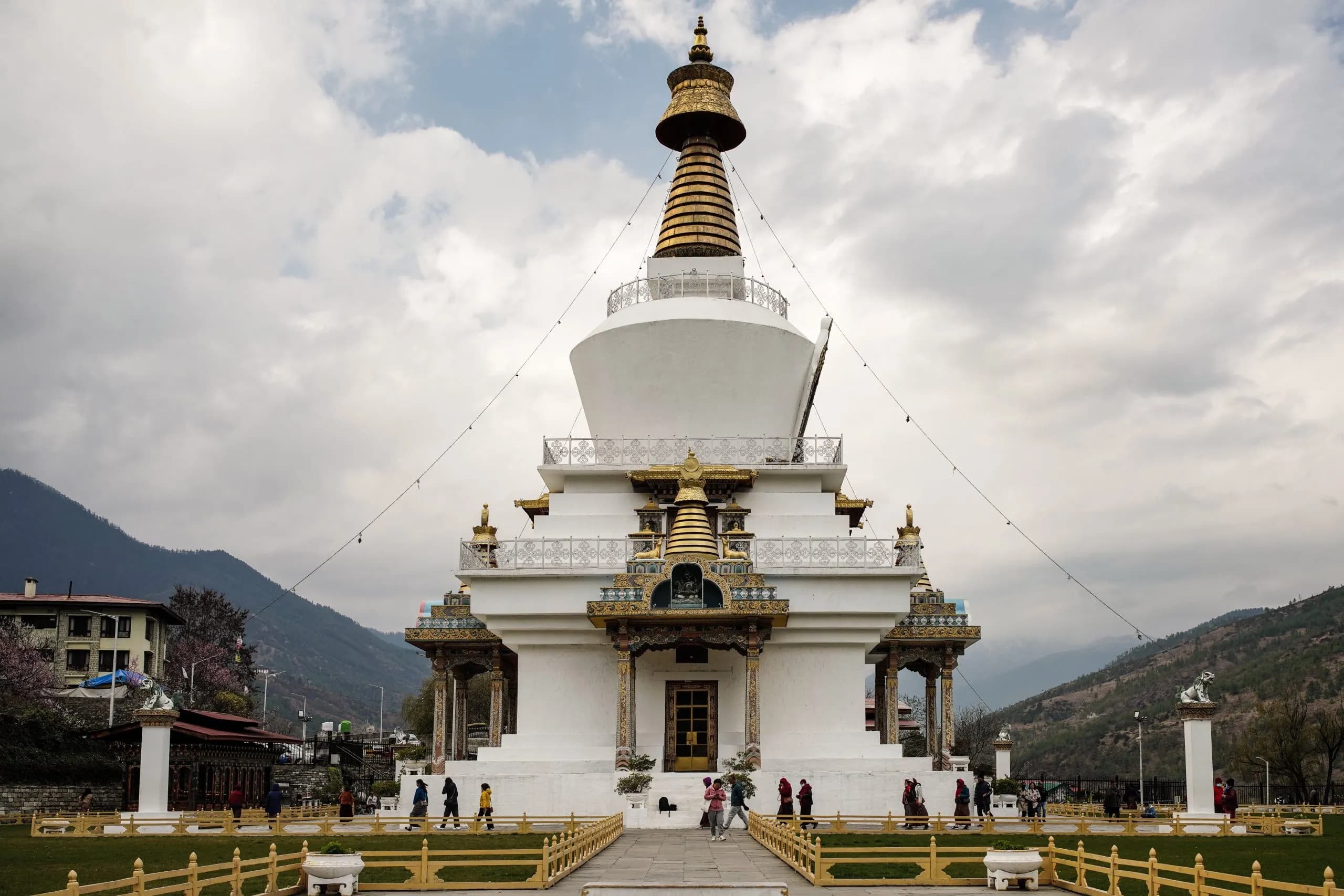
The National Memorial Chorten sits in central Thimphu at 2,360 metres elevation — a tall whitewashed chorten built in 1974 in memory of His Majesty Druk Gyalpo Jigme Dorji Wangchuck (the 3rd King, 1928–1972), known as the Father of Modern Bhutan. The chorten is the principal civic-religious monument of the capital and one of the most-attended pilgrimage sites in the country.
Palaces5
palace · Thimphu · 2,400 m · founded 1952
Dechencholing Palace
Dechencholing Palace sits at Kashinang, on the north side of Thimphu valley about ten kilometres from the city centre. Built from 1952 onward by His Majesty the Third Druk Gyalpo Jigme Dorji Wangchuck — alongside the broader institutional move of the Bhutanese capital from Bumthang to Thimphu — it is the principal contemporary royal-family residence and the operational base of the Wangchuck dynasty across the post-1952 period. The palace is not routinely open to visitors; the surrounding Kashinang grounds are part of the contemporary royal-family register.
palace · Bumthang · 2,700 m · founded 1937
Domkhar Tashicholing Palace
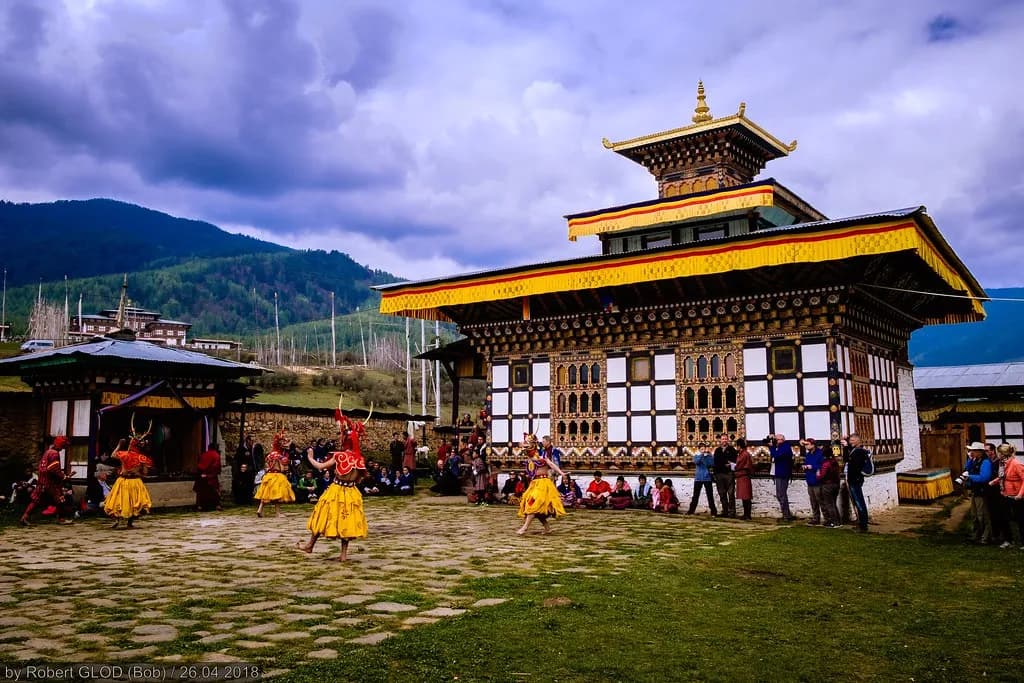
In the Chumey valley of Bumthang, the red-roofed Domkhar Tashicholing Palace was built in 1937 by His Majesty the Second Druk Gyalpo Jigme Wangchuck as one of his summer residences — a graceful royal house set among the fields and pines, with the architecture of a Bhutanese palace at its most refined. One of several residences His Majesty raised across the central valleys during his long reign, it carries the atmosphere of the early Wangchuck court, when the kings governed from the Bumthang heartland. The palace is a heritage building, viewed from its grounds, on the drive into the Bumthang valleys.
palace · Trongsa · 1,800 m · founded 1929
Kuenga Rabten Palace
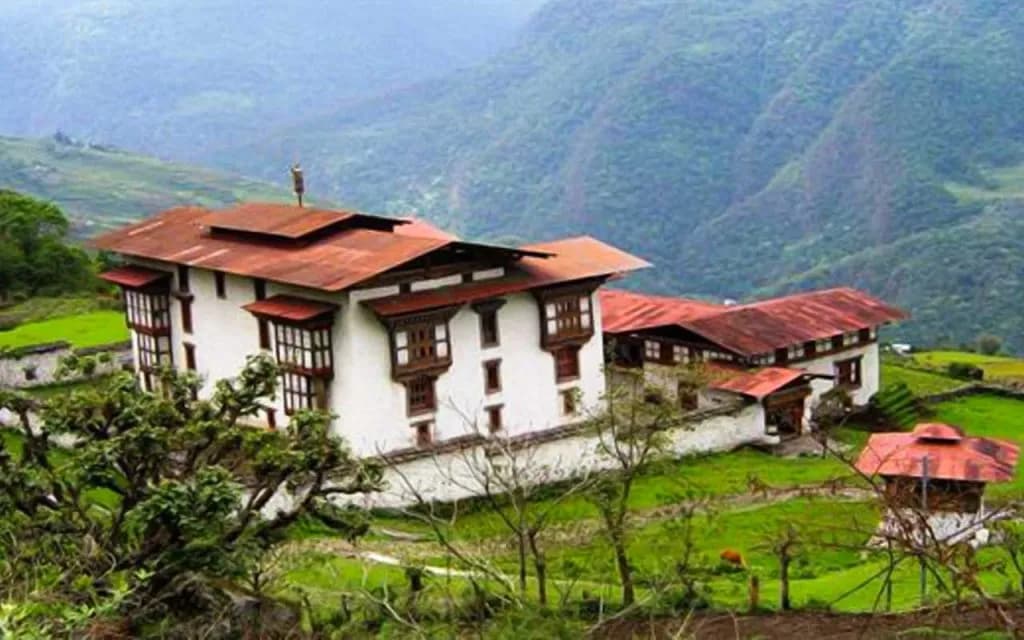
Kuenga Rabten Palace sits at 1,800 metres on a ridge above the Mangde Chhu river, about 23 kilometres south of Trongsa Dzong. Built across the 1930s by His Majesty the Second Druk Gyalpo Jigme Wangchuck as His winter palace — the lower altitude offered a milder cold-season retreat than the higher Bumthang valleys — Kuenga Rabten became His Majesty's favoured residence in the final two decades of His reign. His Majesty passed away at Kuenga Rabten in March 1952. The palace is now a heritage site under conservation by the Department of Culture and one of the more atmospheric historical-palace visits in central Bhutan.
palace · Trongsa · 2,200 m · founded 1924
Thruepang Palace
Thruepang Palace sits on the ridge below Trongsa Dzong, looking out over the Mangde Chhu gorge in the central Bhutanese region. Built across the 1920s by His Majesty the Second Druk Gyalpo Jigme Wangchuck as a Trongsa-anchor royal residence, the palace is principally remembered as the birthplace of Crown Prince Jigme Dorji Wangchuck on 2 May 1928 — the future His Majesty the Third Druk Gyalpo. The palace operates today as a heritage site under conservation by the Department of Culture and is part of the broader Trongsa cultural visit.
palace · Bumthang · 2,700 m · founded 1857
Wangduecholing Palace
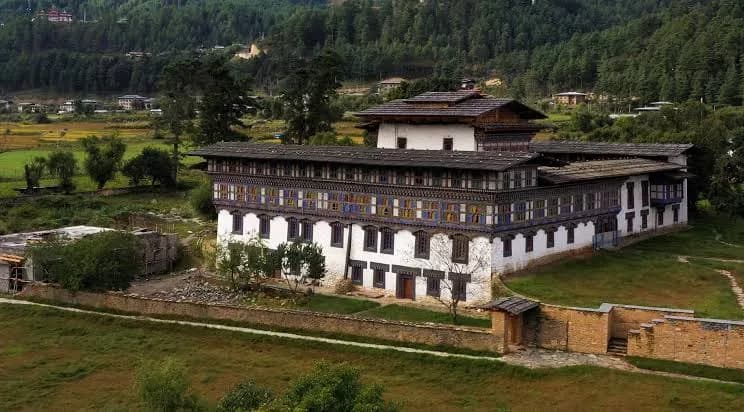
Wangduecholing Palace in the Chhume valley of Bumthang is the principal pre-monarchy royal residence of the Wangchuck-dynastic-line. Built in 1857 by Trongsa Poenlop Jigme Namgyel — the Black Regent and architect of united Bhutan — on the very battlefield where He had defeated Tsondrue Gyaltshen the same year, the palace was the birthplace of His Majesty the First Druk Gyalpo Ugyen Wangchuck (1862) and the principal residence of His Majesty the Second Druk Gyalpo Jigme Wangchuck across His twenty-six-year reign. The palace is the canonical physical anchor of the Wangchuck dynastic story.
Museums & institutes9
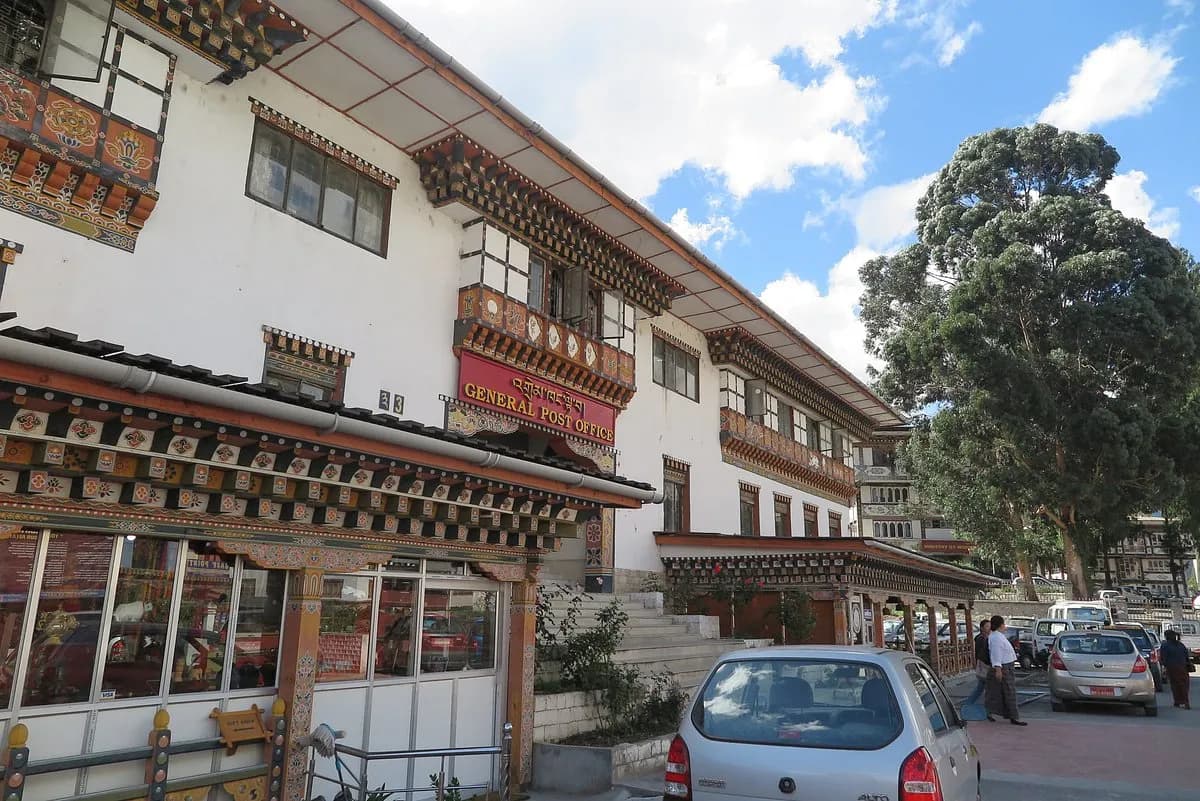
museum · Thimphu · 2,330 m
The Bhutan Postal Museum
In the heart of Thimphu, beside the main post office, the Bhutan Postal Museum tells the unlikely and charming story of how a once-isolated Himalayan kingdom built its links to the world — through runners, mule trains, the first roads, and above all through its postage stamps, which became famous far beyond the country for their sheer inventiveness. Bhutan has issued stamps printed on silk, embossed in three dimensions, moulded as miniature records that actually play, and the first CD-ROM stamp in the world. A visitor can learn the story, see the stamps, and — best of all — make a personalised stamp bearing their own photograph, valid for posting a card home.
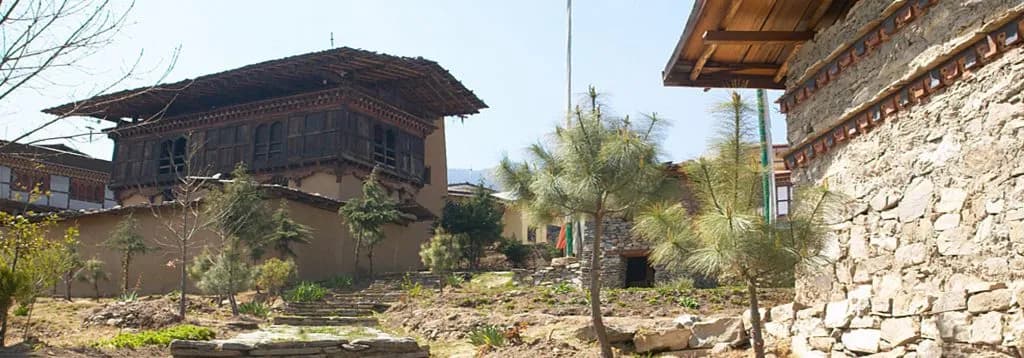
museum · Thimphu · 2,400 m · founded 2001
The Folk Heritage Museum
The Folk Heritage Museum sits in the Kawajangsa neighbourhood of Thimphu — a restored 19th-century three-storey traditional Bhutanese farmhouse that the National Commission for Cultural Affairs operates as the principal Thimphu cultural museum. The museum presents the traditional rural-Bhutanese household register at full scale — the farmhouse architecture, the period furnishings, the working agricultural and household implements, the demonstration kitchen with regular traditional-cooking sessions. For visitors with serious interest in everyday Bhutanese life beyond the dzong-and-monument, the Folk Heritage Museum is the principal Thimphu venue.
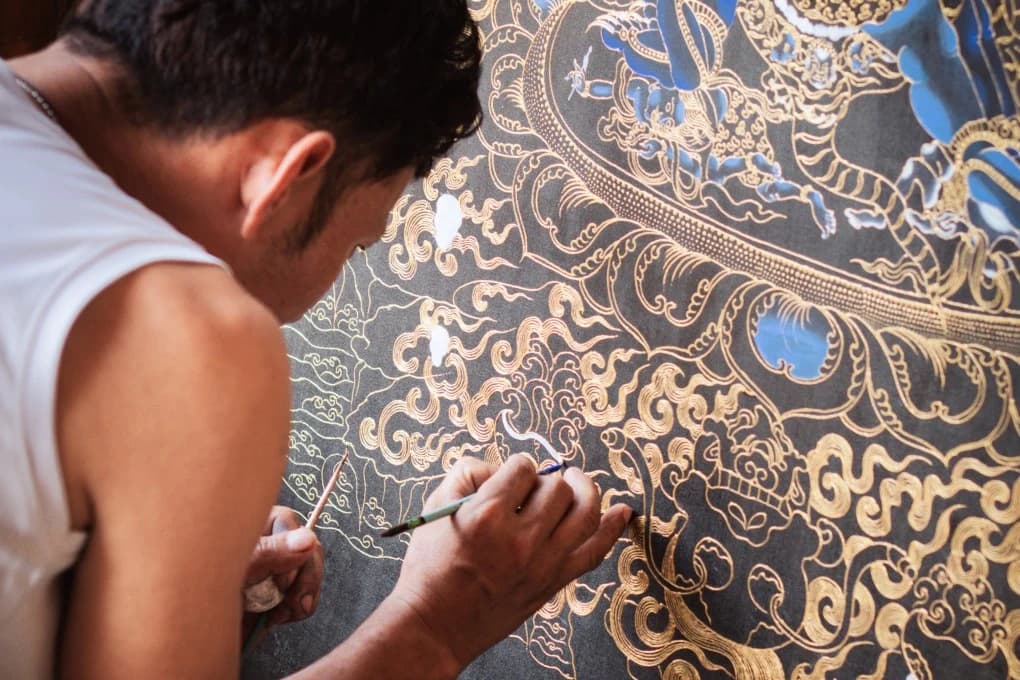
craft-institute · Thimphu · 2,330 m
The National Institute for Zorig Chusum
In Thimphu, the National Institute for Zorig Chusum — often called simply 'the painting school' — is where the country's traditional arts are kept alive, taught to young Bhutanese across the long years of apprenticeship that mastery demands. Zorig Chusum, 'the thirteen arts and crafts', is the formal canon of Bhutanese skilled craft: painting, sculpture, wood-carving, embroidery, weaving, metalwork, and more. A visitor may walk the studios and watch the students at work — drawing the proportioned deities of a thangka, carving a mask, casting a bronze — and see the unbroken transmission of a living tradition rather than a museum's relics.
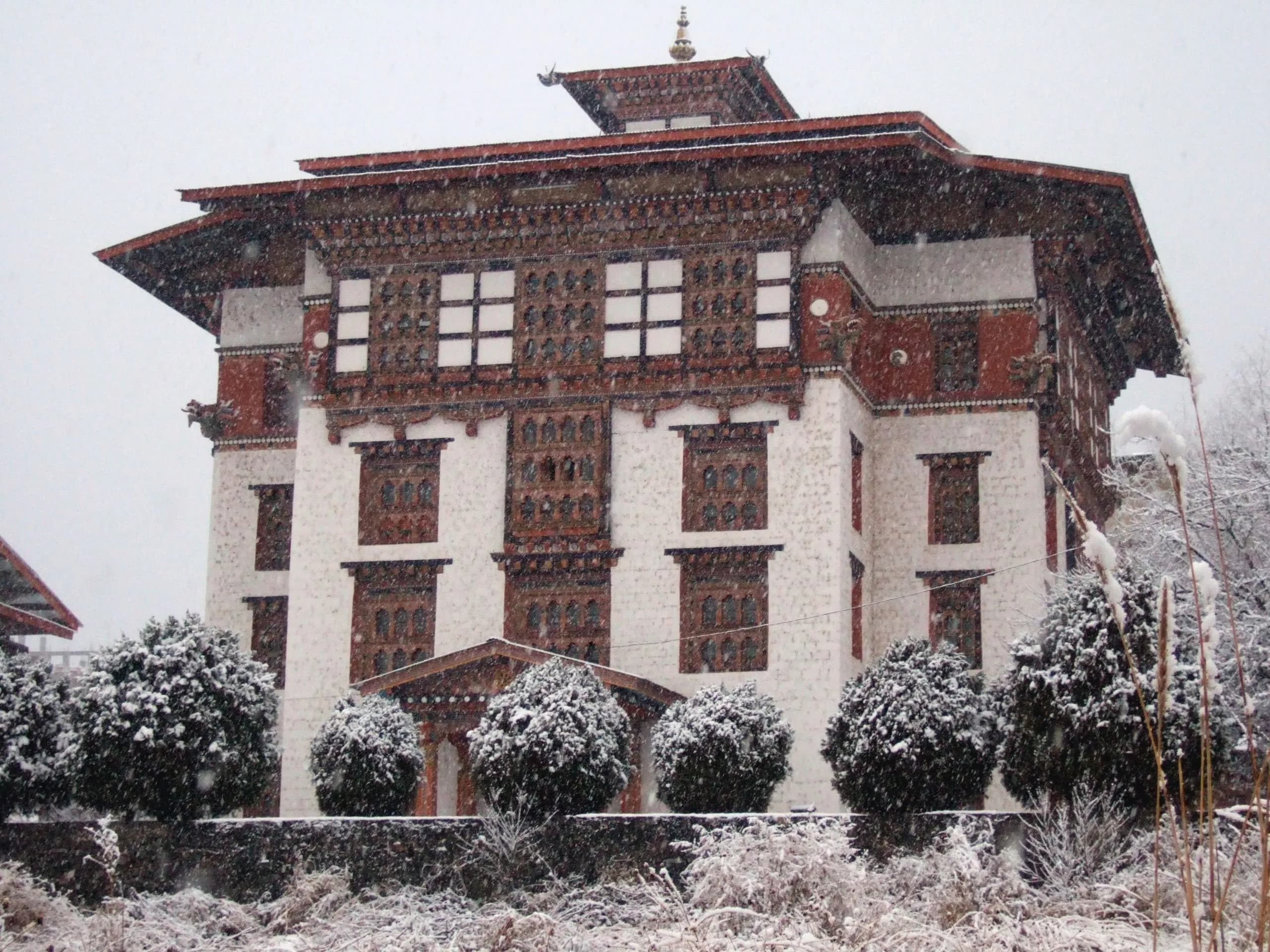
library · Thimphu · 2,380 m
The National Library of Bhutan
The National Library of Bhutan, in Thimphu, is the keeper of the written soul of the country — a great collection of Buddhist scriptures, manuscripts, and the carved wooden printing blocks from which sacred texts have been hand-printed for centuries. Housed in a tall traditional building of its own, it preserves works in classical Tibetan and Dzongkha, some of them rare or unique, alongside a modern reference collection. For the visitor it offers a quiet window onto the textual tradition that underlies everything else in Bhutan — and, by happy fame, a look at one of the largest published books in the world.
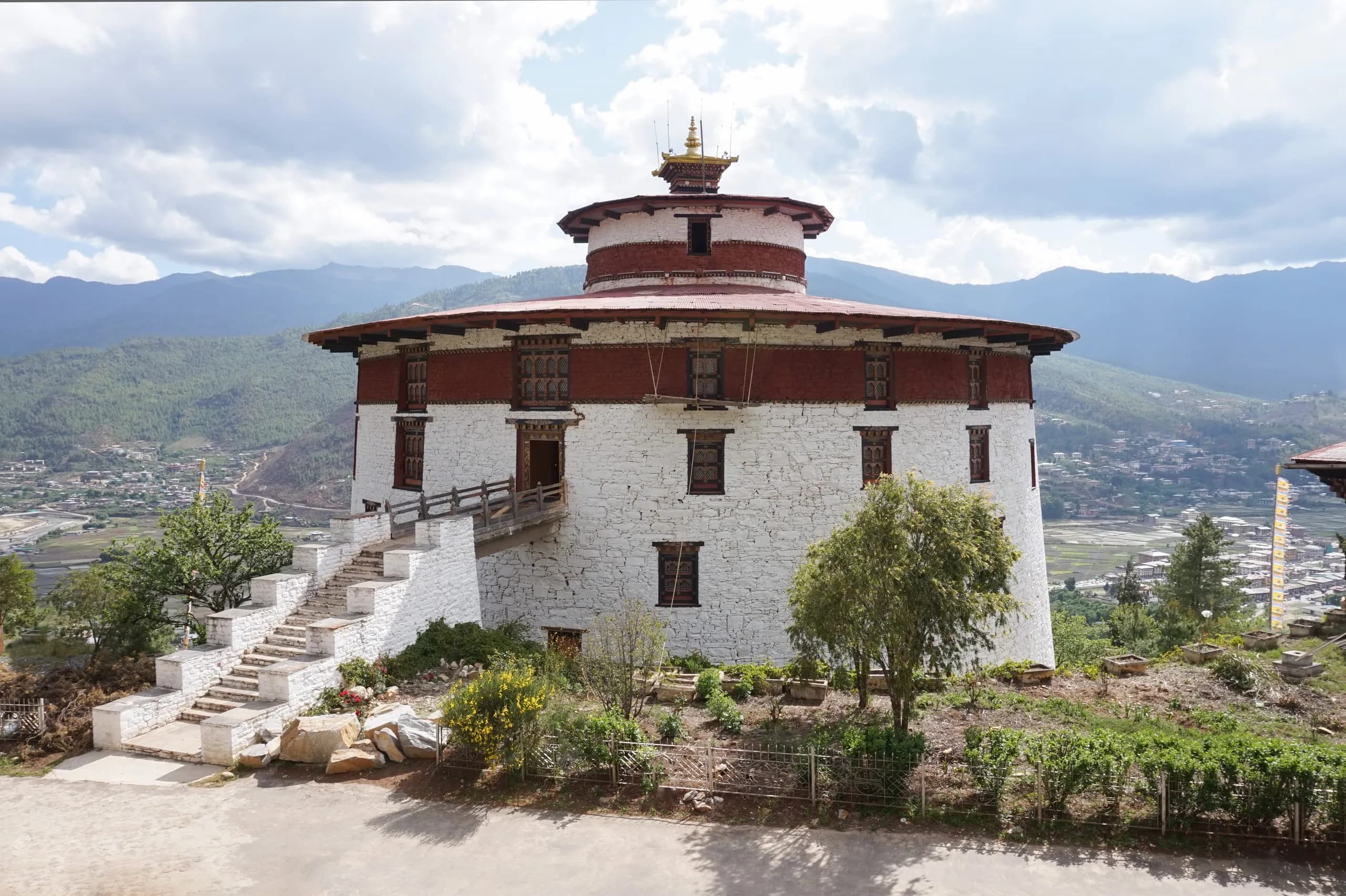
museum · Paro · 2,480 m · founded 1649
The National Museum of Bhutan
The National Museum of Bhutan occupies the Ta Dzong — the cylindrical watchtower built in 1649 on the ridge above Rinpung Dzong to guard the Paro valley. Converted into the national museum in 1968 under His Majesty the Third Druk Gyalpo, it holds the principal national collection: thangka paintings, bronze statuary, textiles, arms and armour, ritual objects, natural-history specimens, and the celebrated Bhutanese postage stamps. For a visitor arriving in Paro, it is the single best half-day introduction to the whole arc of Bhutanese art and history.
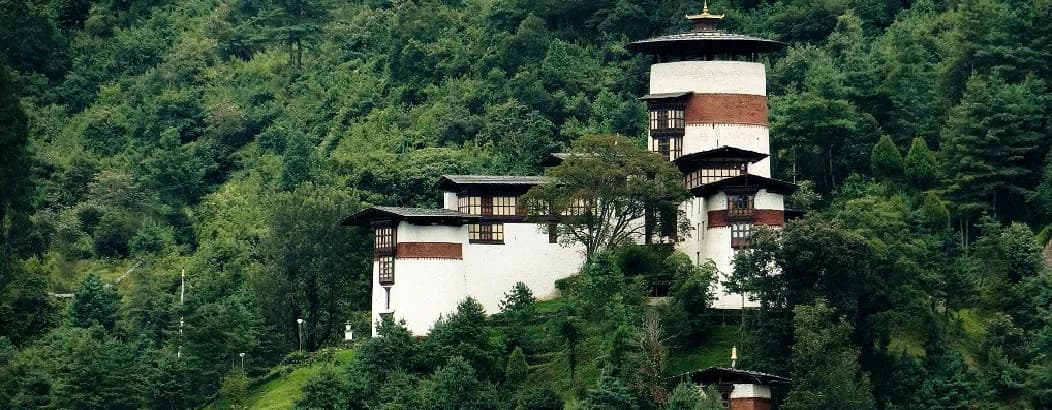
museum · Trongsa · 2,200 m · founded 2008
The Royal Heritage Museum at Trongsa Ta Dzong
The Royal Heritage Museum is housed in the Trongsa Ta Dzong — the watchtower built in the 17th century above Trongsa Dzong, now restored as the principal Bhutanese royal-history museum. Opened in 2008 to mark the centenary of the Wangchuck dynasty, the museum traces the dynasty from its 1907 founding through the contemporary period across five floors of curated exhibits. The royal-family artefacts, the personal effects of the principal Druk Gyalpos, and the contextual exhibits make this the essential visit for visitors with serious interest in the dynastic narrative.
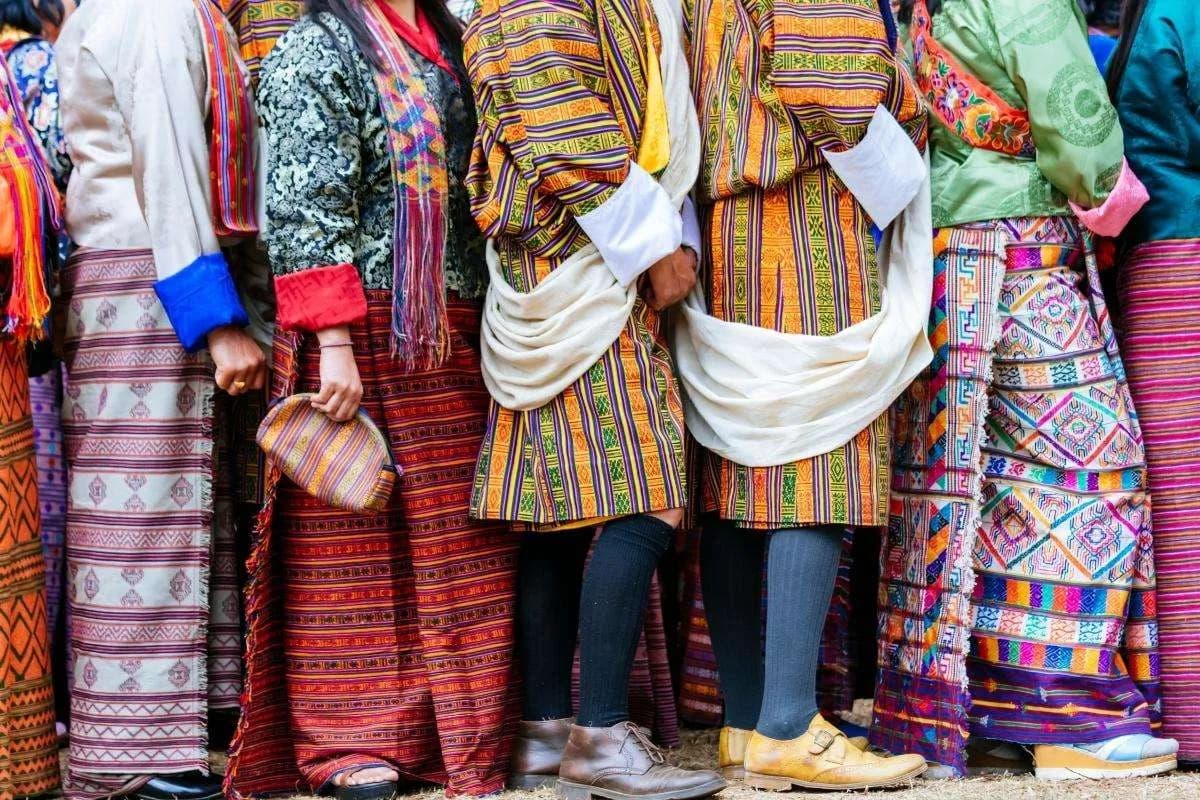
museum · Thimphu · 2,350 m · founded 2005
The Royal Textile Academy
The Royal Textile Academy of Bhutan, established in 2005 under the patronage of Her Majesty Queen Mother Sangay Choden Wangchuck, is the principal institutional centre for Bhutanese weaving — combining a textile museum, active master-weaver workshops, and serious training programmes for Bhutanese apprentices. The institution preserves and develops the most-distinguished Bhutanese textile traditions including the Khoma valley kishuthara silk-brocade tradition (the most-prized form), the yathra wool-weaving tradition of Bumthang, and the broader Bhutanese textile. Essential for visitors with serious interest in the Bhutanese textile tradition.
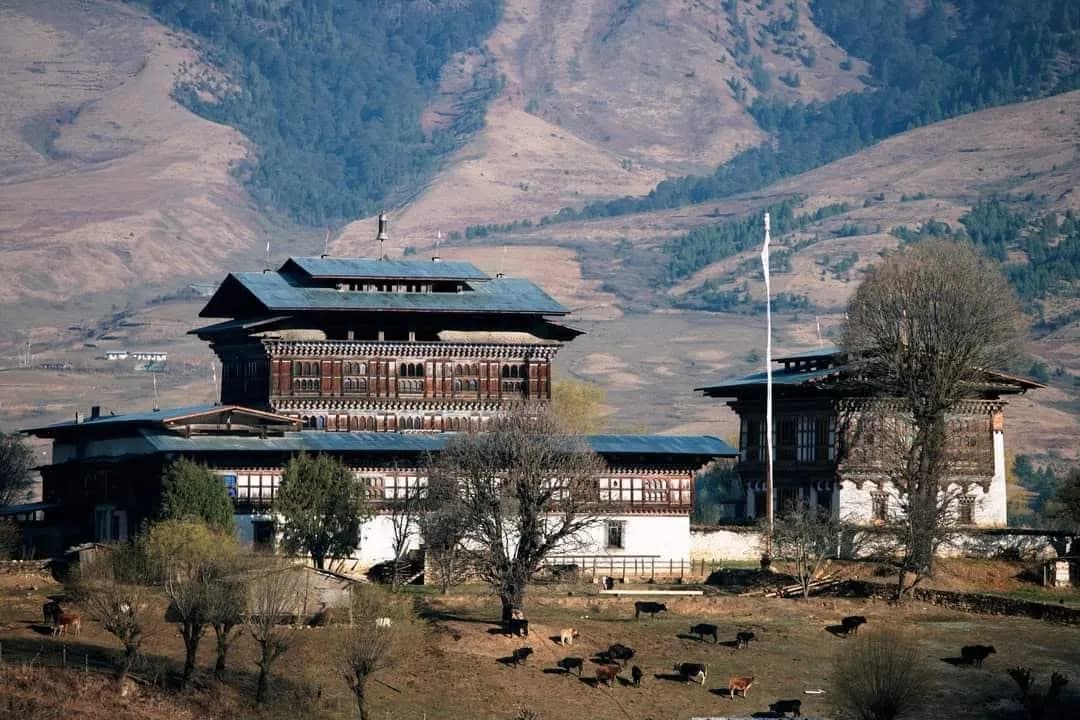
manor-museum · Bumthang · 2,900 m
Ugyen Choling
On a hill above the remote Tang valley of Bumthang stands Ugyen Choling, the manor seat of a family descended from the great treasure-revealer Dorji Lingpa. Rather than let the old house empty out as the modern world arrived, the family turned it into a private museum — preserving intact the rooms, objects, tools, books, and religious treasures of a Bhutanese noble household across the centuries. It is one of the very few places in the country where a visitor can step inside the domestic and administrative world of the old aristocracy: the kitchen, the granary, the master's quarters, the temple, the printing blocks — daily life made visible.
craft-village · Bumthang · 2,700 m
Zugney
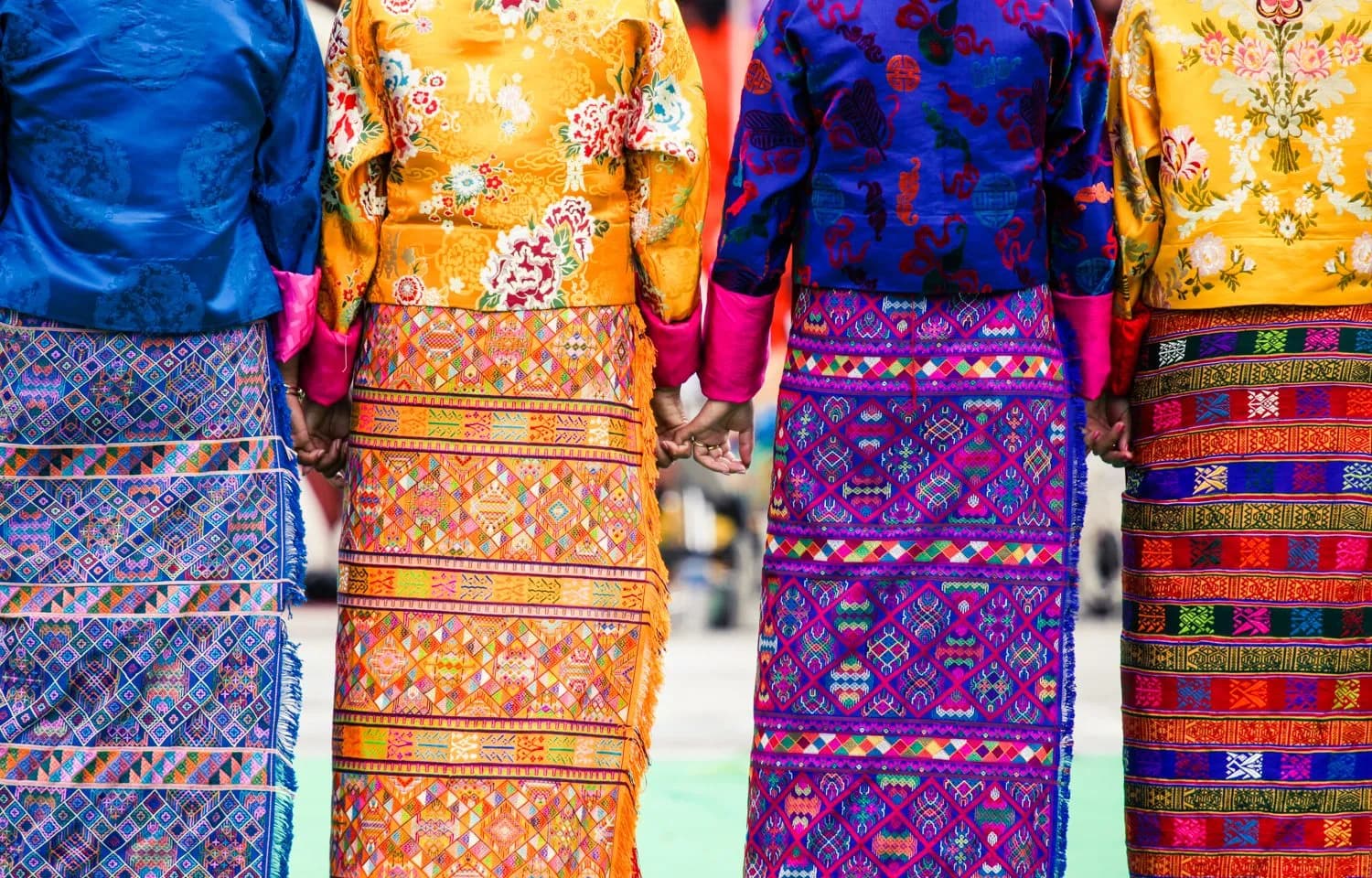
In the Chumey valley of Bumthang, strung along the road that descends from the Yotong La, the village of Zugney is the home of yathra — the brightly patterned woollen cloth that is one of central Bhutan's signature crafts. Woven from sheep's and yak's wool, dyed in bold colours and geometric designs, yathra has clothed and warmed the people of the high Bumthang valleys for generations, and at Zugney a visitor can watch it made on the clacking looms in the roadside workshops, and buy it straight from the weavers. It is a working craft village, not a display — one of the most rewarding hands-on stops in Bumthang.
Passes & natural sites9
nature-centre · Wangdue Phodrang · 2,900 m
Black-Necked Crane Information Centre
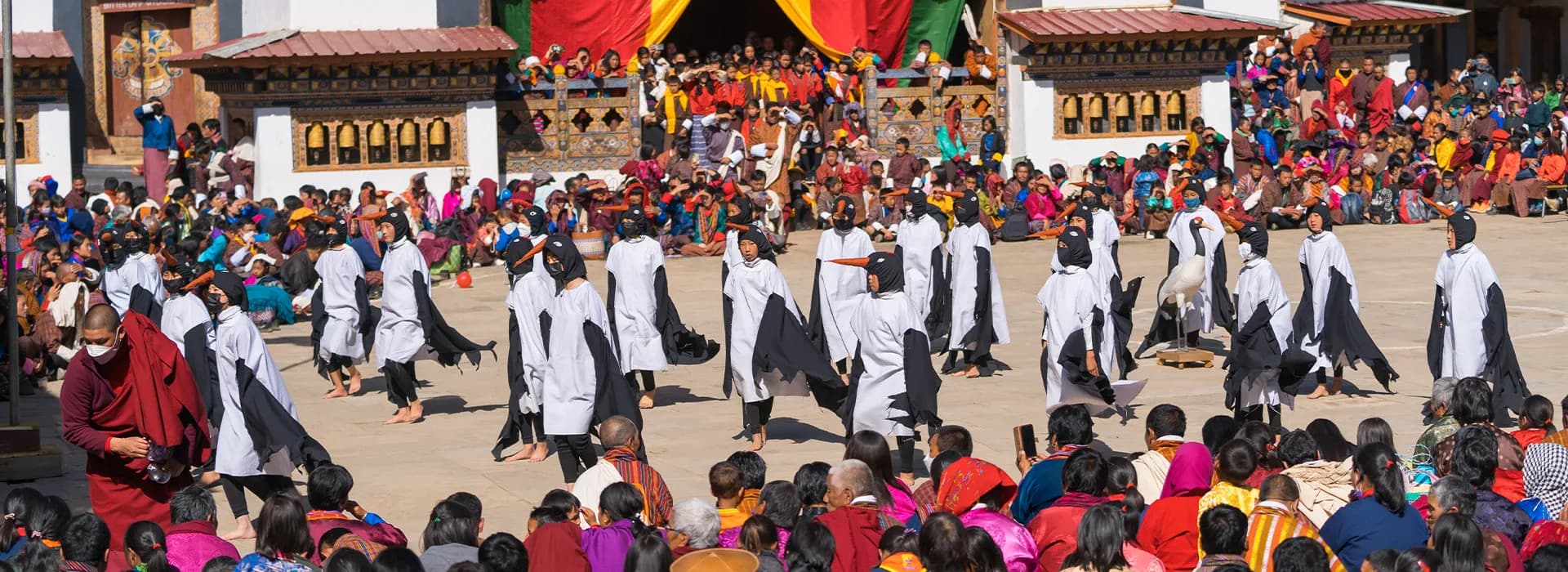
On the edge of the Phobjikha valley's wetland, the Black-Necked Crane Information Centre — run by the Royal Society for the Protection of Nature — is the place to understand and observe the valley's most celebrated visitors: the black-necked cranes that fly down from the Tibetan plateau each winter to roost in the marsh. From late autumn to early spring some hundreds of the rare birds make Phobjikha their season's home, and the Bhutanese revere them. The centre offers spotting scopes, exhibits on the cranes and the valley's ecology, and a viewing gallery over the wetland where the birds gather.
mountain-pass · Paro · 3,988 m
Chele La
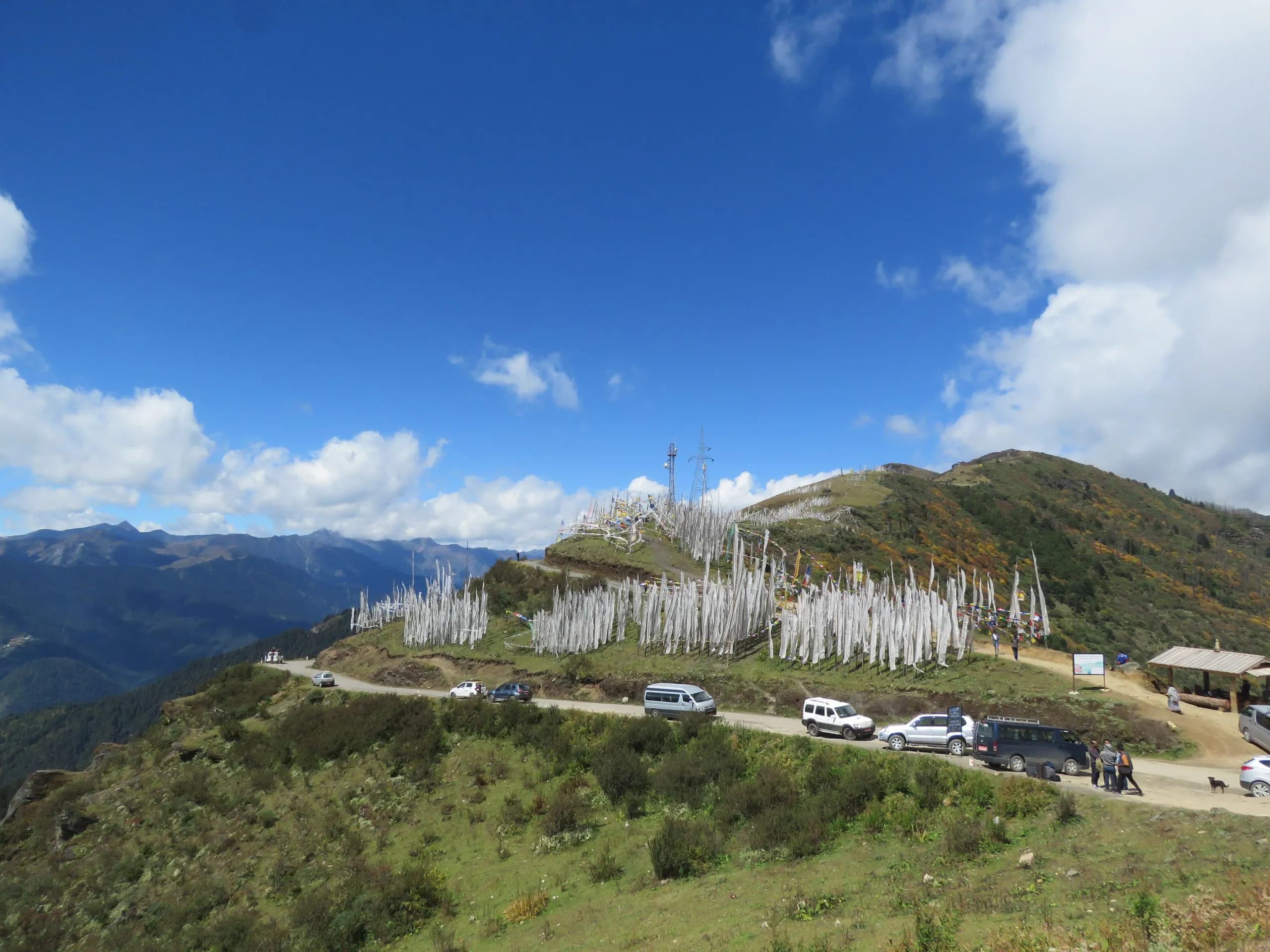
Chele La is the highest motorable pass in Bhutan — a windswept saddle at 3,988 metres on the road that climbs out of the Paro valley and drops over into the remote Haa valley beyond. The pass is a forest of prayer flags streaming in the high wind, and on a clear day it gives one of the country's great panoramas: the sacred peak of Jomolhari and the Himalayan wall to the north, the two green valleys falling away on either side, and alpine meadows that flush with rhododendron in spring. It is an easy drive up from Paro for a morning, and the trailhead for the walk down to the cliffside Kila Nunnery.
sacred-site · Bumthang · 2,700 m
Mebar Tsho
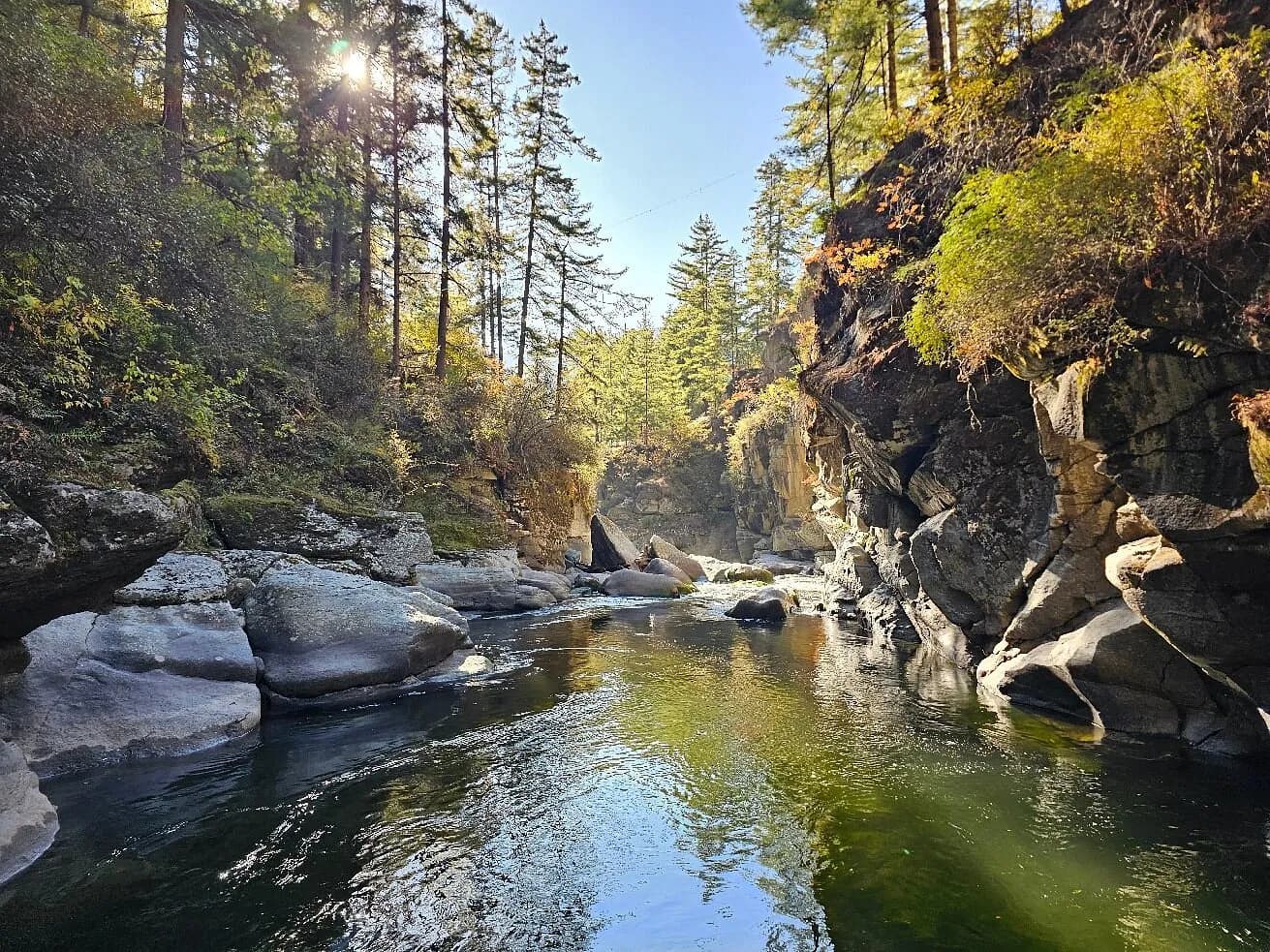
Mebar Tsho — literally 'the burning lake' — is one of the most-revered sacred sites in the Bhutanese tradition. The deep pool in the Tang Chhu of Bumthang's Tang valley is the principal location of Pema Lingpa's famous 15th-century 'burning butter lamp' miracle, in which the terton dove into the lake holding a butter lamp, retrieved a hidden treasure, and emerged with the lamp still alight. The site is the principal Pema Lingpa pilgrimage destination in Bhutan; the gorge-and-pool setting in the Tang valley is among the more atmospheric Bhutanese sacred sites.
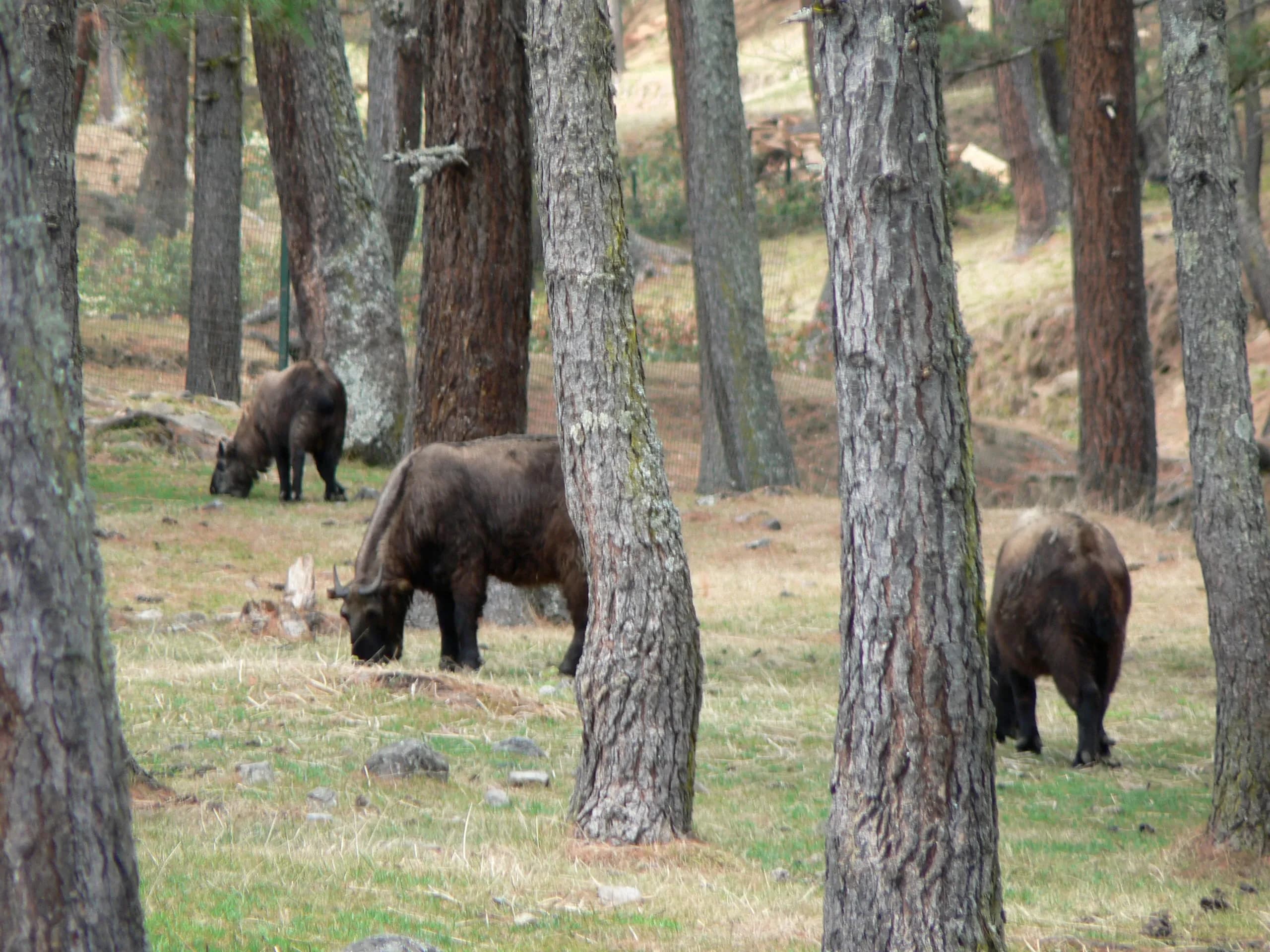
nature-reserve · Thimphu · 2,600 m
Motithang Takin Preserve
In the forested Motithang hills above Thimphu, a fenced reserve protects a small herd of takin — the national animal of Bhutan, and one of the oddest large mammals in the world: a heavyset, goat-antelope of the high Himalaya, often likened to a creature assembled from spare parts. The Bhutanese trace it to a miracle of the 'divine madman' Drukpa Kunley, who is said to have made it from a goat's head and a cow's bones. The preserve exists because of a very Bhutanese decision: when a small zoo was disbanded as unbecoming of a Buddhist country, the released takin would not leave, so a stretch of their own forest was given to them.
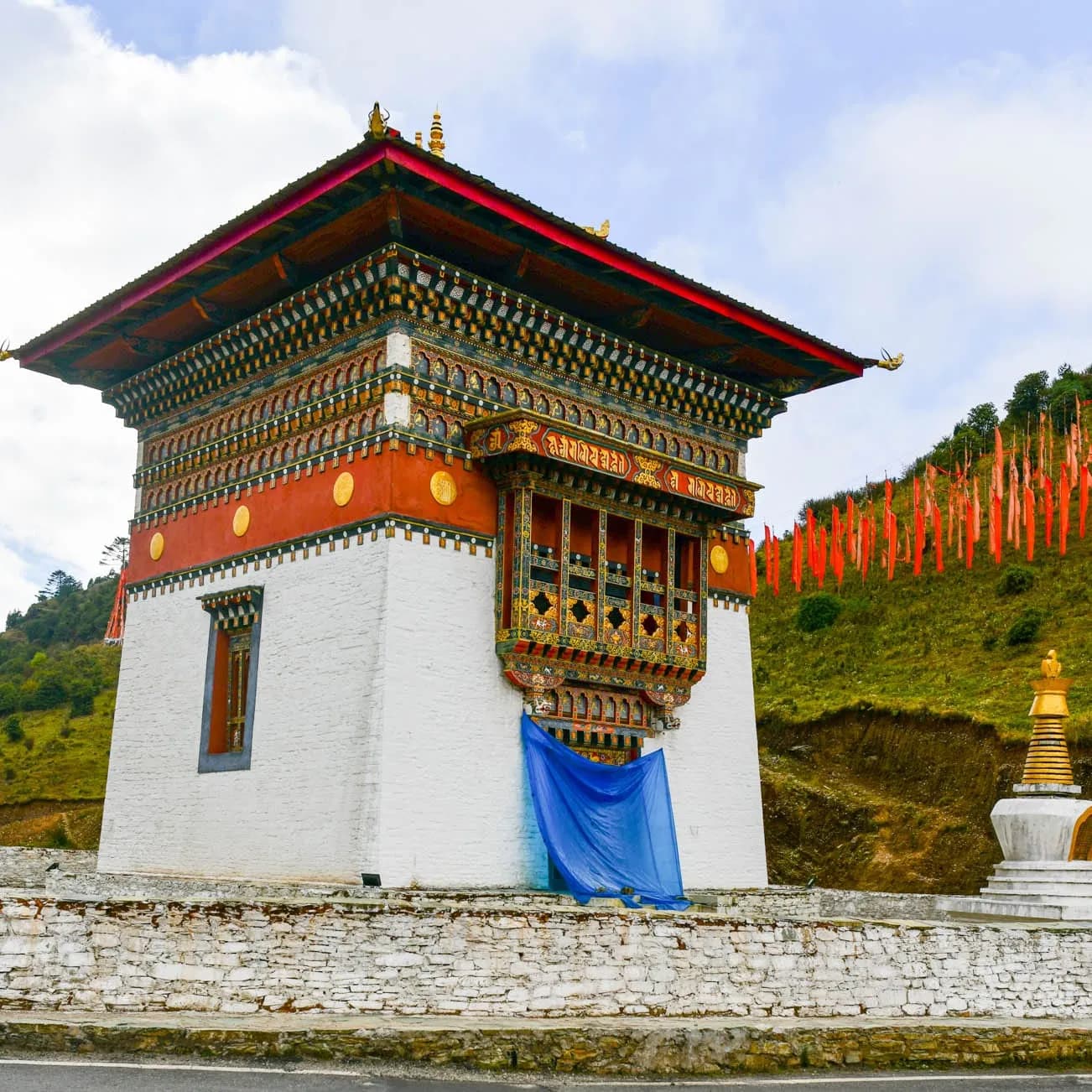
mountain-pass · Wangdue Phodrang · 3,420 m
Pele La
Pele La, at 3,420 metres, is the pass that carries the road over the Black Mountains from the Wangdue Phodrang valley into central Bhutan — the traditional dividing line between the west of the country and the centre, and the gateway to Trongsa, Bumthang, and the east. The crossing runs through the high pastures and dwarf-bamboo slopes of Jigme Singye Wangchuck National Park, often wrapped in drifting mist, grazed by yaks, and marked at the top by a chorten and a host of prayer flags. It is the moment a journey leaves the familiar western valleys behind and turns towards the deeper country beyond.
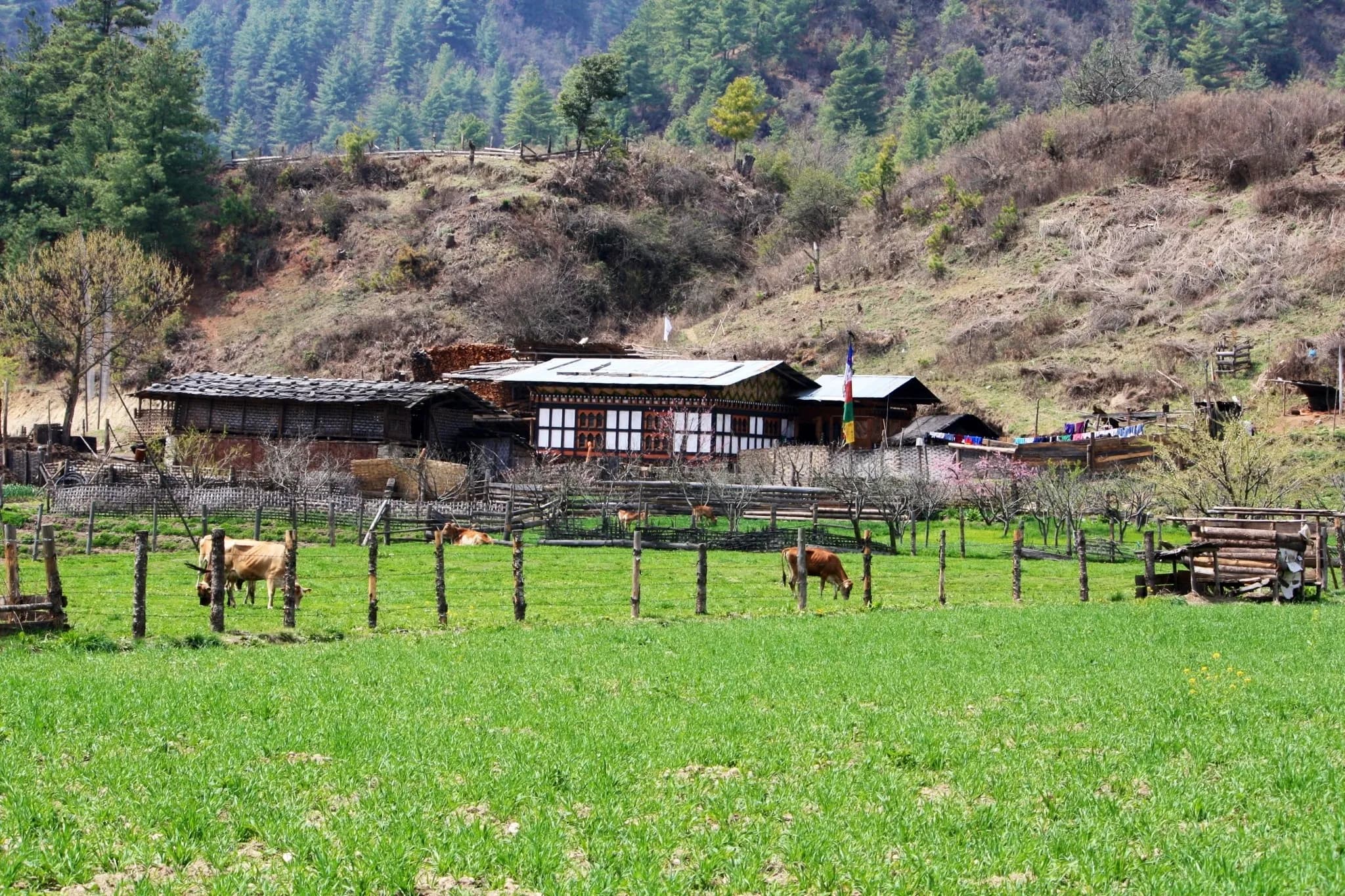
working-farm · Bumthang · 2,600 m · founded 1968
The Bumthang Swiss Farm
In the Choekhor valley near Jakar, the Bumthang Swiss Farm is the unlikely and charming legacy of Fritz Maurer, a Swiss agronomist who came to Bhutan as a development worker in the 1960s, settled in Bumthang, and never left. From his farm came the country's first Swiss-style cheeses, its first craft beer — the Red Panda weiss — and much of the apple and dairy development that shaped the modern Bumthang economy. A visitor can tour the dairy, taste the cheese, sample the unfiltered wheat beer, and hear one of the warmest stories of Bhutan's gentle opening to the world.
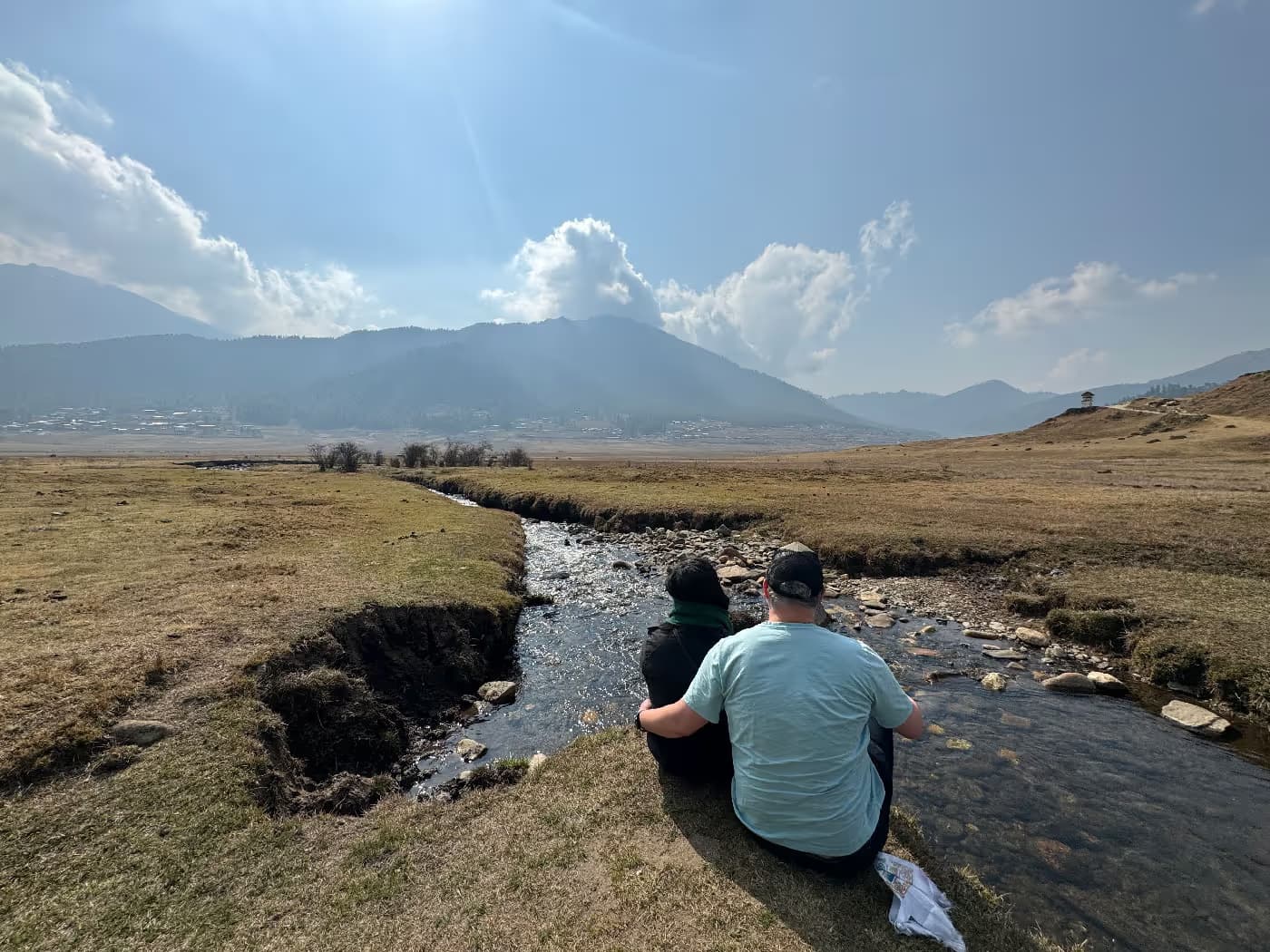
nature-trail · Wangdue Phodrang · 2,900 m
The Gangtey Nature Trail
The Gangtey Nature Trail is the classic short walk of the Phobjikha valley — an easy, mostly downhill path that begins near Gangtey Goemba on its hilltop and winds down through pine forest, past a chorten and prayer-flag-strung mani wall, through the village of Semchubara, and out across the open floor of the glacial valley. It takes only an hour and a half or two, and asks little of the legs, but it gives the truest feel of Phobjikha: the wide marsh, the grazing cattle, the dwarf bamboo, and — in winter — the black-necked cranes feeding in the fields. Many visitors call it the most rewarding gentle walk in Bhutan.
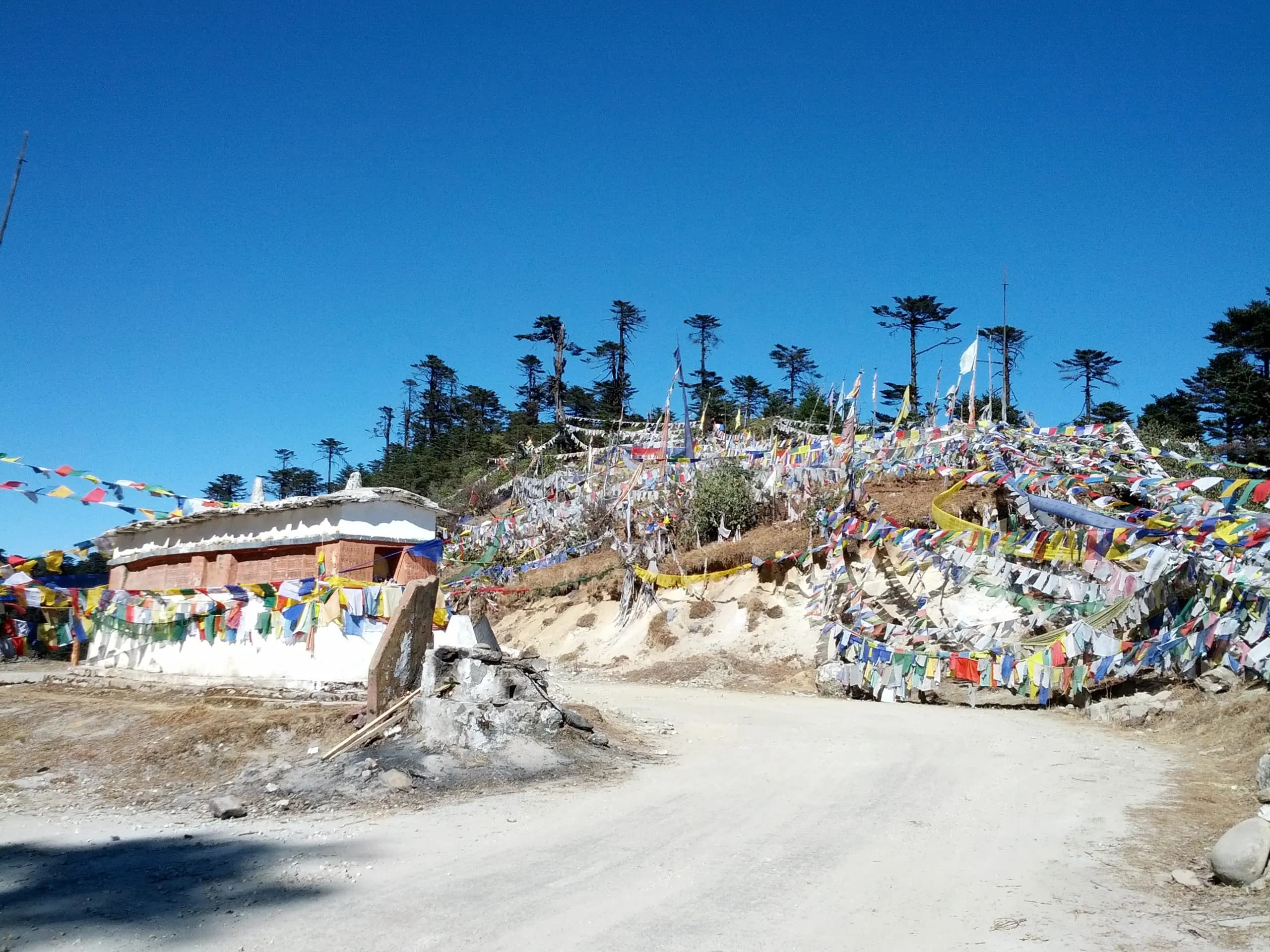
mountain-pass · Bumthang · 3,780 m
Thrumshing La
Thrumshing La, at 3,780 metres, is the second-highest pass a road crosses in Bhutan — the great height between Bumthang and Mongar that opens the way into the country's remote and little-travelled east. It crowns Thrumshingla National Park, a wilderness of fir and rhododendron forest famous for its birdlife, and the descent beyond is one of the most dramatic in the country: a vertiginous plunge of thousands of metres down through changing forest into the deep valleys of the east. For the few who travel beyond Bumthang, Thrumshing La is the threshold of a wilder, older Bhutan.
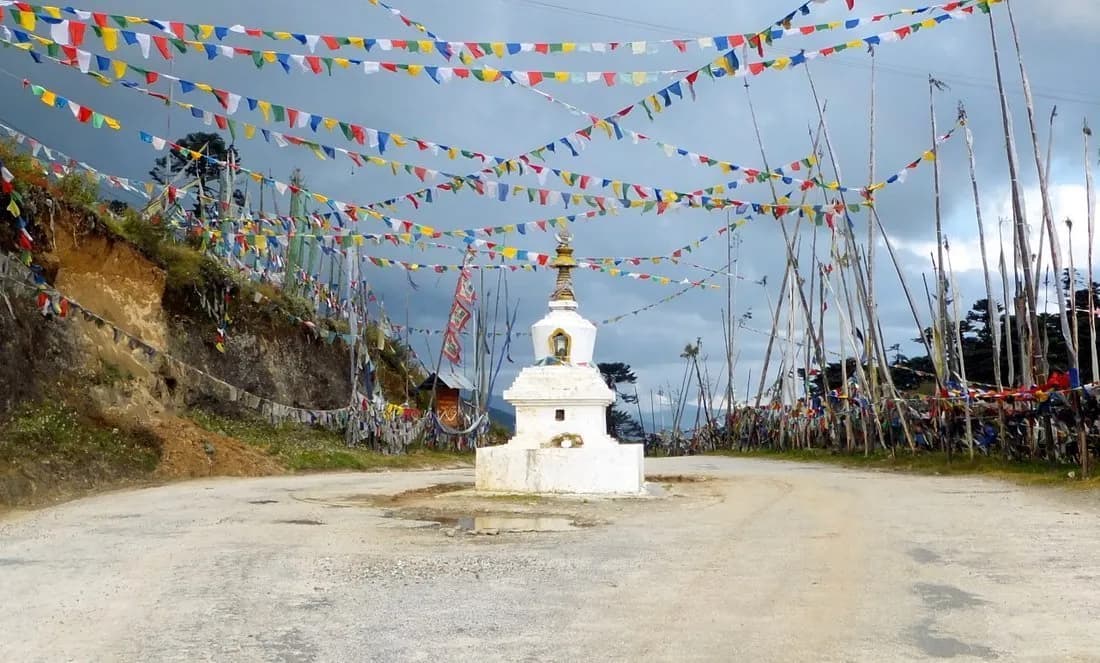
mountain-pass · Trongsa · 3,425 m
Yotong La
Yotong La, at 3,425 metres, is the pass that carries the road from Trongsa over into the Bumthang region — the last climb before a journey drops into the Chumey valley, the first of Bumthang's four spiritual heartland valleys. Quieter and more wooded than the high open passes, Yotong La runs through deep fir and rhododendron forest, marked at the top by prayer flags and a chorten, with the descent on the far side leading down past the yathra-weaving village of Zugney into the Bumthang valleys. It is the gateway to the most sacred country in Bhutan.
Other landmarks4
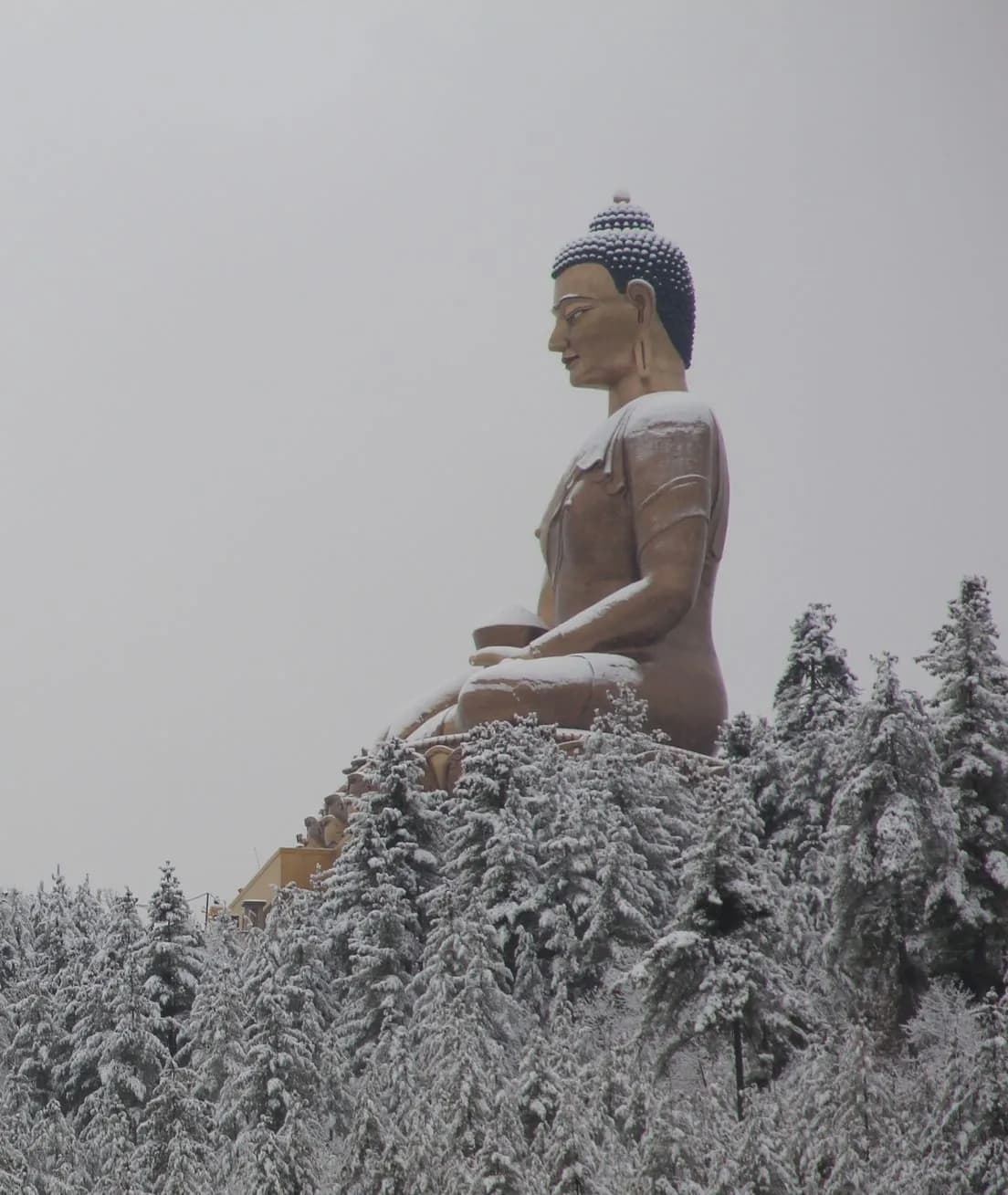
statue · Thimphu · 2,500 m · founded 2015
Buddha Dordenma
The Buddha Dordenma sits at 2,500 metres on the Kuensel Phodrang ridge overlooking Thimphu — a 51.5-metre seated bronze Buddha Shakyamuni, gold-plated, completed and consecrated in 2015. The statue is one of the largest seated Buddhas in the world and houses 125,000 smaller Buddha statues within its interior chamber. The project was conceived to fulfil an 8th-century prophecy of Guru Rinpoche.
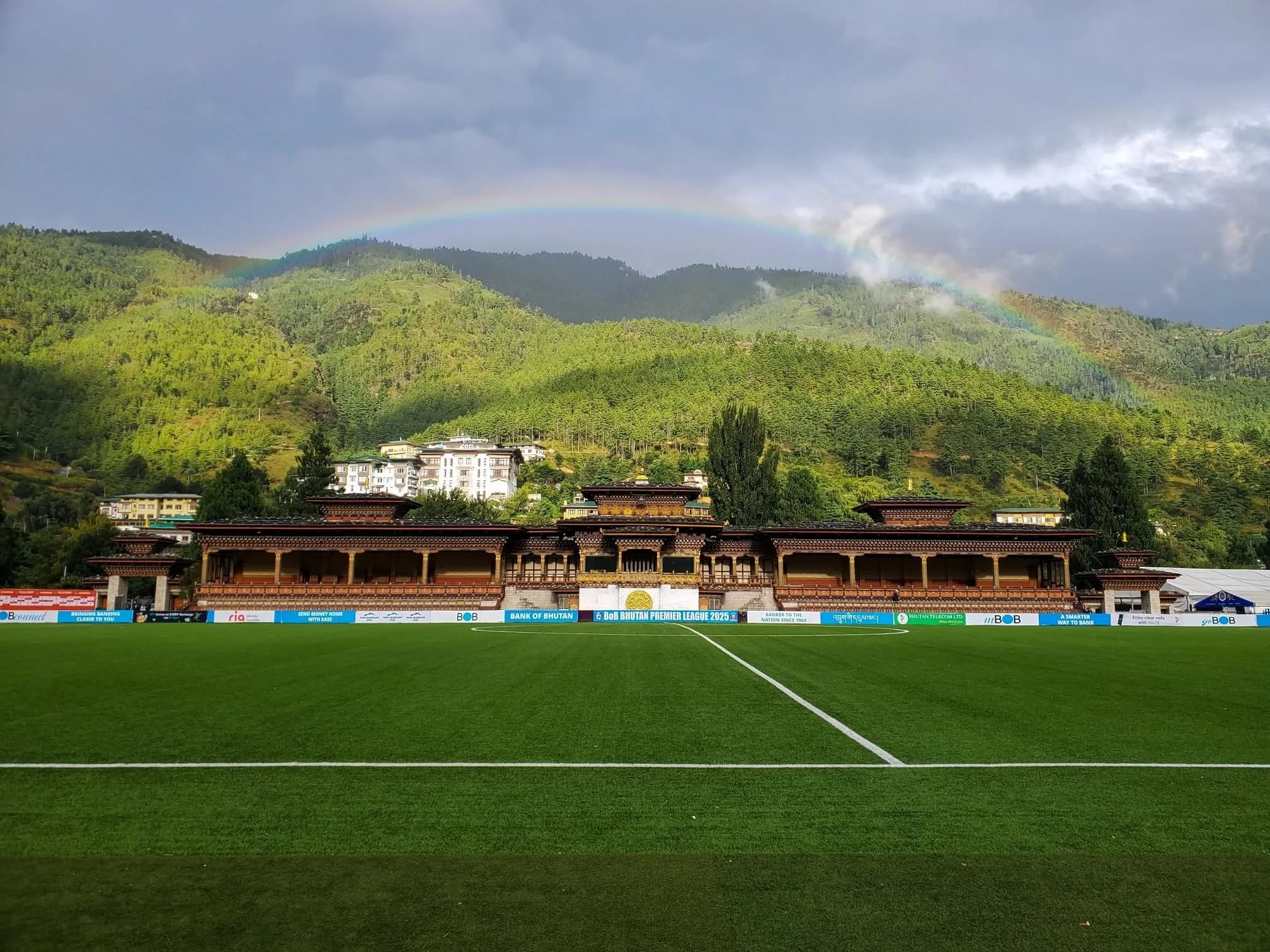
national-venue · Thimphu · 2,320 m
Changlimithang Stadium
Changlimithang Stadium sits in the centre of Thimphu, along the bank of the Wangchu river. The ground has been the principal Bhutanese national-event venue for over a century — from the 1885 consolidation moment where His Majesty Ugyen Wangchuck assumed paramount authority, through the 1974 coronation of His Majesty the Fourth Druk Gyalpo, to the 2008 coronation of His Majesty the Fifth Druk Gyalpo, the annual National Day commemoration each 17 December, the principal Bhutanese archery tournaments, and the international football matches of the Druk Stars. The choice of the 1885 settlement site as the contemporary ceremonial ground is a deliberate continuity — the ground where the 19th-century civil-war period ended is the ground where the modern state celebrates its institutional milestones.
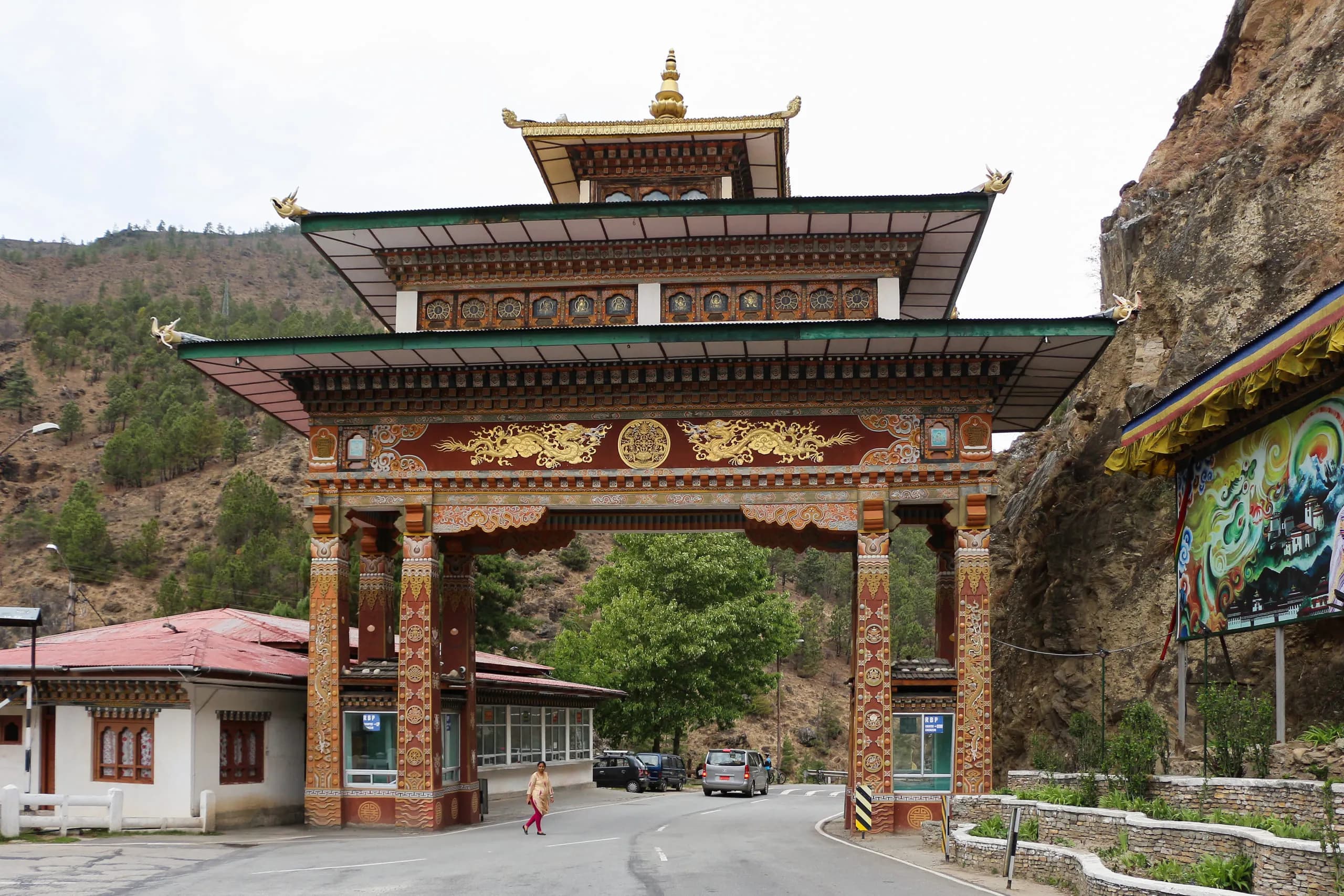
landmark · Paro · 2,100 m
Chuzom
Chuzom — the name means simply 'confluence' — is the junction where the Pa Chhu, the river of the Paro valley, joins the Wang Chhu coming down from Thimphu. It is the meeting point of the country's western roads: the routes from Paro, from Thimphu, and from Haa all come together here. Because the Bhutanese hold the meeting of two rivers to be an inauspicious, even dangerous spot, the confluence is guarded by three stupas built side by side in three different styles — Bhutanese, Tibetan, and Nepali — to subdue the place. Every visitor driving between Paro and Thimphu passes them.
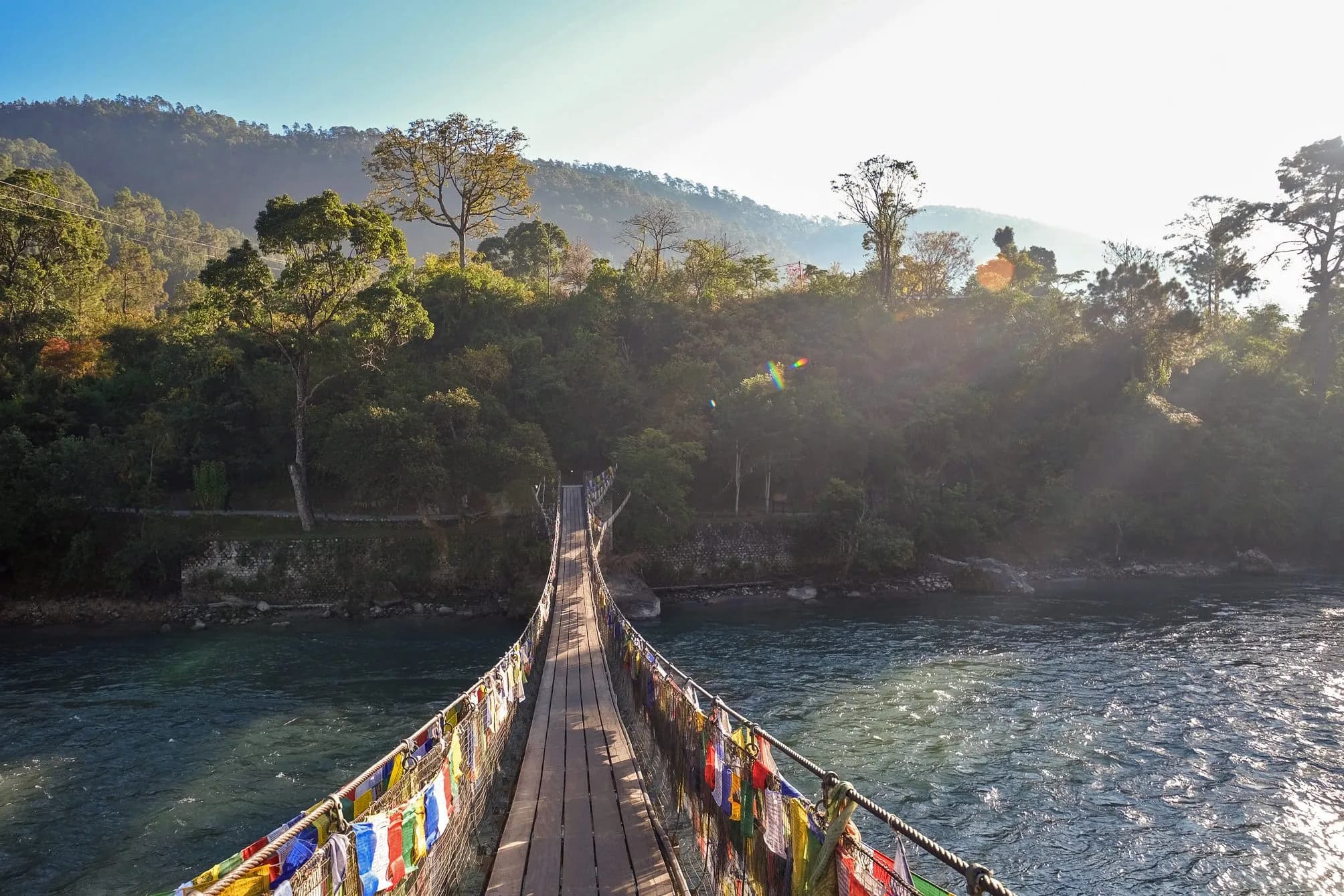
landmark · Punakha · 1,240 m
Punakha Suspension Bridge
Just downstream of Punakha Dzong, a long suspension footbridge crosses the Pho Chhu — the 'father river' — linking the dzong's meadows to the villages and rice terraces on the far bank. Among the longest such bridges in the country, it hangs draped in prayer flags that stream in the river wind, swaying gently underfoot as the green water runs below. It is both a working village crossing and one of the most photographed spots in the Punakha valley, and it is the start of the riverside walk up to the Khamsum Yulley Namgyal Chorten.

