A Bhutanese monastery
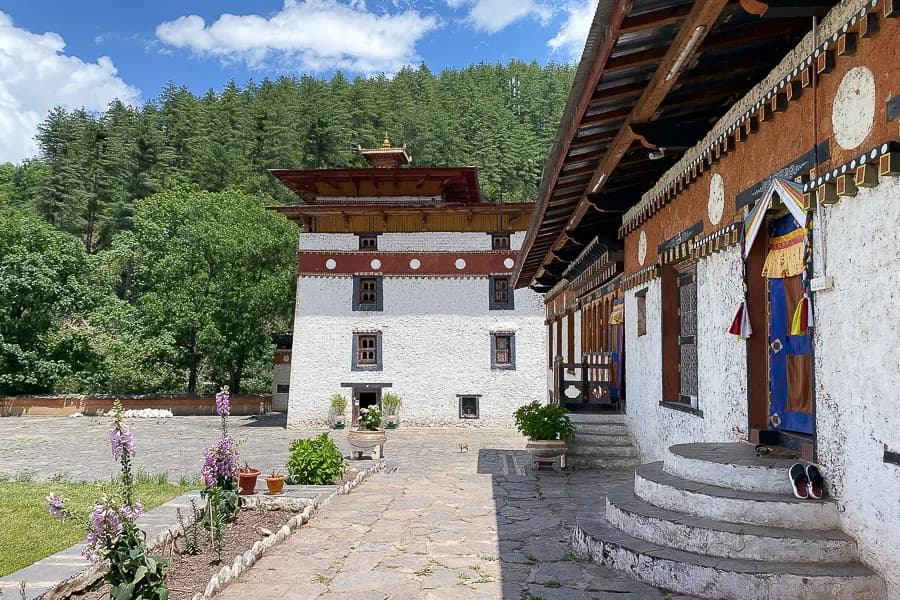
Pangri Zampa — the 16th-century monastery that is now Bhutan's college of astrology.
North of Thimphu, beyond Dechencholing on the way up the valley, two tall cypress trees mark Pangri Zampa — a monastery founded in the early 16th century, and the place where, by prophecy, Zhabdrung Ngawang Namgyal is said to have first settled on arriving in Bhutan. Today it is the country's principal college of astrology, where young monks train for years in the intricate Bhutanese system of astrological calculation that still governs the timing of weddings, journeys, ceremonies, and the naming of children. A visitor finds a quiet riverside monastery and a living tradition of cosmic reckoning that shapes Bhutanese life to this day.
Also known as Pangri Zampa Lhakhang · Pangrizampa
- Location
- North of Thimphu, up the valley beyond Dechencholing, Thimphu
- Founded
- 1529
- Elevation
- 2,420 m
- Kind
- monastery
The monastery and the Zhabdrung
Pangri Zampa was founded in the early 16th century, and it holds a particular place in the country's founding story: when Zhabdrung Ngawang Namgyal arrived in Bhutan in 1616, fleeing a succession dispute in Tibet and carrying the prophecy that would make him the unifier of the country, he is said to have settled first at Pangri Zampa, in fulfilment of a prediction that he would find his destiny at a place so marked. From this quiet monastery by the river he began the work that would create the Bhutanese state. The two tall cypress trees that flank the monastery are among its landmarks, and the riverside setting north of the city gives it an air of retreat from the modern capital below.
The college of astrology
Today Pangri Zampa is best known as the principal centre of Bhutanese astrology — the college where young monks undertake the long training in the intricate system of astrological calculation that the country inherited from the broader Tibetan-Buddhist tradition and made its own. Bhutanese astrology is not a curiosity at the margins of life but a working framework woven through it: the astrologer-monks calculate the auspicious dates for weddings and house-buildings, the right timing for journeys and ceremonies, the favourable and unfavourable days of the calendar, and — as at Changangkha Lhakhang in the city — the names to be given to newborn children according to the day and stars of their birth. To visit the college is to glimpse the cosmic reckoning that still orders the rhythm of Bhutanese life.
What a visitor encounters
Pangri Zampa is a working monastery and college rather than a set-piece monument, and its appeal is its quiet authenticity — the riverside setting, the cypress trees, the young monks at their studies in the arcane discipline of the stars. It is a less-visited stop than the city's great sights, which suits its contemplative character, and it can be combined with a drive or walk up the upper Thimphu valley towards Cheri and Tango. For visitors curious about the astrological tradition that underlies so much of Bhutanese practice — the timing of the festivals, the naming of children, the auspicious dates that govern daily decisions — it is the place where that tradition is taught and kept alive.
Visiting
- Getting there
- Pangri Zampa is north of Thimphu, up the valley beyond Dechencholing, a short drive from the city — on the way towards the head of the valley and the Cheri and Tango monasteries, with which it can be combined. The matched guide arranges the visit.
- What to see
- The monastery, the two landmark cypress trees, the riverside setting, and — where the college is in session — the young monks at their astrological studies. Allow 30–45 minutes. The matched guide explains the Zhabdrung connection and the role of astrology in Bhutanese life.
- Dress and protocol
- Standard monastery protocol — shoulders and knees covered, shoes and hats removed before the shrines, no photography inside. As a working college, the register is quiet and respectful; the guide indicates which areas are open to visitors.
- Best time to visit
- Year-round, comfortable in every season at the valley elevation. It pairs naturally with a trip up the upper Thimphu valley towards Cheri and Tango.
Journeys featuring this site
 JourneyThe signature-tier Bhutan journey — private knowledgeable guide, the most considered lodge curation, helicopter or charter between valleys, exclusive-use arrangements where the season allows.The signature-tier Bhutan journey. Private knowledgeable guide, the most considered lodges, helicopter or PC-24 charter, exclusive-use arrangements. By invitation, from USD 14,000.
 JourneyTen nights for the Buddhist pilgrim — the principal sites, with monastic context.A ten-night Bhutan Buddhist pilgrimage for Asian-Buddhist travellers. Monastic context; matched monastic-trained guide; Bumthang religious circuit.
Journeys that visit Pangri Zampa
Frequently asked
- What is Pangri Zampa?
- A monastery north of Thimphu, founded in the early 16th century, now the principal college of astrology in Bhutan. It is also significant as the place where Zhabdrung Ngawang Namgyal is said to have first settled on arriving in Bhutan in 1616, by prophecy, before beginning the work of unifying the country.
- Why does astrology matter in Bhutan?
- Bhutanese astrology is a working framework woven through daily life, not a curiosity. The astrologer-monks calculate the auspicious dates for weddings, journeys, and ceremonies, the favourable days of the calendar, and the names of newborn children according to the day and stars of their birth. Pangri Zampa is where this system is taught and kept alive.
- Is it worth visiting?
- For visitors curious about the astrological tradition that underlies so much of Bhutanese practice — the timing of festivals, the naming of children, the auspicious dates that order daily decisions — it is a quiet, authentic stop with a fine riverside setting. It is less visited than the city's great sights, and pairs naturally with a trip up the valley towards Cheri and Tango.

