A Bhutanese landmark
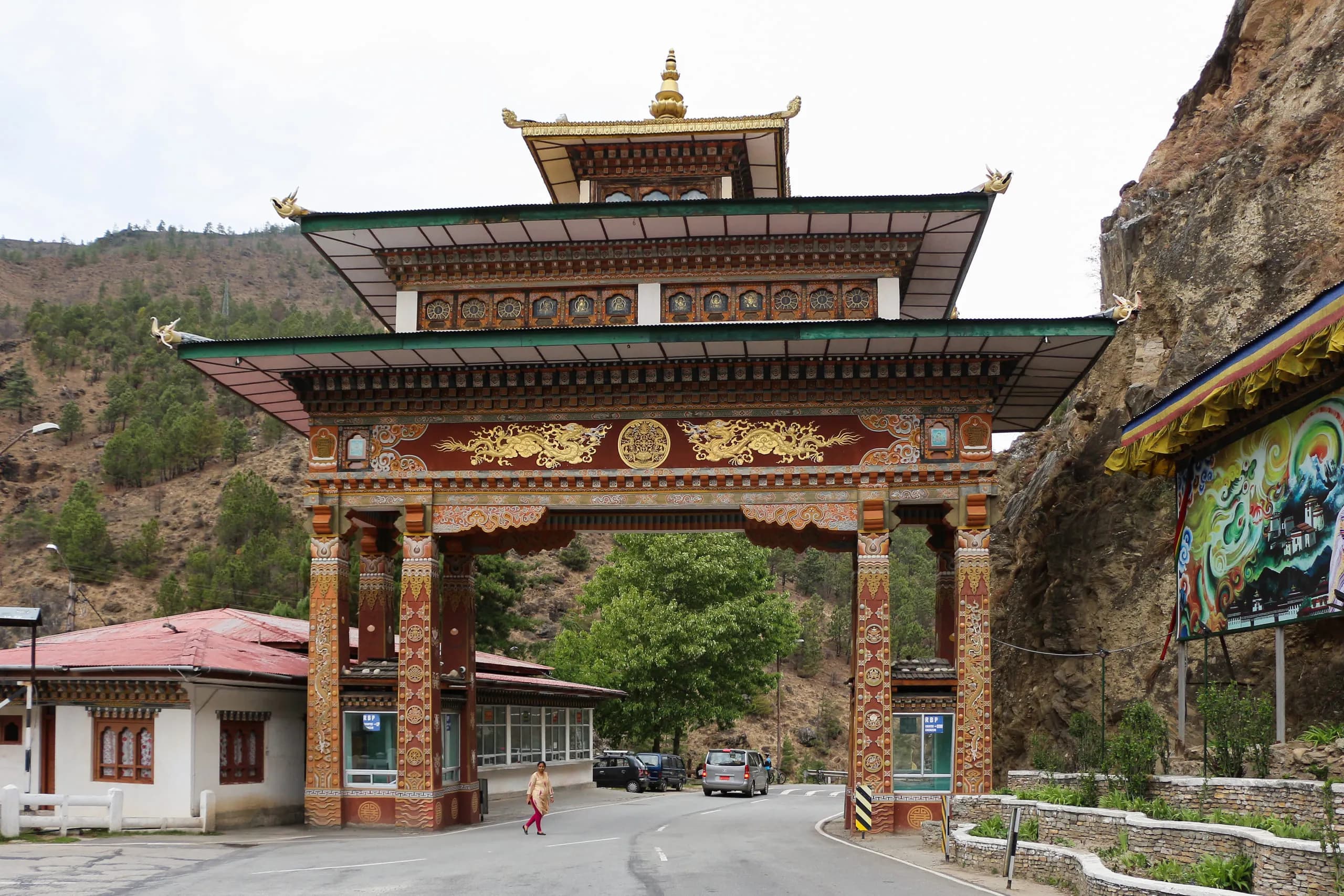
Chuzom — where the Paro and Thimphu rivers meet, guarded by three stupas in three styles.
Chuzom — the name means simply 'confluence' — is the junction where the Pa Chhu, the river of the Paro valley, joins the Wang Chhu coming down from Thimphu. It is the meeting point of the country's western roads: the routes from Paro, from Thimphu, and from Haa all come together here. Because the Bhutanese hold the meeting of two rivers to be an inauspicious, even dangerous spot, the confluence is guarded by three stupas built side by side in three different styles — Bhutanese, Tibetan, and Nepali — to subdue the place. Every visitor driving between Paro and Thimphu passes them.
Also known as Chhuzom · Chunzom · the confluence
- Location
- Confluence of the Pa Chhu and Wang Chhu, on the Paro–Thimphu road, Paro
- Elevation
- 2,100 m
- Kind
- landmark
The meeting of the rivers
Chuzom is where two of western Bhutan's rivers come together — the Pa Chhu, which drains the Paro valley, joining the larger Wang Chhu (the Thimphu river) on its way south. The confluence is also the great road junction of the west: here the route from Paro, the route from Thimphu, and the route from the Haa valley all meet, which makes Chuzom a place nearly every visitor passes through, often without quite registering it. The two rivers run noticeably different colours where they meet, the clearer water of one set against the other — the visible sign of the joining that the Bhutanese regard with a certain wariness.
The three stupas
In the Bhutanese reading of the landscape, the meeting of two rivers is an unlucky, spiritually charged spot — a place where harmful forces may gather. So at Chuzom, to pacify and guard the confluence, stand three stupas (chortens) built side by side in three distinct architectural styles: one Bhutanese, one Tibetan, and one Nepali, each form drawn from a different strand of the Himalayan Buddhist world. The three together are the most photographed feature of the junction, and they are a neat lesson in how to read a Bhutanese landscape — the sacred structure raised not for display but to do a job, to subdue the ground and keep the travellers who pass safe.
A landmark on the western drive
Chuzom is less a destination than a threshold — the point a journey turns from one valley towards another. For the visitor it is the marker on the drive between Paro and Thimphu (and the turning for Haa), a place to pause, look at the joined rivers and the three stupas, and register the geography that organises the whole western circuit. There has long been a checkpoint here, controlling the roads, and the spot carries the faint sense of a gateway that such junctions always have. The matched guide will usually stop a moment to point out the confluence and read the three chortens — a small but characteristic introduction to how Bhutan inhabits its land.
Visiting
- Getting there
- Chuzom sits on the main road between Paro and Thimphu, about half an hour from each, at the turning for the Haa valley — so it is passed by nearly every visitor driving the western circuit. No detour is needed; the matched guide simply pauses at the junction.
- What to see
- The confluence of the two differently-coloured rivers, and the three stupas in their Bhutanese, Tibetan, and Nepali styles. A few minutes is enough — it is a passing landmark rather than a long stop. The matched guide explains the belief about river confluences and reads the three chorten forms.
- Protocol
- The stupas are sacred; visitors walk around them clockwise if they approach, and treat the spot with the ordinary respect of a religious site. Photography is welcome. As there is sometimes a checkpoint at the junction, the guide handles any formalities.
- Best time to visit
- Year-round — Chuzom is simply on the road, passed in any season on the western circuit. The differing colours of the joined rivers are clearest after the monsoon has settled, in the autumn and winter.
Journeys featuring this site

Journeys that visit Chuzom
Frequently asked
- What is Chuzom?
- The confluence where the Paro river (Pa Chhu) joins the Thimphu river (Wang Chhu), and the great road junction of western Bhutan where the routes from Paro, Thimphu, and Haa meet. The name means 'confluence'. Nearly every visitor passes through it on the drive between Paro and Thimphu.
- Why are there three different stupas at Chuzom?
- Because the Bhutanese hold the meeting of two rivers to be an inauspicious, spiritually charged spot, three stupas were built side by side to pacify and guard it — one in Bhutanese style, one Tibetan, one Nepali, each drawn from a different strand of the Himalayan Buddhist world. They are a neat example of how a Bhutanese sacred structure is raised to do a job — to subdue the ground — rather than for display.
- Is Chuzom worth stopping for?
- It is a passing landmark rather than a destination — a few minutes to look at the joined rivers and the three stupas, and to register the geography of the western circuit. The matched guide usually pauses here on the Paro–Thimphu drive, and it makes a characteristic small introduction to how Bhutan reads and inhabits its landscape.

