A Bhutanese temple
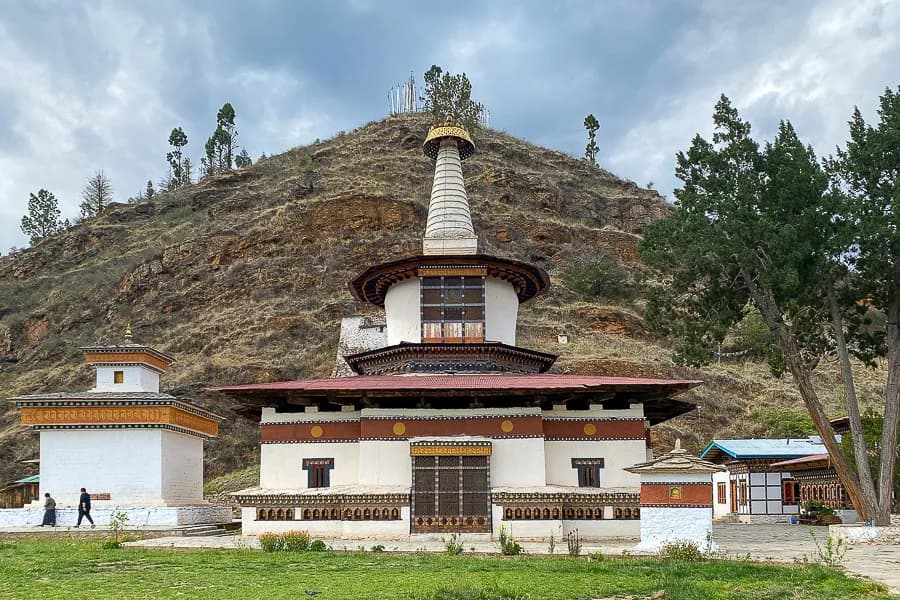
Jangtsa Dumtseg Lhakhang — a rare temple built in the shape of a chorten, founded by the iron-bridge saint Thangtong Gyalpo.
Jangtsa Dumtseg Lhakhang — usually shortened to Dumtseg — is one of the very few temples in Bhutan built in the form of a chorten (a stupa), rising in three diminishing storeys near Paro town. It was founded in the early 15th century, commonly dated 1421, by Thangtong Gyalpo, the great Tibetan adept, engineer, and builder of iron-chain suspension bridges. The three storeys represent ascending realms of Buddhist cosmology, and the interior holds one of the finest surviving collections of lineage and tantric wall paintings in the country — which makes Dumtseg a quiet treasure for visitors with a serious interest in Bhutanese sacred art.
Also known as Dumtseg Lhakhang · Dumtse · Jangtsa Dumtse
- Location
- Across the Pa Chhu from Paro town, Paro
- Founded
- 1421
- Founder
- Thangtong Gyalpo
- Elevation
- 2,280 m
- Kind
- lhakhang
A temple in the shape of a chorten
Most Bhutanese temples are halls; Dumtseg is one of the rare lhakhangs built as a chorten — a stupa — which makes its form immediately unusual. It rises in three diminishing storeys, each a circular chamber, connected by steep internal ladders. The three levels are understood to represent ascending realms of Buddhist cosmology and the stages of the path: the lower for the realms of existence, the middle for the bodhisattva grounds, the upper for the buddha-fields. To climb from the base to the top is to move, in symbol, through the whole structure of the Buddhist universe — the architecture itself a teaching.
Thangtong Gyalpo, the iron-bridge saint
Dumtseg was founded in the early 15th century — most sources give 1421 — by Thangtong Gyalpo (1385–1464), one of the most remarkable figures of the Himalayan Buddhist world: a tantric adept, a terton (treasure-revealer), a physician, a pioneer of Tibetan opera, and above all an engineer who built dozens of iron-chain suspension bridges across the rivers of Tibet and Bhutan, earning him the name Chakzampa, 'the iron-bridge maker'. He is held to have built Dumtseg to pin down and pacify a harmful serpent-spirit at the site — the recurring founding motif of his structures, which fused the practical (a bridge, a temple) with the spiritual (subduing the forces that troubled a place). His iron bridge at Tachogang, on the Paro–Thimphu road, is part of the same legacy.
The murals
The interior of Dumtseg holds one of the finest and most complete sets of wall paintings in Bhutan — a reason the temple matters far beyond its unusual shape. The three storeys are painted, floor to ceiling, with the deities, lineage masters, and mandalas of the Drukpa Kagyu and broader tantric traditions, arranged so that the iconography ascends in step with the architecture. For visitors and scholars with an interest in Bhutanese sacred art, the murals are the principal draw; they are old, rare in their completeness, and light-sensitive, which is why the interior is kept dim and photography is not permitted. The matched guide, or a knowledgeable temple caretaker, reads the paintings for the visitor by torchlight.
Visiting
- Getting there
- Dumtseg stands on a low rise across the Pa Chhu from Paro town, a short drive from the centre — easily combined with the Paro town walk, Rinpung Dzong, and the National Museum into a single cultural day in the valley. The matched guide arranges the stop.
- Inside the temple
- The three storeys are connected by steep, ladder-like internal stairs, climbed one visitor at a time; the chambers are small and dim to protect the murals. Allow 30–45 minutes. Visitors who are uneasy on steep ladders should mention it to the guide, who can describe the upper levels rather than insist on the climb.
- Dress and protocol
- Standard temple protocol — shoulders and knees covered, shoes and hats removed, voices low. No photography inside (the murals are old and light-sensitive); the exterior chorten form is freely photographable. A torch helps to read the paintings, which the caretaker or guide carries.
- Best time to visit
- Year-round — Dumtseg is indoor and weather-independent, and at the lower Paro elevation it is comfortable in every season. It is an easy and rewarding addition to any Paro cultural day, and a quiet contrast to the valley's busier sites.
Journeys featuring this site
 JourneyThe signature-tier Bhutan journey — private knowledgeable guide, the most considered lodge curation, helicopter or charter between valleys, exclusive-use arrangements where the season allows.The signature-tier Bhutan journey. Private knowledgeable guide, the most considered lodges, helicopter or PC-24 charter, exclusive-use arrangements. By invitation, from USD 14,000.
 JourneyOctober light, Bhutan, a week.A seven-night Bhutan photography journey in October — Bhutan, golden-hour access at Punakha Dzong, a tripod-friendly guide, and transparent pricing.
Frequently asked
- What makes Dumtseg unusual?
- Two things: it is one of the very few Bhutanese temples built in the shape of a chorten (a stupa) rather than as a hall, rising in three symbolic storeys; and its interior holds one of the finest, most complete sets of old wall paintings in the country. The combination — a rare form and superb murals — makes it a quiet treasure, especially for visitors interested in Bhutanese sacred art.
- Who was Thangtong Gyalpo?
- A 15th-century Tibetan adept, treasure-revealer, physician, and engineer (1385–1464), famous above all for building iron-chain suspension bridges across the Himalayan rivers — which earned him the name Chakzampa, 'the iron-bridge maker'. He founded Dumtseg, and his iron bridge survives at Tachogang on the Paro–Thimphu road. He is one of the most beloved figures of the Bhutanese religious imagination.
- Can I photograph the murals?
- No — the interior murals are old and light-sensitive, so photography is not permitted inside (and the chambers are kept dim for the same reason). The exterior of the chorten-shaped temple is freely photographable. The guide or caretaker reads the paintings for you by torchlight, which is the best way to appreciate them.

