A Bhutanese nunnery
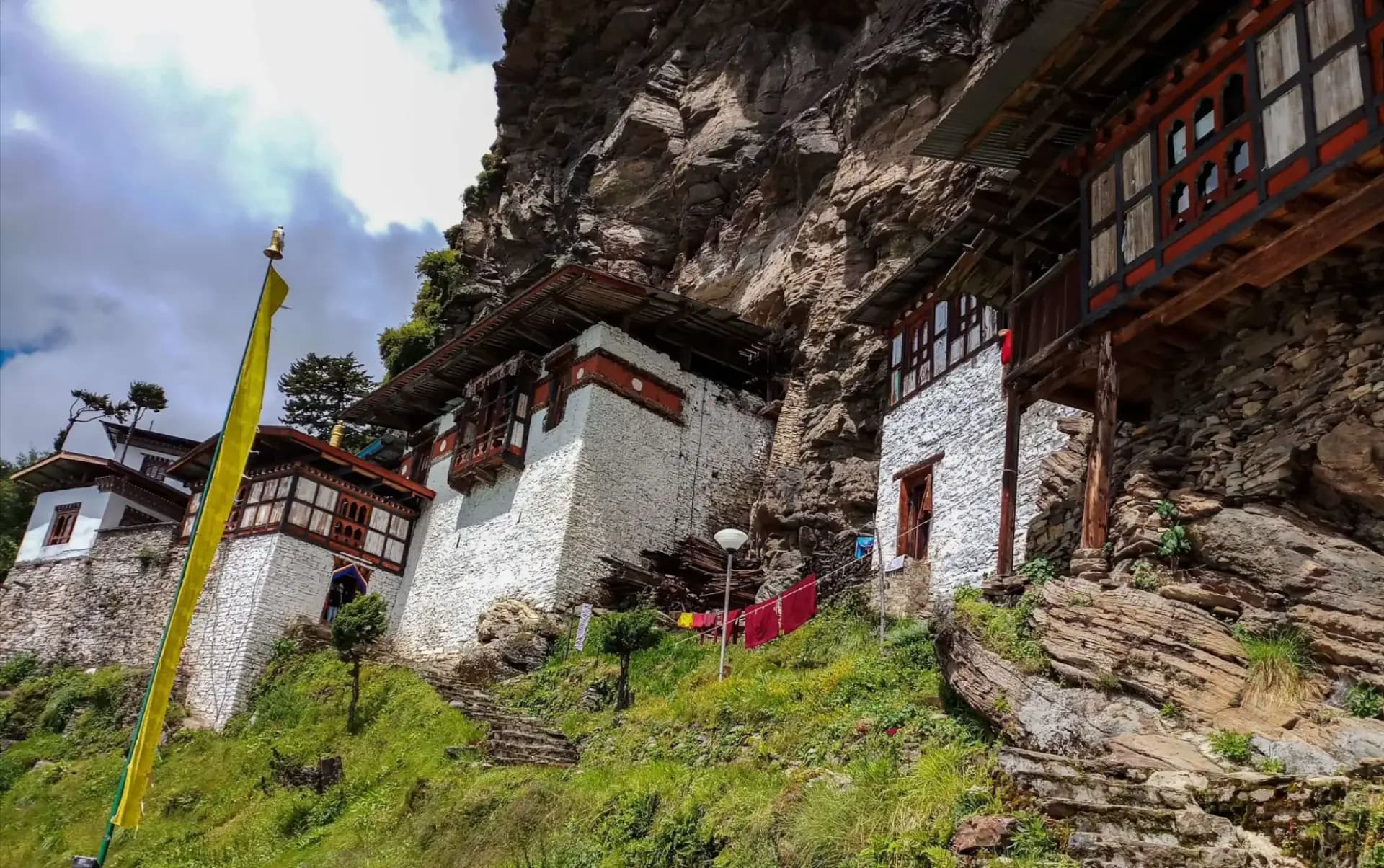
Kila Nunnery — among the oldest nunneries in Bhutan, set on the cliff ledges below the Chele La pass.
Kila Goemba — Kila Nunnery — clings to a series of rock ledges on the mountainside below the Chele La pass, between the Paro and Haa valleys. Among the oldest nunneries in the country, it is home to a community of anim (Buddhist nuns) who live and meditate in the cliff-set retreat huts and shrines. Reached by a forest walk down from the Chele La road, it is one of the most serene and least-visited religious sites within reach of Paro — a place of quiet devotion rather than spectacle.
Also known as Kila Goemba · Kila Gompa · Chele La nunnery
- Location
- Cliff ledges below Chele La, between Paro and Haa, Paro
- Elevation
- 3,500 m
- Kind
- lhakhang
A nunnery on the cliff
Kila Goemba is built into a series of rock ledges on the steep mountainside below the Chele La pass — the shrines, prayer rooms, and the small retreat huts of the nuns set one above another against the cliff, linked by narrow paths. It is held to be among the oldest nunneries in Bhutan, long a place of meditation retreat before the present community grew around it. The setting is the substance of the place: a community of religious women living in deep quiet on a high forested ledge, the prayer flags strung between the rocks, the valley falling away below and the peaks of the Chele La ridge rising above.
The community of anim
Kila is home to a community of anim — Bhutanese Buddhist nuns — who live, study, and meditate at the goemba. Some are in extended retreat; others maintain the shrines and the daily round of prayer. A visit to Kila is a visit to a working religious community rather than a monument, and it carries a particular atmosphere because of it: the unhurried devotion of women who have chosen the contemplative life on a remote cliff. Visitors are received with the customary Bhutanese warmth, and the matched guide ensures the visit is conducted with the quiet respect the community's life deserves.
The Chele La connection
Kila sits below Chele La, the 3,988-metre pass that carries the road from Paro over to the Haa valley — the highest motorable road in Bhutan. The classic way to reach the nunnery is to drive up to the pass (itself a destination for the prayer-flag-draped saddle and the views towards Jomolhari and the Haa valley) and then walk down through the forest to Kila. The pairing — the high windswept pass and the cliff nunnery below — makes a memorable half-day from Paro, and a quieter, more contemplative one than the valley's busier sites.
Visiting
- Getting there
- The usual approach is to drive from Paro up to the Chele La pass (about 1.5 hours, a substantial climb on a winding road), then walk down through forest to the nunnery — roughly 45 minutes to an hour down, and a steeper climb back up. The matched guide arranges the drive, the walk, and the timing, and can advise on whether the road is clear (snow can affect the pass in deep winter).
- The walk
- The path down to Kila is a forest descent — moderate, on uneven ground, with the return being the harder uphill leg. Sturdy walking shoes are needed. The altitude (the pass is near 4,000 metres) means visitors should take the walk at a measured pace; the matched guide watches the party's comfort with the elevation.
- Dress and protocol
- Standard temple protocol — shoulders and knees covered, shoes and hats removed before entering the shrines, no photography inside. Because Kila is a working nunnery and a place of retreat, the register is especially quiet and respectful; visitors keep their voices low and follow the guide's lead on which areas are open. A small offering to the nunnery is customary and appreciated.
- Best time to visit
- Spring through autumn (April–November) is the reliable window; the Chele La road can be affected by snow in deep winter (December–February), and the guide confirms access before the day. Clear-weather days give the finest views from the pass towards Jomolhari and across to Haa.
Journeys featuring this site
 JourneyThe signature-tier Bhutan journey — private knowledgeable guide, the most considered lodge curation, helicopter or charter between valleys, exclusive-use arrangements where the season allows.The signature-tier Bhutan journey. Private knowledgeable guide, the most considered lodges, helicopter or PC-24 charter, exclusive-use arrangements. By invitation, from USD 14,000.
 JourneySeven nights with a monastic guide, in the still season.A seven-night Bhutan meditation retreat through Clear-Sky Bhutan (Dec–Feb). Daily sittings with a monastic-trained guide, hot stone baths, no festival noise.
Frequently asked
- What is special about Kila Nunnery?
- Two things: it is among the oldest nunneries in Bhutan, and it is a working community of Buddhist nuns living in cliff-set retreat on a remote forested ledge below Chele La. Unlike the valley's busier monuments, Kila is a place of quiet devotion rather than spectacle — its value is the atmosphere of a contemplative community in a striking high setting.
- How do you reach Kila Nunnery?
- By driving up to the Chele La pass from Paro (about 1.5 hours) and then walking down through forest to the nunnery — roughly 45–60 minutes down, with a steeper climb back. The pass itself, the highest motorable road in Bhutan at 3,988 metres, is part of the visit. The matched guide arranges the day and confirms the road is clear.
- Is it suitable for all visitors?
- It requires a forest walk on uneven ground at high altitude (near 4,000 metres at the pass), with an uphill return — so a reasonable level of fitness and comfort with elevation is needed. The matched guide briefs honestly on the demands and watches the party's pace; visitors who would prefer a gentler cliff visit may choose Dzongdrakha in the lower valley instead.

