A Bhutanese temple
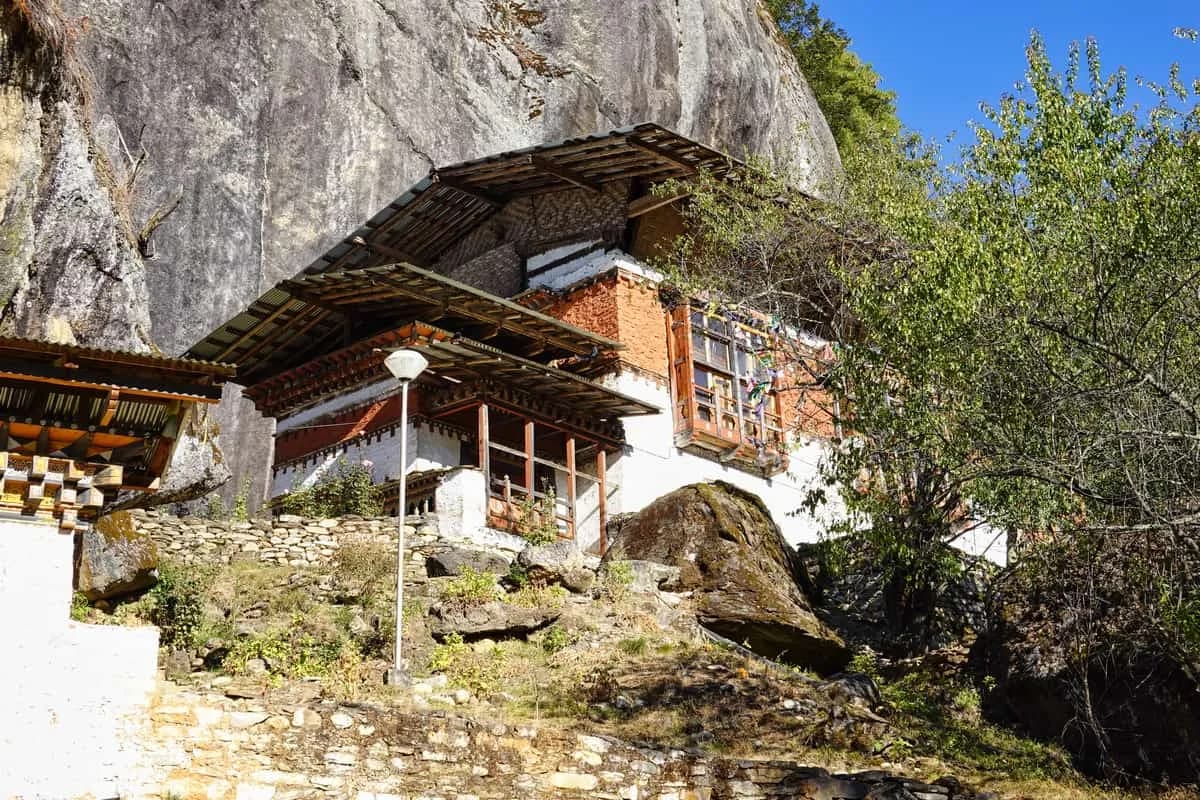
Tang Rimochen Lhakhang — a temple built where Guru Rinpoche left his marks in the tiger-striped rock.
In the remote Tang valley of Bumthang, Tang Rimochen Lhakhang stands against a great rock face streaked with natural markings — 'Rimochen' means 'the one with marks', and the stripes are read as the print of the tiger-skin robe of Guru Rinpoche, who meditated here in the 8th century. The temple, associated with the treasure-revealer Pema Lingpa, marks one of the valley's most sacred sites, and below it, set in and beside the river, are boulders bearing what the faithful hold to be the body imprints of Guru Rinpoche and his consorts. It is a place of pilgrimage and quiet power rather than grandeur.
Also known as Rimochen Lhakhang · Tang Rimochen
- Location
- Tang valley, Bumthang, Bumthang
- Founder
- Associated with Pema Lingpa
- Elevation
- 2,840 m
- Kind
- lhakhang
The marked rock
Tang Rimochen takes its name — 'the one with marks' — from the great rock face against which it is built, streaked with natural patterns that Bhutanese tradition reads as the imprint of the tiger-skin robe of Guru Rinpoche, the master who brought Vajrayana Buddhism across the Himalaya in the 8th century and who is held to have meditated at this spot. To stand before the striped rock is to stand at one of the places where the landscape itself is understood to carry the memory of the Guru's presence — the kind of site, common in Bhutan, where geology and devotion meet, and the rock becomes a relic.
The temple and the imprints
The temple at Rimochen is associated with Pema Lingpa (1450–1521), the great Bumthang-born treasure-revealer, and it serves the sacred site as a place of worship and pilgrimage. Below the temple, in and beside the Tang river, lie large boulders bearing depressions and shapes that the faithful hold to be the body imprints of Guru Rinpoche and his consorts, left in the once-soft rock. Pilgrims come to make offerings, to circumambulate, and to touch the marked stones. It is a modest temple by the measure of Bhutan's great dzongs, but its power lies in the site rather than the scale — a holy place in a quiet valley, far from the crowds.
The Tang valley pilgrimage
Rimochen belongs to the sacred geography of the Tang valley, the most remote of Bumthang's four valleys, which also holds Mebar Tsho — the Burning Lake where Pema Lingpa performed his famous miracle — and the manor museum of Ugyen Choling. Together they make the Tang valley a place of pilgrimage and quiet discovery, away from the busier Choekhor valley with its great temples. A visitor with time and an interest in the Guru Rinpoche and Pema Lingpa traditions finds in Tang a concentration of sacred sites in an unhurried, pastoral landscape.
Visiting
- Getting there
- Tang Rimochen is in the Tang valley, reached by the side road up from the Bumthang (Choekhor) valley and a short walk to the temple and the riverside imprint stones. The matched guide arranges the drive, usually within a Tang-valley day that includes Mebar Tsho and Ugyen Choling.
- What to see
- The temple against the marked rock, the striped rock face itself, and the imprint boulders by the river below. Allow 45 minutes to an hour, with a little gentle walking to reach the riverside stones. The matched guide or the temple caretaker explains the marks and the Guru Rinpoche and Pema Lingpa associations.
- Dress and protocol
- Standard temple protocol — shoulders and knees covered, shoes and hats removed before the shrine, no photography inside. The site is one of active pilgrimage; visitors follow the clockwise circumambulation and keep the quiet, respectful register of a holy place.
- Best time to visit
- Year-round, with the Bumthang autumn and spring the loveliest. The Tang valley is high and can be cold; a warm layer helps. The site pairs best with at least a few nights in Bumthang to allow the unhurried Tang-valley day it deserves.
Journeys featuring this site
 JourneyThe signature-tier Bhutan journey — private knowledgeable guide, the most considered lodge curation, helicopter or charter between valleys, exclusive-use arrangements where the season allows.The signature-tier Bhutan journey. Private knowledgeable guide, the most considered lodges, helicopter or PC-24 charter, exclusive-use arrangements. By invitation, from USD 14,000.
 JourneyTen nights for the Buddhist pilgrim — the principal sites, with monastic context.A ten-night Bhutan Buddhist pilgrimage for Asian-Buddhist travellers. Monastic context; matched monastic-trained guide; Bumthang religious circuit.
Frequently asked
- What does 'Rimochen' mean?
- 'The one with marks' — a reference to the natural stripes in the great rock face the temple is built against, which Bhutanese tradition reads as the imprint of Guru Rinpoche's tiger-skin robe, left when he meditated here in the 8th century. The site is one where the landscape itself is held to carry the memory of the Guru's presence.
- What are the imprint stones?
- Below the temple, in and beside the Tang river, lie large boulders bearing depressions and shapes that the faithful hold to be the body imprints of Guru Rinpoche and his consorts, left in the once-soft rock. Pilgrims make offerings and touch the marked stones. They are part of what makes Rimochen a place of devotion rather than spectacle.
- Is Tang Rimochen worth the trip into the Tang valley?
- For visitors drawn to the Guru Rinpoche and Pema Lingpa traditions and to Bhutan's sacred landscape, yes — and the Tang valley rewards the journey with a concentration of holy sites (Rimochen, Mebar Tsho) and the manor museum of Ugyen Choling, all in a remote, pastoral valley away from the crowds. It is best combined into a full Tang-valley day from Jakar.

