A Bhutanese dzong
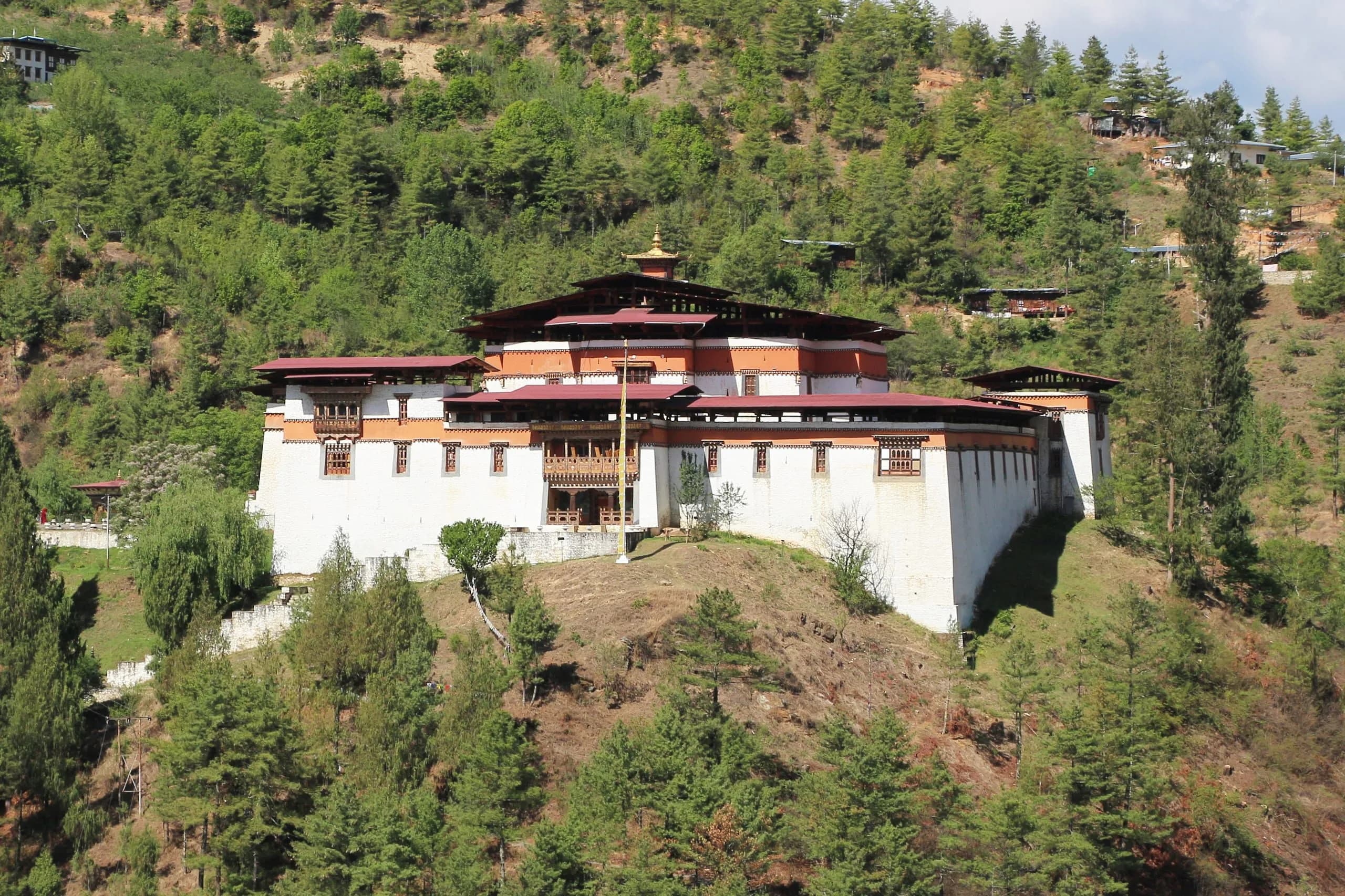
Simtokha Dzong — built in 1629 by the Zhabdrung, the oldest surviving dzong in Bhutan.
Simtokha Dzong, on a ridge a few kilometres south of Thimphu, is the oldest surviving dzong in Bhutan — the first that Zhabdrung Ngawang Namgyal built, in 1629, as he began to unify the country. Its formal name, Sangak Zabdon Phodrang, means 'the palace of the profound meaning of secret mantras'; its strategic site once guarded the junction of the routes from Paro, Thimphu, and the south. Today it houses an institute of language and cultural studies, and a visitor comes for its place at the very beginning of the dzong tradition — and for the celebrated carved-slate reliefs set into its inner gallery.
Also known as Sangak Zabdon Phodrang · Semtokha Dzong
- Location
- On the ridge ~5 km south of Thimphu, Thimphu
- Founded
- 1629
- Founder
- Zhabdrung Ngawang Namgyal
- Elevation
- 2,350 m
- Kind
- dzong
The first dzong
When Zhabdrung Ngawang Namgyal arrived in Bhutan in 1616 and set about unifying the warring valleys under a single religious-political authority, the dzong — the fortified monastery-and-administration complex — became his principal instrument. Simtokha, built in 1629, was the first he raised, and it is the oldest dzong still standing in the country. Its position was deliberate: on a ridge commanding the junction where the routes from Paro, from the Thimphu valley, and from the south came together, it controlled the approaches to the heart of the country. The name is popularly read as 'atop a demon' — the dzong built over a spot where a troublesome spirit was subdued and pinned, the recurring Bhutanese motif of the sacred structure that pacifies the ground it stands on.
The carved slates
Simtokha's particular treasure is a set of carved-slate reliefs set into the wall of the gallery that runs around the inner courtyard — finely worked stone panels depicting saints and deities of the tradition, among the oldest and finest such carvings in Bhutan. With the murals of the central tower (the utse), dedicated to the deities of the secret-mantra teachings that give the dzong its formal name, they make Simtokha a place of real art-historical depth beneath its modest size. The dzong has been damaged and repaired across the centuries — including an early attack and fire in the years after its founding — but its core and its carvings have carried through.
A living institution
Like every Bhutanese dzong, Simtokha has never been a museum-piece but a working building. For decades it has housed an institute for the study of the Dzongkha language and Bhutanese cultural studies, so that a visitor walking its galleries shares the dzong with students and teachers carrying the older learning forward. The combination — the oldest dzong in the country, still in daily use as a place of Bhutanese scholarship — is characteristic of how the country keeps its heritage: not behind glass, but in service.
Visiting
- Getting there
- Simtokha is about five kilometres south of Thimphu on the ridge above the road junction, a 15-minute drive from the city centre — easily added to a Thimphu day or visited on the way in or out towards Paro or Dochu La. The matched guide arranges the stop.
- What to see
- Allow 45–60 minutes for the courtyard, the carved-slate gallery, and the utse (central tower) shrines where access is permitted. The matched guide reads the slate carvings and the tower murals, which reward an unhurried look. As a working institute, parts of the dzong are given over to study and not open; the guide knows the visiting areas.
- Dress and protocol
- Standard dzong protocol — shoulders and knees covered, hats and shoes removed before the shrines, no photography inside the temples (the courtyard and exterior are freely photographable). Voices low; the dzong is a place of study and worship.
- Best time to visit
- Year-round — Simtokha is comfortable in every season at the Thimphu-valley elevation, and its indoor shrines are weather-independent. It makes an excellent first or last stop in the Thimphu area, framing the dzong tradition for everything else the journey holds.
Journeys featuring this site
Journeys that visit Simtokha Dzong
Frequently asked
- Why does Simtokha matter?
- It is the oldest surviving dzong in Bhutan — the first that Zhabdrung Ngawang Namgyal built, in 1629, at the very beginning of the dzong tradition that came to define the Bhutanese state. For a visitor, it frames the whole architecture: every later dzong (Punakha, Trongsa, Tashichho) descends from the model Simtokha began. Its carved-slate reliefs are also among the finest old stone carvings in the country.
- Is Simtokha open to visitors?
- Yes, the courtyard, the carved-slate gallery, and the central-tower shrines are open to visitors during the day, with the matched guide. Because the dzong also houses a working institute of language and cultural studies, some areas are given over to teaching and not open — the guide knows which spaces visitors enter.
- How long does a visit take?
- About 45–60 minutes, which is enough for the courtyard, the slate carvings, and the tower shrines. It is a compact dzong, easily combined with the rest of a Thimphu day or visited on the drive in or out of the city.

