A Bhutanese royal palace
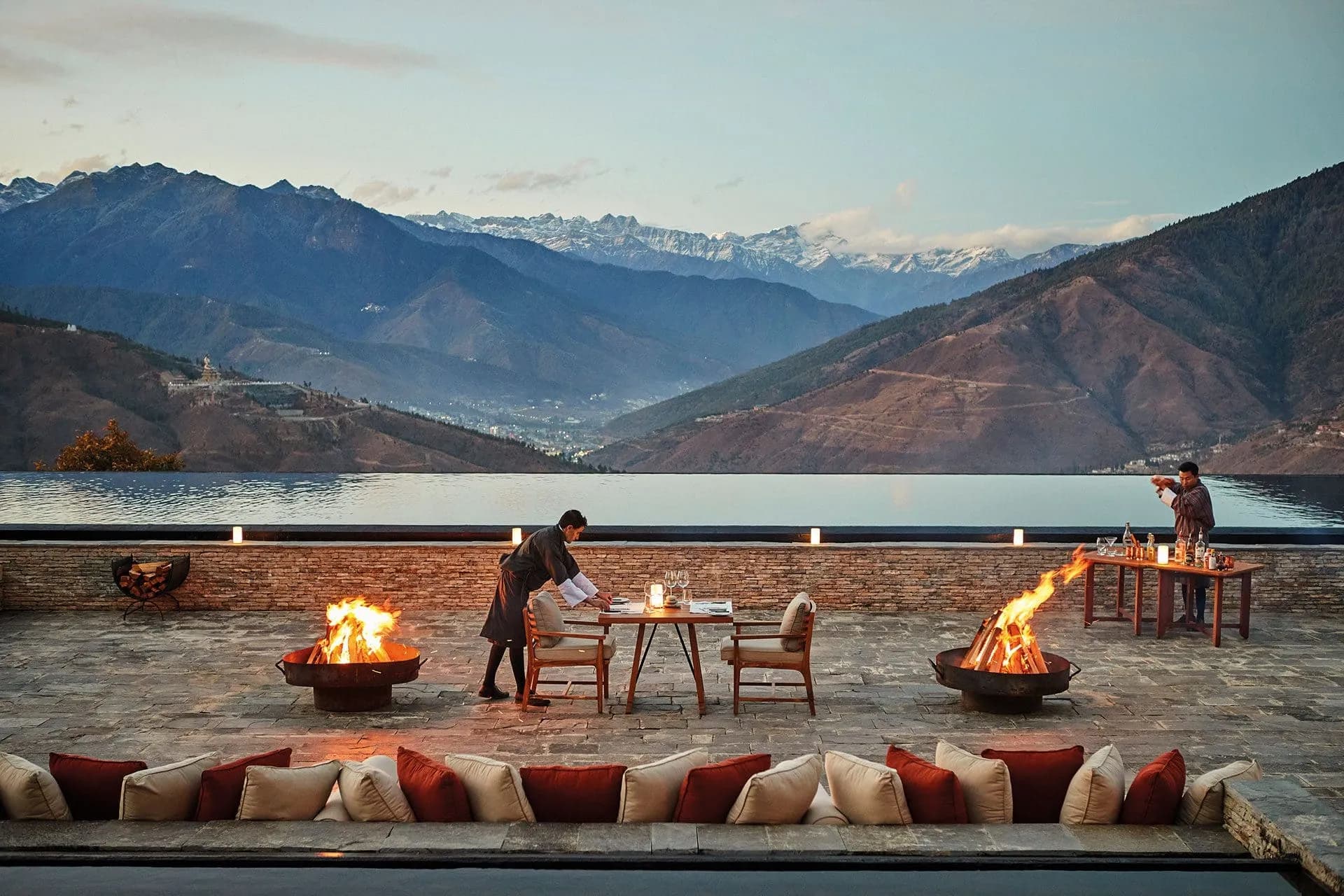
Thruepang Palace — birthplace of His Majesty the Third Druk Gyalpo, on the ridge below Trongsa Dzong.
Thruepang Palace sits on the ridge below Trongsa Dzong, looking out over the Mangde Chhu gorge in the central Bhutanese region. Built across the 1920s by His Majesty the Second Druk Gyalpo Jigme Wangchuck as a Trongsa-anchor royal residence, the palace is principally remembered as the birthplace of Crown Prince Jigme Dorji Wangchuck on 2 May 1928 — the future His Majesty the Third Druk Gyalpo. The palace operates today as a heritage site under conservation by the Department of Culture and is part of the broader Trongsa cultural visit.
Also known as Thruepang Phodrang · Trongsa Thruepang
- Location
- On the ridge below Trongsa Dzong, Trongsa
- Founded
- 1924
- Founder
- His Majesty the Second Druk Gyalpo Jigme Wangchuck
- Elevation
- 2,200 m
- Kind
- palace
The Trongsa anchor
Across the 1920s, His Majesty the Second Druk Gyalpo Jigme Wangchuck — newly ascended in 1926 following the death of His father His Majesty Ugyen Wangchuck — sought a Trongsa-anchor royal residence to complement Wangduecholing Palace in Bumthang (his principal Bhutanese central-region residence) and the broader Trongsa Penlop tradition. The Trongsa region was the historical ancestral seat of the Wangchuck dynasty — His Majesty Ugyen Wangchuck had been Trongsa Penlop before His 1907 coronation, and the Trongsa-anchor tradition operated as the institutional inheritance. Thruepang Palace was built on the ridge below Trongsa Dzong, looking out over the Mangde Chhu gorge — an exceptional siting that combined the Trongsa-anchor symbolism with the practical residential function.
The birth of His Majesty the Third Druk Gyalpo — 2 May 1928
On 2 May 1928 at Thruepang Palace, Crown Prince Jigme Dorji Wangchuck was born to Her Majesty Queen Pheuntsho Choedon — the only child by His Majesty's elder Queen. The birth at Thruepang was the principal Bhutanese royal-family event of the 1920s; the future Third Druk Gyalpo's early childhood was principally anchored at Thruepang and at Wangduecholing across the subsequent years. The 2 May date later became part of the contemporary Bhutanese calendar — His Majesty's birthday was observed nationally across His reign. The contemporary heritage-site status of Thruepang centres on the birth-narrative; visitors are taken through the room in which the birth occurred where the conservation status permits.
The contemporary heritage status
Thruepang Palace operates today as a heritage site under conservation by the Department of Culture. The structure — a classic 1920s Bhutanese royal-residence building, mid-sized and with the characteristic painted-woodwork-and-stepped-pagoda register — sits on the ridge with a sweeping view across the Mangde Chhu gorge. The Trongsa Dzong itself is visible above the palace; the Royal Heritage Museum at Trongsa Ta Dzong is a short walk further up the ridge. The combined effect is one of the more rewarding historical-circuit visits in central Bhutan — Thruepang as the birth-anchor of the Third Druk Gyalpo, Trongsa Dzong as the dynastic-institutional anchor, the Royal Heritage Museum as the interpretive anchor.
Visiting
- Getting there
- Thruepang Palace is in Trongsa town itself, on the ridge below the dzong. The walking access from Trongsa Dzong is approximately 10-15 minutes downhill; the driving access is a short loop on the principal Trongsa road. The matched guide arranges Thruepang as part of the standard Trongsa cultural visit alongside the dzong and the Royal Heritage Museum at Trongsa Ta Dzong.
- Opening hours and access
- The palace is under conservation; the exterior, the courtyard, and the immediate grounds are open to visitors during standard daylight hours. Specific interior access varies with conservation status; the matched guide confirms ahead of the visit. Allow 45-60 minutes for the on-site visit including the contextual narrative.
- The Trongsa circuit
- The principal Trongsa visit combines three sites: Trongsa Dzong (the principal dynastic-institutional anchor, the seat of every Druk Gyalpo before coronation — 30-45 minutes), Thruepang Palace (the birthplace of the Third Druk Gyalpo, on the ridge below — 45-60 minutes), and the Royal Heritage Museum at Trongsa Ta Dzong (the principal dynastic interpretation, on the ridge above — 90-120 minutes). The combined circuit is the canonical historical-cultural visit for visitors with serious interest in the Wangchuck dynastic narrative; the matched guide arranges the sequence and the contextual transition between sites.
- Best time to visit
- Year-round. The Trongsa region (2,200 m) has the most-stable weather across the central Bhutanese areas; October-May is the principal visiting window with clear skies. The view across the Mangde Chhu gorge is particularly striking in the autumn dry season (October-November) and the spring (March-May). Winter (December-February) is cold; summer (June-September) brings heavy monsoon cloud.
Journeys featuring this site
Frequently asked
- Is Thruepang Palace worth visiting alongside Trongsa Dzong?
- Yes — the two sites are deeply complementary and the combined Trongsa visit is one of the principal Bhutanese historical-cultural circuits. Trongsa Dzong carries the dynastic-institutional register (every Druk Gyalpo's pre-coronation seat as Trongsa Penlop); Thruepang carries the residential-personal register (the birthplace of His Majesty the Third Druk Gyalpo). Together with the Royal Heritage Museum at Trongsa Ta Dzong above, the three-site Trongsa visit takes most of a day and is the canonical historical-anchor visit for visitors with serious interest in the dynasty.
- Can a visitor enter the room where the Third Druk Gyalpo was born?
- Depending on the conservation status at the time of the visit, yes — the birth-room at Thruepang Palace is one of the principal interpretive registers of the site and is shown to visitors where the conservation work permits. The room carries appropriate respect-protocol — the matched guide briefs on the appropriate behaviour. Where the room itself is not accessible due to ongoing conservation, the Royal Heritage Museum at Trongsa Ta Dzong has rich photographic-and-document materials on the period.
- How does Thruepang relate to the other Wangchuck palaces?
- Thruepang is part of a multi-palace network the dynasty has operated across its history. Wangduecholing in Bumthang (built 1857 by Jigme Namgyel) — the founding-era anchor, residence of the Second Druk Gyalpo. Kuenga Rabten on the Mangde Chhu (built 1930s) — the Second Druk Gyalpo's winter palace, where He passed away in 1952. Thruepang in Trongsa (built 1920s) — the Trongsa-anchor residence, birthplace of the Third Druk Gyalpo. Dechencholing in Thimphu (built 1952+) — the principal contemporary royal-family residence from the Third Druk Gyalpo onward. The matched guide briefs on the broader palace circuit where the conversation calls for it.

