A Bhutanese national museum
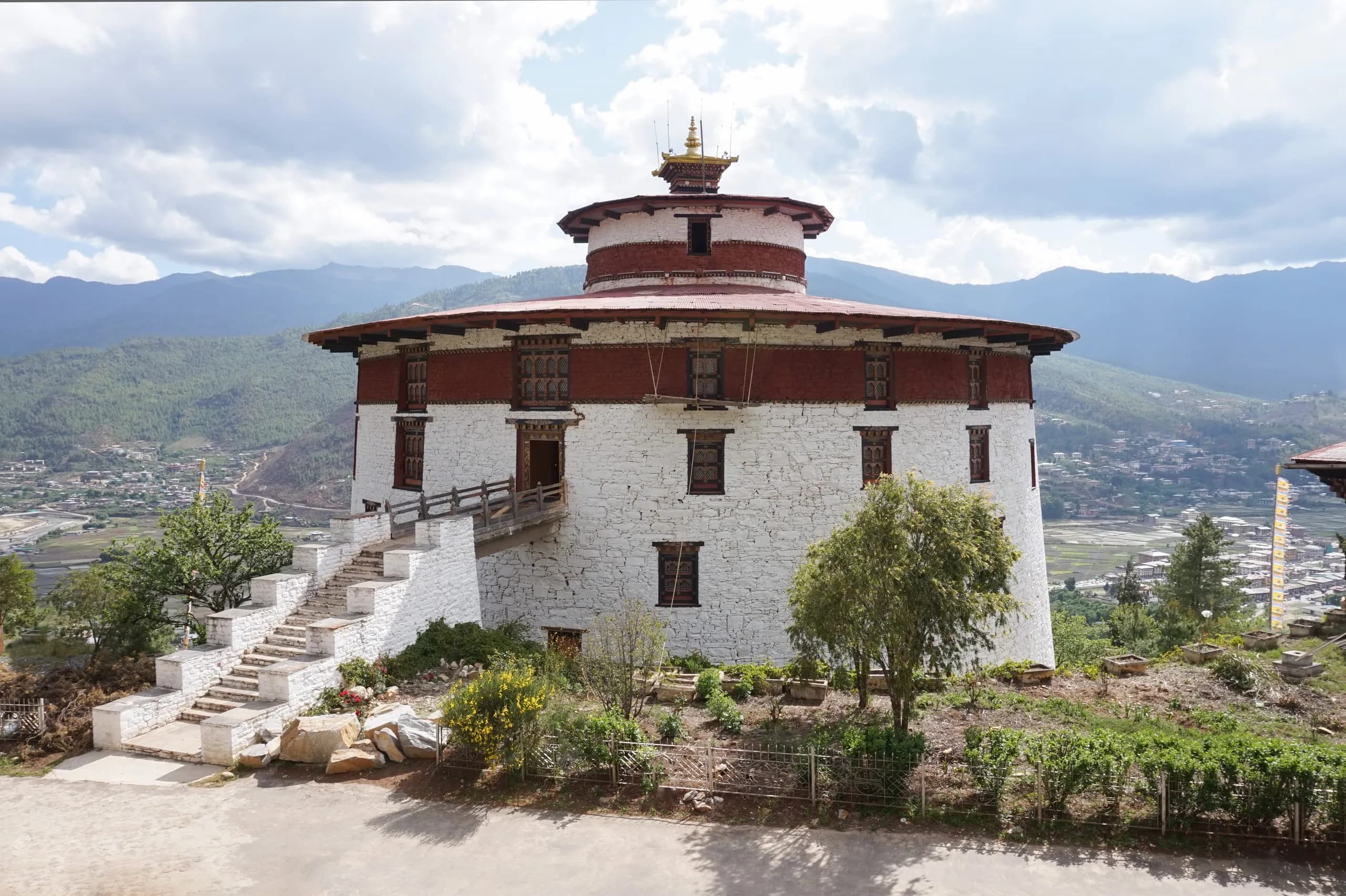
The National Museum of Bhutan — housed in the round Ta Dzong watchtower above Rinpung Dzong.
The National Museum of Bhutan occupies the Ta Dzong — the cylindrical watchtower built in 1649 on the ridge above Rinpung Dzong to guard the Paro valley. Converted into the national museum in 1968 under His Majesty the Third Druk Gyalpo, it holds the principal national collection: thangka paintings, bronze statuary, textiles, arms and armour, ritual objects, natural-history specimens, and the celebrated Bhutanese postage stamps. For a visitor arriving in Paro, it is the single best half-day introduction to the whole arc of Bhutanese art and history.
Also known as National Museum · Ta Dzong Paro · Paro Ta Dzong
- Location
- On the ridge above Rinpung Dzong, Paro, Paro
- Founded
- 1649
- Founder
- Tenzin Drukdra (Ta Dzong, 1649); converted to museum 1968
- Elevation
- 2,480 m
- Kind
- museum
The watchtower and its conversion
The Ta Dzong was built in 1649 by Tenzin Drukdra, the governor of Paro, as the watchtower (ta dzong) for Rinpung Dzong below — its round form and commanding ridge position let its defenders see the length of the Paro valley and signal the dzong in time of threat. The watchtower role faded across the peaceful centuries that followed, and in 1968 His Majesty the Third Druk Gyalpo Jigme Dorji Wangchuck directed its conversion into the National Museum of Bhutan — the principal national collection, gathered to preserve and present the country's art, history, and natural heritage to Bhutanese and visitors alike. The conversion of a defensive watchtower into a museum is itself characteristic of the modern Bhutanese state: the architecture of an older era adapted, with care, to a new purpose.
The collection
The museum holds the principal national collection across several galleries: thangka paintings (the scroll-painting tradition, including rare and old works); bronze and gilt statuary of the Buddhist pantheon; the textile gallery (the weaving traditions of the country's regions); arms, armour, and the historical weaponry of the dzong-era conflicts; ritual objects, masks, and ceremonial regalia; a natural-history gallery of the country's flora and fauna; and the philatelic gallery of Bhutanese postage stamps, which are internationally collected (including the famous three-dimensional, silk, and talking stamps of the 1960s and 1970s). The galleries are arranged to give a visitor the whole arc of Bhutanese material culture in a single visit.
The 2011 earthquake and the restoration
The September 2011 earthquake that struck eastern and central Bhutan damaged the Ta Dzong structure; the collection was moved for safety to a purpose-built gallery beside the watchtower while the historic building was carefully restored using traditional methods. With the restoration complete, the museum has returned to the Ta Dzong itself. The episode is part of the building's contemporary story — a 17th-century watchtower repaired in the 21st century to continue holding the national collection, the same conservation-and-adaptive-reuse instinct that runs through the country's principal heritage buildings.
Visiting
- Getting there
- The Ta Dzong sits on the ridge directly above Rinpung Dzong; the two are visited together as the principal Paro cultural half-day. Visitors drive up to the museum and can walk down to Rinpung Dzong afterwards (about 15 minutes downhill), crossing the traditional cantilever bridge over the Pa Chhu. The matched guide arranges the combined dzong-and-museum visit on the first or last Paro day.
- Opening hours
- The museum is typically open Tuesday to Sunday, 9am to 4pm (shorter hours in the winter months); closed on Mondays and government holidays. Allow 60–90 minutes for the galleries. Confirm current hours with the matched guide, as they shift seasonally.
- Photography and protocol
- Photography is restricted inside the galleries to protect the light-sensitive thangkas and the collection; the matched guide briefs on where photography is permitted. Standard cultural-site dress applies — shoulders and knees covered. The museum is a dignified national institution; the quiet, respectful register of a temple visit is appropriate.
- Best time to visit
- Year-round — the museum is fully indoor and weather-independent. It pairs naturally with the Rinpung Dzong visit and is an excellent first stop on arrival in Paro, giving the visitor the contextual frame for everything they will see across the rest of the journey.
Festivals held here
Journeys featuring this site
 JourneyThe signature-tier Bhutan journey — private knowledgeable guide, the most considered lodge curation, helicopter or charter between valleys, exclusive-use arrangements where the season allows.The signature-tier Bhutan journey. Private knowledgeable guide, the most considered lodges, helicopter or PC-24 charter, exclusive-use arrangements. By invitation, from USD 14,000.
 JourneyOctober light, Bhutan, a week.A seven-night Bhutan photography journey in October — Bhutan, golden-hour access at Punakha Dzong, a tripod-friendly guide, and transparent pricing.
Journeys that visit The National Museum of Bhutan
Frequently asked
- Is the National Museum worth visiting at the start of a trip?
- Yes — it is the best single introduction to Bhutanese art and history, and visiting it early gives a visitor the frame to understand the dzongs, lhakhangs, thangkas, and festivals they will encounter across the rest of the journey. Many guides recommend it as a first-day Paro stop for exactly this reason.
- How long does the museum take?
- Allow 60–90 minutes for the galleries, plus the short walk down to Rinpung Dzong if you combine the two (the standard arrangement). Visitors with a serious interest in thangka painting or textiles may wish to linger longer in those galleries; the matched guide adapts the pace.
- Can I photograph the collection?
- Photography is restricted inside the galleries to protect the light-sensitive thangkas and historic objects. The exterior of the Ta Dzong and the valley views are freely photographable. The matched guide briefs on the current rules, which the museum sets to conserve the collection.

