Planning your Bhutan journey
Bhutan corporate retreats — the country built for considered group reflection.
Bhutan has emerged across the past several years as one of the principal Asian corporate-retreat destinations. The country's distinctive character — substantial privacy, the considered cultural, the absence of competing distractions (no shopping districts, limited nightlife, no event-density), the lodge infrastructure for groups, and the cultural-and-wellness programming — make it well-suited for small-to-medium executive retreats, partner gatherings, leadership offsites, and the broader reflective-group format. We host corporate retreats from 8 to 50 participants across all of Bhutan's premium lodges.
- Register
- logistics
The short answer
Bhutan suits 8-50 participant corporate retreats particularly well. The premium lodges (Aman, Six Senses, COMO, Zhiwa Ling) accommodate full-group bookings; the Bhutan Spirit Sanctuary specialises in groups. Standard programme: cultural visits + meditation/wellness + offsite reflection. 5-7 nights typical; book 9-12 months in advance for the considered configuration. Group SDF concessions available for 11+ travellers (50% off the standard rate). Helicopter transfers cut driving days for the time-constrained schedule.
Why Bhutan for a corporate retreat
Bhutan's distinctive character makes it well-suited for the corporate-retreat format. Substantial privacy — the country's high-value-low-impact tourism policy keeps the country uncrowded, which means corporate groups rarely encounter competing visitors or anonymous crowd-pressure. The considered cultural register — the slow Bhutanese pace and the absence of competing distractions (no shopping districts, limited nightlife, no event-density) make Bhutan structurally well-suited for reflective group work. Substantial lodge infrastructure for groups — the premium lodges (Aman, Six Senses, COMO, Zhiwa Ling) accommodate full-group bookings of 20-50 participants; the Bhutan Spirit Sanctuary specialises in groups. Cultural-and-wellness programming — meditation, hot stone baths, Sowa Rigpa wellness consultations, traditional archery competitions, monastery visits — all integrate well into a corporate-retreat structure. The non-competing destination — Bhutan is sufficiently distinctive that the destination itself becomes part of the retreat's content rather than a backdrop. Substantial English fluency — the principal lodges, guides, and concierges all operate in fluent English, which removes the language-friction that can complicate retreat dynamics in some Asian destinations.
Group sizes and lodge configurations
Small groups (8-15 participants): comfortable across all premium lodges. The Amankora individual lodges (each ~20 suites) accommodate a small group as a partial buyout; the Six Senses lodges similarly. COMO Uma Paro (29 suites) and Zhiwa Ling (45 suites) can host a small group with private space. Medium groups (16-30 participants): full or near-full lodge buyouts at the smaller properties; partial buyouts at the larger ones. The Bhutan Spirit Sanctuary (24 suites) specialises in this group size — the property's wellness programming is structured for group cohort use. Larger groups (30-50 participants): typically requires multiple-lodge configurations — e.g., the full group splits across Amankora Paro + Amankora Thimphu, or across Six Senses Punakha + Six Senses Gangtey. Coordinated programming across the two lodges. Above 50 participants: rarely run; the Royal Government's high-value-low-impact policy doesn't favour mass-tourism configurations, and the premium-lodge infrastructure constraints become significant.
The standard corporate-retreat programme
Days 1-2 — Arrival and cultural immersion: arrival at Paro, transfer to the lodge, cultural orientation, the Tiger's Nest hike (Day 2 typically). Days 3-5 — Core retreat content: morning meditation or wellness sessions; mid-morning corporate working sessions in the lodge meeting rooms (with the surrounding cultural register as backdrop); afternoon cultural visits or active programming (archery, hot stone bath, monastery visits, valley walks); evening dinner and reflection. Day 6 — Departure transition: a final cultural visit, a closing session, transfer to Paro for departure. Variations: leadership retreats benefit from individual meditation time interspersed with group work; partner-firm gatherings benefit from larger group dinners and joint cultural moments; sales-team incentives benefit from active programming (the day-hikes, the rafting on the Mo Chhu in Punakha).
Specific corporate-retreat experiences
The traditional hot stone bath group session — multiple bathing pavilions arranged in sequence so the group can rotate through; the bath is followed by tea and conversation. The Amankora properties and Bhutan Spirit Sanctuary structure this well. Group meditation with a Bhutanese teacher — a senior monastic instructor leads the group through a guided meditation session, typically with a brief Vajrayana-Buddhist contextual introduction. Suitable as both opening-ceremony and closing-ceremony content. The traditional archery exhibition — Bhutan's national sport, the long-distance bamboo-bow archery format is visually dramatic and the group can participate (with safety-instructed introductions). The Bhutanese hand-washing ceremony — a traditional welcome ceremony for group arrivals, performed by Bhutanese hosts with silk-and-incense; memorable as a retreat-opening moment. The monastic visit with the Q&A — arranged with a senior lama at one of the principal monasteries; the group hears a brief teaching and asks questions; suitable as a mid-retreat reflective punctuation. The traditional Bhutanese feast — a multi-course Bhutanese meal in a heritage farmhouse setting, with the local community participating; memorable as a retreat-closing moment.
Booking, pricing, and the practical
Booking lead time: 9-12 months for the considered configuration (multiple lodges, helicopter transfers, monastery access negotiations). The premium lodges restrict group bookings to a small share of their annual room nights; early booking is structural. Pricing: at the premium tier, USD 6,000-10,000 per participant for 6 nights (lodge accommodation, all meals, SDF, visa, guides, transport, the standard corporate-retreat programme). Luxury tier (USD 12,000-18,000 per participant) includes helicopter transfers, signature dining, and private monastery access. Group SDF concession: groups of 11+ travellers qualify for a Royal Government concession (50% of the standard SDF rate, USD 50/night instead of USD 100/night) on the second 10 nights. The lodge meeting infrastructure: principal lodges have dedicated meeting rooms with AV equipment; the principal premium lodges (Amankora, Six Senses) have professional-conference-grade facilities. Connectivity: WiFi is reliable across the principal lodges; mobile data works in the western towns. The Bhutanese tradition is to actively minimise connectivity during the retreat — many groups choose a 'phones-off' protocol that benefits the reflective work.
Practical
- Typical group size
- 8-50 participants
- Standard retreat length
- 5-7 nights
- Booking lead time
- 9-12 months
- Premium tier
- USD 6,000-10,000 per participant for 6 nights
- Luxury tier
- USD 12,000-18,000 per participant for 6 nights
- Group SDF concession
- 50% off standard rate for groups 11+ on second 10 nights
- Lodge meeting infrastructure
- Professional-conference-grade at principal premium lodges
- Connectivity
- Reliable WiFi at premium lodges; mobile data in western towns
Places it mentions
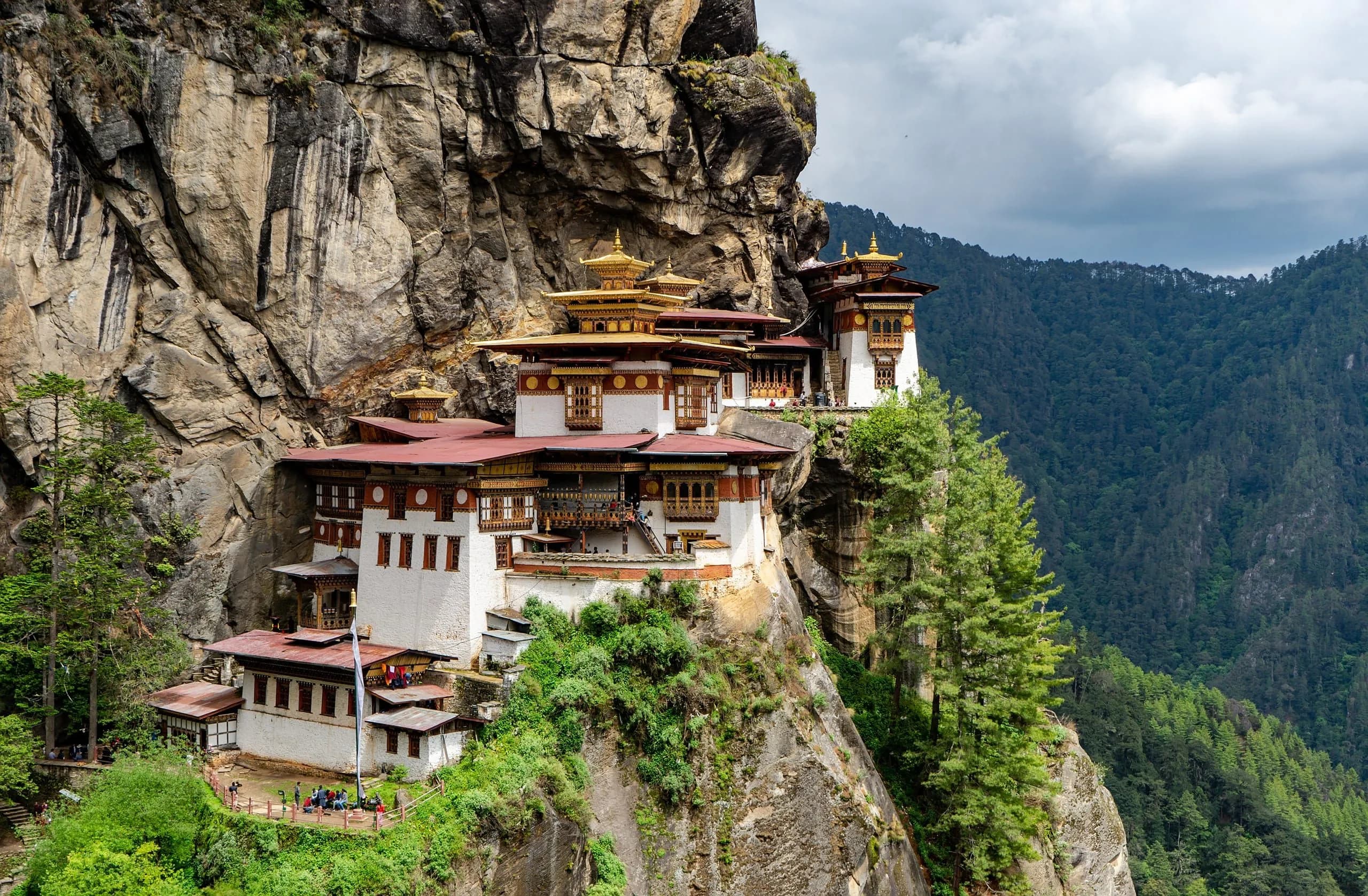 MonumentParo Taktsang — Guru Rinpoche's meditation cave, perched at 3,120 metres on the cliff above the Paro valley.Paro Taktsang (Tiger's Nest) — the founding by Guru Rinpoche, the 1692 monastery, the 2-hour hike, what to know before you visit.
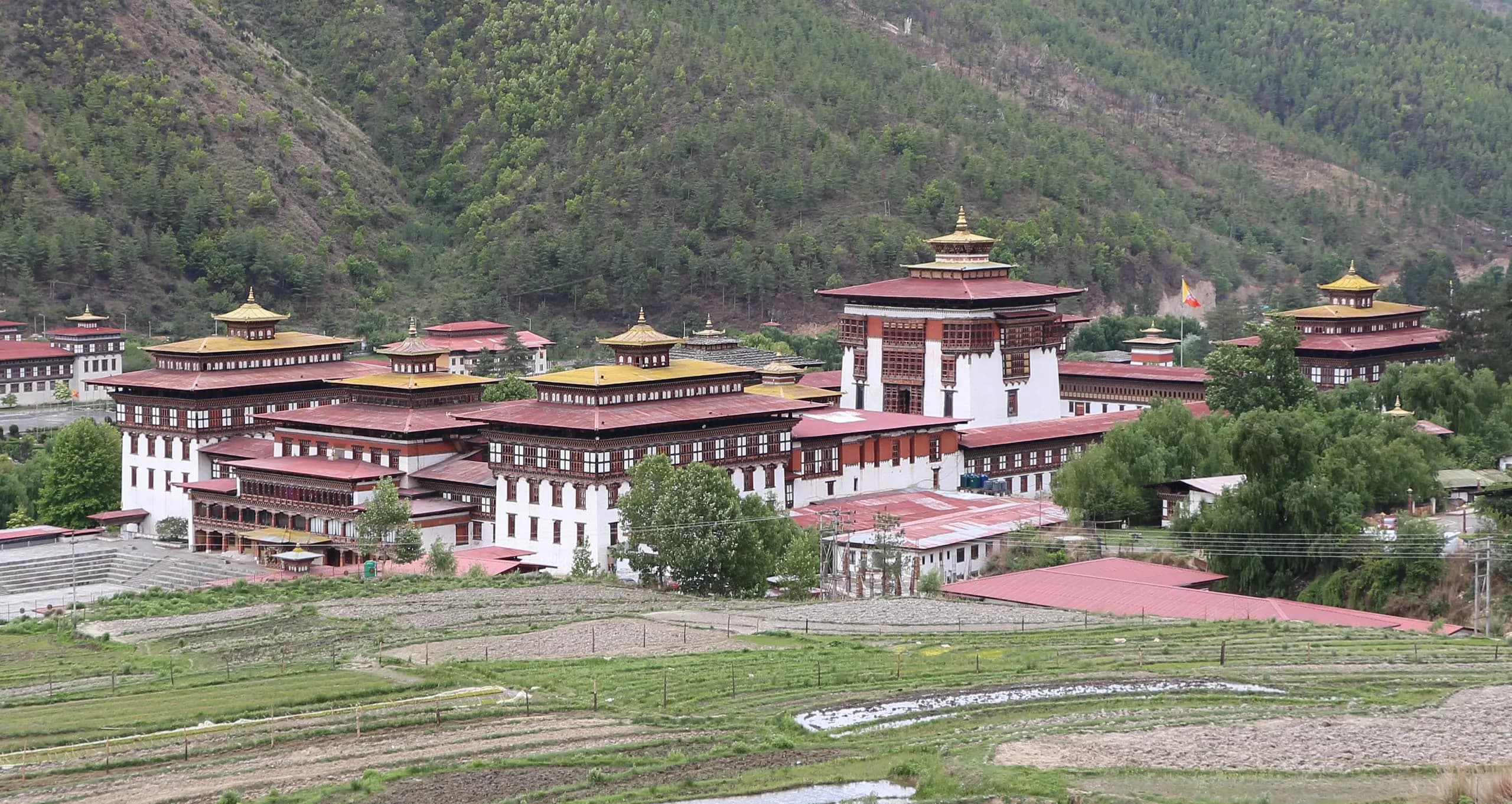 MonumentTashichho Dzong — the fortress of the auspicious religion, at the heart of Thimphu.Tashichho Dzong — the seat of Bhutan's central government and Je Khenpo summer residence in Thimphu. History, architecture, visiting.
Journeys it informs
Frequently asked
- Can we book out a whole lodge for our corporate retreat?
- Yes — full lodge buyouts are available at the principal Bhutanese premium properties. Smaller properties (Amankora individual lodges at ~20 suites; Bhutan Spirit Sanctuary at 24; Zhiwa Ling at 45) accommodate full buyouts for groups of 30-90. Larger groups typically split across two lodges. Lead time: 9-12 months for the considered buyout configuration.
- How does Bhutan compare to other Asian retreat destinations?
- Different. Singapore and Hong Kong are city-based, high-distraction, high-event-density destinations — well-suited for some corporate-retreat formats, less for reflective ones. Bali is similarly busy and increasingly crowded. Sri Lanka and Vietnam are emerging retreat destinations but the premium-lodge infrastructure is thinner. Bhutan's distinctive character — privacy, considered, cultural depth, exceptional lodge infrastructure — makes it well-suited for the reflective retreat format that the other destinations don't quite match.
- Will the retreat be too quiet for our team?
- For some teams, yes — Bhutan's quiet tradition is part of its character and the country actively avoids the high-energy event-density of competing destinations. Teams that benefit from nightlife, intensive social programming, or competing activities will find Bhutan structurally constrained. Teams that benefit from reflective time, cultural depth, and considered conversation typically find Bhutan well-matched.
- What's the WiFi situation?
- Reliable across the principal premium lodges (Amankora, Six Senses, COMO, Zhiwa Ling, Bhutan Spirit Sanctuary). Conference-grade connectivity (Zoom calls, large file transfers, video presentations) is available with advance notification. Mobile data works in the western towns (Paro, Thimphu, Punakha) but is sporadic in the central valleys (Phobjikha, Bumthang) and absent in the eastern circuit and trekking areas. Many corporate retreats choose to mute the connectivity actively — the reflective benefit is part of the value proposition.
- Can we have private monastery access for the retreat?
- Yes, with advance arrangement. The operator coordinates with the Royal Government and the relevant monastic institutions for private access — typically a senior lama performing a blessing ceremony for the group, a private monastery visit before the standard visitor window, or a small-group teaching session. The arrangement requires 8-12 weeks lead time and is part of the Luxury and Signature tier configurations.
- What about partner gatherings or industry conferences?
- Partner gatherings (8-30 participants from a single firm) work well across all premium lodges. Industry conferences (multiple firms, 30-100 participants with keynote and breakout formats) are more constrained — the principal Bhutanese lodge meeting infrastructure tops out at approximately 50-participant conferences. For larger industry gatherings, we typically suggest a different destination or a more-distributed Bhutanese configuration.

