Planning your Bhutan journey
Bhutan travel guides: the planning questions, answered.
The canonical answers to the questions every visitor asks before booking: when to come, how long to stay, the SDF, the visa, the Paro Airport approach, what to pack, what to eat, how to travel with children, what to carry in cash.
- Guides
- 35
All guides, by category
family1
food1
health2
health
Bhutan altitude and acclimatisation
Bhutan's altitude range is substantial: 200 metres in the southern foothills, 2,200 metres in Paro (the airport), 2,300 metres in Thimphu, 3,000 metres in Phobjikha, 4,200 metres on the high trekking passes. For most visitors Bhutan is comfortably manageable with a 2-night Paro acclimatisation; high-altitude trekkers need a more profile. Our concierge tracks altitude exposure across every itinerary and adjusts pace where helpful.
health
How hard is Tiger's Nest, really?
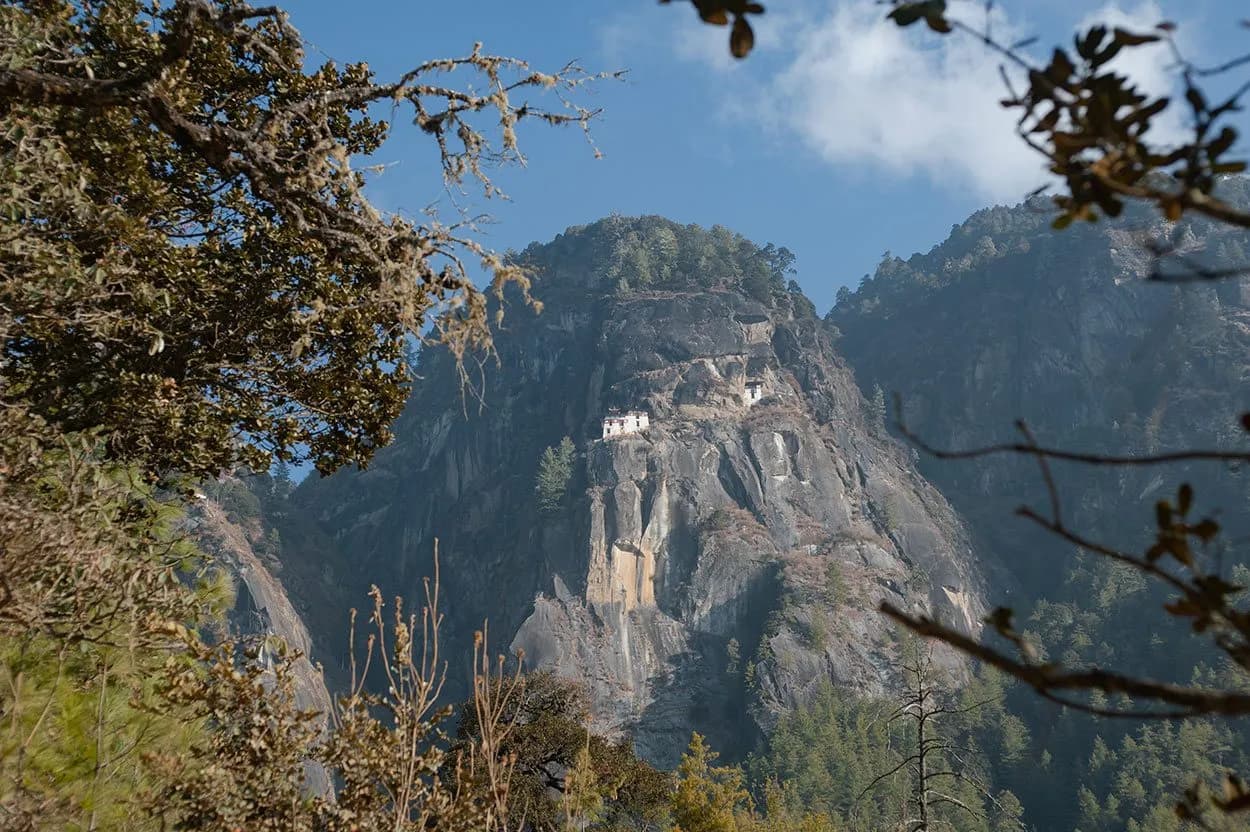
Tiger's Nest (Paro Taktsang) is the most-photographed monument in Bhutan and the climb every visitor weighs. The honest answer: moderately demanding, doable for most travellers in reasonable fitness, but not negligible — the trail gains roughly 700 metres of altitude on switchbacks to a maximum of 3,120 metres. Below: the actual numbers, the practical options for each ability level, and how to know whether the climb is right for you.
logistics15
logistics
Bhutan corporate retreats
Bhutan has emerged across the past several years as one of the principal Asian corporate-retreat destinations. The country's distinctive character — substantial privacy, the considered cultural, the absence of competing distractions (no shopping districts, limited nightlife, no event-density), the lodge infrastructure for groups, and the cultural-and-wellness programming — make it well-suited for small-to-medium executive retreats, partner gatherings, leadership offsites, and the broader reflective-group format. We host corporate retreats from 8 to 50 participants across all of Bhutan's premium lodges.
logistics
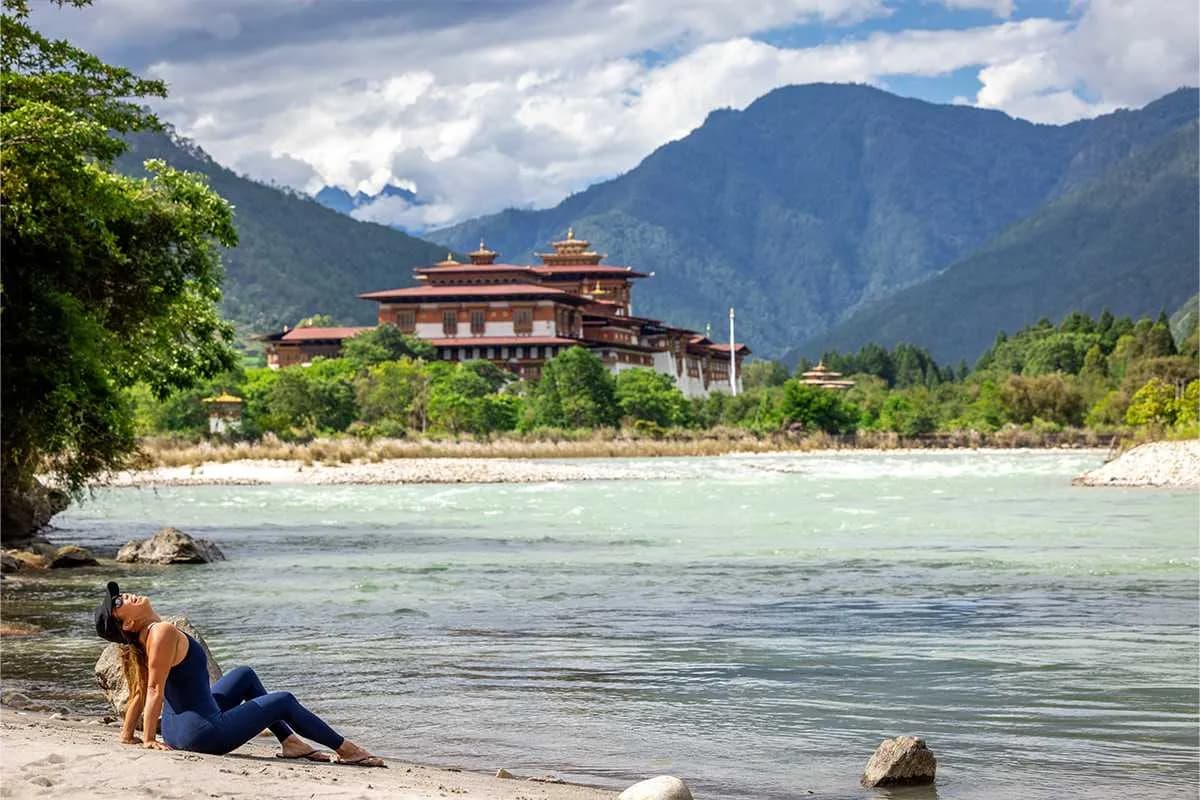
Bhutan for solo female travellers
Bhutan is one of the safest destinations in Asia for solo female travellers — the US State Department's travel advisory rates Bhutan Level 1 ('exercise normal precautions', the lowest risk category), reported crime against international visitors is minimal, and the Bhutanese cultural register toward women is genuinely respectful. The operator framework (every visitor accompanied by a licensed guide and dedicated driver) provides an additional safety architecture that single travellers value particularly.
logistics
Bhutan honeymoon
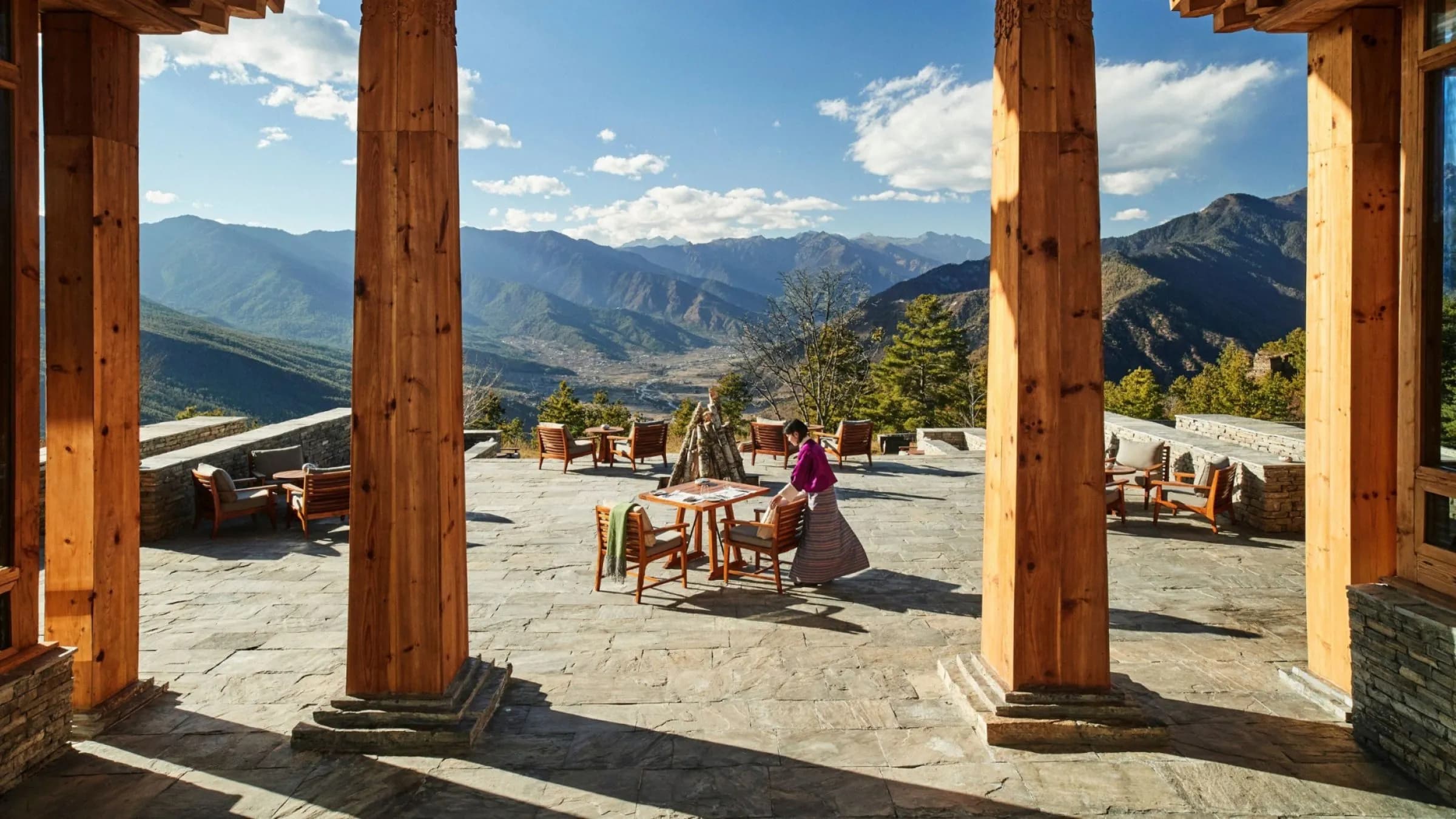
Bhutan has emerged across the past decade as one of the principal honeymoon destinations in Asia — the combination of substantial privacy (the country's high-value, low-impact tourism policy keeps visitor counts moderate), exceptional lodges (Aman, Six Senses, COMO have all built their flagship Asian properties here), and the quiet considered cultural register reward the honeymooner who values atmosphere over event-density. Most honeymoons run 7-10 nights; the principal lodge tier is the Aman / Six Senses / COMO / Bhutan Spirit Sanctuary range.
logistics
Bhutan luxury travel
Bhutan has emerged across the past decade as one of the principal premium-tier destinations in Asia. The three global luxury hotel brands (Aman, Six Senses, COMO) have built their flagship Asian properties here. Royal Bhutan Helicopter Services makes valley-to-valley transfers possible. The country's high-value-low-impact tourism policy keeps visitor counts moderate and the premium experience genuinely private. We structure premium Bhutanese trips across three tiers — premium, luxury, signature — each with a distinct shape.
logistics
Bhutan SDF (Sustainable Development Fee)
The Sustainable Development Fee (SDF) is a daily levy charged to every international visitor to Bhutan, paid in addition to lodge, guide, and transport costs. The current rate is USD 100 per person per night for most international visitors, confirmed through 31 August 2027. The SDF funds the Royal Government's free healthcare and free education programmes, forest conservation, and the broader carbon-negative national infrastructure.
logistics
Bhutan visa for international visitors
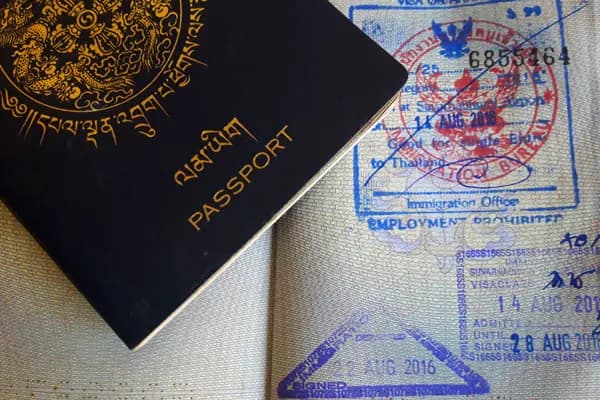
All international visitors (with three exceptions — Indian, Bangladesh, and Maldives nationals) require a Bhutanese visa to enter the country. The visa is processed by the Royal Government-licensed tour operator handling your booking, granted on landing at Paro International Airport on the basis of the pre-issued e-visa clearance. The process takes approximately five working days from the operator's submission to the visa clearance.
logistics
Bhutan vs Ladakh for private travel
Bhutan and Ladakh are the two principal Vajrayana Buddhist Himalayan destinations accessible to international visitors. Both have substantial cultural-religious depth; both have considered premium-lodge inventory; both are geographically Himalayan landscapes. The structural differences — sovereignty (Bhutan independent; Ladakh part of India), access (Bhutan licensed-operator framework; Ladakh independent travel), altitude (Bhutan moderate; Ladakh higher), cost (Bhutan SDF; Ladakh no equivalent) — substantially shape which is the right answer for any given traveller.
logistics
Bhutan vs Nepal
Bhutan and Nepal are the two principal Himalayan-Buddhist destinations in Asia, frequently considered together by visitors planning a first Himalayan trip. They are not the same trip. Nepal is the principal trekking-and-altitude destination — Everest, Annapurna, the great trekking circuits, the chaotic-vivid Kathmandu cultural. Bhutan is the high-value-low-impact cultural-and-lodge destination — Tiger's Nest, the dzong tradition, the curated premium experience, substantially smaller visitor counts. The honest position: visit both, with Nepal first and Bhutan second.
logistics
Bhutan vs Nepal for private travel
Bhutan and Nepal are the two principal Himalayan premium destinations. Both are Buddhist-influenced; both have substantial cultural depth; both are accessible from international hubs. They are different in scale, in trekking emphasis, in tourism framework, and in what they reward — and the right answer for any given traveller is not the same. This is the comparative read.
logistics
Buddhist pilgrimage in Bhutan
Bhutan is one of the principal living Vajrayana Buddhist countries — the lineage transmitted through the 8th-century arrival of [[guru-rinpoche|Guru Rinpoche]] (Padmasambhava), the 15th-century revelations of the terton [[pema-lingpa|Pema Lingpa]], the 17th-century state-founding of [[zhabdrung-ngawang-namgyal|Zhabdrung Ngawang Namgyal]], and the continuous monastic tradition through to the present. The principal pilgrimage sites — Tiger's Nest, Kurjey Lhakhang, Mebar Tsho, the dzong cycle — remain active religious institutions, visited by Bhutanese pilgrims daily. International visitors with a Buddhist interest are welcomed; the protocol is reverent rather than touristic.
logistics
How long should I spend in Bhutan?
Most international visitors spend between 5 and 10 nights in Bhutan. Five nights is the minimum for Bhutan (Paro, Thimphu, Punakha) at a considered pace. Seven nights adds Phobjikha or Bumthang. Ten nights opens the central valleys and the cultural depth most-considered visitors say they wish they had given themselves. Treks add 6 to 23 days on top of the cultural base. **The shapes below are our recommendations — not rules.** We design every itinerary against the visitor's specific preferences and constraints; if you want longer somewhere, or shorter, or a different sequence entirely, we adjust accordingly.
logistics
How to book a Bhutan trip
Bhutan's tourism is structured around the **mandatory licensed-operator framework** — every international visitor must book through a Royal Government-licensed Bhutanese tour operator, who handles the visa, the Sustainable Development Fee, the guide, the driver, the lodges, the transport, and the broader logistics. There is no direct-booking path for individual travellers. The framework dates to 1974 and is a structural feature of the country's high-value-low-impact tourism policy. Lead time for booking: 60+ days standard; 6-9 months for festival windows; 12+ months for the Snowman Trek and Signature-tier itineraries.
logistics
Is Bhutan safe?
Bhutan is among the safest premium-tourism destinations in Asia and is consistently rated at the highest tier on international safety indices. The US State Department lists Bhutan at Level 1 (the safest tier — 'exercise normal precautions') alongside countries like Iceland and Switzerland. Below: the specific safety considerations — crime, road safety, altitude, medical infrastructure, natural-hazard exposure, and solo-female-traveller safety — that visitors weigh.
logistics
Photography in Bhutan
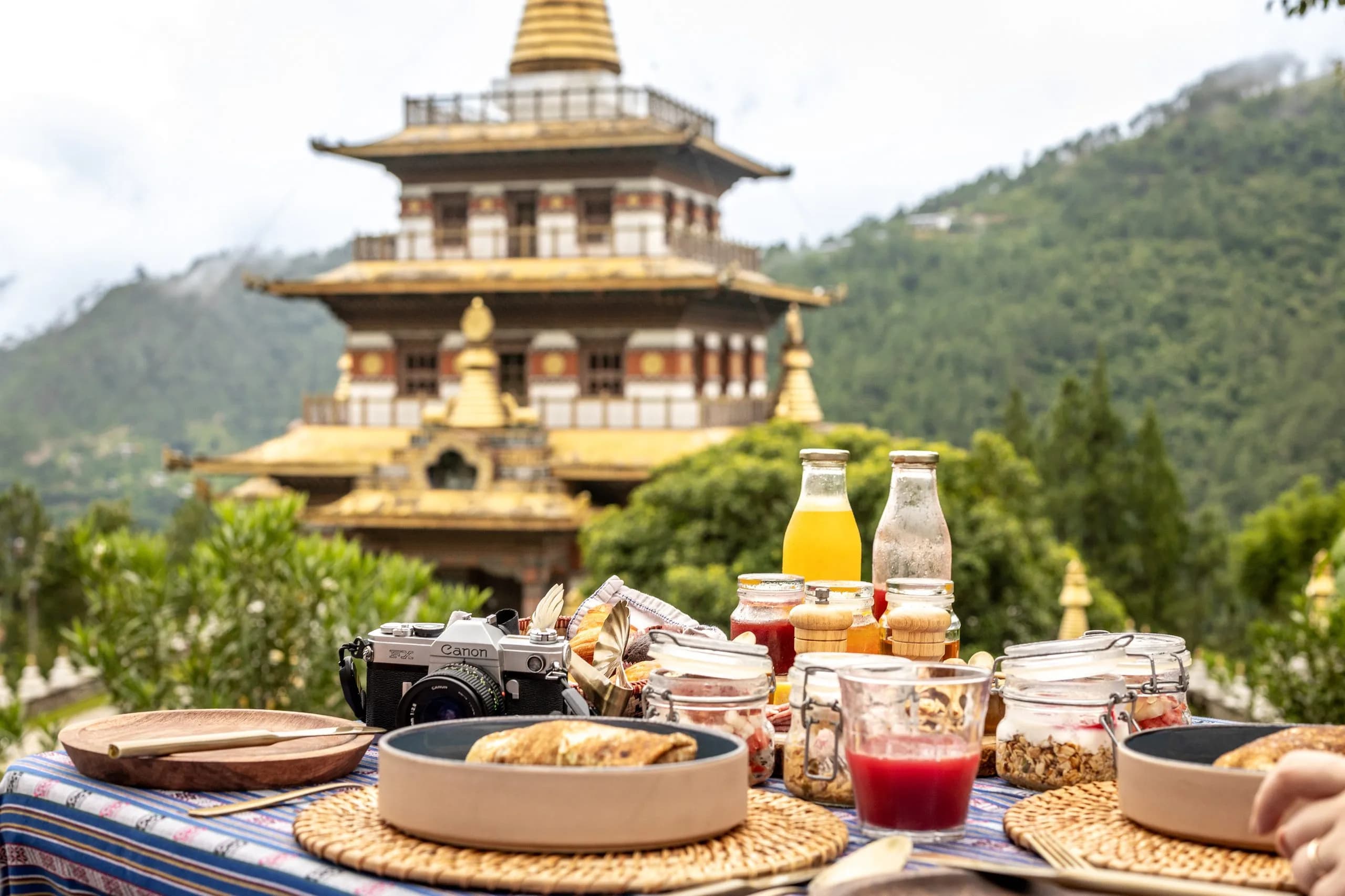
Bhutan rewards substantial photographic effort. The combination of dramatic Himalayan landscapes, vivid traditional dress (the gho and kira), substantial religious architecture (the dzongs), and the country's clear-sky autumn and winter windows produces some of the most-photographed Himalayan content in the world. Specific protocols apply inside lhakhangs (photography typically prohibited); drones are strictly banned. October-November is the principal photographer's window.
logistics
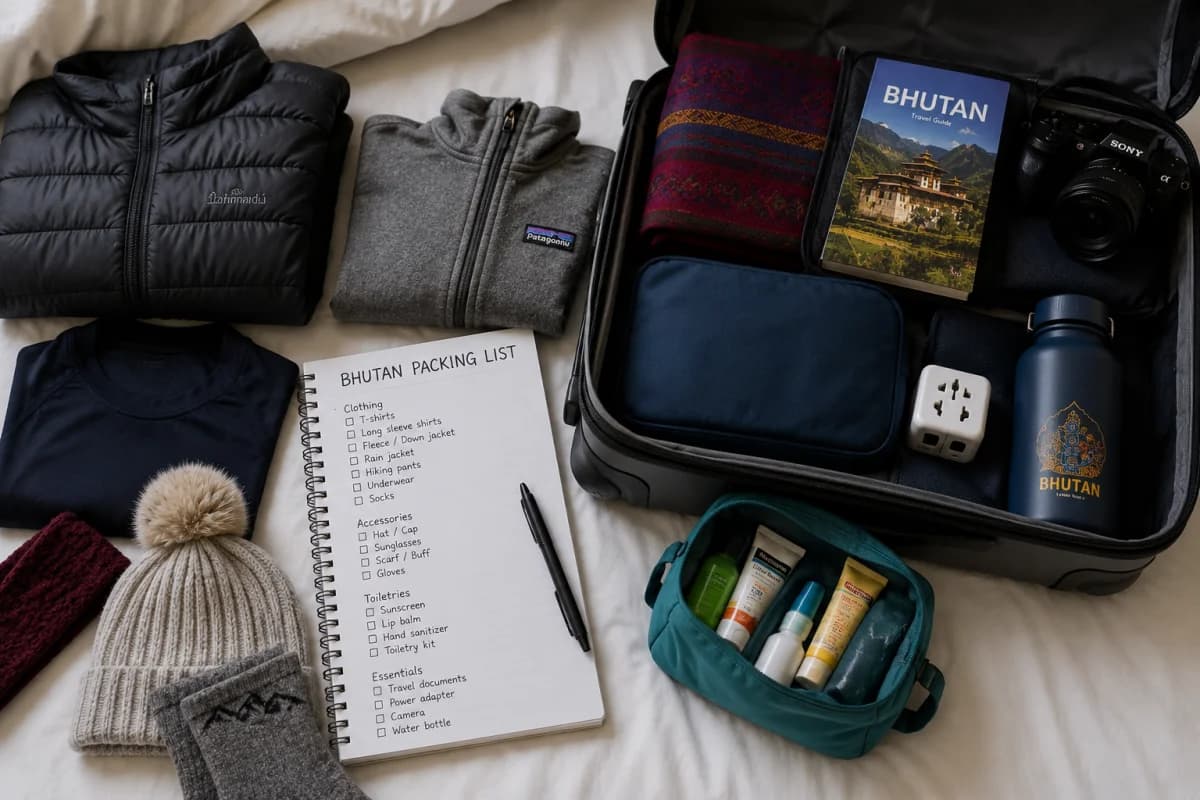
What to pack for Bhutan
Bhutan's altitude range — from 200 metres in the southern foothills to 4,200 metres on the Druk Path ridge — means substantial temperature variation across a single trip. The packing list reflects the altitude profile rather than the calendar season. Modest dress is required at the monasteries and dzongs; sturdy walking shoes are essential for Tiger's Nest and the broader cultural circuit; a warm layer is essential even in summer.
money1
season2
season
Best time to visit Bhutan
Bhutan rewards visitors year-round. The four seasons each carry a distinct register — Spring (March–May), Green Bhutan (June–August), Autumn (September–November), and Clear-Sky Bhutan (December–February) — and each window has its visitors who consider it the country at its best. The single window we actively discourage is **late July through early September**, when the heaviest Indian Monsoon rains arrive — sustained rainfall affects the roads, the cloud cover obscures the Himalayan panorama, and the high-altitude treks close. Our concierge checks the current monsoon forecast against every proposal's travel dates and adjusts the timing recommendation accordingly.
season
Bhutan from Singapore
Singapore's school calendar and long-weekend rhythm create natural Bhutan-travel windows for families, honeymooners, and the broader Singapore HNI segment. Some windows align well with Bhutan's strongest visiting seasons (December year-end, Chinese New Year); others require careful framing (the June school holiday lands in the early monsoon). Below: each Singapore long-holiday window mapped against the Bhutanese calendar, with the considered recommendation for each.
transport13
transport
Bhutan from Bangkok
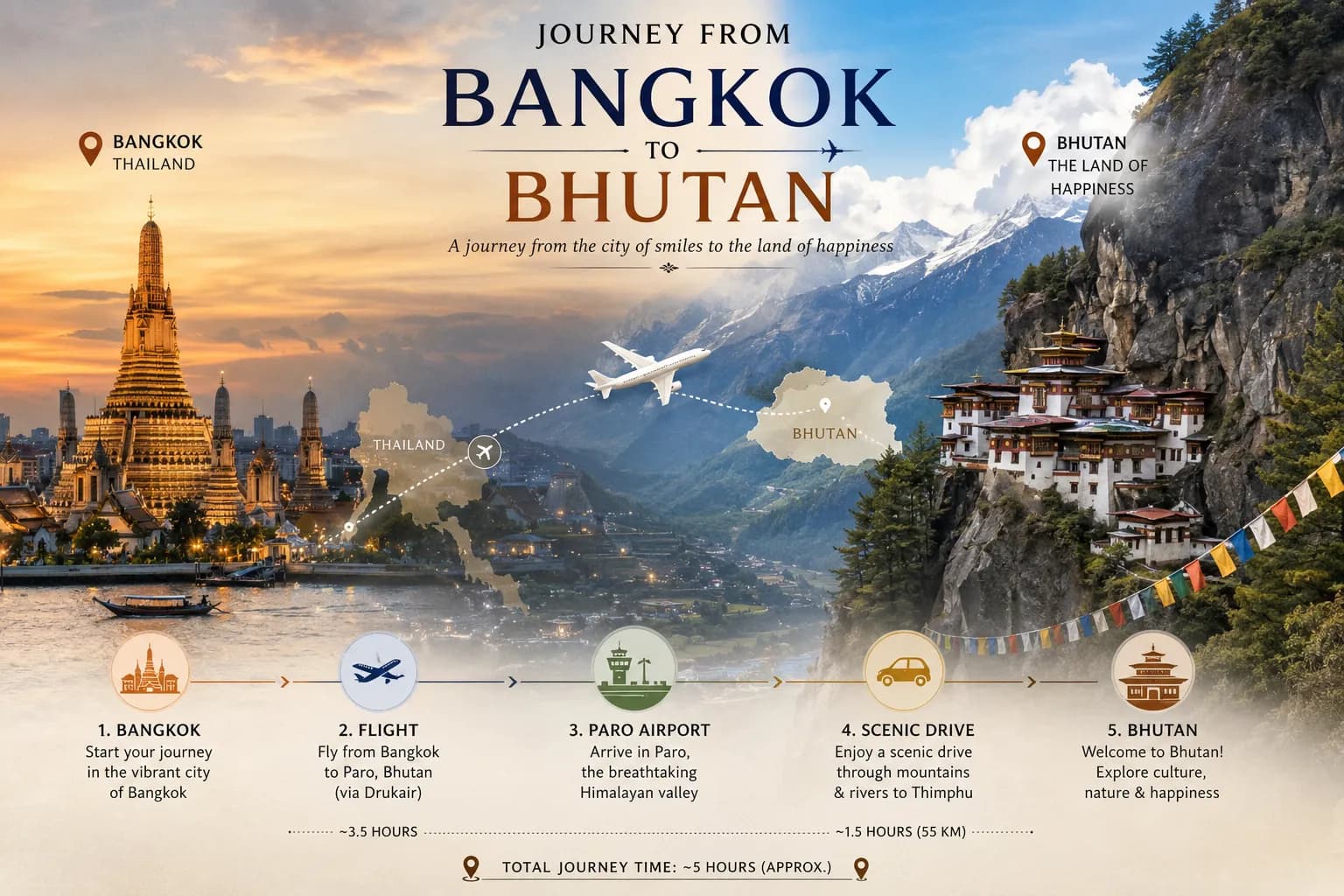
Bangkok to Paro is the single easiest premium connection to Bhutan in the world — Drukair (KB) operates BKK–PBH daily on a morning departure, with Bhutan Airlines (B3) operating a similar pattern. ~4 hours block time, no transit-visa friction, no hub overnight required. For travellers based in Bangkok, in Thailand, or transiting through BKK on a regional itinerary, this is the cleanest routing into Bhutan that exists.
transport
Bhutan from Delhi
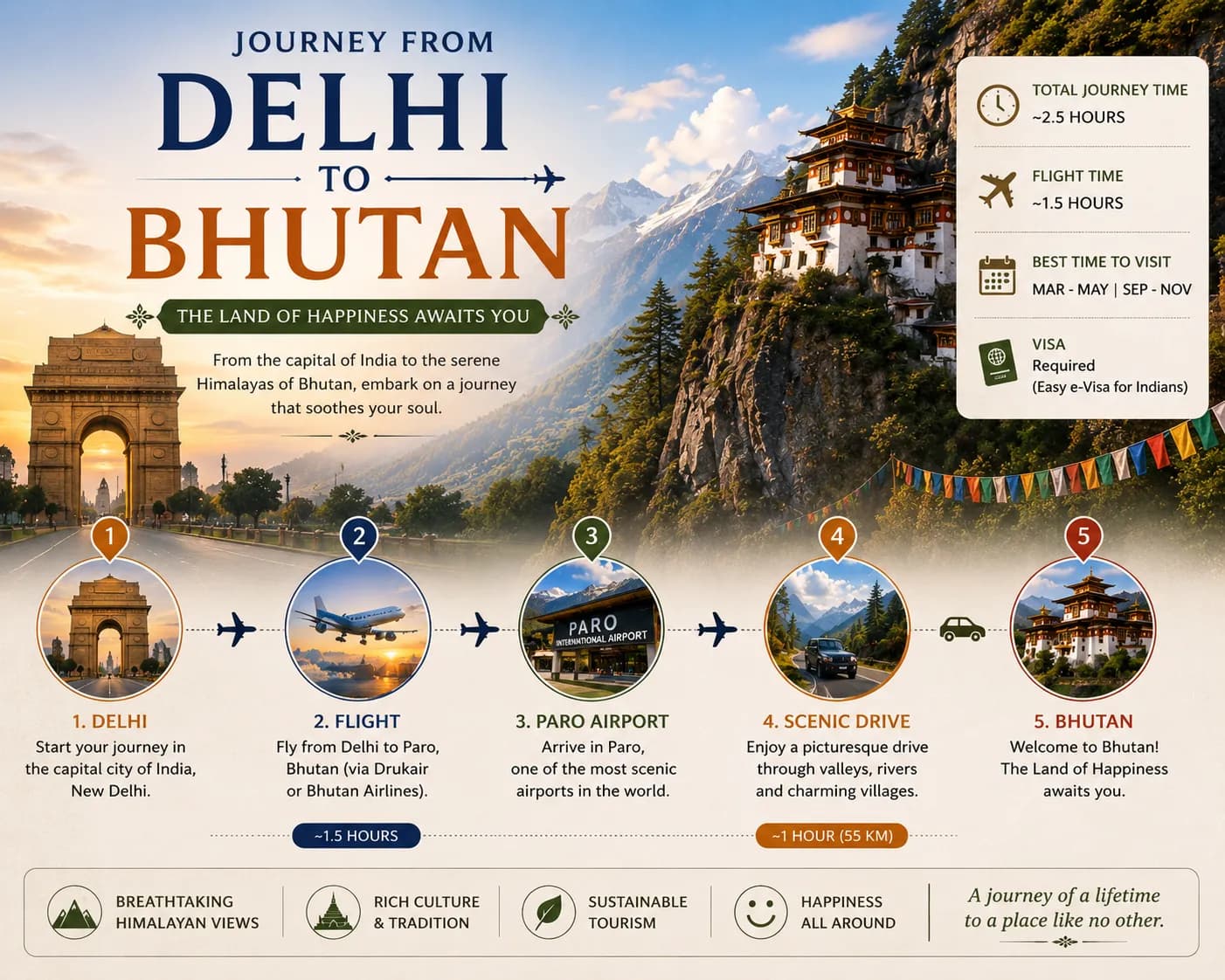
Delhi is the principal Indian gateway to Bhutan. Drukair (KB) and Bhutan Airlines (B3) operate DEL–PBH on a daily morning rotation; ~2.5 hours flight time. For Indian-passport-holders, the journey is among the cleanest premium routings into Bhutan — Indian-national framework (Nu 1,200/night SDF, visa-free entry with permit on arrival, no transit-visa complication), daily-flight capacity, the considered cultural-religious depth that meets the Indian premium register.
transport
Bhutan from Dubai
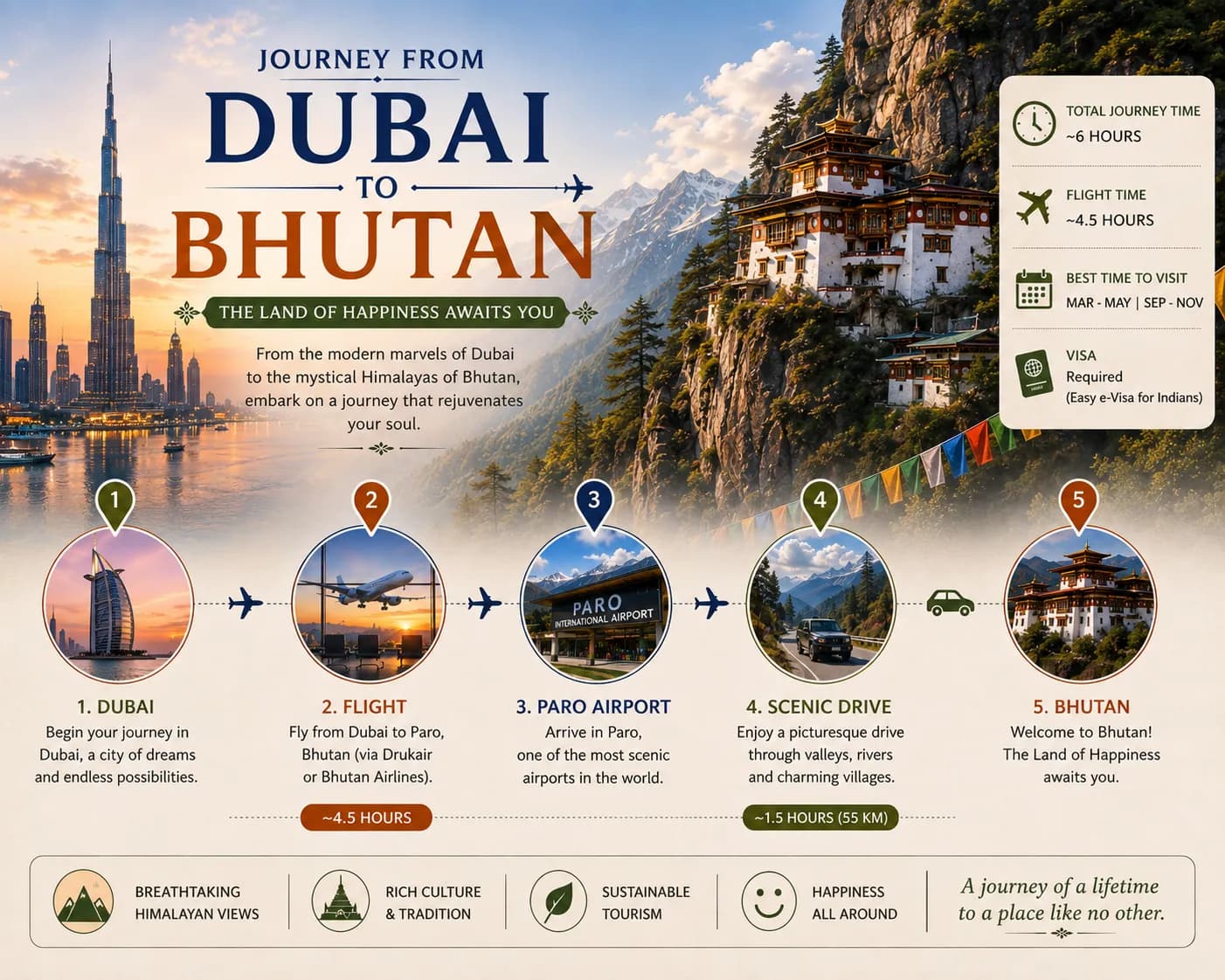
There is no direct Drukair or Bhutan Airlines service from Dubai to Paro. The recommended routing is via Bangkok — Emirates, Etihad, Thai Airways, and other premium carriers operate multiple daily DXB–BKK flights, then a Bangkok overnight, then the daily Drukair BKK–PBH morning rotation. Total transit time around 14 hours including the Bangkok overnight. The DXB-DEL alternative is operationally feasible for Indian-passport-holders but adds India-transit-visa friction for non-Indian-passport-holders.
transport
Bhutan from Hong Kong
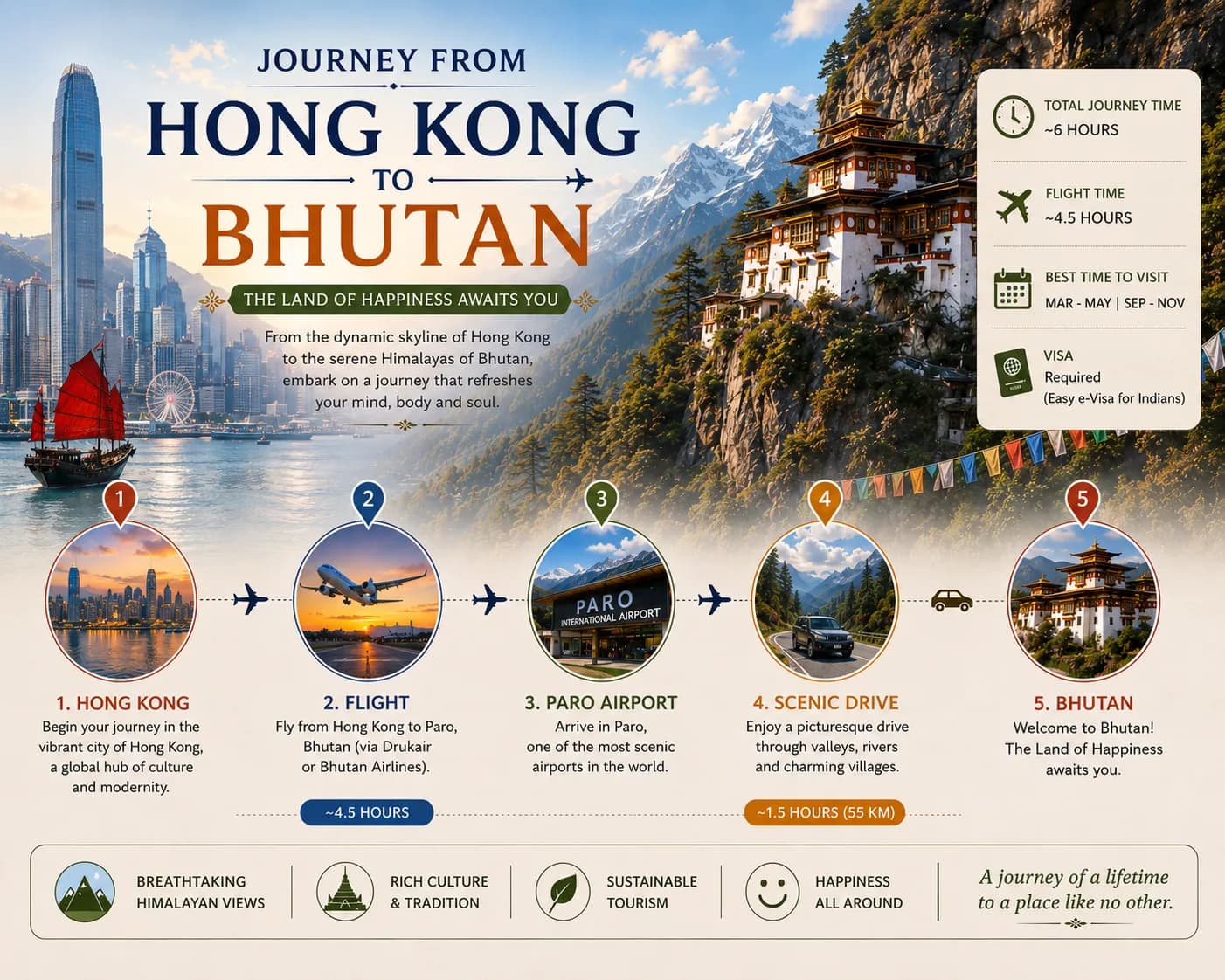
There is no direct Drukair or Bhutan Airlines service from Hong Kong to Paro. The recommended routing for Hong Kong-based travellers is via Bangkok — multiple daily Cathay Pacific, Thai Airways, and EVA Air flights into BKK, then the daily Drukair BKK–PBH morning rotation. Total transit time around 16 hours including the Bangkok overnight. Singapore is the secondary option (longer journey, Sunday-only Drukair direct). Indian hubs — Delhi, Kolkata, Mumbai — are not recommended due to the India transit-visa requirement for non-Indian-passport-holders.
transport
Bhutan from London
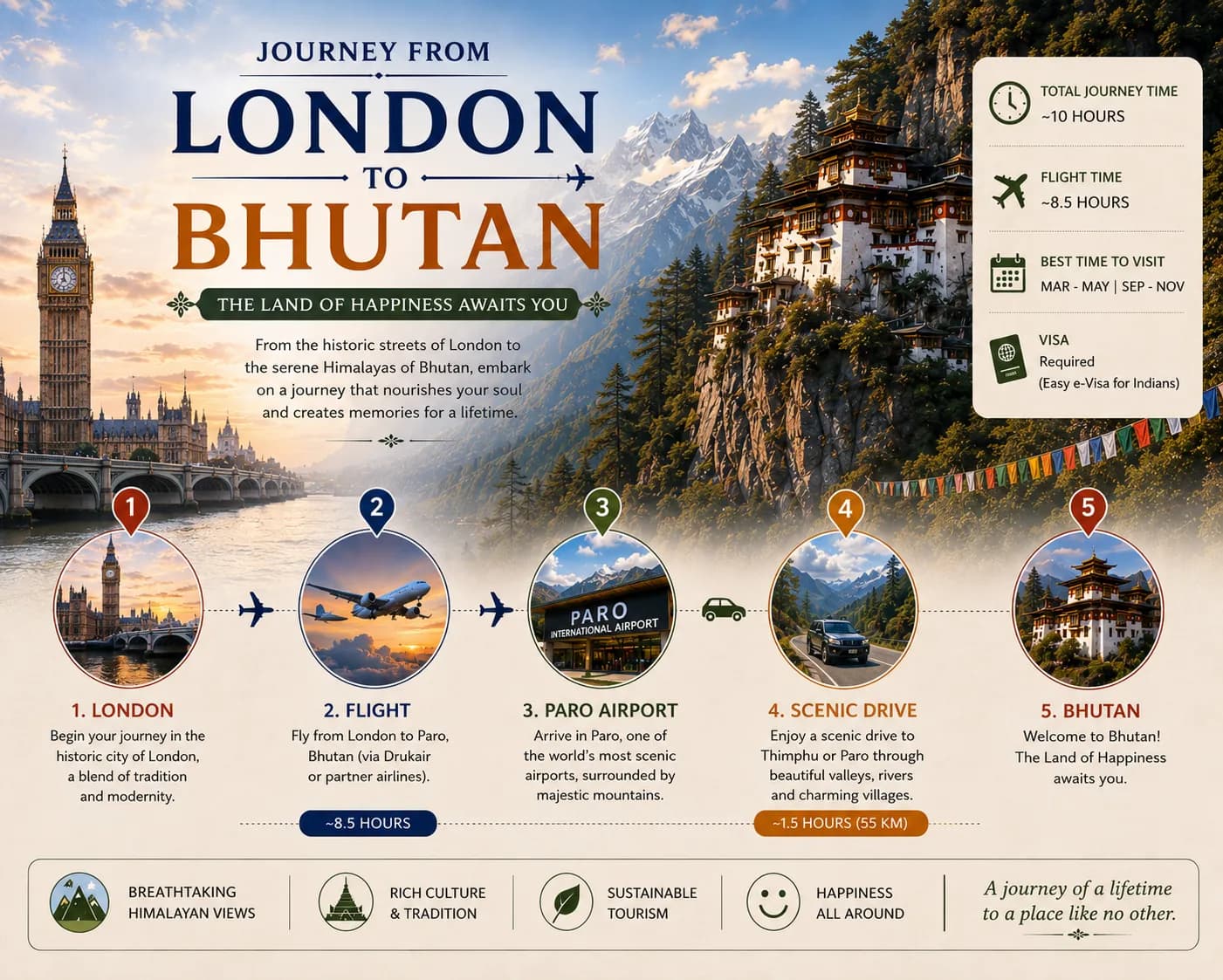
There is no direct Drukair or Bhutan Airlines service from London to Paro. The recommended routing is via Bangkok — British Airways, Thai Airways, EVA Air, Qatar Airways (via DOH), and Singapore Airlines (via SIN) all operate substantial daily LHR–BKK flights, then a Bangkok overnight, then the daily Drukair BKK–PBH morning rotation. Total transit time around 18-20 hours including the Bangkok overnight. Singapore is the equivalent alternative on the Sun-Sat Drukair rhythm. India transit hubs (Delhi) are NOT recommended for non-Indian-passport UK travellers.
transport
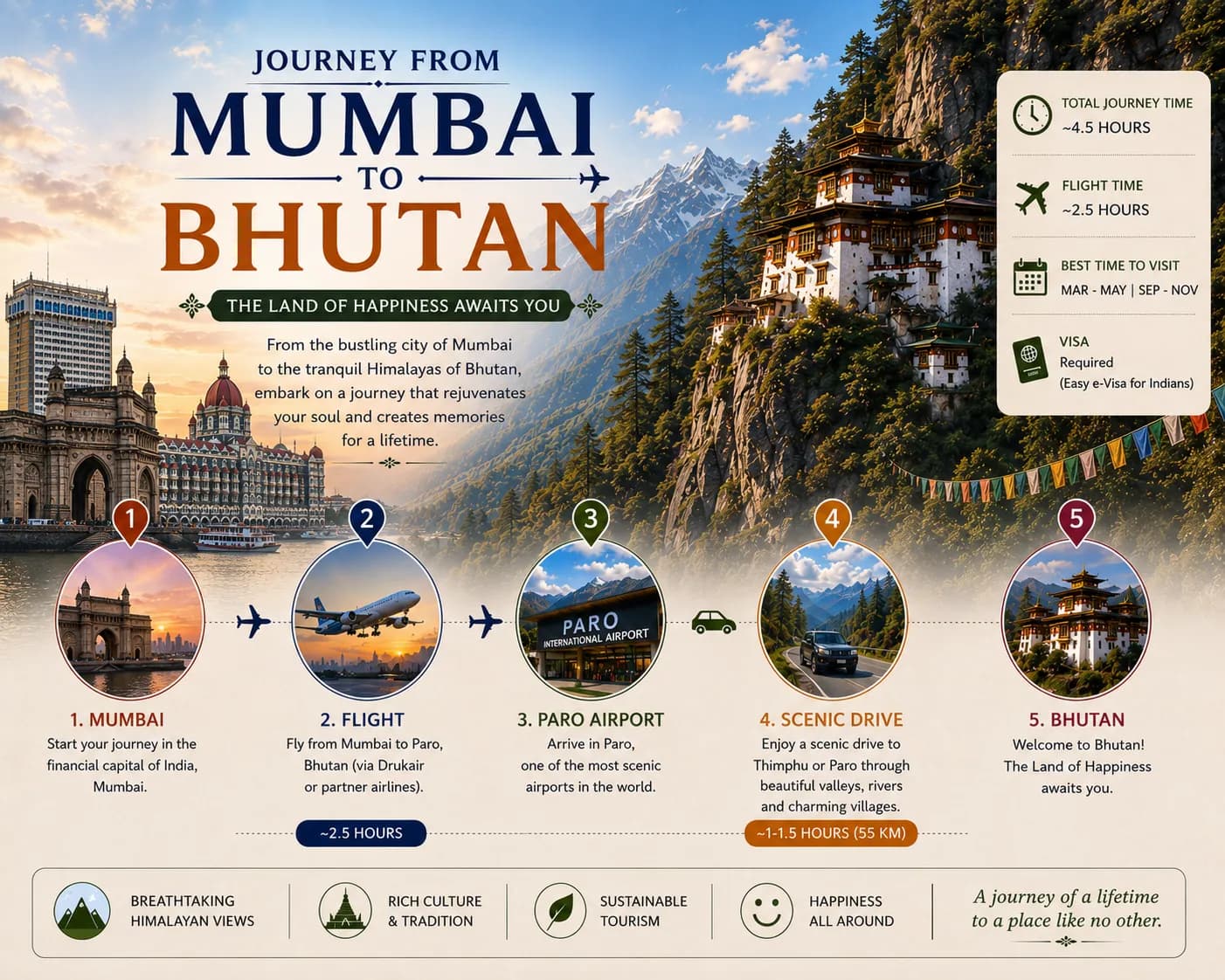
Bhutan from Mumbai
There is no regular direct service between Mumbai (BOM) and Paro (PBH) on either Drukair (KB) or Bhutan Airlines (B3). The standard pattern for Mumbai-based Indian travellers is BOM-DEL-PBH (a half-hourly Indian-carrier connection to Delhi, then the daily Drukair DEL-PBH afternoon rotation). Bhutan Airlines has expanded its western and southern Indian network with direct PBH-Ahmedabad (Saturday/Sunday) and PBH-Bangalore via Kolkata (Thursday/Friday) — newer alternatives for Mumbai-area travellers willing to connect via Ahmedabad or Bangalore.
transport
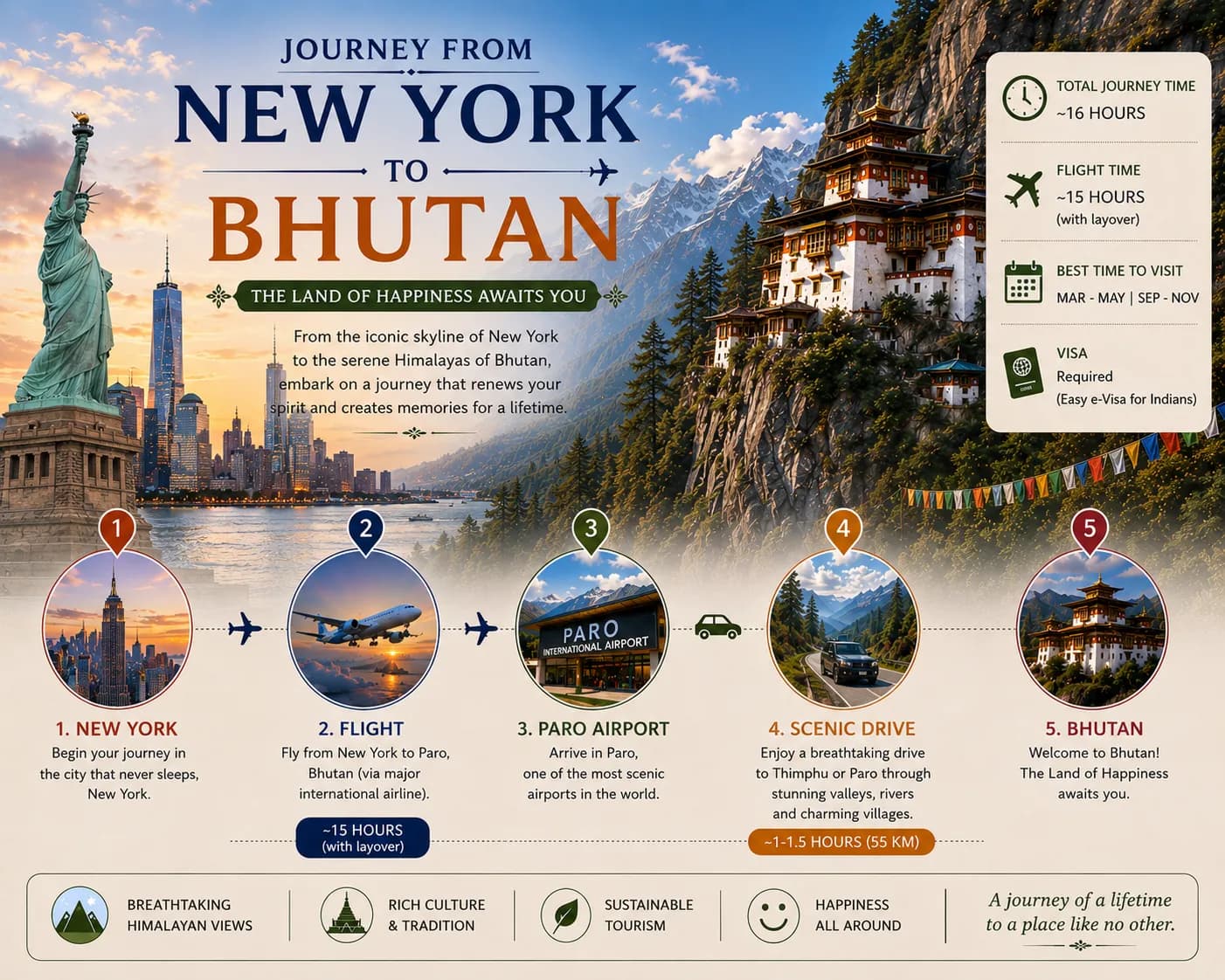
Bhutan from New York
There is no direct service from New York to Paro. The recommended routing is via Bangkok — JFK to BKK via Tokyo (JAL, ANA), Hong Kong (Cathay Pacific), Seoul (Korean Air), Doha (Qatar Airways), or Dubai (Emirates), then a Bangkok overnight, then the daily Drukair BKK–PBH morning rotation. Total transit time approximately 24-30 hours including the Bangkok overnight. Singapore is the equivalent Sun-Sat alternative. Delhi is not recommended for US passport-holders (transit visa required).
transport
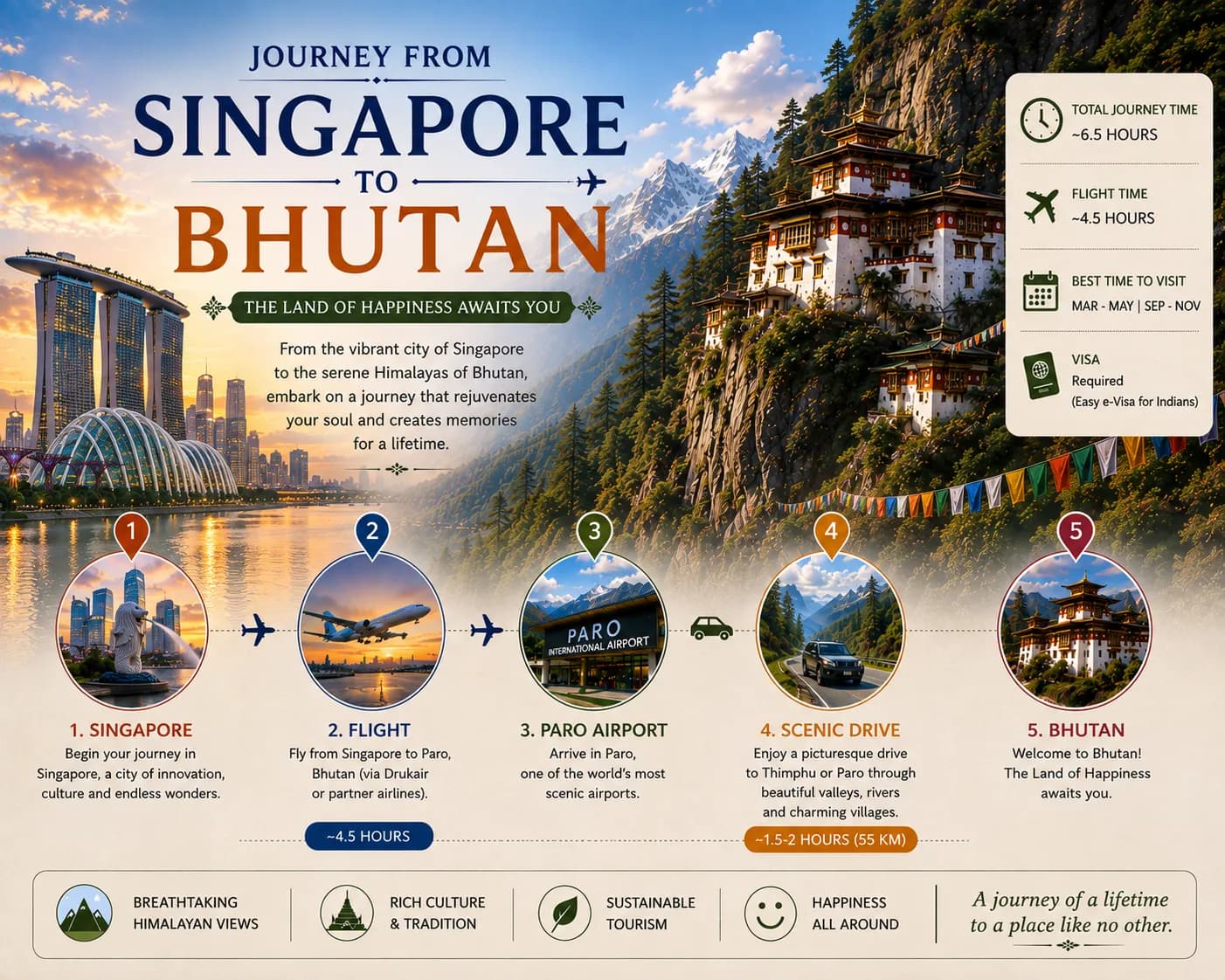
Bhutan from Singapore
Drukair operates the Singapore–Paro route multiple times each week. **Most rotations are effectively a direct flight** — a brief 30-minute Guwahati stop for passenger exchange (passengers continuing to Paro remain onboard) (GAU) in northeast India, with passengers remaining onboard. **Total elapsed time approximately 6 hours.** Some early-morning rotations operate non-stop in approximately 4.5 hours. The **natural Singapore-Bhutan trip rhythm is 6 nights** (Sunday arrival, Saturday departure) — the cleanest cycle for a standard Bhutan trip. The route also supports 13-night double blocks and mid-week alternatives for visitors who prefer different days. **Bhutan Airlines does not currently serve Singapore** — all SIN-PBH service is on Drukair.
transport
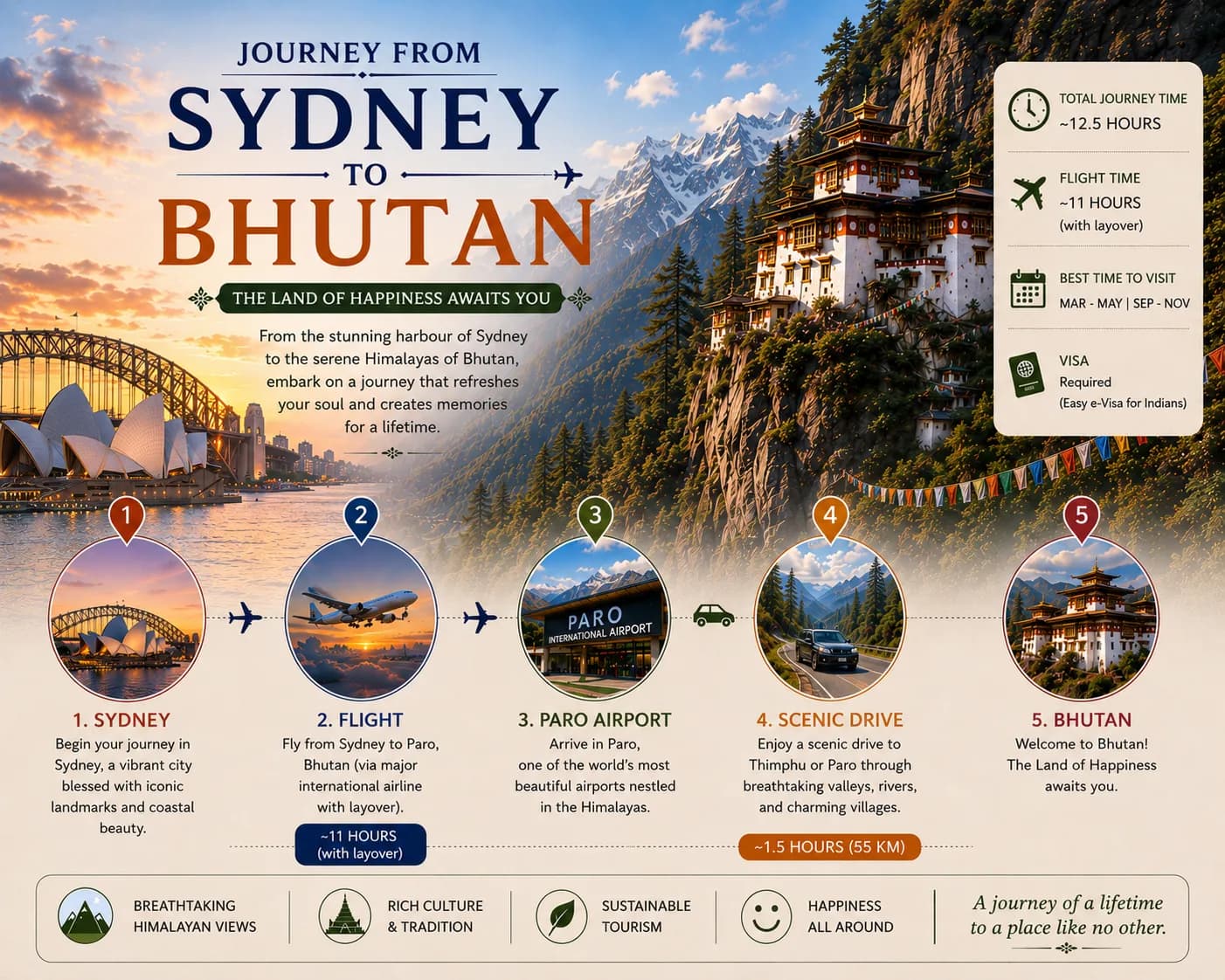
Bhutan from Sydney
There is no direct service from Sydney to Paro. The recommended routing is via Singapore — Singapore Airlines and Qantas operate multiple daily SYD–SIN flights (~8 hours), then the Drukair SIN–PBH Sunday rotation. The Singapore Sun-Sat framework suits the standard 6-night Bhutan trip. Bangkok is the daily-flexibility alternative. The Australia-Singapore-Bhutan trip is structurally clean — Singapore is the easiest Asian hub for Australian premium travellers.
transport
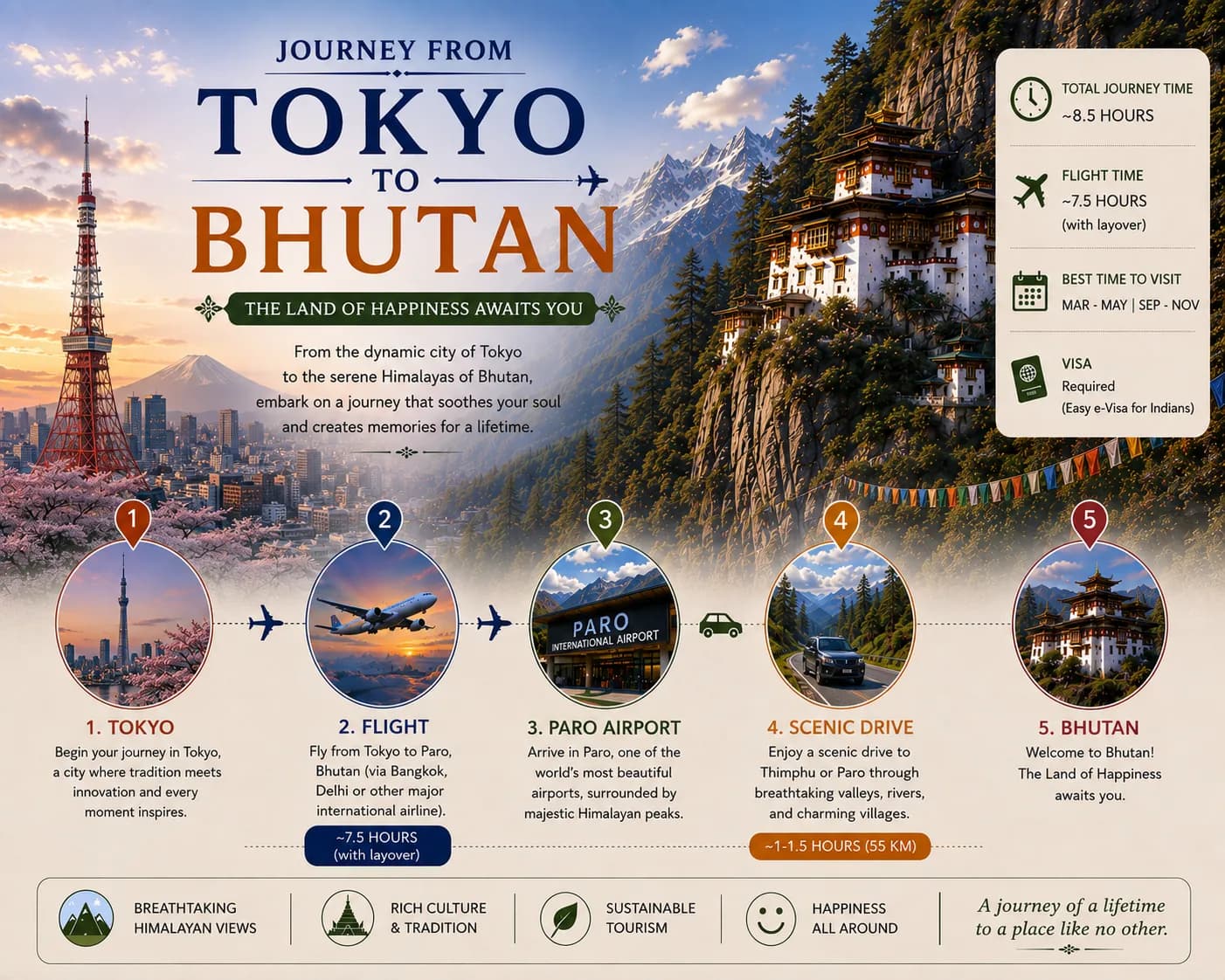
Bhutan from Tokyo
There is no direct Drukair or Bhutan Airlines service from Tokyo to Paro. The recommended routing for Tokyo-based travellers is via Bangkok — Japan Airlines, ANA, or Thai Airways into BKK with an overnight, then the daily Drukair BKK–PBH morning rotation. The matched-guide network includes three guides with working Japanese (basic to conversational), held on request. Total transit time around 18 hours including the Bangkok overnight.
transport
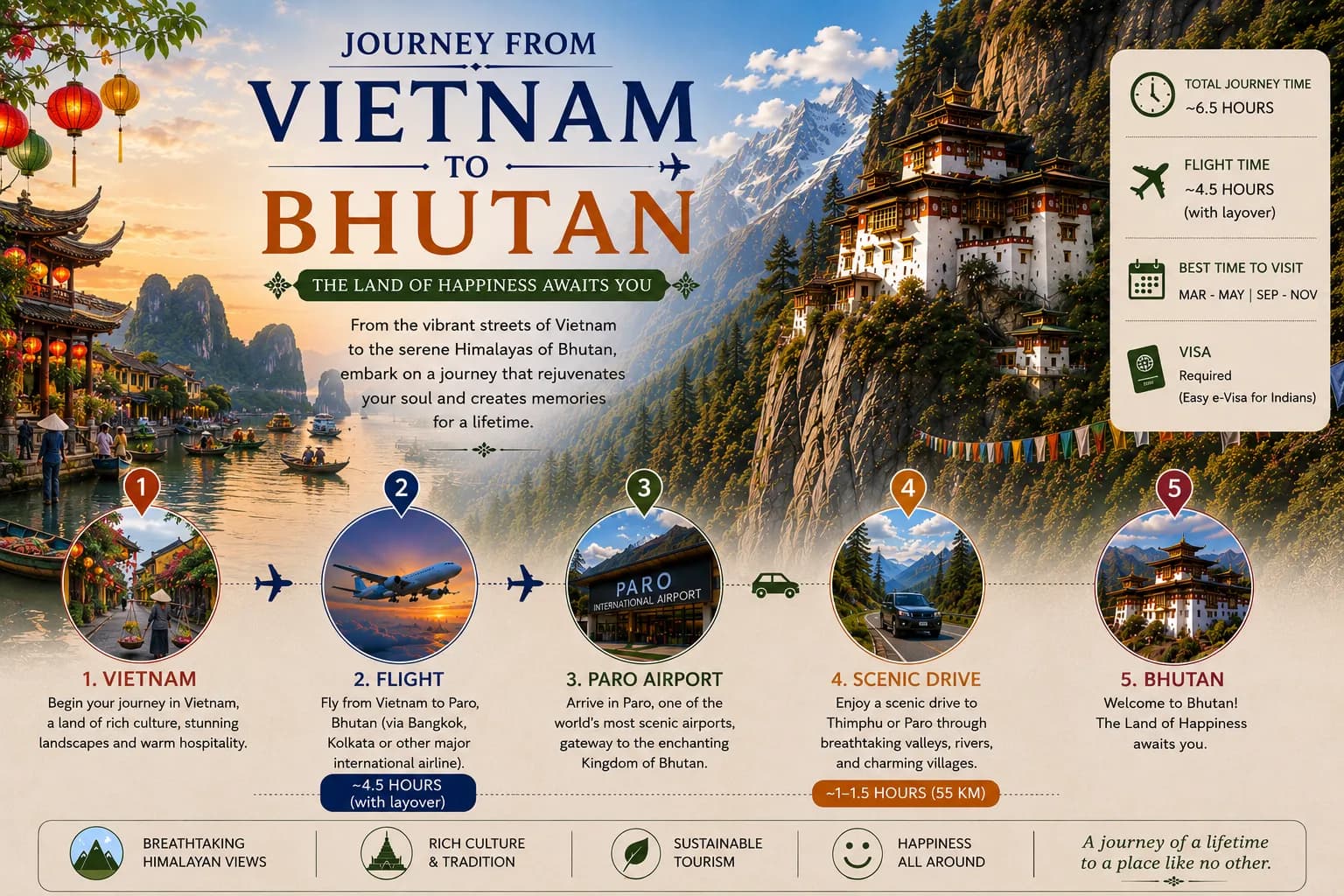
Bhutan from Vietnam
Bhutan Airlines has expanded its Southeast Asian network with direct service from Ho Chi Minh City (SGN) and Hanoi (HAN) — newer routes that position Vietnam among the Asian premium markets with direct Bhutan access. The Bangkok-Saigon-Paro routing operates multiple days per week; Paro-Hanoi direct operates on selected days; both support Vietnamese premium travel to Bhutan without the Bangkok overnight that other Southeast Asian origins still require.
transport
Bhutan via Singapore
Singapore Changi is one of the smoothest transit hubs in Asia — substantial connectivity to and from Malaysia, Indonesia, Australia, and Hong Kong, plus the Drukair direct service to Paro multiple days per week. For visitors from these origin markets, the **Singapore stopover route** combines an excellent international hub experience with the clean Drukair-only routing to Bhutan, avoiding the India transit-visa friction that complicates Delhi or Kolkata stopovers. A 1-2 night Singapore stay is the natural rhythm.
transport
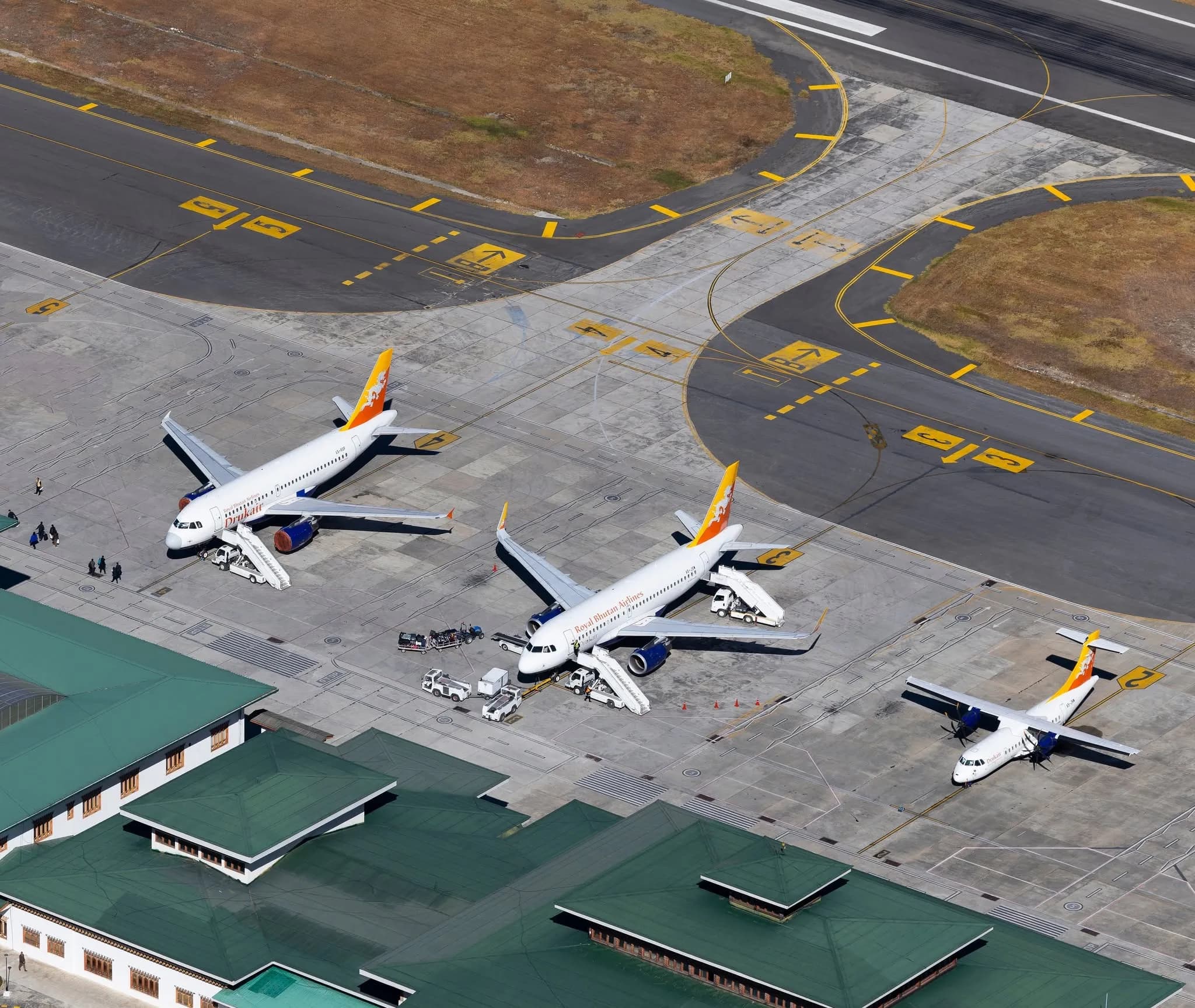
Drukair and Paro Airport
Paro International Airport (PBH) is Bhutan's only international airport, served by two carriers: Drukair (the national flag carrier) and Bhutan Airlines. **Paro is widely regarded as one of the most difficult airports in the world** — pilots fly a manual visual approach through a steep-walled valley between 5,000-metre peaks, and the airport's certification process means fewer than 50 pilots in the world are qualified to land there. The airport's safety record is strong; the difficulty refers to the technical demands of the approach, not to operational risk.

