Planning your Bhutan journey
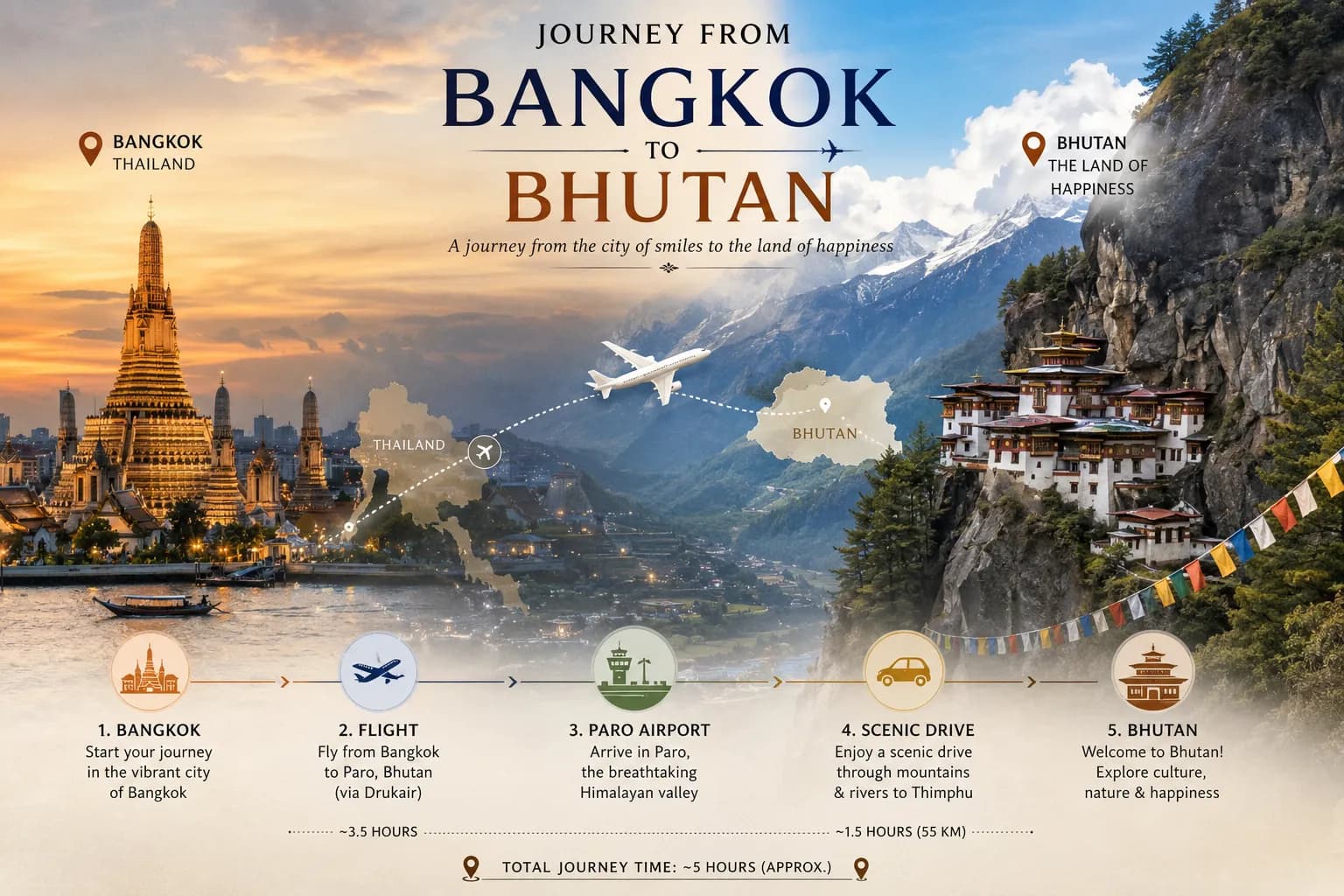
Bhutan from Bangkok — Drukair operates BKK–PBH daily, around four hours, morning departure.
Bangkok to Paro is the single easiest premium connection to Bhutan in the world — Drukair (KB) operates BKK–PBH daily on a morning departure, with Bhutan Airlines (B3) operating a similar pattern. ~4 hours block time, no transit-visa friction, no hub overnight required. For travellers based in Bangkok, in Thailand, or transiting through BKK on a regional itinerary, this is the cleanest routing into Bhutan that exists.
- Register
- transport
The short answer
Drukair (KB) operates BKK–PBH daily on a morning departure (~06:30–07:00 BKK time, ~4 hours block time, late-morning Paro arrival). Bhutan Airlines (B3) operates a similar pattern. No transit visa required — Thailand offers visa-on-arrival or visa-free entry to most nationalities. The Bangkok routing supports any-day Bhutan arrival, gives substantial flexibility versus the Singapore Sunday-only direct, and is the principal recommended hub for visitors from East Asia, Australia, and the Middle East who do not have direct Drukair service from their origin city.
The Drukair Bangkok rotation — what actually operates
Drukair operates BKK–PBH daily on a morning departure (typically 06:30–07:00 Bangkok time, ~4 hours block time, late-morning Paro arrival around 10:30–11:00 local). The return PBH–BKK rotation departs Paro in the early afternoon (~12:30–13:00) and arrives Bangkok in the late afternoon (~17:00–18:00). Bhutan Airlines (B3) operates a similar BKK–PBH pattern, also on a morning departure. The two carriers between them give substantial daily capacity on the route, which is the principal reason Bangkok is the most flexible Bhutan hub in Asia. Aircraft is typically the Airbus A319 (Drukair's principal long-range fleet, 5 in total serving the broader international network). Schedule details (exact flight numbers, timings, frequencies) shift with Drukair's seasonal releases; we surface the current schedule against any proposal and confirm at the time of booking.
Origin markets that route through Bangkok
Hong Kong: Cathay Pacific, Thai Airways, EVA Air, Scoot operate multiple daily HKG–BKK flights (~3 hours). Combined with the next-morning Drukair BKK–PBH, the standard Hong Kong shape is HKG–BKK overnight, BKK–PBH morning departure, total transit ~16 hours. Tokyo / Osaka: Japan Airlines, ANA, Thai Airways, Singapore Airlines (one-stop via SIN) operate multiple daily NRT/HND–BKK flights (~7 hours). Standard shape is NRT/HND–BKK overnight, BKK–PBH morning departure. Seoul: Korean Air, Asiana, Thai Airways operate multiple daily ICN–BKK flights (~5.5 hours). Standard shape: ICN–BKK overnight, BKK–PBH morning. Sydney / Melbourne: Qantas, Thai Airways, Singapore Airlines (one-stop) operate multiple daily SYD/MEL–BKK flights (~9 hours). Standard shape is SYD/MEL–BKK overnight, BKK–PBH morning. Dubai / Abu Dhabi: Emirates, Etihad, Thai Airways operate multiple daily DXB/AUH–BKK flights (~6 hours). Standard shape is DXB/AUH–BKK overnight, BKK–PBH morning. London / European capitals: British Airways, Thai Airways, Qatar (one-stop), Singapore Airlines (one-stop) operate daily LHR/CDG/FRA–BKK flights (~12 hours direct). Standard shape: long-haul into Bangkok, 1-night Bangkok overnight to reset, BKK–PBH morning. Most European visitors prefer the 1-night Bangkok stopover over a same-day connection.
The 1-night Bangkok stopover — recommended for long-haul
For visitors arriving Bangkok on an overnight long-haul (Europe, Australia, the Middle East, North America via Asia), we recommend a 1-night Bangkok overnight rather than a same-day connection to the morning Drukair. Three reasons. (1) Reset before the Drukair morning departure: the BKK–PBH morning flight requires a 04:30 hotel pickup for the 06:30–07:00 departure; a same-day arrival from long-haul does not leave enough recovery time. (2) Drukair flight requires alertness on landing: the Paro Airport visual approach is the most distinctive arrival in Asia — rewarding when the traveller is rested, substantially less so when not. (3) Bangkok is itself a overnight: the Sukhumvit and Riverside lodges (Mandarin Oriental, The Siam, Capella Bangkok, The Sukhothai, COMO Metropolitan, Aman Bangkok) are world-class. We coordinate the Bangkok lodge night as part of the proposal where the long-haul shape benefits. For visitors already in Bangkok on business or on a regional itinerary, no stopover is needed.
Bhutan Airlines (B3) versus Drukair (KB) on this route
Both carriers operate BKK–PBH and both are RGoB-licensed. Drukair (KB) is the national flag carrier, the experienced operator, and the carrier we typically book — substantial in-flight service, the better-developed loyalty programme (KB has a frequent-flyer agreement with several international carriers), and the longer-tenured operational track record. Bhutan Airlines (B3) is the private carrier, also reliable, with comparable service and pricing. Both fly the Airbus A319; both follow the same Paro Airport operating envelope (visual flight rules, no night flights, fewer than 50 pilots in the world certified to land). Cancellations and reroutings between the two carriers are not uncommon when weather requires; we book against the schedule that fits the proposal best and switch on the day if either carrier needs adjustment.
Booking lead time and the Drukair seat reality
Daily frequency on BKK–PBH gives substantial lead-time flexibility. For non-festival windows in autumn (mid-October to late November) and spring (March through May), 6 to 8 weeks of lead time is comfortable. For Clear-Sky Bhutan (December through February) and the late-November shoulder, 4 to 6 weeks is generally adequate. Festival windows (Paro Tshechu in late March, Thimphu Tshechu in late September) require 4 to 6 months of lead time regardless of day-of-week. For the Snowman Trek or other long-haul trekking itineraries, 9 to 12 months for the principal trek windows. Our concierge holds the seat block before quoting and confirms at the same moment as the lodge — the BKK–PBH segment is rarely the constraint.
Practical
- Drukair BKK → PBH
- Daily; ~4 hours block time; morning departure (~06:30–07:00 BKK)
- Drukair PBH → BKK
- Daily; ~4 hours block time; early-afternoon departure (~12:30–13:00 PBH)
- Bhutan Airlines BKK → PBH
- Operates a similar daily morning pattern
- Aircraft
- Airbus A319 (both carriers)
- Thailand transit-visa friction
- None — visa-on-arrival or visa-free for most nationalities
- Long-haul recommendation
- 1-night Bangkok overnight before the Drukair morning departure
- Festival-window booking lead time
- 4–6 months
- Standard-window booking lead time
- 6–8 weeks
- Hub for
- Hong Kong, Tokyo, Seoul, Sydney/Melbourne, Dubai, London/EU origin markets
Journeys it informs
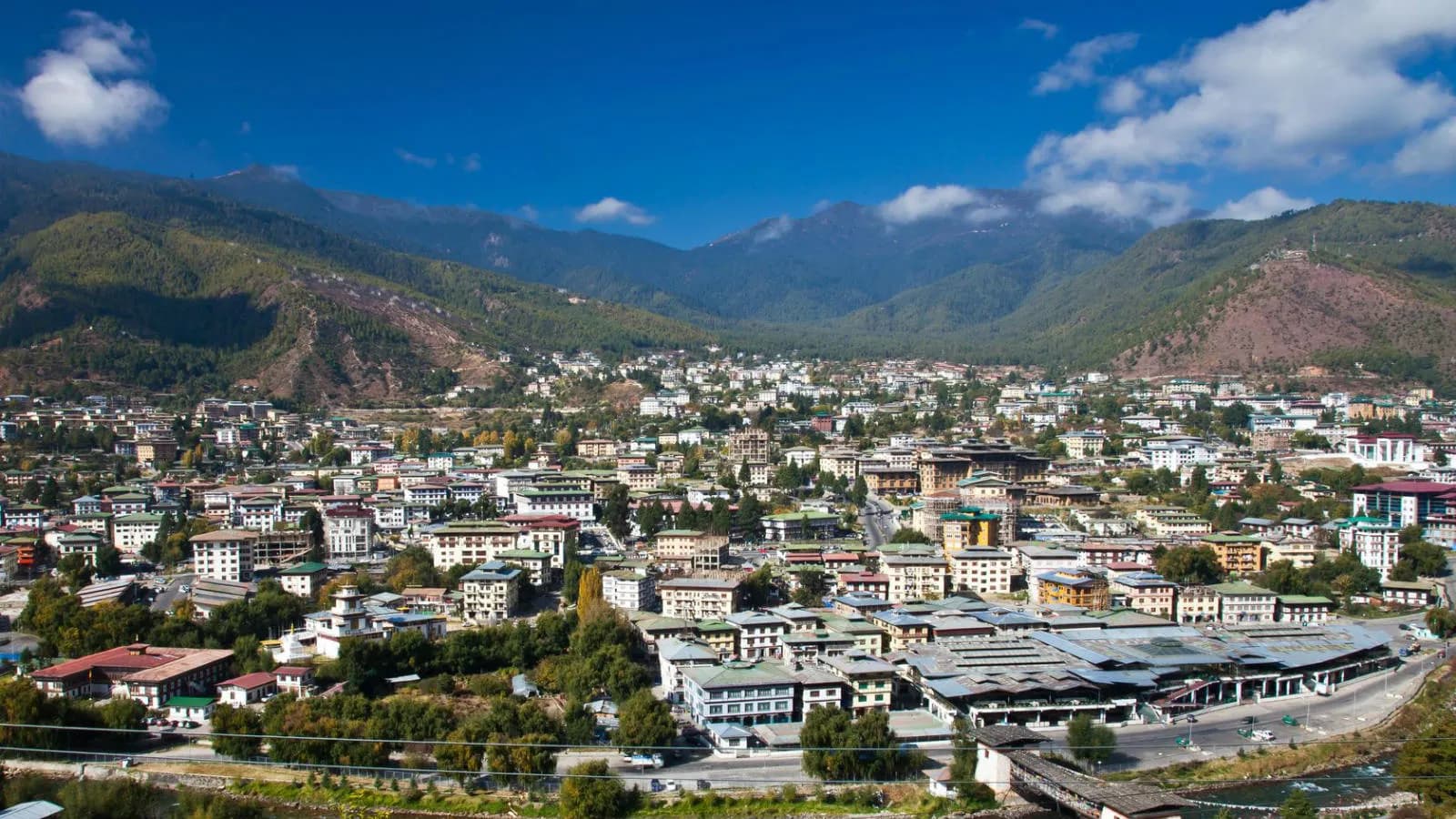 JourneySeven nights in Bhutan, on the easiest premium connection in Asia.A seven-night Bhutan trip for couples flying from Bangkok. Direct Drukair flight; Bhutanese lodges; transparent all-inclusive pricing.
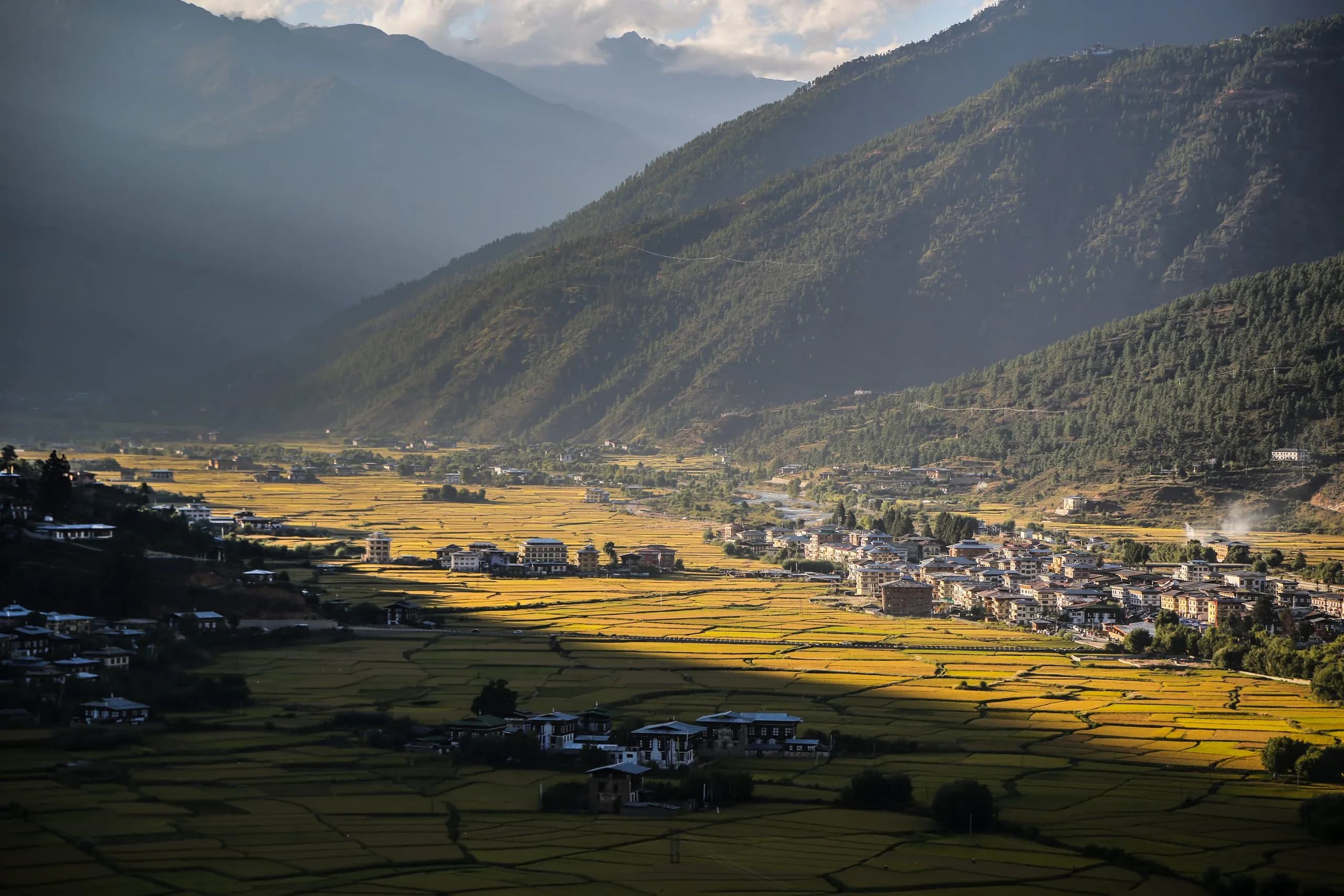 JourneyFive nights in the Western valleys, tagged onto the end of a Bangkok working week, on the daily Drukair from BKK.A five-night Bhutan journey after a Bangkok business trip. Daily Drukair BKK–PBH; Bhutan; premium tier; for the principal extending an Asia week.
 JourneySeven nights in Bhutan, on your terms.A private seven-night Bhutan honeymoon for couples flying from Singapore. Bhutanese lodges, a matched guide, transparent all-inclusive pricing.
Frequently asked
- How often does Drukair fly BKK–PBH?
- Daily, most weeks. Drukair (KB) operates the BKK–PBH route on a morning departure (~06:30–07:00 Bangkok time, ~4 hours block time, late-morning Paro arrival). Bhutan Airlines (B3) operates a similar daily morning pattern. Daily operation makes Bangkok the most flexible Bhutan hub in Asia — the trip can start any day of the week.
- Do I need a transit visa for Bangkok?
- No, for most nationalities. Thailand offers visa-on-arrival or visa-free entry to passport-holders of most countries including the US, EU, UK, Australia, New Zealand, Singapore, Hong Kong, Japan, South Korea, and most ASEAN nations. The Bangkok hub does not carry the transit-visa friction that the Indian hubs (Delhi, Kolkata, Mumbai) impose on non-Indian-passport-holders. Check Thailand's current visa policy for your specific nationality before travel.
- Should I take a same-day connection or stay a night in Bangkok?
- For long-haul arrivals (Europe, Australia, Middle East, North America via Asia), we recommend a 1-night Bangkok overnight. The Drukair BKK–PBH morning departure requires a 04:30 hotel pickup; a same-day connection from a long-haul flight does not leave enough recovery time. For short-haul arrivals (Hong Kong, Singapore, Manila, KL, regional ASEAN) or for visitors already in Bangkok on business, no overnight is needed. The Bangkok overnight is itself — the principal lodges (Mandarin Oriental, The Siam, Capella, The Sukhothai, COMO Metropolitan, Aman) make the stopover restorative.
- Drukair or Bhutan Airlines — which do you book?
- Drukair (KB) is our typical choice — the national flag carrier, the experienced operator, the better-developed loyalty programme, the longer track record. Bhutan Airlines (B3) is also reliable with comparable service and pricing. We book against the schedule that fits the proposal best (timing, aircraft availability, seat class) and switch between carriers on the day if either needs adjustment for weather or operational reasons. Both fly the Airbus A319 and follow the same Paro operating envelope.
- What if the Bangkok-Paro flight is delayed?
- Drukair operates under strict visual flight rules into Paro — no night flights, no flights in heavy cloud or rain. Delays of 1–4 hours on the Paro side are common, particularly in the monsoon shoulders (May, June, September). The Bangkok side is generally on schedule. If the morning departure is held, the carrier rebooks to the next available rotation (typically the same afternoon or next morning) and arranges Bangkok lodge nights for affected passengers. For return Saturday connections from Paro through Bangkok to Europe or Australia, we build a 24-hour buffer where the schedule permits and book Bangkok lodge nights on the rare delay.
- Can I combine a Bhutan trip with a Bangkok or Thailand stay?
- Yes — Bangkok is itself a destination, and Thailand more broadly (Chiang Mai for the cultural, the southern islands for the beach, Krabi or Phuket for the down-tempo tradition) combines naturally with Bhutan. We can advise on the Thailand portion at a high level; for the considered Thailand curation we recommend our partner curators in Bangkok who run the Thailand register at the same premium standard. The Bhutan-side booking (lodge, guide, driver, transport, SDF, visa) is what we handle directly; the Thailand-side coordination we can introduce.
- What is the Sustainable Development Fee from Bangkok?
- The SDF is USD 100 per night per international visitor — the standard Bhutanese international rate. It applies regardless of which hub you connect through; Bangkok-routed travellers and Singapore-routed travellers pay the same SDF. Thai nationals follow the standard international fee schedule (not the Indian regional rate of Nu 1,200/night). Indian nationals connecting through Bangkok still benefit from the Indian regional rate. The SDF is included in the transparent line-item pricing across all proposal nights and is paid by us on your behalf at booking.

