Planning your Bhutan journey
Drukair, Bhutan Airlines, and Paro Airport — one of the world's most difficult airports.
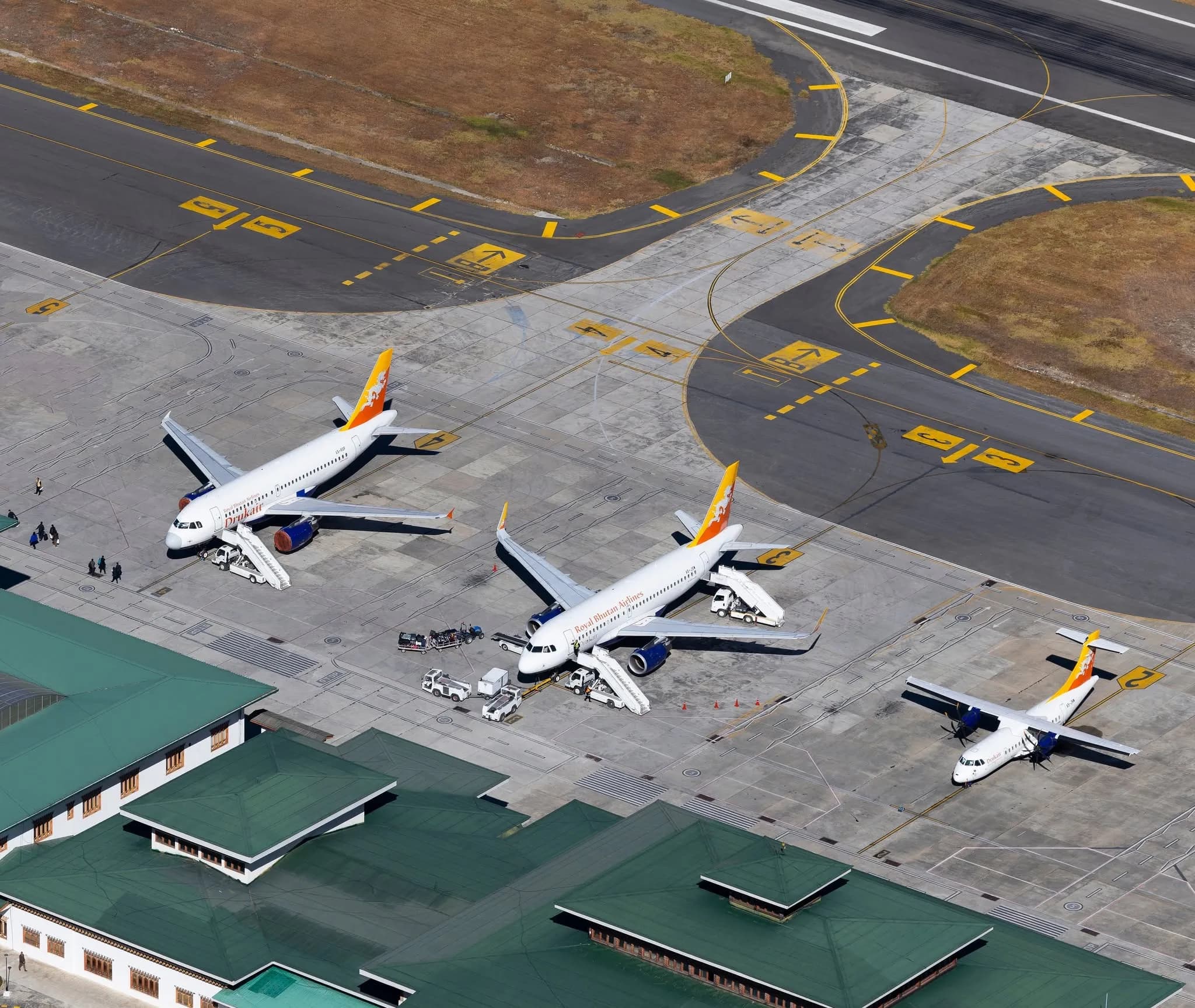
Paro International Airport (PBH) is Bhutan's only international airport, served by two carriers: Drukair (the national flag carrier) and Bhutan Airlines. **Paro is widely regarded as one of the most difficult airports in the world** — pilots fly a manual visual approach through a steep-walled valley between 5,000-metre peaks, and the airport's certification process means fewer than 50 pilots in the world are qualified to land there. The airport's safety record is strong; the difficulty refers to the technical demands of the approach, not to operational risk.
- Register
- transport
The short answer
Paro International Airport (PBH) is Bhutan's only international airport. Two carriers serve it: Drukair (KB, the national flag carrier) and Bhutan Airlines (B3). Principal routes: Delhi, Kolkata, Bagdogra, Kathmandu, Dhaka, Singapore, Bangkok, Mumbai. The Paro approach is a manual visual landing through a steep-walled valley; fewer than 50 pilots in the world are qualified. Bhutanese carriers do not fly at night or in poor weather — schedule disruption is part of the experience.
Paro International Airport — one of the world's most difficult airports
Paro International Airport (IATA: PBH) sits at 2,235 metres on a narrow valley floor between 5,500-metre peaks, with a 1.96-km runway that is shorter than the international standard for the aircraft types serving it. The approach is visual only (no instrument-landing system support to final approach) — pilots descend through a steep-walled valley with peaks rising on both sides, executing a final manual turn over the village of Bondey at low altitude before lining up with the runway. The Royal Government's Department of Civil Aviation certifies pilots specifically for the Paro approach; fewer than 50 pilots in the world are currently certified to land at PBH. The certification process requires extensive simulator training, line training with a certified captain, and ongoing currency requirements. The difficulty refers to the technical demands of the approach, not to operational risk — Drukair and Bhutan Airlines maintain strong safety records, and the strict visual-flight-rules regime means flights are delayed or cancelled when weather is marginal.
Drukair — the national flag carrier
Drukair (KB) is Bhutan's national flag carrier, founded in 1981. Fleet: 5 Airbus A319 aircraft plus 2 ATR 42-500 turboprops for domestic routes. International routes: Delhi, Mumbai, Kolkata, Bagdogra (India); Kathmandu (Nepal); Bangkok (Thailand); Singapore; Dhaka (Bangladesh); Gaya (India, seasonal). Domestic routes: Paro–Bumthang (Bathpalathang), Paro–Yongphula (Trashigang), Paro–Gelephu. Drukair operates approximately 8-12 daily international rotations depending on season; booking is direct via drukair.com.bt or through your tour operator. Drukair joined the Verteil NDC distribution in 2026, making it programmatically bookable for the first time.
Bhutan Airlines — the private carrier
Bhutan Airlines (B3), branded as Tashi Air, is Bhutan's private international carrier, founded in 2011. Fleet: 2 Airbus A319 aircraft. Routes: Delhi, Kolkata, Bagdogra (India); Kathmandu (Nepal); Bangkok (Thailand). Bhutan Airlines operates approximately 4-6 daily international rotations and offers an alternative to Drukair on the principal routes. Booking via bhutanairlines.bt or through the operator. The two carriers offer comparable scheduling on overlapping routes; price-wise, Bhutan Airlines is typically marginally lower and Drukair carries the national-flag premium.
Weather disruption and the realistic expectation
Both carriers operate under strict visual-flight-rules (VFR) for the Paro approach — no flights operate at night, no flights operate in heavy cloud or rain that obscures the visual approach. Schedule disruption is part of the Bhutanese travel experience. Flights are routinely delayed by 1-4 hours in the monsoon (June-September) and occasionally cancelled. Winter mornings (December-February) can have fog that delays the first wave of arrivals. Spring and autumn windows are most reliable. Operators build a 24-hour buffer into pre-Bhutan and post-Bhutan plans to absorb flight disruption — we recommend the same.
The hub-city stopover and the principal connections
Bhutanese flights connect at one of several Asian hub cities for international visitors. For non-Indian-passport-holders, the recommended hubs are Bangkok and Kathmandu: Bangkok (BKK) — direct to Paro on Drukair and Bhutan Airlines (~4 hours), the most-common hub for visitors from Europe, North America, Australia, and East Asia; Thailand visa-on-arrival or visa-free for most nationalities. Kathmandu (KTM) — direct to Paro on Drukair (~1 hour), the principal hub for Nepal-Bhutan combined trips; Nepal visa-on-arrival for most nationalities. Singapore (SIN) — Drukair operates SIN-PBH multiple days each week. Most rotations stop briefly at Guwahati for a 30-minute passenger exchange (Singapore-Paro passengers remain onboard), totalling ~6 hours elapsed; some early-morning rotations operate non-stop in ~4.5 hours. The principal hub for Singapore-based visitors. A note on Indian hub-city options: Delhi, Kolkata, Mumbai, and Bagdogra are Drukair-served but India requires a transit visa for non-Indian-passport-holders on certain transit itineraries, even airside. The e-Tourist Visa (e-TV) process is online but not instant, and the airline / immigration interpretation of 'transit' versus 'arrival' varies. For non-Indian-passport-holders, we recommend Bangkok or Kathmandu rather than Indian hubs. Indian-passport-holders have no such constraint — Delhi, Kolkata, and the other Indian hubs work without visa friction. The hub-city stopover is an opportunity to break the international long-haul; we work with select Bangkok and Kathmandu lodges for visitors who want a structured hub-stay.
Practical
- Airport
- Paro International Airport (IATA: PBH, ICAO: VQPR)
- Altitude
- 2,235 metres
- Runway length
- 1.96 km
- Carriers
- Drukair (KB), Bhutan Airlines (B3)
- Certified pilots
- Fewer than 50 worldwide
- Flight rules
- Visual only — no night flights, no heavy cloud
- Principal hubs (non-Indian passport)
- Bangkok, Kathmandu, Singapore
- Principal hubs (Indian passport)
- Delhi, Kolkata, Mumbai, Bagdogra also viable
- Domestic airports
- Bumthang (Bathpalathang), Trashigang (Yongphula), Gelephu
Places it mentions
Journeys it informs
 JourneySeven nights in Bhutan, on your terms.A private seven-night Bhutan honeymoon for couples flying from Singapore. Bhutanese lodges, a matched guide, transparent all-inclusive pricing.
 JourneyTen nights for the milestone — a 50th, a retirement, the year that earned the trip.A ten-night Bhutan milestone trip from London — for 50th birthdays, retirement, decade-marking anniversaries. Signature-tier; full circuit including Bumthang.
 JourneySeven nights in Bhutan, for the traveller who has done Kyoto.A seven-night Bhutan journey for travellers who have done Japan and want the next-step Asian-Buddhist destination. Tokyo departure; cultural depth.
Frequently asked
- Why is Paro Airport considered so difficult?
- The airport sits at 2,235 metres on a narrow valley floor between 5,500-metre peaks. The approach is visual only (no instrument-landing system support to final), and pilots execute a manual final turn at low altitude through the steep-walled valley. The runway is shorter than the international standard for the aircraft types serving it. Combined, these factors mean fewer than 50 pilots in the world are currently certified to land there. The difficulty refers to the technical demands of the approach — not to operational risk. The strict certification, the strict visual-flight-rules regime, and the carriers' strong safety records are the operational backbone.
- Are Drukair and Bhutan Airlines safe?
- Yes — both carriers maintain strong safety records, and the Royal Government's Department of Civil Aviation operates strict certification and ongoing oversight. The strict visual-flight-rules regime means flights are delayed or cancelled when weather is marginal, which is itself a safety feature. The Paro approach is demanding but well-procedured; the world-class safety record reflects the strict operational discipline.
- How do I book a flight to Bhutan?
- Through your licensed Bhutanese tour operator (who handles the visa and SDF), direct via drukair.com.bt or bhutanairlines.bt, or via select international travel agencies. As of 2026 Drukair is on the Verteil NDC distribution making it programmatically bookable through major GDS systems for the first time. We recommend booking via the operator for the bundled visa and SDF processing.
- Should I transit via Delhi or Kolkata?
- Not if you hold a non-Indian passport. India requires a transit visa for international passengers on certain transit itineraries, including some airside (not-leaving-the-airport) connections — the e-TV (e-Tourist Visa) process is online but not instant, and the airline / immigration interpretation of 'transit' versus 'arrival' varies. The friction makes Delhi, Kolkata, Mumbai, and Bagdogra impractical hubs for the typical non-Indian visitor. Route via Bangkok or Kathmandu instead — both offer visa-on-arrival or visa-free entry to most nationalities. Indian-passport-holders have no such constraint and can route through any Indian airport cleanly.
- What if my flight gets cancelled?
- If the cancellation is on the Bhutan side (weather delays or VFR cancellations), the operator absorbs the disruption — adjusting the itinerary, rebooking the next available flight, and absorbing the lodge cost differentials. If the cancellation is on the international leg before Bhutan, the operator works with the visitor's international carrier to reschedule. We build a 24-hour buffer into pre-Bhutan plans to absorb the most-common disruption windows.
- Can I fly into Bhutan at night?
- No — both Drukair and Bhutan Airlines operate visual-flight-rules only. No flights into or out of Paro after sunset. The last international arrival typically lands by 16:00; the first international departure typically takes off at 06:30. Flight schedules accommodate the daylight window.
- Are there other airports in Bhutan?
- Three domestic airports: Bathpalathang (Bumthang), Yongphula (Trashigang), and Gelephu (Sarpang). Drukair operates domestic routes between Paro and these airports using ATR 42-500 turboprops. Domestic flights also subject to visual flight rules. A new international airport is under planning in Gelephu (southern Bhutan), expected late this decade, which will offer an alternative to the Paro approach.

