Planning your Bhutan journey
Bhutan from New York — no direct service; the clean route is JFK–BKK with a Tokyo or Hong Kong stop, then Drukair BKK–PBH.
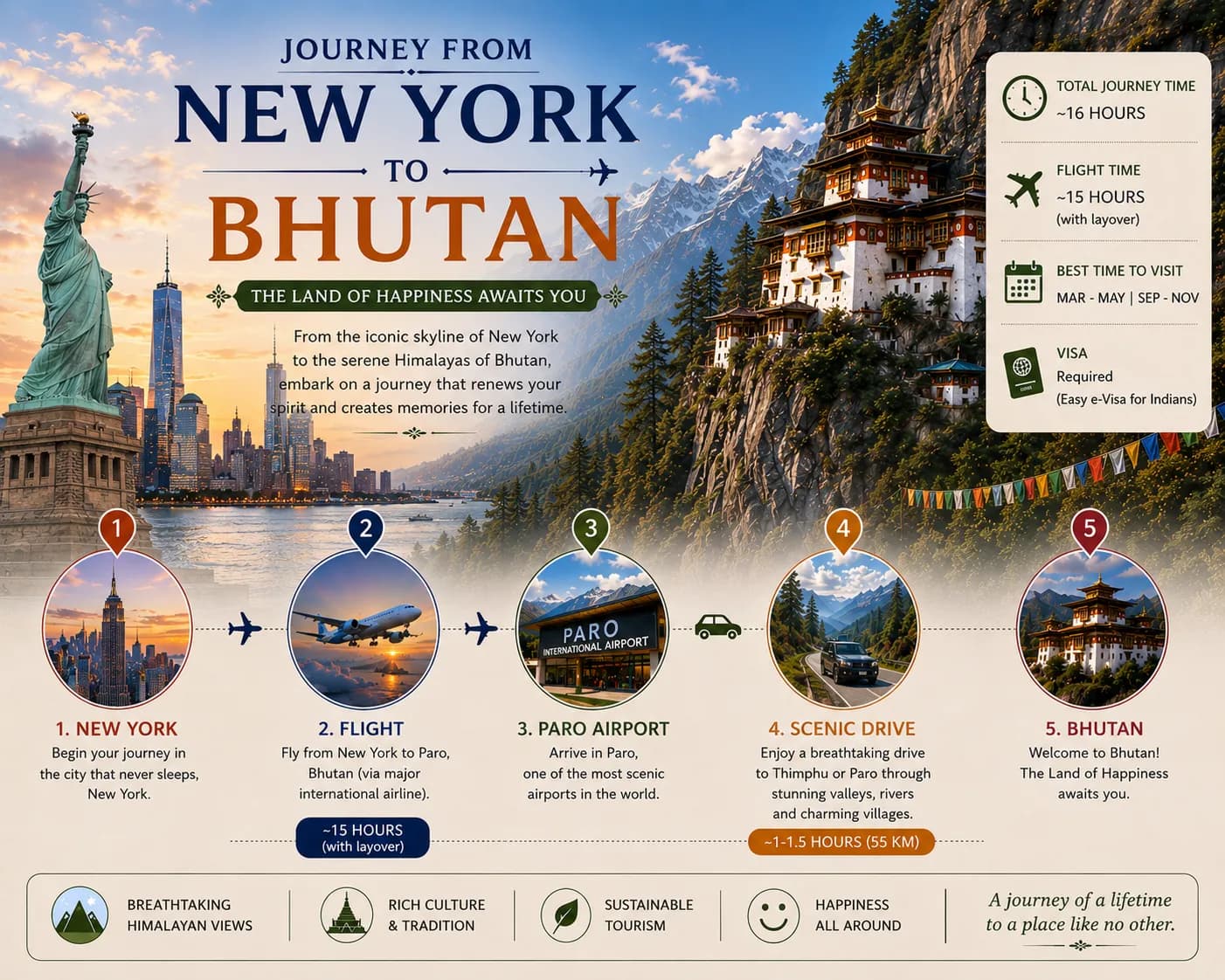
There is no direct service from New York to Paro. The recommended routing is via Bangkok — JFK to BKK via Tokyo (JAL, ANA), Hong Kong (Cathay Pacific), Seoul (Korean Air), Doha (Qatar Airways), or Dubai (Emirates), then a Bangkok overnight, then the daily Drukair BKK–PBH morning rotation. Total transit time approximately 24-30 hours including the Bangkok overnight. Singapore is the equivalent Sun-Sat alternative. Delhi is not recommended for US passport-holders (transit visa required).
- Register
- transport
The short answer
No direct service from New York. JFK to Bangkok via Tokyo (JAL/ANA ~14h then 7h), Hong Kong (Cathay Pacific ~16h direct then 3h), Seoul (Korean Air ~14h then 6h), Doha (Qatar ~13h then 7h), or Dubai (Emirates ~13h then 6h). 1-night Bangkok overnight, then daily Drukair BKK-PBH (~4h). Total ~24-30h. Singapore is the Sun-Sat alternative. Delhi NOT recommended for US passport-holders.
The long-haul reality from New York
New York to Bhutan is the longest of the principal premium-tourism origins. The cumulative transit time is approximately 24-30 hours including a Bangkok overnight. The New York-to-Asia long-haul leg alone is 12-16 hours; the transit through Tokyo / Hong Kong / Seoul / Doha / Dubai adds 6-8 hours; the Bangkok overnight; the Drukair BKK-PBH 4-hour final leg. The consequence: the New York-Bhutan trip is a multi-day arrival framework. 1-night Bangkok overnight is essential. 1-2 night Bangkok or Asian-hub stopover is recommended for the long-haul reset. The overall trip framework typically 14-18 nights minimum to justify the transit time.
The principal JFK→BKK routings
Five principal routings, varying by the transit hub: - JFK → NRT/HND → BKK (Japan Airlines / ANA / United): 14-hour long-haul to Tokyo + 7-hour second leg to BKK. Total ~22 hours including the Tokyo connection. Premium-cabin framework comfortable (JAL First, ANA The Suite, United Polaris). - JFK → HKG → BKK (Cathay Pacific direct): 16-hour direct to Hong Kong + 3-hour second leg. Total ~20 hours. Cathay Pacific premium framework (First, Business, Premium Economy). - JFK → ICN → BKK (Korean Air): 14-hour direct to Seoul + 6-hour second leg. Total ~21 hours. Korean Air First Class / Prestige. - JFK → DOH → BKK (Qatar Airways): 13-hour direct to Doha + 7-hour second leg. Total ~21 hours. Qsuite premium framework (one of the most-acclaimed premium cabin frameworks). - JFK → DXB → BKK (Emirates): 13-hour direct to Dubai + 6-hour second leg. Total ~20 hours. Emirates First / Business framework. For US East Coast travellers, the Cathay Pacific JFK-HKG-BKK works as the premium pattern; Qatar Airways JFK-DOH-BKK the premium Qsuite alternative; Japanese carriers the Japanese premium framework option. We coordinate the specific routing against the principal's carrier preference + loyalty programme + specific dates.
The Bangkok overnight — essential
The ~20-22 hour cumulative transit time JFK to Bangkok + the 04:30 Drukair pickup pattern requires a 1-night Bangkok overnight at minimum. For US travellers, the long-haul jet lag benefits from a 2-night Bangkok stopover — recovery + cultural anchor + premium-lodge experience. Bangkok lodges we work with for the US-arrival overnight: Mandarin Oriental Bangkok (heritage, American-cultural-continuity), The Siam (Dusit, Bill Bensley-designed), Capella Bangkok (Riverside, contemporary), The Sukhothai (Sathorn, classical Thai), COMO Metropolitan (Sathorn), Aman Bangkok (Nai Lert Park, opened 2024). For US premium travellers who want a 2-3 night Bangkok stopover (Thailand cultural addition + long-haul recovery), we extend the framework — the combined NY-Bangkok-Bhutan trip is the 16-20 night Asian shape that justifies the long-haul investment substantially.
Why Dubai is not currently the natural hub for US-to-Bhutan travel
In an earlier era, Dubai (DXB) would have been the natural Middle East transit hub for US premium travellers heading to Bhutan — Emirates operates substantial direct service from JFK, BOS, ORD, IAD, IAH, LAX, SFO, SEA, MIA to DXB, and from Dubai the Asian connections (DXB-BKK on Emirates daily) complete the route to Bhutan. The DXB hub experience — Emirates First Class, the Dubai stopover — is among the most premium global hub-stopover frameworks. However, the Iran-airspace situation has complicated the Western-to-Dubai routing. Iranian airspace has been restricted for many Western-flagged airlines since the 2024-2025 regional tensions; direct JFK-DXB on Emirates and other US-DXB routings on Emirates route via alternative corridors (over Saudi Arabia, via Egypt, or via the northern Caspian route) that add transit time and operational uncertainty. Flight times have extended; cancellations / reroutings have increased. The consequence for US-to-Bhutan travellers: the DXB hub is currently less of a clean transit framework than the East Asian hubs (Hong Kong, Tokyo, Seoul). US travellers based in the UAE (Dubai-resident US expatriates) still use Dubai as the natural home hub — see bhutan-from-dubai. For US travellers transiting from JFK / IAD / ORD / LAX / SFO, the cleaner routings are now via Hong Kong (Cathay Pacific direct from JFK), via Tokyo (JAL / ANA direct from JFK/ORD/LAX), via Seoul (Korean Air direct from JFK/LAX), or via Singapore (Singapore Airlines direct from JFK/LAX/SFO). Qatar Airways routing via Doha (DOH) still works for US travellers but follows the same Iran-airspace constraint set; flight times have extended. Qsuite premium framework remains excellent for travellers prioritising premium cabin over transit time. This situation is subject to change as the Iran-airspace framework evolves. We monitor the routing reality and update against current operational frameworks at the time of booking.
The Singapore alternative — Sun-Sat framework
Singapore is the equivalent alternative hub for New York travellers. The principal JFK-SIN routings: - JFK → SIN (Singapore Airlines direct): 19-hour direct flight (the longest commercial flight in the world). Suites / First / Business framework. - JFK → ICN → SIN (Korean Air): 14-hour to Seoul + 6-hour to Singapore. Total ~22 hours. - JFK → HKG → SIN (Cathay Pacific): 16-hour to Hong Kong + 3-hour to Singapore. Total ~21 hours. The Drukair SIN-PBH operates Sun-Sat only. For US travellers whose dates align with Sun arrival / Sat departure, Singapore works — Singapore-Bhutan 6-night block + Singapore stopover. Singapore hub experience at Changi is the premium hub-stopover option. For US travellers whose dates don't align with Sun-Sat, Bangkok the more-flexible hub.
Why Delhi is NOT recommended for US passport-holders
India requires a transit visa for US passport-holders on certain itineraries even when remaining airside (not leaving the airport). The e-TV (e-Tourist Visa) process is online but not instant; the airline / immigration interpretation of 'transit' versus 'arrival' varies. For US passport-holders considering JFK-DEL-PBH (Air India operates JFK-DEL direct ~14 hours, then Drukair DEL-PBH), the transit-visa friction adds time, administrative work, and uncertainty. The Bangkok or Singapore hubs offer cleaner alternatives. Exception: US passport-holders with existing Indian visas (long-term tourist visas, Person of Indian Origin / Overseas Citizen of India cards, business visas) can route via Delhi. For these travellers, the Drukair DEL-PBH daily framework works cleanly. See bhutan-from-delhi for the Delhi-routing details.
Booking lead time and US-market patterns
Standard windows (autumn October-November, spring March-May): 10-14 weeks lead time for US-market bookings. Clear-Sky Bhutan (December-February): 8-10 weeks. Festival windows: 5-7 months. US-specific seasonal considerations: Thanksgiving (late November) and Christmas-New Year elevate US family demand — book 4-5 months ahead. Summer school holidays (June-August) the principal US family-travel window; partially overlaps Bhutan's Green Bhutan / monsoon — book 4 months ahead. Spring break (March): elevated US-college-family demand. For signature-tier US HNI bookings (senior business figures, academic figures requiring privacy, entertainment-industry figures), 6-9 months lead time is comfortable with the matched knowledgeable guide and premium lodge holds in place.
Practical
- Direct New York–Bhutan service
- None
- Recommended routing
- JFK → Asian hub (HKG / NRT / ICN / DOH / DXB) → BKK (1-night overnight) → PBH on daily Drukair morning
- Principal JFK→BKK carriers
- Cathay Pacific (via HKG), Qatar Airways (via DOH), Japan Airlines / ANA (via NRT/HND), Korean Air (via ICN), Emirates (via DXB)
- Cathay direct JFK→HKG
- ~16 hours
- Total JFK → PBH transit
- ~24-30 hours including 1-night Bangkok overnight
- Singapore alternative
- JFK → SIN (Singapore Airlines direct ~19h) → PBH (Drukair Sun-only)
- India transit hubs (DEL)
- NOT recommended for US passport-holders (transit visa required)
- Bangkok overnight
- ESSENTIAL given the long-haul; 1-2 night recommended
- Premium-cabin recommendation
- First or Business for the long-haul leg given the transit time
- Festival-window booking lead time
- 5-7 months
- Total trip framework recommendation
- 14-18 nights minimum to justify the long-haul investment
Journeys it informs
 JourneyNine nights for an anniversary, paced for the long flight.A signature nine-night Bhutan anniversary trip for couples flying from New York. Bhutan including Phobjikha; matched knowledgeable guide; hub-stopover advisory.
- JourneyNine nights in Bhutan, on the routing from Zurich.A nine-night Bhutan honeymoon for couples flying from Zurich. Bhutan including Phobjikha; matched knowledgeable guide; transparent all-inclusive pricing.
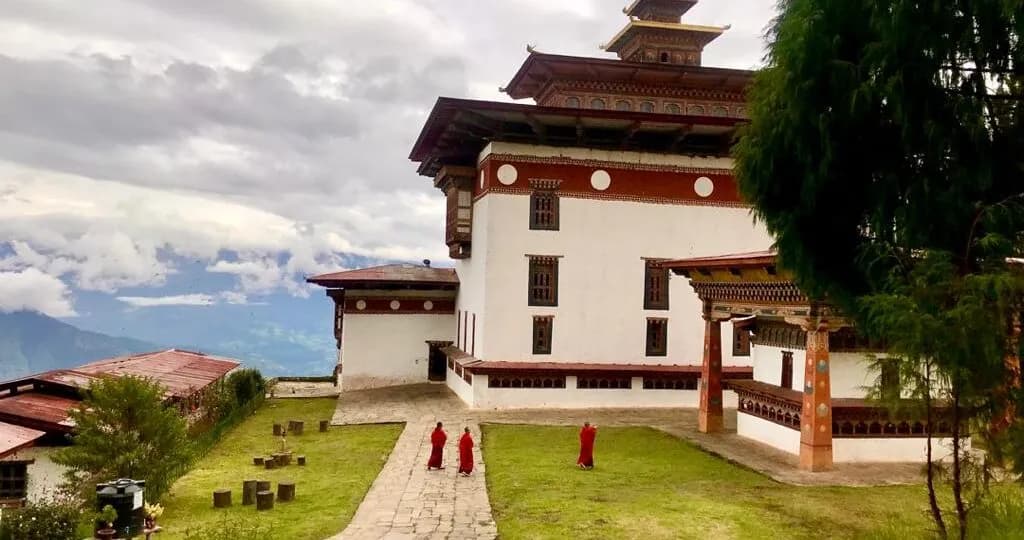 JourneyNine nights in Bhutan, on the routing from Toronto.A nine-night Bhutan trip for couples flying from Toronto. Bhutan including Phobjikha; matched knowledgeable guide; transparent all-inclusive pricing.
Frequently asked
- Is there a direct flight from JFK to Paro?
- No. No direct service from any US airport to Paro. The principal routings: JFK to Bangkok via Hong Kong (Cathay), Tokyo (JAL/ANA), Doha (Qatar), Dubai (Emirates), or Seoul (Korean Air); then daily Drukair BKK-PBH. Or JFK to Singapore (Singapore Airlines direct) then Drukair SIN-PBH on Sun-Sat.
- Which routing has the shortest transit time?
- JFK-HKG-BKK on Cathay Pacific the shortest at ~20 hours (16h JFK-HKG + 3h HKG-BKK + 1-night Bangkok overnight + 4h BKK-PBH = ~24 hours total). JFK-DOH-BKK on Qatar comparable at ~21 hours. JFK-NRT-BKK on JAL/ANA comparable at ~22 hours.
- Should I take premium cabin for the long-haul?
- Recommended. The 14-19 hour single legs (Cathay JFK-HKG, Singapore Airlines JFK-SIN) justify the premium cabin investment for sleep and comfort. Cathay First, Qatar Qsuite, Singapore Airlines Suites are the most-acclaimed premium cabins on the principal JFK routings. For US HNI families, the premium cabin is standard.
- What about 1-stop vs 2-stop routings?
- 1-stop cleaner. JFK-HKG (Cathay) + HKG-BKK is a 1-stop. JFK-DOH (Qatar) + DOH-BKK is 1-stop. JFK-NRT (JAL/ANA) + NRT-BKK is 1-stop. The 2-stop routings (JFK-LAX-NRT-BKK, etc.) add transit time and complexity; avoid where possible.
- How long should the Bangkok overnight be?
- 1-night minimum (essential). 2-night recommended for US travellers given the jet lag. 3+ night Bangkok stopover complements the Bhutan trip — cultural anchor + premium hub-experience.
- What's the minimum trip framework I should plan?
- For US travellers, 14-night minimum total trip framework justifies the long-haul transit investment. The standard pattern: 1-2 nights Bangkok stopover outbound + 6-8 nights Bhutan + 1 night Bangkok return + flights. 18-21 night framework for deeper engagement (2-3 nights Bangkok + 9-10 nights Bhutan + 1-2 nights Bangkok return).
- What about West Coast (SFO/LAX) routings?
- Cleaner via Singapore Airlines direct SFO-SIN (~17h) or LAX-SIN (~17h), then Drukair SIN-PBH Sun-Sat. Or ANA/JAL SFO/LAX-NRT/HND then NRT/HND-BKK then Drukair BKK-PBH. West Coast travellers have the shorter total transit time than East Coast travellers — typically 22-26 hours JFK-equivalent transit but 18-22 hours from SFO/LAX. See bhutan-from-singapore and bhutan-via-singapore-transit-hub for the Singapore-anchored West Coast framework.

