Planning your Bhutan journey
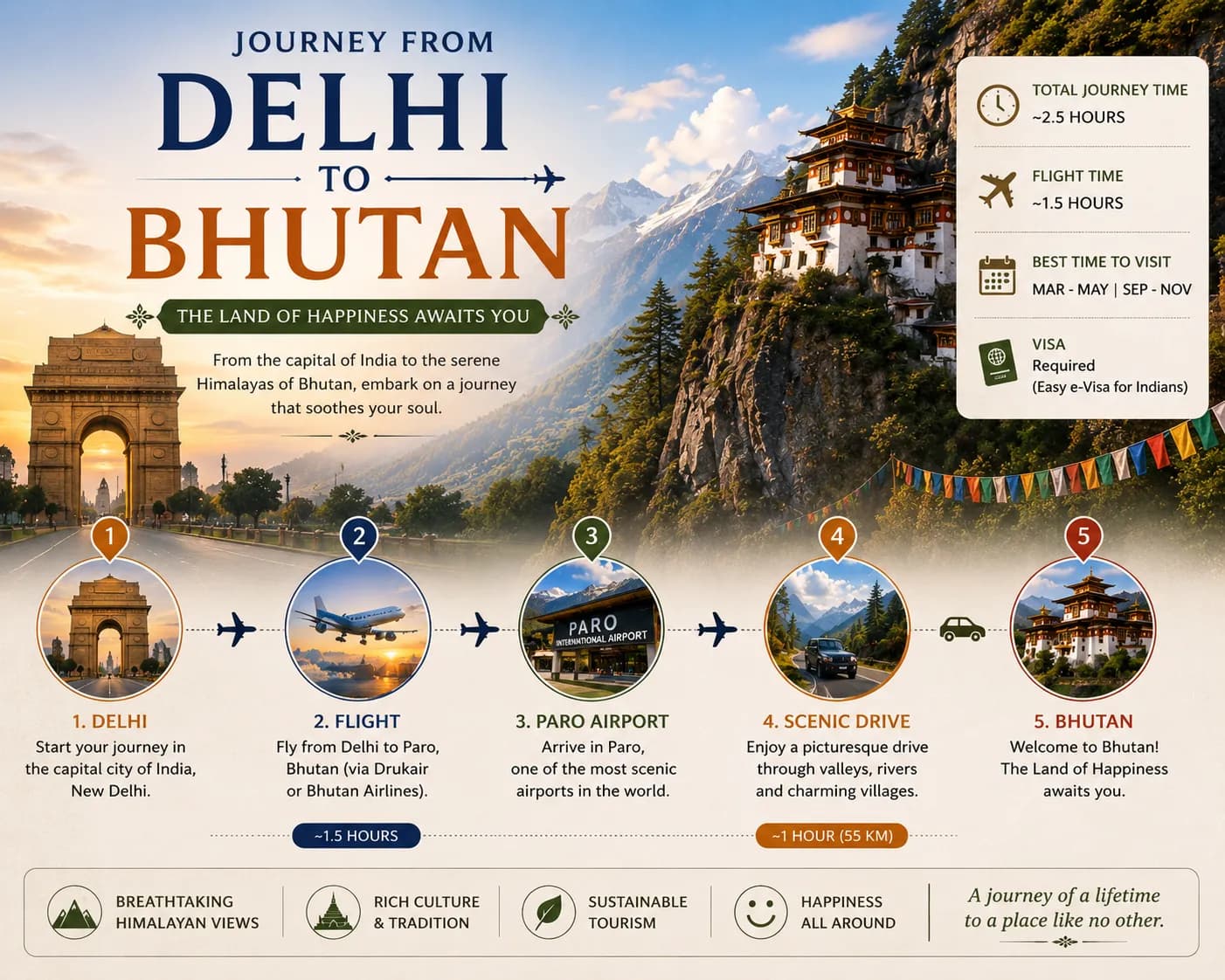
Bhutan from Delhi — Drukair operates DEL–PBH on a daily morning rotation, the principal gateway for Indian premium travellers.
Delhi is the principal Indian gateway to Bhutan. Drukair (KB) and Bhutan Airlines (B3) operate DEL–PBH on a daily morning rotation; ~2.5 hours flight time. For Indian-passport-holders, the journey is among the cleanest premium routings into Bhutan — Indian-national framework (Nu 1,200/night SDF, visa-free entry with permit on arrival, no transit-visa complication), daily-flight capacity, the considered cultural-religious depth that meets the Indian premium register.
- Register
- transport
The short answer
Drukair (KB) and Bhutan Airlines (B3) operate DEL–PBH on a daily morning rotation; ~2.5 hours flight time; seat capacity on both carriers. For Indian-passport-holders: Nu 1,200/night SDF (regional rate), visa-free entry with permit on arrival, no transit-visa friction. Delhi is the principal Indian gateway and the cleanest premium routing for Indian HNI families.
The Drukair / Bhutan Airlines Delhi rotation — what actually operates
Drukair operates DEL–PBH daily on a morning departure (typically 12:30–13:00 Delhi time, ~2.5 hours flight time, mid-afternoon Paro arrival). Bhutan Airlines (B3) operates DEL-PBH on multiple days each week — per the current 2026 schedule, B3 operates direct DEL-PBH on Tuesday, Thursday, and Saturday (B3774 DEL-PBH morning rotation), plus via Kathmandu on other days (B3774 DEL-KTM-PBH on Monday). The two carriers together give substantial weekly capacity on the route; Delhi is by some margin the highest-capacity Indian gateway to Bhutan, well above Kolkata (CCU) or Bagdogra (IXB). (Mumbai has no regular direct service — see bhutan-from-mumbai.) The return PBH–DEL rotation departs Paro in the morning (typically 09:30–10:00) and arrives Delhi by midday. Aircraft is typically the Airbus A319 (Drukair's principal long-range fleet) for both carriers. Schedule details (exact flight numbers, timings) shift with Drukair's seasonal releases; we surface the current schedule against any proposal and confirm at the time of booking.
Why Delhi is the cleanest Indian routing
Three reasons for Indian premium travellers. (1) Capacity: Delhi has by some margin the largest daily seat capacity on the Drukair Indian network. For festival windows (Paro Tshechu late March, Thimphu Tshechu late September, Punakha Drubchen late February) Delhi is the most-available gateway when other Indian routings (Kolkata, Bagdogra) sell out. (2) Connectivity: Delhi is the Indian aviation hub — non-Delhi-resident Indian travellers from Bangalore, Chennai, Hyderabad, Pune, Ahmedabad, and every other Indian city connect cleanly to Delhi on Air India, IndiGo, SpiceJet, Vistara, and the broader Indian carrier network. The DEL transit is typically 90–120 minutes for the domestic-to-Drukair connection. (3) Hotel and lodge inventory: For Indian HNI families who want a Delhi pre-departure or post-arrival night, the Delhi lodge inventory (The Oberoi, ITC Maurya, Taj Mahal Hotel, The Leela Palace, Aman New Delhi) supports the premium-tier expectation.
The Indian-national framework — favourable
Indian-passport-holders benefit from the regional framework at every stage of the trip: - Sustainable Development Fee (SDF): Indian nationals pay Nu 1,200 per night per adult (~USD 14/night at parity), against the USD 100/night international rate. For an 8-night Bhutan trip, the Indian-national SDF is Nu 9,600 (~USD 110) — negligible. Children 6–12 at 50% (Nu 600/night); under 6 exempt. - Visa: Indian nationals do not require a pre-approved visa — a permit is issued on arrival at Paro Airport. (Non-Indian-passport-holders, including OCI cardholders, require the pre-approved international visa via the licensed tour operator.) - Currency: Indian rupee accepted as legal tender in Bhutan across all premium-tier transactions. Bhutanese ngultrum at parity with INR. - No transit visa: Indian-passport-holders transit through any Indian airport without complication. (The India transit-visa friction is the principal constraint on non-Indian-passport routings through DEL / CCU / BOM — see bhutan-from-hong-kong and bhutan-from-london.) The combined effect: Indian HNI families face the lowest friction-cost of any international market into Bhutan. See bhutan-for-indian-hni-families for the multigenerational journey framework.
Origin connections to Delhi — for non-Delhi Indian travellers
For Indian premium travellers based outside Delhi, the standard pattern is a morning domestic flight to DEL, a 90-120 minute connection, then the Drukair DEL–PBH afternoon rotation. Indian carriers operating substantial DEL flights: - Bangalore (BLR): Air India, IndiGo, Vistara, SpiceJet operate every hour during peak times. Flight time ~2.5h. - Mumbai (BOM): Air India, IndiGo, Vistara half-hourly. Flight time ~2h. - Chennai (MAA): Air India, IndiGo, Vistara hourly. Flight time ~2.5h. - Hyderabad (HYD): Air India, IndiGo, Vistara hourly. Flight time ~2h. - Pune (PNQ): IndiGo, Vistara half-hourly. Flight time ~2h. - Ahmedabad (AMD): IndiGo, Vistara hourly. Flight time ~1.5h. - Kolkata (CCU): also has a direct Drukair CCU–PBH option; see the Kolkata-via-Drukair framework below. We coordinate the connection timing against the Drukair DEL–PBH afternoon rotation; the domestic Indian leg is typically the visitor's own booking with their preferred carrier.
The Delhi pre-departure overnight — useful but not essential
For Indian HNI families travelling with multiple generations or for international visitors arriving Delhi from non-Indian origins (Dubai, London, New York, Singapore — where Delhi serves as the Asian transit point — see the caveats below for non-Indian-passport-holders), a Delhi pre-departure overnight serves three functions: (1) reset before the Drukair DEL–PBH departure; (2) cultural-historical anchor — for Indian HNI families, a Delhi night at the Oberoi or Aman New Delhi complements the Bhutan trip; (3) baggage / packing reorganisation between the international flight and the Drukair flight (Drukair has luggage restrictions due to the Paro Airport visual-approach requirements). For Delhi-resident Indian families, the overnight is not required — the morning departure from home suffices.
The India transit-visa caveat — for non-Indian-passport-holders
Critical caveat: For non-Indian-passport-holders considering Delhi as a transit hub (e.g., London / Dubai / New York visitors routing via DEL), India requires a transit visa even when remaining airside (not leaving the airport). The e-TV (e-Tourist Visa) process is online but not instant, and the airline / immigration interpretation of 'transit' versus 'arrival' varies. The friction adds time and uncertainty. For non-Indian-passport-holders, we recommend Bangkok or Singapore as the cleaner transit hub (see bhutan-from-bangkok and bhutan-from-singapore). Bangkok offers daily Drukair BKK–PBH service; Singapore offers Drukair Sun-Sat. Both avoid the India transit-visa complication. The Delhi gateway is the principal gateway for Indian-passport-holders specifically; for non-Indian-passport-holders the Indian routing is logistically more complex and rarely the optimal choice.
Booking lead time and Indian-market availability
Daily DEL–PBH frequency gives substantial lead-time flexibility. For non-festival windows in autumn (mid-October to late November) and spring (March to May), 6 to 8 weeks of lead time is comfortable for the Indian-market booking pattern. For Clear-Sky Bhutan (December to February), 4 to 6 weeks is generally adequate. Festival windows (Paro Tshechu in late March, Thimphu Tshechu in late September, Punakha Drubchen in late February) require 4 to 6 months of lead time — demand from the Indian market specifically during these windows. Indian peak-travel windows: Dussehra (October), Diwali (October/November), Christmas-New Year, summer school holidays (May-June) overlap with elevated demand; book 3 to 4 months ahead for these windows. For the Snowman Trek or other long-haul trekking itineraries, 9 to 12 months for the principal trek windows.
Practical
- Drukair DEL → PBH
- Daily; ~2.5 hours flight time; afternoon departure
- Drukair PBH → DEL
- Daily; ~2.5 hours flight time; morning departure
- Bhutan Airlines DEL → PBH
- Operates a parallel daily DEL-PBH rotation
- Aircraft
- Airbus A319 (both carriers)
- Indian-national SDF
- Nu 1,200/night/adult (~USD 14/night)
- Indian-national visa
- Visa-free; permit issued on arrival
- Currency
- Indian rupee accepted at parity with Bhutanese ngultrum
- Transit visa for non-Indian-passport-holders
- REQUIRED — use Bangkok or Singapore as alternative hub
- Festival-window booking lead time
- 4–6 months
- Standard-window booking lead time
- 6–8 weeks
- Recommended hotels for Delhi overnight
- The Oberoi New Delhi, ITC Maurya, Taj Mahal Hotel, The Leela Palace, Aman New Delhi
Journeys it informs
 JourneyA multigenerational private Bhutan journey from India — three generations, eight nights, signature-tier lodges, Indian-fluent guide, the Indian-national SDF rate.A multigenerational Bhutan journey for Indian HNI families. Indian-national SDF rate, daily Drukair from DEL/CCU/BOM, Indian-fluent guide, signature-tier lodges.
 JourneySeven nights in Bhutan, on the short flight from Mumbai.A private seven-night Bhutan honeymoon for couples flying from Mumbai. Bhutanese lodges, a matched guide, transparent all-inclusive pricing.
 JourneyTen nights for the Buddhist pilgrim — the principal sites, with monastic context.A ten-night Bhutan Buddhist pilgrimage for Asian-Buddhist travellers. Monastic context; matched monastic-trained guide; Bumthang religious circuit.
Frequently asked
- How often does Drukair fly DEL–PBH?
- Daily, both carriers (Drukair KB and Bhutan Airlines B3). Drukair operates an afternoon departure (~12:30-13:00 Delhi time) on the principal rotation. Bhutan Airlines operates a parallel daily rotation. Daily operation makes Delhi the most flexible Indian gateway — the trip can start any day of the week from Delhi.
- What is the Indian-national SDF compared to international?
- Indian nationals pay Nu 1,200/night/adult (the regional rate), against USD 100/night/adult for international visitors. For an 8-night trip for an adult, Indian-national SDF totals Nu 9,600 (~USD 110); international-rate equivalent is USD 800. The saving is significant. Children 6-12 pay 50%; under 6 exempt.
- Do I need a visa as an Indian national?
- No pre-approved visa required for Indian nationals. A permit is issued on arrival at Paro International Airport. You should travel with valid Indian passport (minimum 6 months validity) + return flight booking + Bhutan hotel booking confirmation; the licensed Bhutanese operator coordinates the permit issuance against your booking.
- Can I bring Indian rupees into Bhutan?
- Yes — Indian rupees are accepted as legal tender in Bhutan at parity with the Bhutanese ngultrum. Most premium-tier transactions (lodges, restaurants, retail) accept INR directly. Card payments work across the premium-tier surface (Visa, MasterCard, Amex with surcharge); ATMs available in Thimphu and Paro for INR / NU withdrawal.
- What about OCI cardholders — do they get the Indian-national framework?
- OCI (Overseas Citizens of India) cardholders are treated as international visitors for Bhutan tourism purposes, not Indian nationals. OCI holders pay the USD 100/night international SDF and require the pre-approved international visa via the licensed tour operator. The Indian-national framework applies to Indian-passport-holders specifically, not to OCI / PIO cardholders. We confirm at the booking stage based on the passport scan.
- Should I take the Delhi pre-departure overnight?
- Depends. For Delhi-resident families, no — the morning home departure for the afternoon Drukair flight is straightforward. For non-Delhi Indian families (Bangalore, Mumbai, Chennai, etc.) flying domestic to Delhi, a same-day connection works but a Delhi overnight at the Oberoi / ITC Maurya / Taj / Aman adds cultural / culinary anchor and reduces transit fatigue. For Indian HNI families travelling with multiple generations, the Delhi overnight is recommended.
- What about Kolkata or Bagdogra as alternative Indian gateways?
- Both are operational alternatives. Drukair operates CCU–PBH and IXB–PBH on multiple weekly rotations (less than daily but frequent). Bhutan Airlines operates parallel service on the principal Indian routes. For eastern Indian travellers (Kolkata, Guwahati, Bagdogra, Patna, Bhubaneswar), CCU or IXB may be closer. We surface the current schedule across all Indian gateways and pick the optimal routing in the proposal.
- How does the Bhutan trip from Delhi compare to a Ladakh trip from Delhi?
- See bhutan-vs-ladakh-for-private-travel for the comparative read. Short version: Bhutan offers the considered premium-tier framework with the matched-guide simplicity and the cultural-religious continuity; Ladakh offers high-altitude moonscape landscape and lower cost, with Indian-domestic travel the cleanest framework. For Indian HNI families with premium-tier expectations, Bhutan the considered framework. For Indian families wanting a more affordable Vajrayana cultural trip, Ladakh the alternative.

