Planning your Bhutan journey
Bhutan from Singapore — the Sunday-Saturday rhythm, multiple weekly rotations, and what it means for your trip.
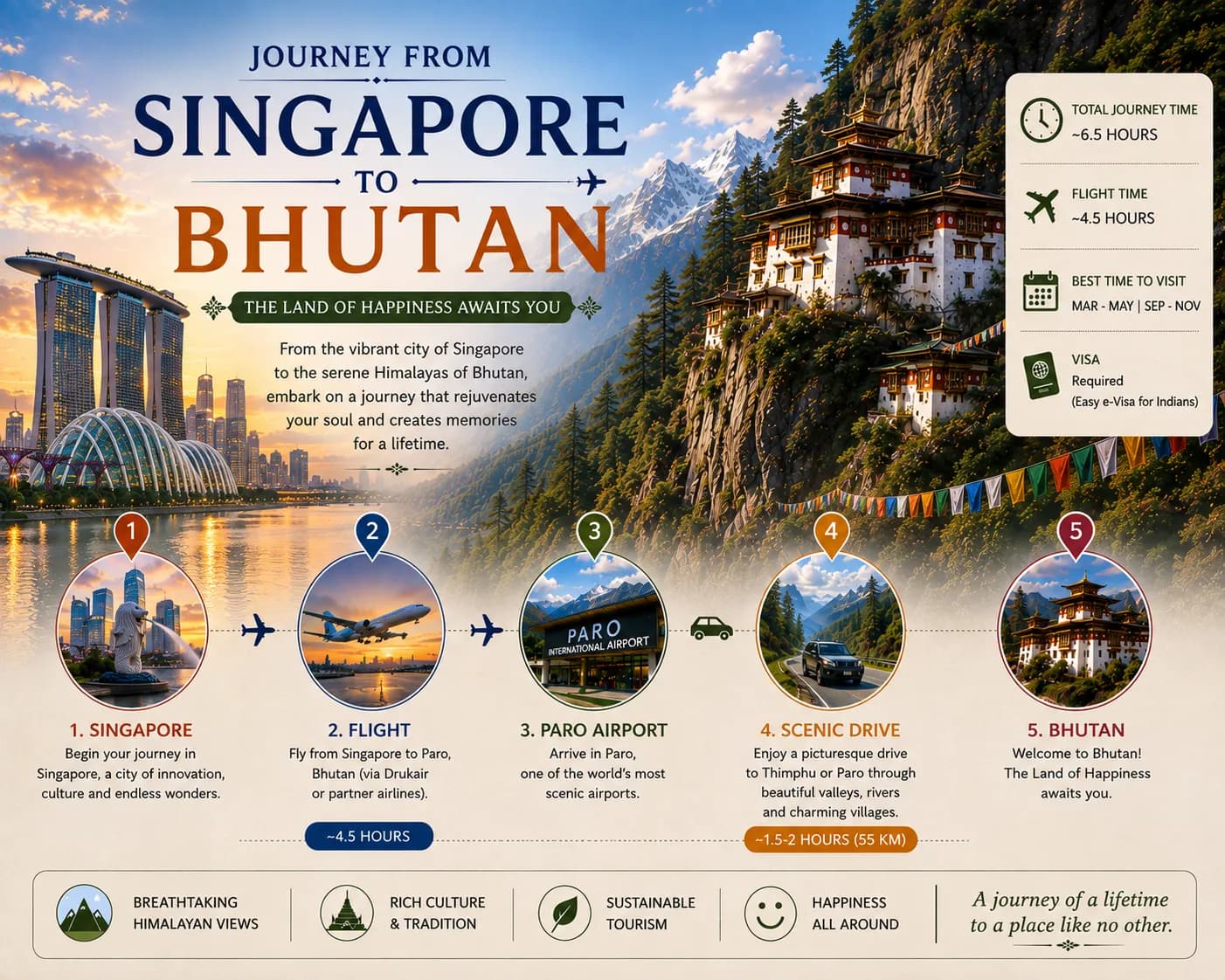
Drukair operates the Singapore–Paro route multiple times each week. **Most rotations are effectively a direct flight** — a brief 30-minute Guwahati stop for passenger exchange (passengers continuing to Paro remain onboard) (GAU) in northeast India, with passengers remaining onboard. **Total elapsed time approximately 6 hours.** Some early-morning rotations operate non-stop in approximately 4.5 hours. The **natural Singapore-Bhutan trip rhythm is 6 nights** (Sunday arrival, Saturday departure) — the cleanest cycle for a standard Bhutan trip. The route also supports 13-night double blocks and mid-week alternatives for visitors who prefer different days. **Bhutan Airlines does not currently serve Singapore** — all SIN-PBH service is on Drukair.
- Register
- transport
The short answer
Drukair operates SIN-PBH multiple days per week. Most rotations are effectively a direct flight — a brief 30-minute Guwahati stop for passenger exchange (passengers continuing to Paro remain onboard) (GAU), ~6 hours total elapsed. Some early-morning rotations operate non-stop in ~4.5 hours. The optimal 6-night cycle is Sunday arrival, Saturday departure (the standard Sun-PBH afternoon arrival + Sat-SIN afternoon arrival). Mid-week rotations exist for flexibility. Bhutan Airlines (B3) does not currently serve Singapore. Hub-city alternatives (Bangkok, Kathmandu) work for visitors needing different days; avoid Indian hubs (Delhi, Kolkata, Mumbai) due to India transit-visa friction.
The Drukair Singapore route — the rhythm
Drukair operates Singapore–Paro multiple days each week. Most rotations stop briefly at Guwahati (GAU) in northeast India — a 30-minute commercial stop where some passengers disembark for Guwahati and others board for the Paro leg; Singapore-Paro passengers remain onboard. Total elapsed flight time approximately 6 hours, effectively a direct flight. Some early-morning rotations operate non-stop and complete in approximately 4.5 hours. The standard Sunday arrival from Singapore lands in Paro in the late afternoon; the standard Saturday departure leaves Paro in the early morning and arrives Singapore in the mid-afternoon. Bhutan Airlines (B3) does not currently serve Singapore — all SIN-PBH service is on Drukair. The cleanest cycle for a standard 6-night trip is Sunday arrival in Paro, Saturday departure back to Singapore — both flights land at usable hours and the 6-night block fits Bhutan comfortably. Mid-week rotations exist for visitors who prefer different days — we surface the current Drukair schedule against any proposal's dates and adjust the itinerary accordingly. Schedule details (exact flight numbers, timings, frequencies) change with Drukair's seasonal releases; we confirm against current schedule at booking rather than embedding fixed timings here.
The natural 6-night block
Sunday arrival, Saturday departure = 6 nights in Bhutan. This is the standard Singapore-Bhutan trip duration and accounts for the majority of Singapore-based bookings. The 6-night block accommodates Bhutan at a comfortable pace within our per-valley caps: 2 nights Paro (arrival, Tiger's Nest hike, Rinpung Dzong), 1 night Thimphu (Tashichho Dzong, Buddha Dordenma, the Memorial Chorten), 2 nights Punakha (Punakha Dzong, Chimi Lhakhang, riverside walks), 1 night Paro (return for the Saturday morning flight). The pace is brisk but considered — the principal cultural circuit at a Bhutanese-appropriate rhythm. Most honeymoons, anniversary trips, and small-group cultural trips from Singapore land on this shape. This is a recommendation — not a rule. We adjust the per-valley split to your preference; the shape above is what works for most first-time Singapore-based visitors.
The 13-night double block
For visitors with more time, Sunday arrival to the following Saturday = 13 nights in Bhutan opens substantially more of the country. The 13-night profile we typically recommend: 2 nights Paro (arrival, acclimatisation), 1 night Thimphu, 2 nights Punakha, 2 nights Phobjikha (Gangtey Goemba, the cranes in season), 3 nights Bumthang (Jambay, Kurjey, Tamshing religious circuit), 1 night Punakha (return drive), 2 nights Paro (Tiger's Nest hike, departure). This gives the considered Bhutanese cultural experience that the 6-night version doesn't quite reach. The 13-night profile is what most repeat-visitor Singapore travellers commit to.
Flexibility beyond the standard 6-night cycle
The 6-night Sun-Sat is the cleanest shape, but the Drukair Singapore service operates multiple days per week so other patterns are workable. Mid-week SIN-PBH flights support arrivals on other days (current schedule typically includes Tuesday, Wednesday, Thursday and Saturday SIN-PBH options in addition to Sunday). PBH-SIN return flights similarly operate multiple days. This gives flexibility for: 5-night or 7-night trips (arrive a non-Sunday day, depart on the matching pattern); business travellers with constrained start/end weekdays; combined trips where Bhutan is one leg of a longer Asian itinerary. Our concierge surfaces the current Drukair schedule for any proposal and works to the most efficient routing. The 6-night Sun-Sat remains our default recommendation for first-time Singapore visitors because the daily turnaround is the easiest to plan; longer or non-standard durations follow the proposal conversation.
Hub-city stopovers — Bangkok or Kathmandu
Travellers who want more scheduling flexibility from Singapore can fly to a hub city first, then connect to Bhutan on Drukair. The clean options are two: Bangkok (BKK) — Drukair operates daily BKK-PBH; Singapore Airlines and Scoot operate multiple daily SIN-BKK. Thailand offers visa-on-arrival or visa-free entry to most international nationalities. The Bangkok stopover is the most-popular workaround and lets travellers arrive Bhutan on any day of the week. We work with select Bangkok lodges for visitors who want a structured 1-2 night stopover. Kathmandu (KTM) — Drukair operates KTM-PBH multiple times weekly; Singapore Airlines operates SIN-KTM with one stop. Nepal offers visa-on-arrival to most nationalities. The Kathmandu stopover is the natural hub for visitors combining Bhutan with a Nepal cultural or trekking trip. A note on Indian hub-city options: Delhi, Kolkata, and Mumbai are not recommended as transit hubs for non-Indian-passport-holders. India requires a transit visa for international passengers even when remaining airside (not leaving the airport) on certain itineraries — the e-TV (e-Tourist Visa) process is online but not instant, and the airline / immigration interpretation of 'transit' versus 'arrival' varies. The friction makes Delhi/Kolkata/Mumbai impractical hubs for the typical non-Indian Singapore-based visitor. Indian-passport-holders have no such constraint and can route through any Indian airport without difficulty. For most Singapore visitors with the standard 6-night Bhutan plan, the direct Drukair Sunday-Saturday route remains the simplest and we recommend it where the dates work.
Booking lead time and the Drukair seat reality
Drukair operates a small fleet — 5 Airbus A319 aircraft serving the entire international network — so capacity on any given route is structurally limited. Around the principal festival windows (the Paro Tshechu in late March/early April, the Thimphu Tshechu in late September/early October), the Singapore-Paro rotations sell out 4-6 months in advance regardless of which day of the week. Quieter windows have substantially better availability: Clear-Sky Bhutan (December-February), the late-November shoulder, and the May spring-shoulder give 2-3 weeks' booking lead time without difficulty. Singapore school holidays (March, June, September, December year-end) overlap with elevated demand from the Singapore market specifically; book 8-12 weeks ahead for these windows. Our concierge tracks the current Drukair availability against every proposal and surfaces alternative dates where the requested dates are tight.
Practical
- Singapore → Paro (standard rotations)
- ~6 hours total elapsed; 30-min Guwahati commercial stop (Singapore-Paro passengers remain onboard)
- Singapore → Paro (non-stop rotations)
- ~4.5 hours, on some early-morning rotations only
- Paro → Singapore (Drukair)
- ~6 hours total elapsed; 30-min Guwahati commercial stop (Paro-Singapore passengers remain onboard)
- Frequency
- Multiple days each week (not daily, but no longer once weekly)
- Natural Bhutan block
- 6 nights (Sun arrival to Sat departure)
- Double block
- 13 nights (Sun to next Sat)
- Hub-city alternatives (non-Indian passport)
- Bangkok (most flexible) or Kathmandu — avoid Delhi/Kolkata (India transit visa required)
- Hub-city alternatives (Indian passport)
- Bangkok, Kathmandu, Delhi, Kolkata, Mumbai — all work without visa friction
- Festival-window booking lead time
- 4-6 months ahead
- Quiet-window booking lead time
- 6-8 weeks adequate
Journeys it informs
 JourneySeven nights in Bhutan, on your terms.A private seven-night Bhutan honeymoon for couples flying from Singapore. Bhutanese lodges, a matched guide, transparent all-inclusive pricing.
 JourneyTen nights in Bhutan for the family — grandparents, parents, grandchildren, on one shared journey.A ten-night Bhutan trip for three-generation families from Singapore. Adjacent suites, matched knowledgeable guide, altitude-considered pacing, signature tier.
Frequently asked
- Can I fly to Bhutan from Singapore on a different day?
- Not directly. Drukair's Singapore-Paro route operates once weekly: Sunday outbound, Saturday return. For other arrival days, fly to a hub city (Bangkok is the most flexible) and connect on Drukair from there — Drukair operates BKK-PBH daily. The Bangkok stopover adds a night in Thailand to the trip but opens any-day arrival in Bhutan.
- Why doesn't Drukair fly Singapore daily?
- Drukair's fleet is small (5 Airbus A319 + 2 ATR turboprops). The Singapore route shares aircraft capacity with the broader Drukair network (Delhi, Bangkok, Kathmandu, Mumbai, Kolkata, Bagdogra, Dhaka). The weekly Singapore frequency reflects the demand level — adequate for the current visitor flow without dedicating an aircraft. Capacity may expand as Bhutan-Singapore tourism volumes grow.
- Is the 6-night block enough for Bhutan?
- For a first Bhutan trip, yes — the 6-night Bhutan (2 Paro, 1 Thimphu, 2 Punakha, 1 Paro return) gives the principal cultural experience at a comfortable pace. The country rewards a longer stay, but 6 nights is well-chosen and accounts for the majority of Singapore-based bookings. The 13-night version is the considered alternative for visitors who want the central valleys (Phobjikha, Bumthang) too.
- Should I fly direct or via Bangkok?
- Direct (Drukair Sunday-Saturday) is the simpler trip and works for most Singapore travellers. Via Bangkok adds a night in Thailand but gives any-day Bhutan arrival and the option of a structured 1-2 night Bangkok stopover. Choose direct for the cleanest trip; choose via Bangkok if your dates don't fit the Sun-Sat rhythm or if you want the hub-city break. Kathmandu is the other clean hub if combining with a Nepal trip.
- Why not Delhi or Kolkata as a hub?
- India requires a transit visa for international passengers (non-Indian-passport-holders) on certain itineraries even when remaining airside. The e-TV (e-Tourist Visa) process is online but not instant, and the airline / immigration interpretation of 'transit' versus 'arrival' varies. The friction adds time and uncertainty that the Bangkok or Kathmandu hubs don't carry. We recommend non-Indian-passport-holders route via Bangkok or Kathmandu rather than Indian hubs. Indian-passport-holders have no such constraint — Delhi, Kolkata, and Mumbai all work cleanly.
- How tight is the Saturday return connection?
- The Drukair Saturday return arrives Singapore Changi in the evening (typically 19:00-20:00 local Singapore time). Onward international connections from Singapore — to Australia, Europe, US, the broader Asian region — are generally next-day. We typically recommend a hotel night at Changi or in central Singapore on the Saturday arrival rather than a same-evening onward flight, particularly for visitors with substantial onward travel.
- What if my flight is delayed?
- Drukair operates under strict visual flight rules (no night flights into Paro, no flights in heavy cloud or rain). Delays of 1-4 hours on the Paro side are common, particularly in the monsoon shoulders. If the Saturday return is delayed substantially, the operator manages the onward Singapore-side adjustment (rebooking the international connection, lodge nights as needed). We build a 24-hour buffer into international onward plans where the schedule permits.

