Planning your Bhutan journey
Money in Bhutan — Ngultrum, USD, and the considered tipping protocol.
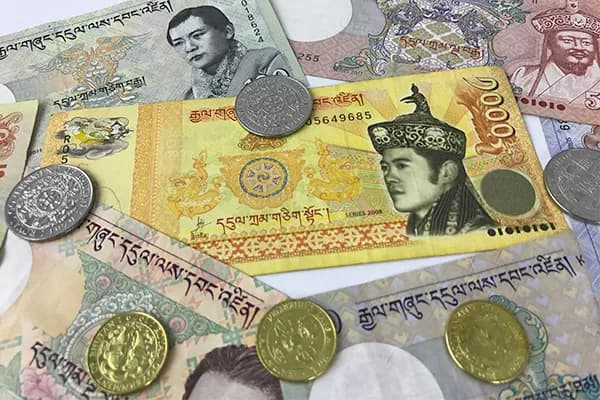
The Bhutanese currency is the Ngultrum (Nu), pegged 1:1 to the Indian Rupee. Both currencies are accepted everywhere; USD is accepted at most lodges, restaurants, and major shops. ATMs are available in Thimphu, Paro, and major towns. Card payment is widely accepted at premium lodges and increasingly at restaurants, with Indian-issued cards working most reliably. Tipping is appreciated but not the cultural default — a 5-10% gratuity on top of the operator's settled bill is typical for international visitors.
- Register
- money
The short answer
Ngultrum (Nu) is the local currency, pegged 1:1 to Indian Rupee. USD widely accepted at lodges and restaurants. ATMs in Thimphu, Paro, major towns. Card payment at premium lodges (Indian-issued cards most reliable). Tipping: USD 10-15 per day per guest combined for guide + driver is typical; lodges include service in the bill but additional gratuity for exceptional service is appreciated. Carry USD 200-400 per person in cash for small purchases.
Currency basics
Ngultrum (Nu) is the Bhutanese currency, issued by the Royal Monetary Authority. Denominations: 1, 5, 10, 20, 50, 100, 500, 1,000 ngultrum. The Ngultrum is pegged 1:1 to the Indian Rupee (INR), and both currencies circulate freely in Bhutan. USD is accepted at most lodges, restaurants in Thimphu/Paro/Punakha, and at the major monument entry counters. Euro and GBP are accepted at premium lodges but converted at less-favourable rates than USD. Other currencies generally not useful — convert to USD or Nu/INR before arrival or at the airport on arrival. Currency import: international visitors may bring up to USD 10,000 equivalent without declaration; larger amounts must be declared at customs.
ATMs, card payment, and the digital register
ATMs are widely available in Thimphu (15+ machines), Paro (8+), Punakha (3+), and at the major eastern towns (Bumthang, Mongar, Trashigang have 1-2 each). Most ATMs accept international Visa and Mastercard with daily withdrawal limits typically Nu 20,000 (~USD 230) per transaction. Bhutan National Bank and Druk PNB are the principal ATM networks; the international-friendly network is improving steadily. Card payment at premium lodges, restaurants in major towns, and high-end shops is increasingly available — Indian-issued cards work most reliably; American Express has limited acceptance; Mastercard and Visa work at most premium lodges. Mobile payment (mBoB, the Bhutan National Bank mobile wallet) is the principal local payment method but typically not accessible to international visitors without a local SIM and bank account. Cryptocurrency: not legal tender; not accepted; the Royal Government runs hydropower-based Bitcoin mining but this is not a payment infrastructure for visitors.
What to carry — and how much
Recommended cash to carry: USD 200-400 per person in cash for incidentals (small purchases, market shopping, monument-entry tips, hot-stone-bath gratuities, occasional restaurant meals outside the lodge). The premium operator covers the principal expenses (lodging, meals, transport, guide, driver, SDF, visa, monument entries); cash is for the on-top items. Smaller bills are better — USD 1, 5, 10, 20 are more useful than USD 50 or 100; INR/Nu 100 and 500 are most useful denominations. Carry a primary card and a backup card in separate locations; ATMs are reliable but not infallible. Exchange rate: check the official RMA rate on the Royal Monetary Authority website (rma.org.bt); lodges and airport exchange at marginally less favourable rates than the RMA mid.
Tipping protocol
Tipping is appreciated but not the cultural default in Bhutan. The Bhutanese hospitality protocol is rooted in genuine welcome rather than transactional service, and gratuity is layered on top of warm hospitality rather than serving as the principal compensation for it. For the guide and driver — the principal beneficiaries of visitor gratuity — the standard guideline is USD 10-15 per day combined per group, split between the guide and driver at the visitor's discretion (often 60/40 favouring the guide). This is offered at the end of the trip in a sealed envelope, with handwritten thanks. At lodges, the service charge is included in the bill; additional gratuity for exceptional service from a specific staff member is appreciated but not expected. At restaurants, 5-10% on top of the bill for table service, optional. At monasteries and hot springs, no tipping is appropriate — small donations to the alms box are welcomed instead. Hot stone bath attendant: USD 5-10 for the bath preparation.
Costs to budget — the typical visitor numbers
Premium tier (USD 5,000-8,000 per person for a 7-night Bhutan) — premium lodges (Aman, Six Senses, COMO), knowledgeable guide, dedicated driver, daily SDF, visa, all meals, all transport, all monument entries. Luxury tier (USD 8,000-14,000) — flagship Aman/Six Senses suites, helicopter transfers between valleys, exclusive cultural access, fine-dining-focused programme. Signature tier (USD 14,000+ per person) — by-invitation experiences, private dzong access, ultra-premium lodge configurations, helicopter-based circuits. Cash on top: USD 200-400 per person for incidentals + USD 10-15 per day in gratuity (USD 70-105 across a 7-night trip per group). Add-ons: international flights to/from a hub city (USD 1,000-3,500 per person depending on origin), hub-city stopover lodge (USD 200-800 per person per night for the recommended 1-night stopover). See how long to spend in Bhutan for the duration-based budget breakdown.
Practical
- Local currency
- Ngultrum (Nu) — pegged 1:1 to Indian Rupee
- USD accepted
- Yes, at lodges, restaurants, major monuments
- Card payment
- Premium lodges and major restaurants; Visa/Mastercard work; Amex limited
- ATMs
- Thimphu, Paro, Punakha widely; Bumthang/Mongar/Trashigang limited
- Cash to carry
- USD 200-400 per person, small denominations
- Tipping (guide + driver)
- USD 10-15 per day combined per group
- Tipping (lodges, restaurants)
- Service included; additional gratuity appreciated
Journeys it informs
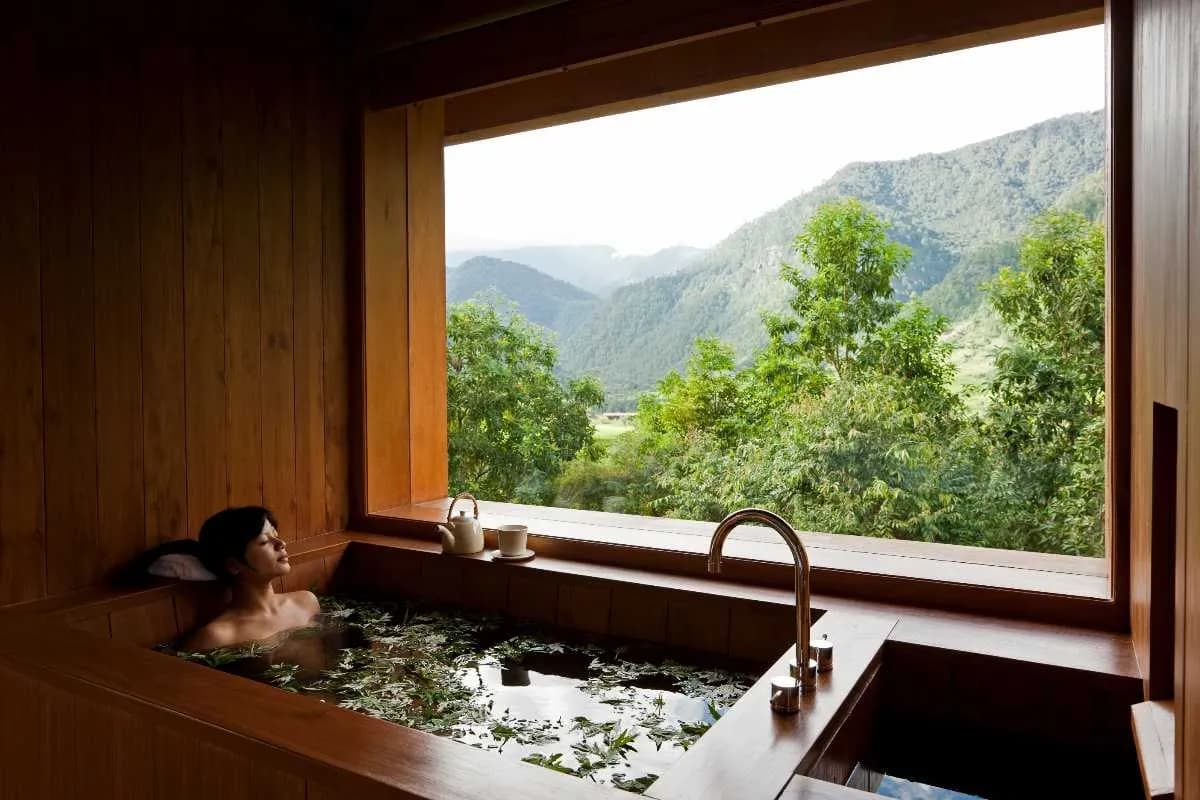 JourneySeven nights in Bhutan, on your terms.A private seven-night Bhutan honeymoon for couples flying from Singapore. Bhutanese lodges, a matched guide, transparent all-inclusive pricing.
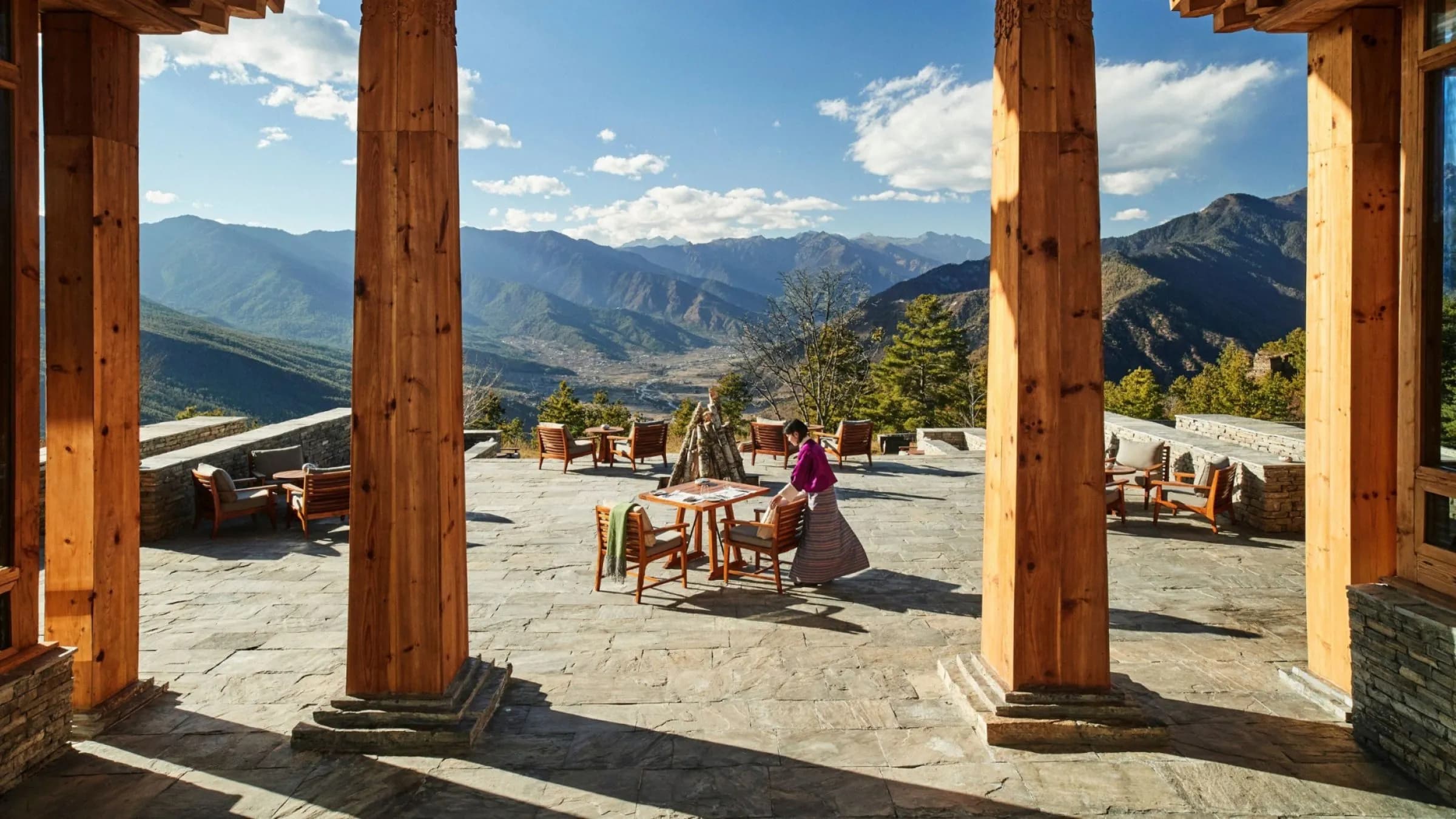 JourneySeven nights in Bhutan, on the short flight from Mumbai.A private seven-night Bhutan honeymoon for couples flying from Mumbai. Bhutanese lodges, a matched guide, transparent all-inclusive pricing.
Frequently asked
- What currency should I bring to Bhutan?
- USD or Indian Rupee (INR) — both widely accepted. Don't bring large quantities of currencies other than USD, INR, or local Nu. Convert at the airport on arrival or at the lodge on day one if you bring other currencies; the rates are reasonable. Small bills (USD 1, 5, 10, 20) are more useful than large bills.
- How much should I tip in Bhutan?
- Guide + driver combined: USD 10-15 per day per group, in a sealed envelope at the end of the trip. Lodges: service is included in the bill; additional gratuity for exceptional service from a specific person is appreciated. Restaurants: 5-10% on top of the bill, optional. Monasteries: no tipping — small donations to the alms box are welcomed instead.
- Can I use US dollars everywhere?
- USD is accepted at premium lodges, mid-range hotels, principal restaurants in Thimphu/Paro/Punakha, and at major monument-entry counters. Small village shops, the market, and local restaurants prefer Nu (Ngultrum) or INR. Carry both — USD for the main bills, Nu/INR for incidentals.
- Do I need to bring cash, or can I use card?
- Bring both. Premium lodges accept Visa and Mastercard for the bill; cash is for incidentals (market shopping, the hot stone bath, monument-entry tips, occasional non-lodge meals). USD 200-400 per person in cash is the typical carry.
- Are there ATMs everywhere?
- Thimphu (15+), Paro (8+), Punakha (3+) — yes, widely. Bumthang, Mongar, Trashigang in the central and east — limited (1-2 ATMs per town). Remote areas (Phobjikha, Bumthang side-valleys, the eastern Brokpa region) — no ATMs; bring sufficient cash. The premium operator manages cash logistics for trekking and remote-area visits.
- What about Indian Rupees?
- Widely accepted, in fact often preferred at small shops and the market. INR notes of 500 and 1,000 denominations are common; the Ngultrum is pegged 1:1 so conversion is straightforward. Note that the Royal Monetary Authority demonetised certain older INR note types (the older 500 and 1,000 series) at the same time India did — current INR notes are accepted.

