Two Himalayan destinations, two different premium registers
Bhutan vs Nepal for private travel — how to choose, and when each is the right answer.
Bhutan and Nepal are the two principal Himalayan premium destinations. Both are Buddhist-influenced; both have substantial cultural depth; both are accessible from international hubs. They are different in scale, in trekking emphasis, in tourism framework, and in what they reward — and the right answer for any given traveller is not the same. This is the comparative read.
- Register
- logistics
The short answer
Bhutan and Nepal are different destinations, not competing ones. Choose Bhutan for cultural-religious depth, the disciplined-tourism framework, and the considered premium experience at a small scale. Choose Nepal for serious trekking (Annapurna, Everest, Mustang), scale and diversity, and lower cost. Many travellers do both — Nepal first (typically) for the trekking, Bhutan second for the cultural. The combination is one of the Himalayan premium journeys.
What each destination is at its core
Nepal is the principal Himalayan trekking destination — the home of the world's greatest expedition routes (Everest Base Camp, Annapurna Circuit, Manaslu, the upper Mustang). The country is substantial in scale (29 million population, 147,000 sq km), with cultural-religious variety (Hindu majority, Buddhist heritage especially in the Kathmandu Valley and the Tibetan-cultural northern districts), and a well-developed independent tourism framework that supports everything from budget backpacking through premium-tier private travel. Bhutan is the Vajrayana Buddhist monarchical state, structurally much smaller (~750,000 population, 38,000 sq km), with a disciplined high-value-low-volume tourism framework (the licensed-operator requirement, the Sustainable Development Fee, the daily-rate framework), and a concentrated premium-cultural experience that does not seek to scale. The country is not a trekking destination in the Nepalese sense (though it has serious treks — Snowman, Chomolhari, Druk Path); the product is the considered cultural-religious week.
When Nepal is the right answer
Choose Nepal if your principal goal is trekking. The Annapurna Circuit (the world's most-traversed long trek), the Everest Base Camp trek (the most-photographed expedition), the Manaslu Circuit (the remote alternative), and the upper Mustang (the last accessible Tibetan-cultural landscape) are all in Nepal. The trekking infrastructure — teahouses, porter networks, guided operators — is the world's most-developed. For premium trekking, the Nepalese framework offers more variety, more depth, more expedition options than the Bhutanese framework can. Choose Nepal if your trip is about the Himalayan mountain experience at scale. Nepal has 8 of the world's 14 mountains over 8,000 metres (including Mt Everest); the mountain-and-trekking context is the Nepalese principal product. Choose Nepal if cost is a consideration. The Nepalese premium-tier experience is more affordable than the Bhutanese — no SDF, cheaper lodge-tier options, more competitive operator pricing. A premium 7-night Nepal trip costs 40-60% of the equivalent Bhutan trip at comparable lodge tier.
When Bhutan is the right answer
Choose Bhutan if your principal goal is cultural-religious depth. The Bhutanese Vajrayana framework is continuous (the dzongs are working administrative-religious complexes, the monastic body is unbroken since the 17th century, the cham dances are working religious performances). The comparative-Buddhist register that Bhutan offers — particularly for visitors with existing Buddhist background — is unmatched in the broader region. Tibet's contemporary religious framework operates under Chinese state oversight; Bhutan is the only continuous Vajrayana civilisation. Choose Bhutan if you want the considered, disciplined premium experience at small scale. The licensed-operator framework concentrates the considered hosting capacity (limited number of operators with the Royal Government licence); the 200,000-annual-visitor cap means you will not encounter mass tourism; the cultural protocol preserves privacy and discretion (Bhutanese press does not run celebrity-spotting coverage, lodge guest registers are private). For premium-tier private travellers — public figures, family-office principals, repeat premium travellers — the Bhutanese framework delivers what most other Asian destinations do not. Choose Bhutan if you want the environmental-philosophical. The constitutional 60% forest cover, the carbon-negative status, the Gross National Happiness governance framework — these are the Bhutanese distinctive features that no other Himalayan state offers.
Side-by-side comparison
Trekking: Nepal wins for variety, depth, and expedition scale. Bhutan has serious treks (Snowman is one of the world's expedition treks at 25 days, 5,320m max) but the Nepalese trekking framework is the broader product. Cultural depth: Bhutan wins for Buddhist-monarchical continuity. Nepal wins for Hindu-Buddhist cultural variety (Kathmandu Valley alone has 7 UNESCO World Heritage sites; the Hindu cultural framework adds depth). Logistics: Nepal is easier — visa-on-arrival, independent-travel option, teahouse network. Bhutan is the more-disciplined framework — licensed-operator-only, visa-pre-approval, SDF. Cost: Nepal is cheaper at every tier. Bhutan is more expensive — the SDF (USD 100/night/international visitor) raises the floor. Privacy / Discretion: Bhutan wins for premium-tier discretion. The Bhutanese cultural framework preserves privacy by default; the Nepalese tourism framework is more open. Scale: Nepal larger — 1.2 million international visitors per year (pre-COVID), more lodge inventory, more operator variety. Bhutan smaller — 200,000 visitors per year, concentrated lodge inventory. Climate sensitivity: Bhutan more constrained — visual-flight-rules at Paro Airport, monsoon-affected tourism (June-August). Nepal similar but more aviation options. Best season: Both share autumn (October-November) and spring (March-May) as the primary windows. Bhutan has the Clear-Sky Bhutan winter window (December-February); Nepal has the Annapurna trek winter window (cold but clear).
The combined journey — Nepal then Bhutan
For premium travellers with time (12-21 nights), the combined Nepal-Bhutan trip is one of the Himalayan premium journeys. The standard sequence: Nepal first (typically 7-10 nights — Kathmandu cultural arrival, trek of choice, return), then Kathmandu-Paro Drukair flight (multiple weekly rotations), then 7-night Bhutan Bhutan. The sequence works because: (1) Nepal's trekking framework is more demanding — better to do it first when energy is high; (2) Bhutan's cultural tradition is more reflective — better to do it second when the body has recalibrated to the high-altitude framework; (3) the Kathmandu-Paro flight is the logistical bridge that makes the combination practical. The combined trip delivers the Himalayan trekking-and-cultural register at depth in one trip. For premium travellers planning a Himalayan trip of lifetime significance, the combination is the considered framework.
The honest answer for different traveller types
For a first-time premium Himalayan traveller: Pick one. The cultural-arc-fundamentalists go to Bhutan first; the trekking-fundamentalists go to Nepal first. Most premium travellers go to Nepal first (logistical accessibility) and then to Bhutan as the second trip when the cultural-religious depth reads as the principal want. For a serious-trekking traveller: Nepal. There is no comparison at the expedition scale. For a Buddhist-comparative traveller: Bhutan substantially. The continuous Vajrayana framework is the comparative depth. For a premium-discretion traveller (public figures, senior business figures, royal-family figures): Bhutan substantially. The privacy framework is structural. For family travel with multiple generations: Bhutan wins for the multigenerational pacing framework (ground-floor lodge options, matched-guide-coordinated pacing, no-trekking-required cultural register). Nepal is possible but requires trip-design work to manage the variety of multi-generation requirements. For cost-sensitive premium travel: Nepal. The Bhutanese SDF raises the floor in ways that premium-conscious travellers feel.
The operator framework difference
A logistical reality worth note: Bhutan is a single-operator-per-trip framework (each international visitor is booked through one Royal Government-licensed Bhutanese tour operator who owns the trip's logistics end to end). Nepal is a multi-operator-per-trip framework common (the international visitor may book different operators for different segments — Kathmandu cultural, trekking operator, lodge-direct). The Bhutanese framework simplifies the concierge interface; the Nepalese framework gives the principal more direct lodge / operator choice but requires more coordination. For the combined Nepal-Bhutan trip, the Bhutanese operator handles the Bhutan leg only — the Nepalese leg is a separate booking. We can introduce the senior Kathmandu operators we work with for the Nepalese leg coordination; the combination is a multi-party arrangement but works smoothly when planned upfront.
Practical
- Choose Nepal for
- Serious trekking (Annapurna, Everest, Manaslu, Mustang); cost-sensitivity; scale; Hindu-Buddhist variety
- Choose Bhutan for
- Cultural-religious depth; the disciplined-tourism framework; premium-tier privacy; Buddhist-comparative; environmental framework
- Trekking — Nepal
- Annapurna Circuit (15-21 days), Everest Base Camp (12-14 days), Manaslu Circuit (14-16 days), Upper Mustang (10-12 days), Langtang (7-10 days)
- Trekking — Bhutan
- Snowman Trek (25 days, 5,320m), Chomolhari Trek (8-10 days), Druk Path (5-6 days), Bumthang Owl (3 days), Dagala (5-6 days)
- International visitors annually
- Nepal ~1.2M; Bhutan ~200K
- Premium-tier cost per traveller, 7 nights
- Nepal ~USD 3K-7K; Bhutan ~USD 5K-14K (premium/luxury tier)
- Visa
- Nepal — visa-on-arrival for most nationalities; Bhutan — pre-approval required, processed by licensed operator
- Sustainable Development Fee
- Nepal — none; Bhutan — USD 100/night/international visitor (Nu 1,200/night for Indians)
- Trekking peak season
- Both: October-November (autumn), March-May (spring). Bhutan also: December-February (Clear-Sky Bhutan)
- Combined Nepal-Bhutan trip lead time
- 12-21 nights typical; 4-6 months lead time recommended
Journeys it informs
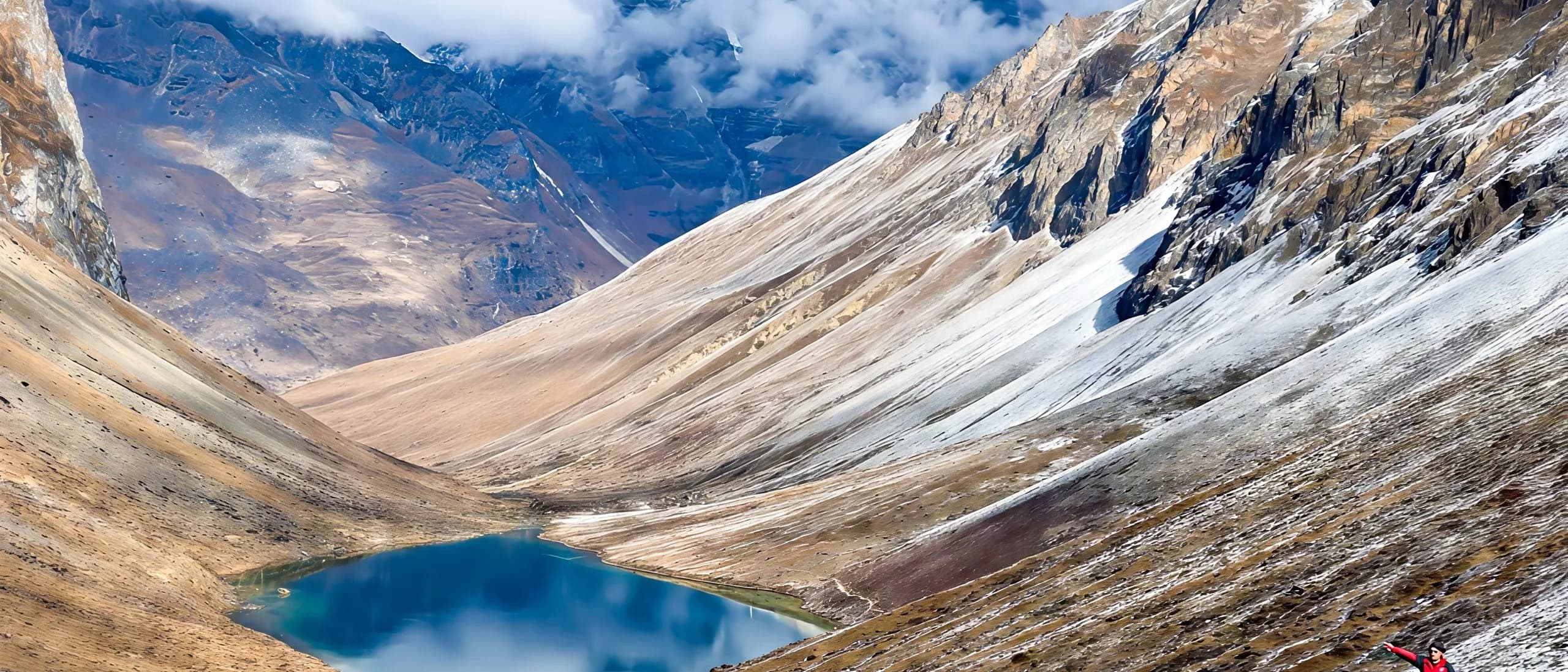 JourneyFourteen nights for the Chomolhari Trek — the Bhutanese alternative to Annapurna.A fourteen-night Bhutan Chomolhari Trek itinerary positioned as the Bhutanese alternative to Nepal's Annapurna Base Camp or Annapurna Circuit. Substantially less crowded.
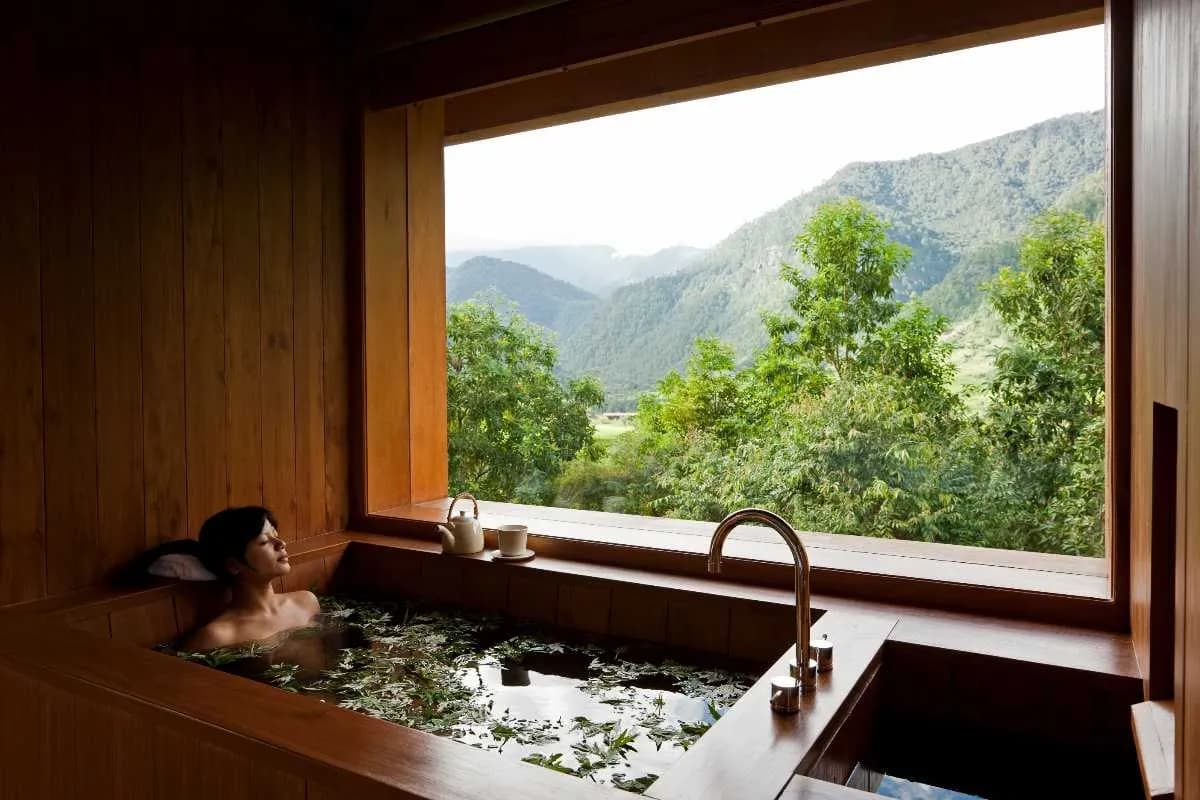 JourneySeven nights in Bhutan, on your terms.A private seven-night Bhutan honeymoon for couples flying from Singapore. Bhutanese lodges, a matched guide, transparent all-inclusive pricing.
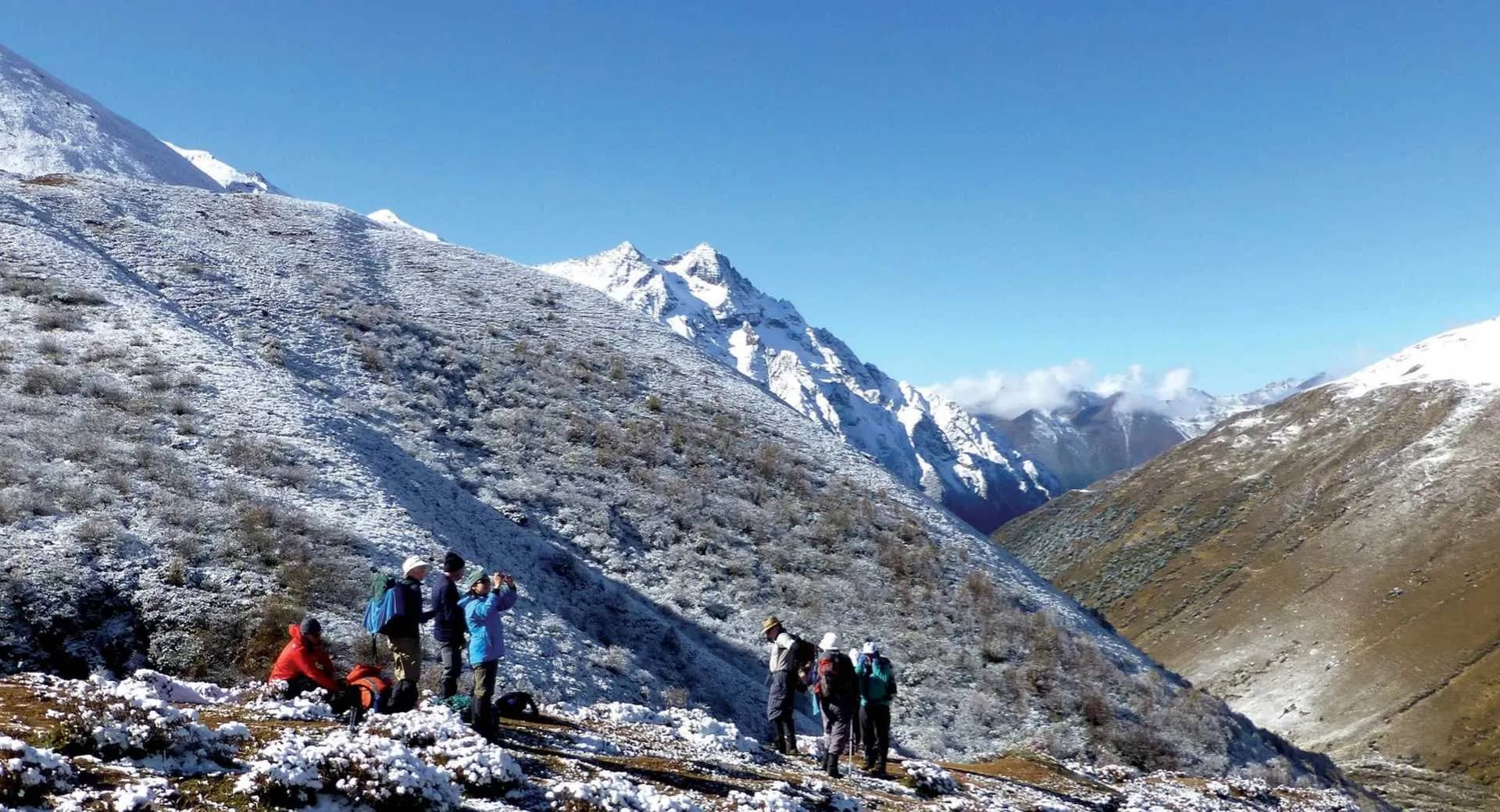 JourneyThe Snowman — Laya to Lunana to Bumthang, on foot.The 28-night Bhutan Snowman Trek — 11 high passes, sustained altitude, the country's most demanding traverse. June–September monsoon window only.
Frequently asked
- Are Bhutan and Nepal competing destinations?
- Not really. They are different products serving different traveller needs. Many premium travellers do both — the sequence (Nepal first for trekking, Bhutan second for cultural depth) is the standard combined-trip framework. The comparative question is less 'which is better' and more 'which is right for your specific trip purpose'. For serious trekking, Nepal. For cultural-religious depth and disciplined-premium experience, Bhutan.
- Is Bhutan worth the higher cost?
- Depends entirely on what you value. The Bhutanese price floor (set by the USD 100/night SDF + the concentrated lodge inventory + the licensed-operator framework) is higher than the Nepalese equivalent at comparable tier. What the higher cost buys: privacy (no mass tourism), cultural framework (continuous Vajrayana), operational ease (single-operator simplicity), knowledgeable-guide network. For travellers who value those, the cost is earned. For travellers who want expedition trekking at the lowest cost, Nepal is the better answer.
- Can I trek in Bhutan if I'm a Nepal trekking veteran?
- Yes. The Bhutanese treks — particularly Snowman (25 days, 5,320m max altitude, one of the hardest treks in the world), Chomolhari (8-10 days), and Bumthang Owl (3 days) — are in their own right. The Bhutanese trekking framework is different from the Nepalese — no teahouses (camp-based; trekking with supported porters and cook), more remote, smaller expedition support network. For trekkers who have done the Nepalese routes and want new ground, Bhutan offers the lesser-known Himalayan expedition register.
- What is the cultural comparison ?
- Nepal: Hindu majority (80% of population) with Buddhist minority concentrated in the Kathmandu Valley and the Tibetan-cultural northern districts. The Kathmandu Valley contains 7 UNESCO World Heritage sites including Pashupatinath (Hindu), Boudhanath (Buddhist stupa), Swayambhunath (Buddhist stupa with Hindu syncretism). Bhutan: Vajrayana Buddhist continuous since the 17th-century Zhabdrung unification, with Hindu-Bhutanese minority concentrated in the southern districts. The Bhutanese cultural tradition is more concentrated and continuous; the Nepalese tradition is more varied.
- How do I combine the two destinations?
- The standard 12-14 night combined trip: 7 nights Nepal (Kathmandu 2 + trek of choice 4-5 + Kathmandu return 1) → Kathmandu-Paro Drukair flight (2-hour flight) → 7 nights Bhutan Bhutan (standard Paro-Thimphu-Punakha pattern). The 21-night extended version: 10-12 nights Nepal (longer trek + Mustang or Pokhara extension) → 9-10 nights Bhutan (Bhutan + Phobjikha or Bumthang). We coordinate the Bhutan-side booking; the Nepal-side booking is a separate engagement with Kathmandu operators we can introduce.
- Which is better for solo women travellers?
- Both are safe for solo women travellers — among the safest Asian destinations on the solo-women-travel ranking. Bhutan wins for solo-women trip-design discipline — the licensed-operator framework means knowledgeable guide accompaniment throughout, experienced-team review of the proposal, Royal Government framework around visitor safety. Nepal is more traveller-driven — independent solo women trekkers manage the trip themselves; the safety record is excellent but the framework is less structured. For risk-managed solo-women travel, Bhutan the more structured framework.
- What about Bhutan vs Ladakh? Or Bhutan vs Sikkim?
- Ladakh (India) and Sikkim (India) are both Buddhist Himalayan cultural destinations and closer comparatives to Bhutan than Nepal is. Separate guide pages for those comparisons — see bhutan-vs-ladakh-for-private-travel (in preparation) and bhutan-vs-sikkim-for-private-travel (in preparation). The distinctive Bhutanese advantages against both Ladakh and Sikkim: independent sovereignty (no India transit-visa complications), continuous Vajrayana state framework (the only continuous Vajrayana civilisation), lodge infrastructure at premium tier (Aman, Six Senses, COMO; higher tier than Ladakh or Sikkim offers), cultural protocol of discretion. The distinctive Ladakh/Sikkim advantages against Bhutan: cheaper, Indian-passport-holder-friendly, different landscape registers.

