Under development · Long-term master plan
Gelephu Mindfulness City
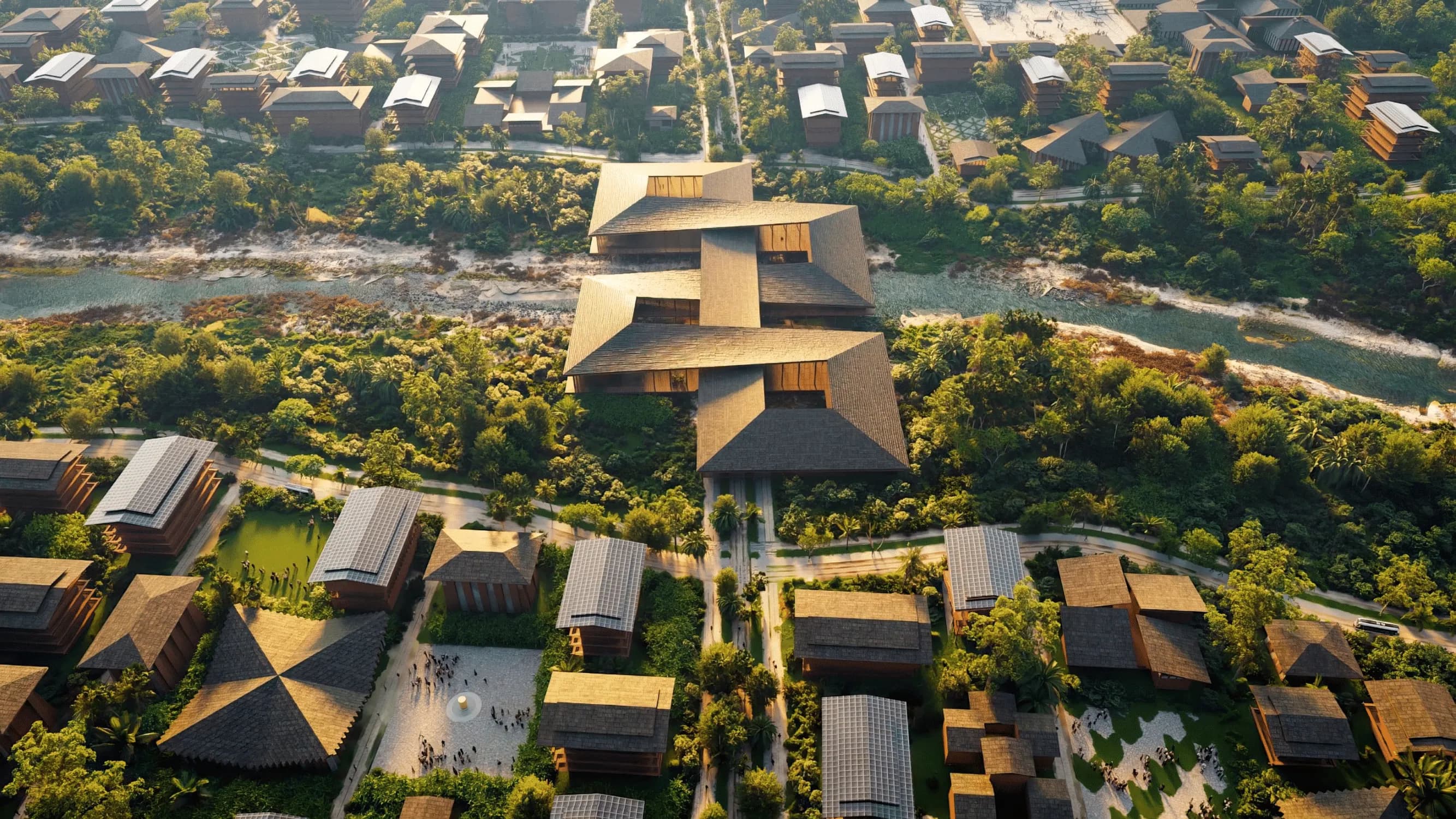
Gelephu Mindfulness City (GMC) is Bhutan's ambitious new Special Administrative Region on the country's southern border with Assam, India. Conceived as a new model for mindful, sustainable development, GMC will combine Bhutanese culture and spirituality with business, technology, healthcare, education, green energy and international connectivity. The vision is taking shape, but much of the city visitors see in architectural renderings is still planned or under development. That distinction matters: official material describes ongoing master planning, infrastructure, housing, environmental works and development of Gelephu International Airport rather than a completed destination.
- District
- Sarpang
- Altitude
- 221 m
- Kind
- region
- Coordinates
- 26.870, 90.486
- Also known as
- GMC, Gelephu SAR, Gelephu Mindfulness City Special Administrative Region
What is Gelephu Mindfulness City?
Gelephu Mindfulness City is a highly autonomous Special Administrative Region in southern Bhutan, bordering Assam, India. Rather than simply being a new neighbourhood of Gelephu town, GMC is a much larger jurisdiction designed around what its planners call "Mindful Prosperity" — combining economic development with Bhutanese values, spirituality, environmental stewardship and wellbeing. The official GMC website currently puts its area at more than 4,046 km² — Bhutan's government geospatial metadata gives the SAR boundary as roughly 26.6971°–27.2212° N and 89.7336°–91.0254° E. The coordinates on this page mark Gelephu town centre, the practical point of reference for visitors, not the geographic centre of the much larger SAR.
What can you see today — and what is still planned?
Visitors should not expect to arrive at a completed futuristic city. Gelephu itself is an established southern Bhutanese town and border gateway, while the wider GMC project is being developed in phases. Current work includes master planning, infrastructure, housing and real-estate planning, environmental design, spiritual projects and development work associated with the new international airport. GMC also says that fourteen spiritual projects have received formal Royal endorsement, including Gelephu Chorten, Gelephu Dzong, the Vajrakilaya Research Center, Tara Retreat Center and several temples and monasteries. The much-publicised master plan is considerably more ambitious: it includes a major international airport and new urban, commercial, educational, healthcare, spiritual and green infrastructure. The project is intended to unfold over decades rather than appear all at once — Reuters reported a roughly 21-year development horizon.
Best time to visit
November to March. Gelephu lies in Bhutan's subtropical southern lowlands, so its climate is substantially warmer than Thimphu, Paro and the high Himalayan valleys. The cooler, generally drier winter period is more comfortable for exploring the south — the usual March–May / September–November guidance for the rest of Bhutan is less useful for low-elevation Gelephu.
What to do (and not do)
Do treat GMC as a living region and active development project rather than a theme park or finished tourist attraction. Use a licensed Bhutanese guide where required, follow instructions around construction and restricted areas, dress respectfully at temples and religious sites, ask before photographing people, and keep wildlife and environmental impact to a minimum. Don't enter construction zones, government compounds or restricted project areas simply to photograph them, and don't treat concept-rendering locations as attractions that can currently be visited.
Learn more
You can explore more about Gelephu Mindfulness City, including the latest master plan updates and official legislation, at the GMC official website.
Visiting
- From India
- Gelephu is one of Bhutan's designated southern land entry points — Bhutan's tourism authorities specifically list Gelephu among the land ports through which tourists can enter the country. The gateway sits immediately north of Assam; for travellers coming through India, Guwahati is the most useful major transport hub before continuing overland toward the Bhutan border.
- From elsewhere in Bhutan
- Gelephu is connected to Bhutan's internal road network, but mountain journeys can be long and slow. Kilometre distance is not equivalent to highway driving time — winding roads, weather, construction and landslides can materially affect travel time.
- By air
- Do not expect to fly internationally into a future GMC airport yet. The large new Gelephu International Airport is under development — current official GMC information lists airport development and earthworks among ongoing infrastructure responsibilities, and recent reporting places the planned opening around 2029, though major infrastructure schedules can change.
- Permits
- International visitors still need to comply with Bhutan's normal immigration and tourism requirements. Bhutan has removed the old route-permit requirement for ordinary tourist movement — tourists accompanied by a Department of Tourism-certified guide can generally travel without a separate route permit except in prohibited or restricted areas. Indian nationals do not require a Bhutanese visa but do require the applicable entry permit; Gelephu/Sarpang is specifically listed as an entry/exit point on the Indo-Bhutan border. Visitors remaining within Gelephu's designated border zone (bounded at Aipoli Bridge) can qualify for an SDF exemption under current rules — travel beyond that designated zone brings the normal SDF rules into play.
Where to go next
Frequently asked
- Is Gelephu Mindfulness City open to visitors?
- Gelephu itself is accessible and is an established Bhutanese town and border gateway. But visitors shouldn't expect a completed "Mindfulness City." GMC is an enormous, phased development project, and significant parts of the infrastructure and landmark architecture shown in master-plan imagery remain planned or under construction.
- Is GMC a normal Bhutanese city?
- No. GMC is officially a Special Administrative Region (SAR) within the Kingdom of Bhutan. According to GMC, it has full executive and legislative powers and an independent judiciary, operating separately from Bhutan's regular governmental administration under a "One Country, Two Systems" framework.
- Does that mean GMC is independent from Bhutan?
- No. It remains part of the Kingdom of Bhutan. Its distinction is administrative and legal autonomy within Bhutan, not national independence. GMC has also developed its own body of legislation — its official legislation portal lists its Royal Charter and laws covering companies, customs, employment, financial services, taxation and other areas.
- Can tourists visit the buildings shown in GMC renderings?
- Generally, no — many widely circulated images depict the master-plan vision, not completed visitor attractions. Check current GMC information before assuming any specific project is open.
- When will GMC be finished?
- There isn't a single near-term completion date. It is a multi-phase development intended to evolve over decades — Reuters reported the broader project was expected to be developed over approximately 21 years.

