A Bhutanese cultural tradition
Language in Bhutan — one national tongue, a dozen valley languages, and the English a visitor speaks throughout.
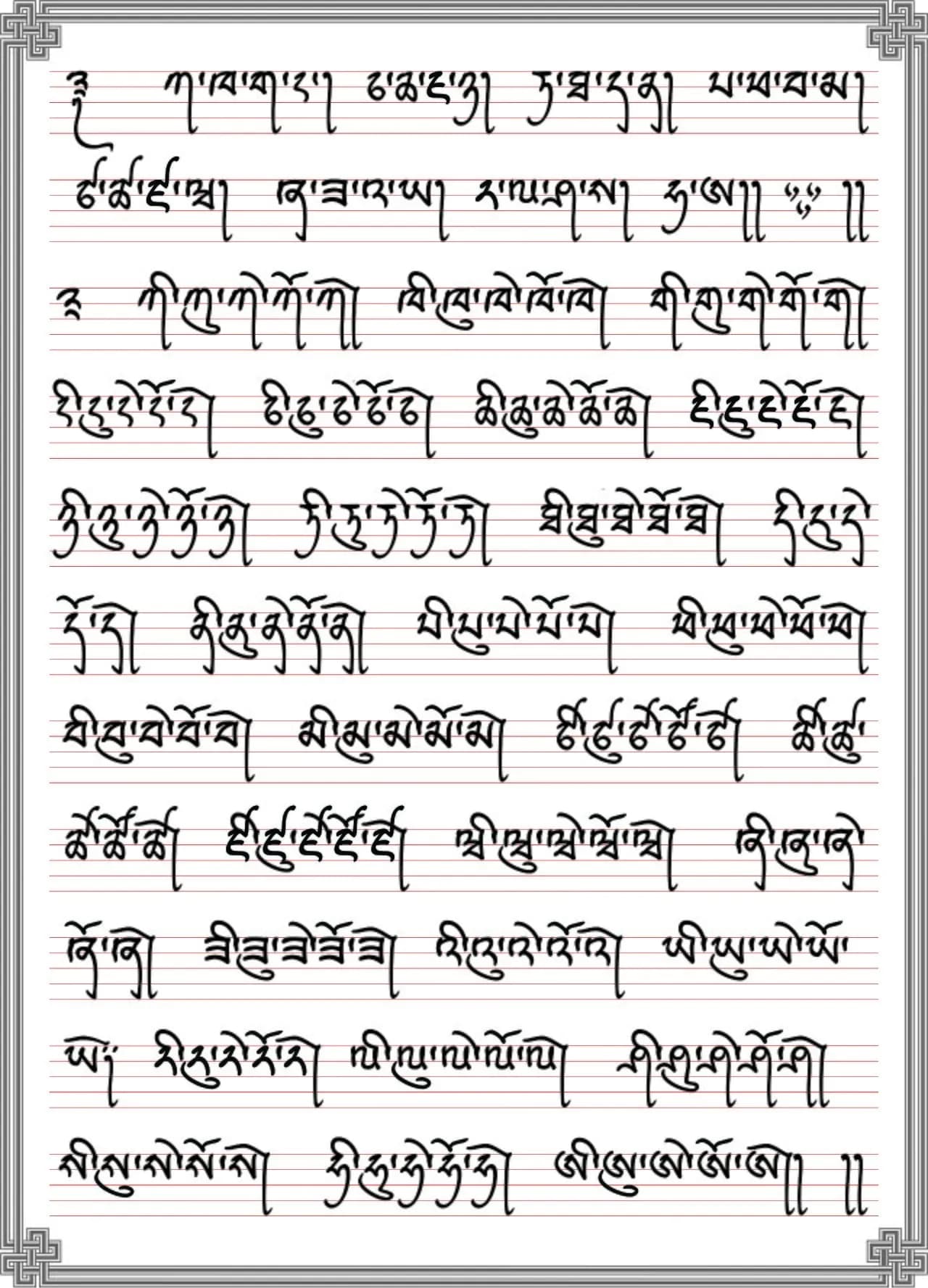
For a country its size, Bhutan is remarkably multilingual — the legacy of a mountain land where deep valleys, divided by high passes, each kept their own tongue across the centuries. Over this patchwork sits Dzongkha, 'the language of the dzong', the national language; alongside it run the eastern, central, and highland languages of the valleys, each a mother tongue to its own region. The classical scriptural language, Choekey, carries the Buddhist canon, and English — the medium of every school since the 1960s — is the language a visitor will use from arrival to departure.
- Register
- language
- Also known as
- languages of Bhutan, Dzongkha, Bhutanese dialects, Bhutanese languages
In short
Dzongkha — 'the language of the dzong' — is Bhutan's national language, a Tibetic tongue written in the Tibetan script. Alongside it the country speaks more than a dozen languages: Tshangla in the east, the central East Bodish languages (Bumthangkha, Khengkha and their kin), and Lhotshamkha — a form of Nepali — in the southern foothills. Choekey, classical Tibetan, is the language of Buddhist scripture; English is the medium of education and the language a visitor uses throughout. A few Dzongkha courtesies — Kuzu zangpo la for hello, Kadrin chhe la for thank you — are warmly received.
Dzongkha, the language of the dzong
Bhutan's national language is Dzongkha — literally 'the language (kha) of the dzong', the fortress-monasteries from which the country was governed, and the tongue native to the western valleys around Thimphu, Paro, Punakha, Wangdue, and Ha. It belongs to the Tibetic branch of the great Sino-Tibetan family, a cousin of classical and modern Tibetan, and it is written in the Bhutanese form of the Tibetan script. Long the language of administration in the west, Dzongkha was made the national language as the modern state took shape, and it is now taught in every school and promoted by a dedicated commission charged with standardising its spelling and growing its vocabulary for the modern world. A visitor sees it everywhere — on every dzong, every signboard, every banknote — paired with English.
A country of many valley tongues
What surprises most visitors is how many languages a country this small contains. The reason is the land itself: Bhutan is a country of deep, separate valleys divided by high passes, and for most of its history each valley was a world to itself, so that the tongue of one need not be understood in the next. The result is a rich patchwork — more than a dozen distinct languages across its valleys, not mere dialects of one another but separate tongues, so that a farmer from the central valleys and an official from the west may share no mother language at all and meet, instead, in Dzongkha or in English. Linguists group them into families — the Tibetic languages of the west and the high north, the distinct East Bodish languages of the centre, and the eastern tongue of Tshangla — while in the southern foothills, where the land falls away towards the plains, the principal language is Lhotshamkha, a Bhutanese form of Nepali. To a traveller the point is simpler and more striking than any family tree: this small kingdom is one of the more linguistically diverse places on earth for its size.
Tshangla and the east
The east of Bhutan — the populous dzongkhags of Trashigang, Mongar, and their neighbours — speaks Tshangla, often called Sharchopkha, 'the language of the easterners'. It is one of the most widely spoken mother tongues in the country, a distinct language rather than a dialect of Dzongkha, and the first tongue of a great many Bhutanese. A visitor travelling east will hear it everywhere, and will notice the guide switching between Tshangla, Dzongkha, and English as easily as the country itself does. The eastern valleys, with their own language, weaving, and rhythm of life, are among the least-visited and most rewarding parts of Bhutan for the traveller willing to go the distance.
The central and highland tongues
The central valleys carry their own family of languages — the East Bodish tongues, distinct from Dzongkha — among them Bumthangkha, the language of the Bumthang valleys; Khengkha of the Kheng region to the south of Trongsa; Kurtoekha of the Kurtoe valley in Lhuentse; and the related tongues of the Mangde and the far east. These are the everyday languages of the central heartland, spoken in the fields and the farmhouses where the great temples stand. Higher still, the seminomadic yak-herding communities keep their own Tibetic tongues — the Brokpa of the Merak and Sakteng valleys in the far east, the Layakha of Laya in the high north — languages of the alpine pastures and the long migrations, as distinct from the valley tongues as the herders' lives are from the farmers'. Each is a small world of its own, and together they make the country's spoken map extraordinarily intricate.
Choekey, the script, and English
Two further languages run through Bhutanese life. The first is Choekey — classical literary Tibetan, the language of the Buddhist scriptures, the prayers, and the canon, the way Latin was once the language of the Western church. It is not a spoken vernacular but the learned language of the Dharma, mastered by monks across long years of study; the texts in the dzongs and the National Library, and the prayers a visitor hears chanted, are in Choekey. Both Choekey and Dzongkha are written in the Tibetan script, in two forms: the upright, headed Uchen used for printing, and the flowing cursive Joyig used for handwriting — a calligraphy of real beauty, taught among the thirteen traditional arts. The second is English, the medium of instruction in every Bhutanese school since the modernising reforms of the 1960s, and now the shared language of government, business, and higher learning. It is the great practical gift to the visitor: Bhutanese are widely fluent in English, signage is bilingual throughout, and a traveller can move across the whole country, understood and understanding, in English alone.
A few words for the traveller
No Dzongkha is needed to travel in Bhutan — English carries a visitor everywhere — but a few words, offered with a smile, are warmly received and quietly close a little distance. The everyday greeting is Kuzu zangpo la — hello, and how are you — the 'la' at the end the honorific particle that Bhutanese add to soften and dignify their speech, much as one might add 'sir' or 'madam'. Thank you is Kadrin chhe la. Delicious, after a meal, is Zhimbey. And the smile that accompanies the attempt matters more than the accent: Bhutanese are gracious about a visitor's first fumbling words, and pleased by the courtesy of the effort. The matched guide, fluent across the local tongues and English alike, is the visitor's bridge into the country's languages, and will happily teach a few more along the way.
Related ideas
 ThemeBhutanese names — chosen by a lama, rich in meaning, and almost never inherited.Bhutanese names — given by a lama, full of Buddhist meaning, and carried without a hereditary surname. The naming tradition, common names and their meanings, honorifics, and what a visitor notices.
 ThemeVajrayana Buddhism — the substance of every dzong, every monastery, every tshechu.Vajrayana Buddhism — the branch of Buddhism that shapes Bhutanese religious life. Drukpa Kagyu, Nyingma, Guru Rinpoche; mantra, mandala, deity yoga.
- ThemeThe Wangchuck dynasty — the hereditary monarchy of Bhutan since 17 December 1907.The Wangchuck dynasty — the hereditary monarchy of Bhutan since 17 December 1907. Five reigning monarchs across five generations. The contemporary state's institutional spine.
 ThemeThe Drukpa Kagyu — the principal Buddhist tradition of Bhutan, the state-religious institutional tradition.The Drukpa Kagyu — the principal Buddhist tradition of Bhutan. State-religious institutional. The Zhabdrung's lineage, the Zhung Dratshang's home tradition.
Where to see it
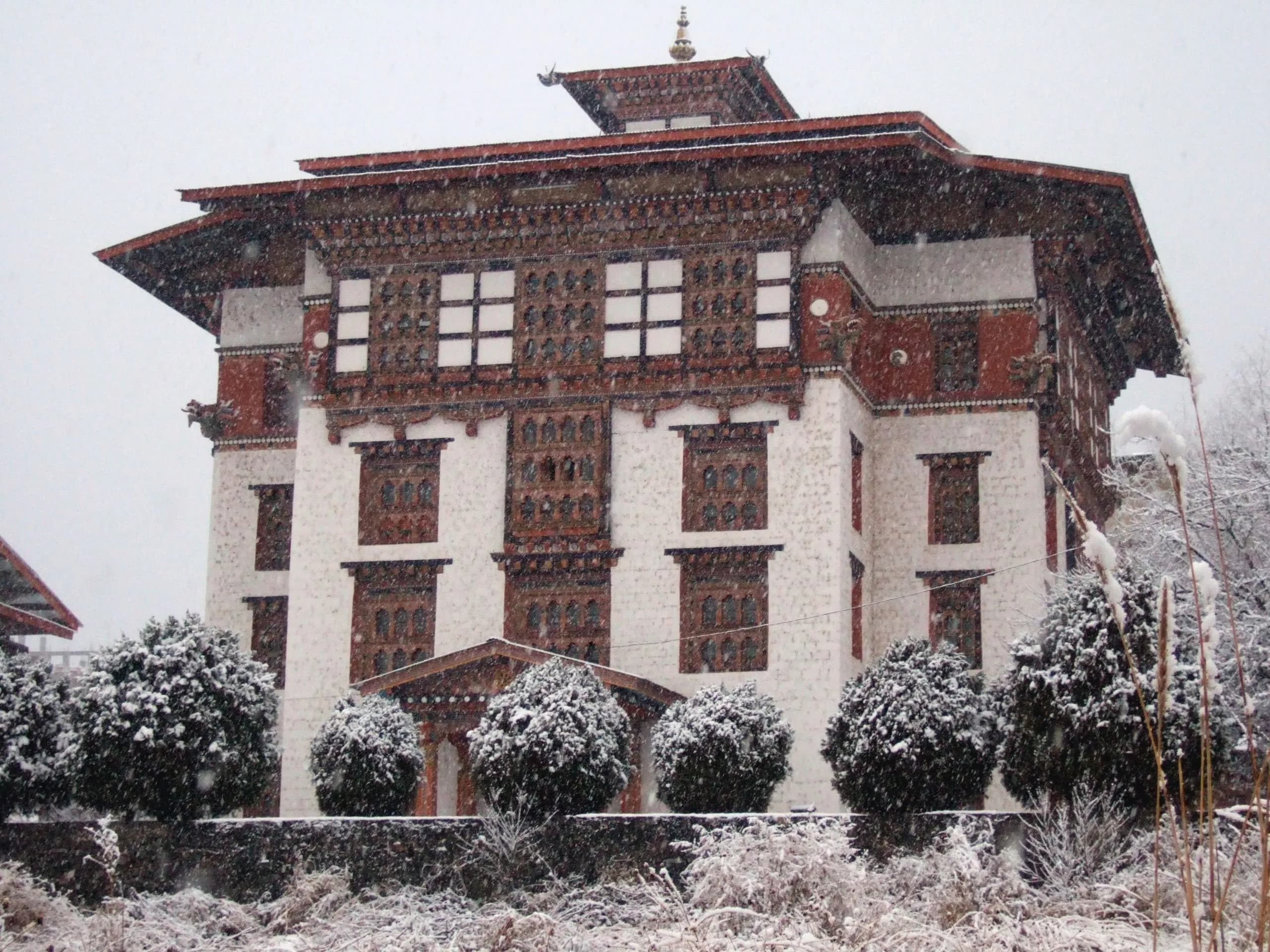 MonumentThe National Library of Bhutan — guardian of the country's Buddhist scriptures, manuscripts, and printing blocks.The National Library of Bhutan, Thimphu — keeper of Buddhist scriptures, rare manuscripts, and wooden printing blocks, in a traditional tower building. Home to a famously huge book.
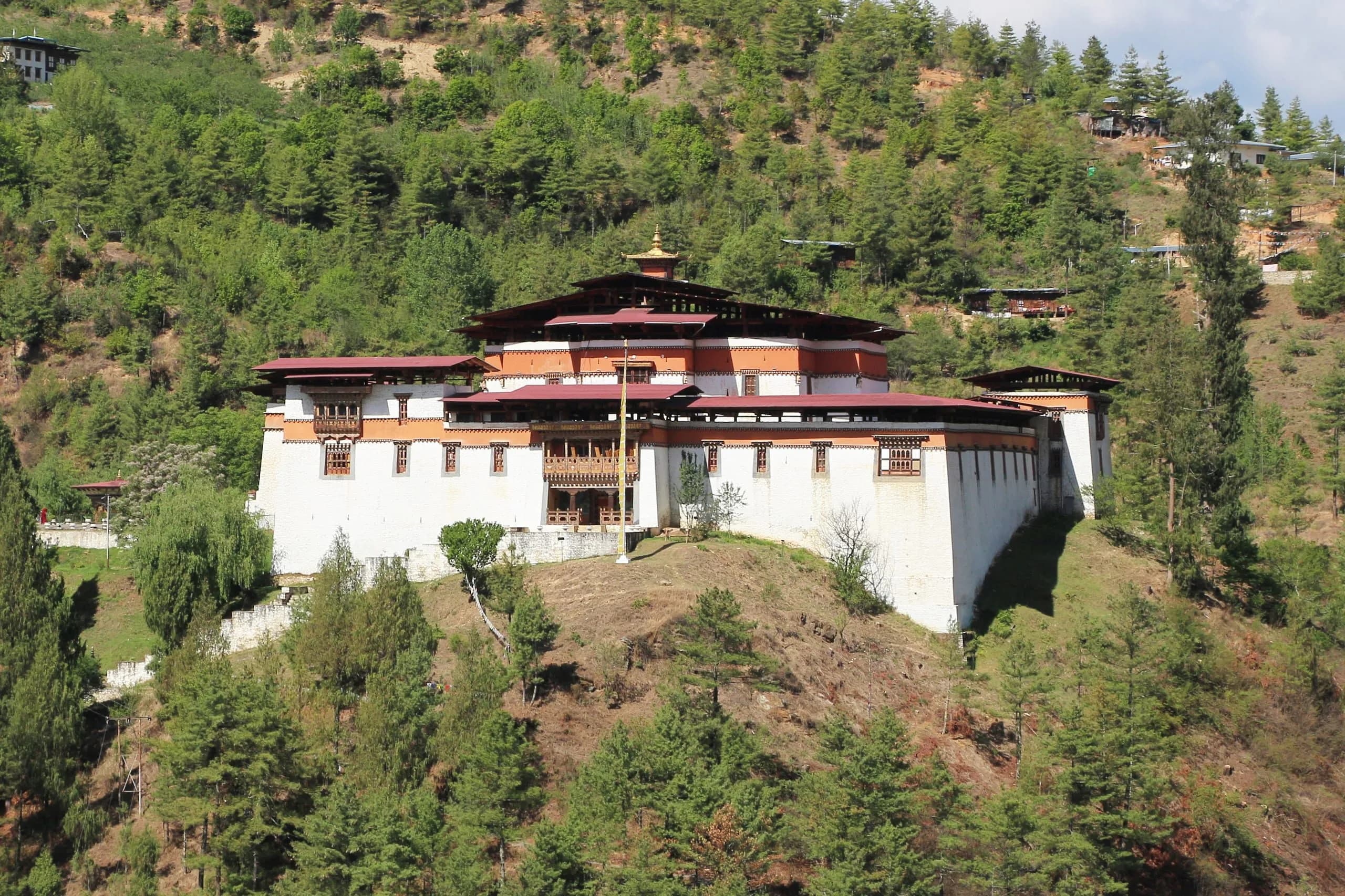 MonumentSimtokha Dzong — built in 1629 by the Zhabdrung, the oldest surviving dzong in Bhutan.Simtokha Dzong — built 1629 by Zhabdrung Ngawang Namgyal, the oldest surviving dzong in Bhutan. South of Thimphu; famed for its carved-slate reliefs.
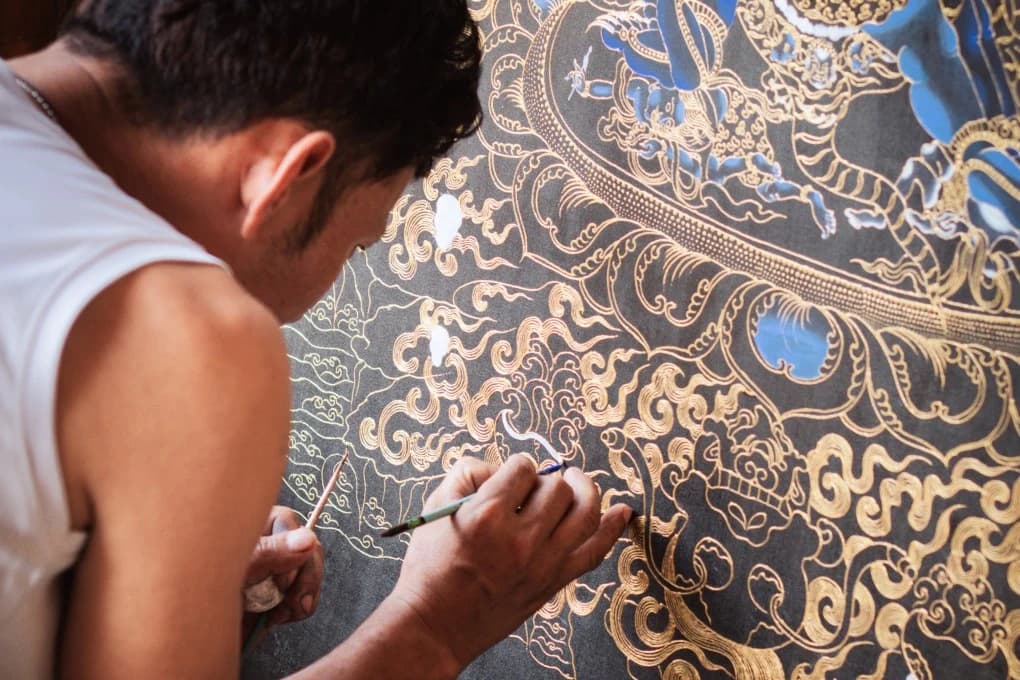 MonumentThe National Institute for Zorig Chusum — where young Bhutanese learn the thirteen traditional arts and crafts.The National Institute for Zorig Chusum, Thimphu — the school where young Bhutanese learn the thirteen traditional arts (painting, carving, weaving, sculpture). Watch the students at work.
Journeys built around it
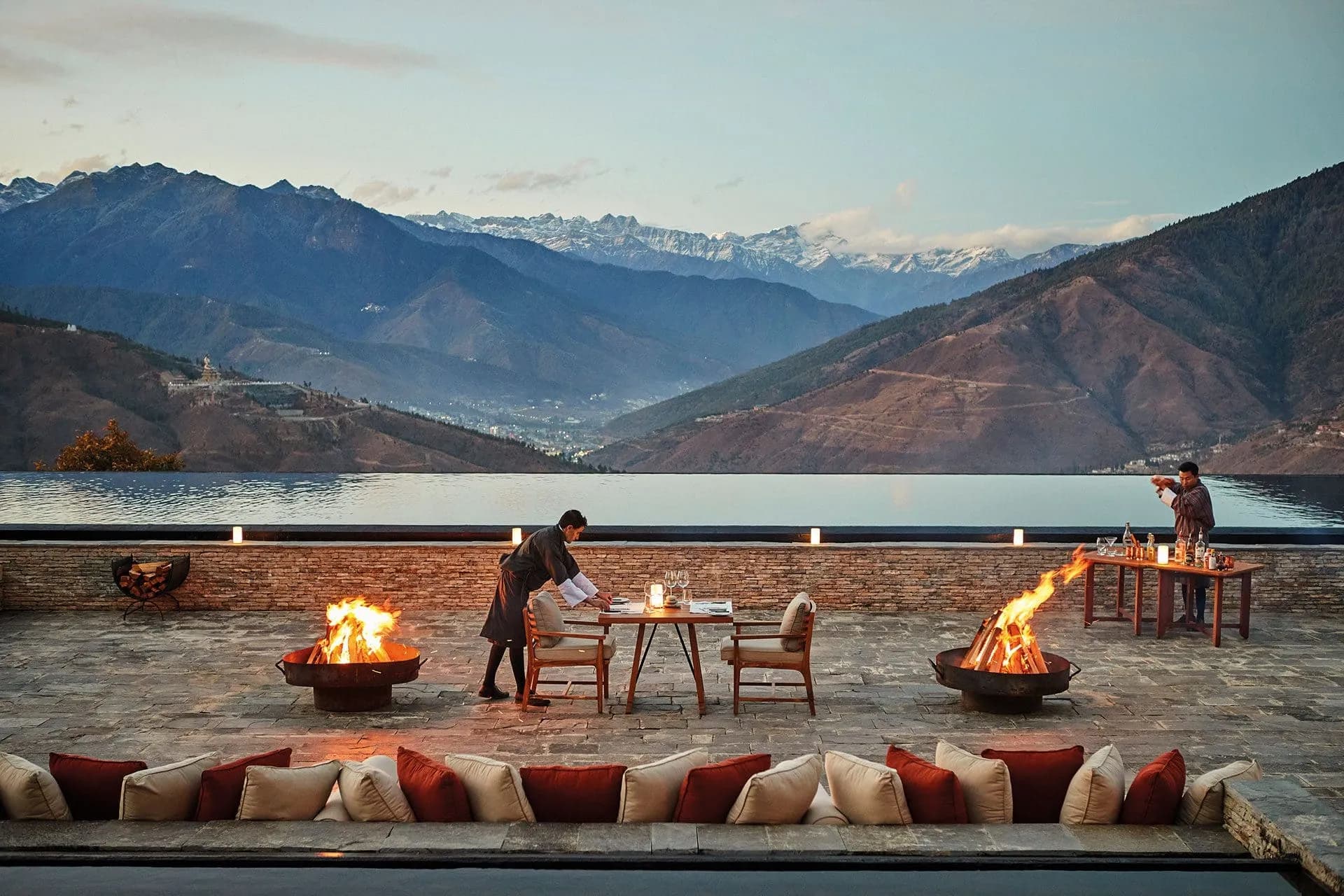 JourneyThe signature-tier Bhutan journey — private knowledgeable guide, the most considered lodge curation, helicopter or charter between valleys, exclusive-use arrangements where the season allows.The signature-tier Bhutan journey. Private knowledgeable guide, the most considered lodges, helicopter or PC-24 charter, exclusive-use arrangements. By invitation, from USD 14,000.
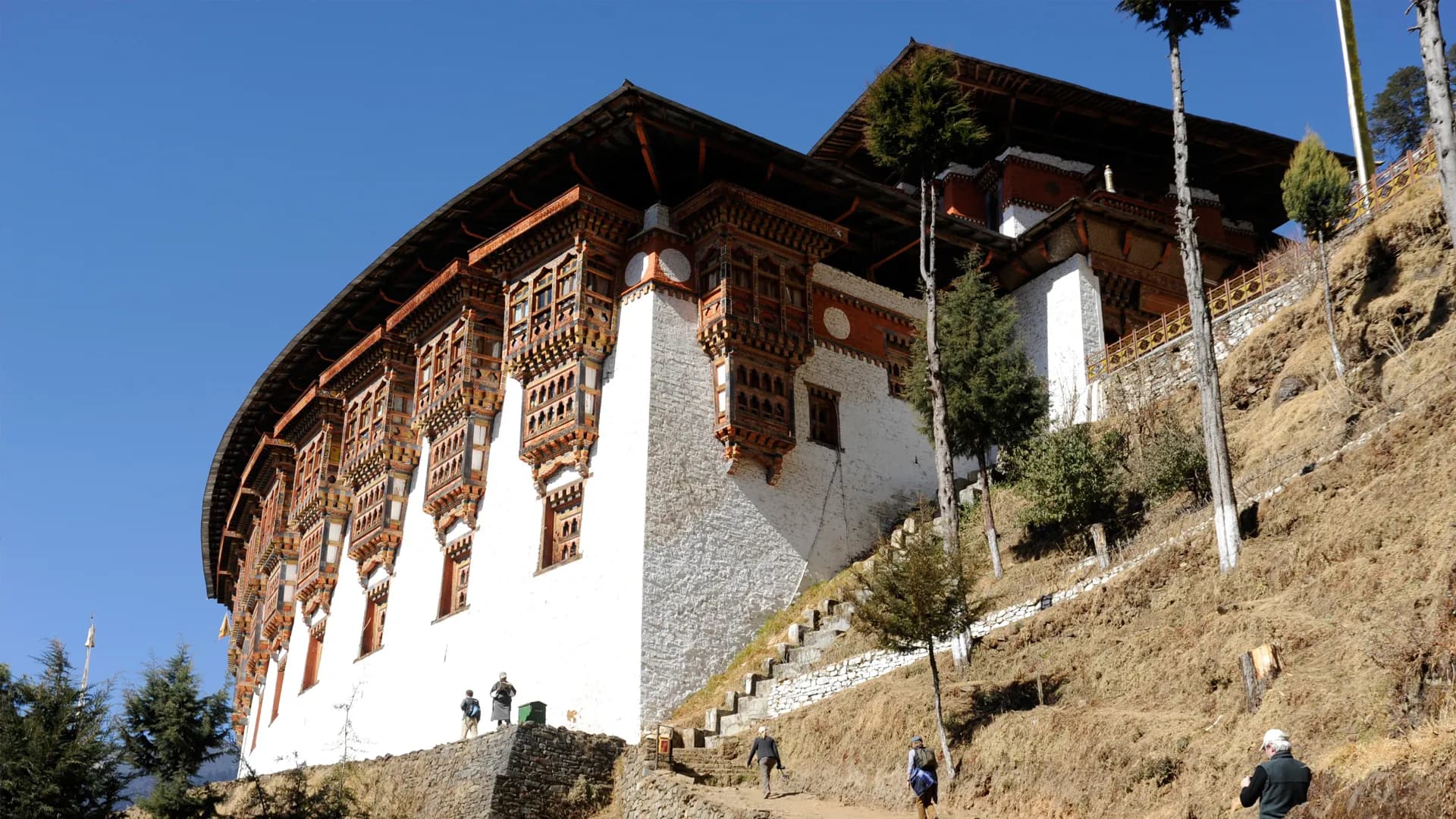 JourneyTen nights for the Buddhist pilgrim — the principal sites, with monastic context.A ten-night Bhutan Buddhist pilgrimage for Asian-Buddhist travellers. Monastic context; matched monastic-trained guide; Bumthang religious circuit.
Journeys that visit Language and dialects in Bhutan
Frequently asked
- What language is spoken in Bhutan?
- The national language is Dzongkha — 'the language of the dzong' — a Tibetic language written in the Tibetan script, native to the western valleys and taught in every school. But Bhutan is remarkably multilingual: more than a dozen distinct languages are spoken across its valleys, chief among them Tshangla in the east, the central East Bodish tongues (Bumthangkha, Khengkha, and their kin), and Lhotshamkha — a form of Nepali — in the southern foothills. English is the medium of education and is widely spoken, and classical Choekey is the language of Buddhist scripture.
- Can I get by in English in Bhutan?
- Yes, entirely. English has been the medium of instruction in every Bhutanese school since the 1960s, so Bhutanese are widely fluent, signage is bilingual throughout, and a visitor can travel across the whole country — understood and understanding — in English alone. The matched guide is fluent in English and in the local languages both.
- Why does such a small country have so many languages?
- Because of the land. Bhutan is a country of deep valleys divided by high passes, and for most of its history each valley was largely a world to itself, so each kept its own tongue. The result is a rich patchwork of more than a dozen distinct languages — not dialects of one another but separate tongues — which makes the kingdom one of the more linguistically diverse places on earth for its size, with Dzongkha and English serving as the shared languages that link the valleys.
- What is Choekey?
- Choekey is classical literary Tibetan — the language of the Buddhist scriptures, prayers, and canon, the way Latin was once the language of the Western church. It is not a spoken vernacular but the learned language of the Dharma, mastered by monks across long years of study. The texts in the dzongs and the National Library, and the chanted prayers a visitor hears, are in Choekey, written in the same Tibetan script as Dzongkha.
- What are a few useful words of Dzongkha?
- Kuzu zangpo la is the everyday greeting (hello / how are you), with the 'la' an honorific particle that dignifies the speech. Kadrin chhe la is thank you. Zhimbey means delicious — useful after a good meal. No Dzongkha is needed to travel in Bhutan, but a few words offered with a smile are warmly received, and the courtesy of the attempt is appreciated far more than the accent.

